
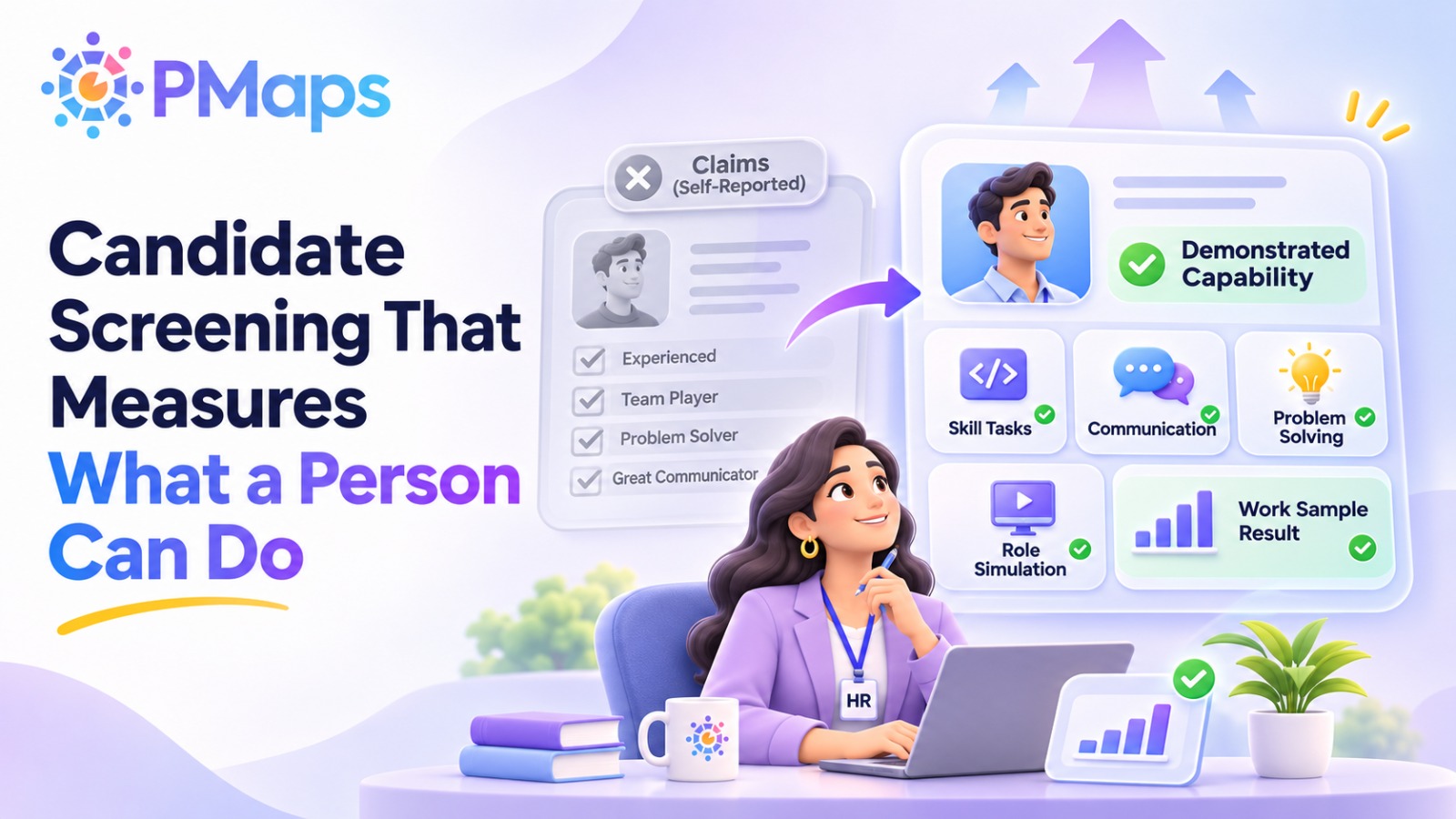
Candidate screening is the stage where an employer narrows a pool of applications to a shortlist worth interviewing, and it is where most hiring quality is won or lost. This page is for employers - heads of talent acquisition, CHROs and hiring managers running volume recruitment in India - and it is about a failure that became measurable in 2026: screens that reject real candidates. The answer is not simply a better filter. It is a screening process built around structured, role-relevant evidence that is harder to misrepresent and can be independently reviewed.
What is candidate screening?
Candidate screening is the stage where an employer reduces a pool of applications to a shortlist worth interviewing. It usually combines resume review, knockout questions and an assessment. Its purpose is to predict who will perform in the role, which means every screening rule is a prediction that can be measured for accuracy.
Three things happen here and are usually collapsed into one. The pool is reduced, a priority order is set, and a standard is applied. Most organizations can describe the first two and cannot write down the third. That distinction matters in skills-based hiring, where demonstrated ability replaces credentials and self-reported claims as the basis for screening decisions.
That matters because a screening rule is a prediction. Reject an application in four seconds and you have predicted that this person would not have performed. Predictions can be scored for accuracy. Screening predictions almost never are.
Why is candidate screening failing in 2026?
Because the document it runs on no longer carries a reliable signal. In a Greenhouse survey of nearly 1,350 recruiters and hiring managers published on 19 November 2026, 90% of US employers said they believe they may have rejected real candidates because the applications appeared fake or AI-generated. The finding suggests employers are increasingly concerned that genuine candidates may be screened out because their applications resemble fabricated or AI-generated submissions.
The same Greenhouse research describes what that belief has cost. 86% of employers said they had to change their hiring process because of fake or AI-generated applications. Among the 86% of employers who changed their hiring process because of fake or AI-generated applications, 57% added another human interview, contributing to longer hiring timelines. Shortlisted candidates now wait an average of 19 days for a first interview.
Together those figures describe a screen that has stopped working and a process absorbing the failure by getting slower. One limitation, stated plainly: that survey covered the US, UK, Ireland, Germany and Australia, and the 90% is the US subset. There is no India cut. The mechanism is not country-specific, though, and in Indian volume hiring - frontline sales, BPO voice processes, campus intakes - one screening rule runs several hundred times a month, so at high hiring volumes, even a small error rate can affect many candidates.
What is a screening false negative, and what does it cost?
A false negative is a candidate who could have done the job and was rejected before anyone looked. Its cost is harder to measure than that of a bad hire. A wrongly rejected candidate never appears in quality of hire, never appears in attrition, and never appears in any report, so the error compounds without ever being counted.
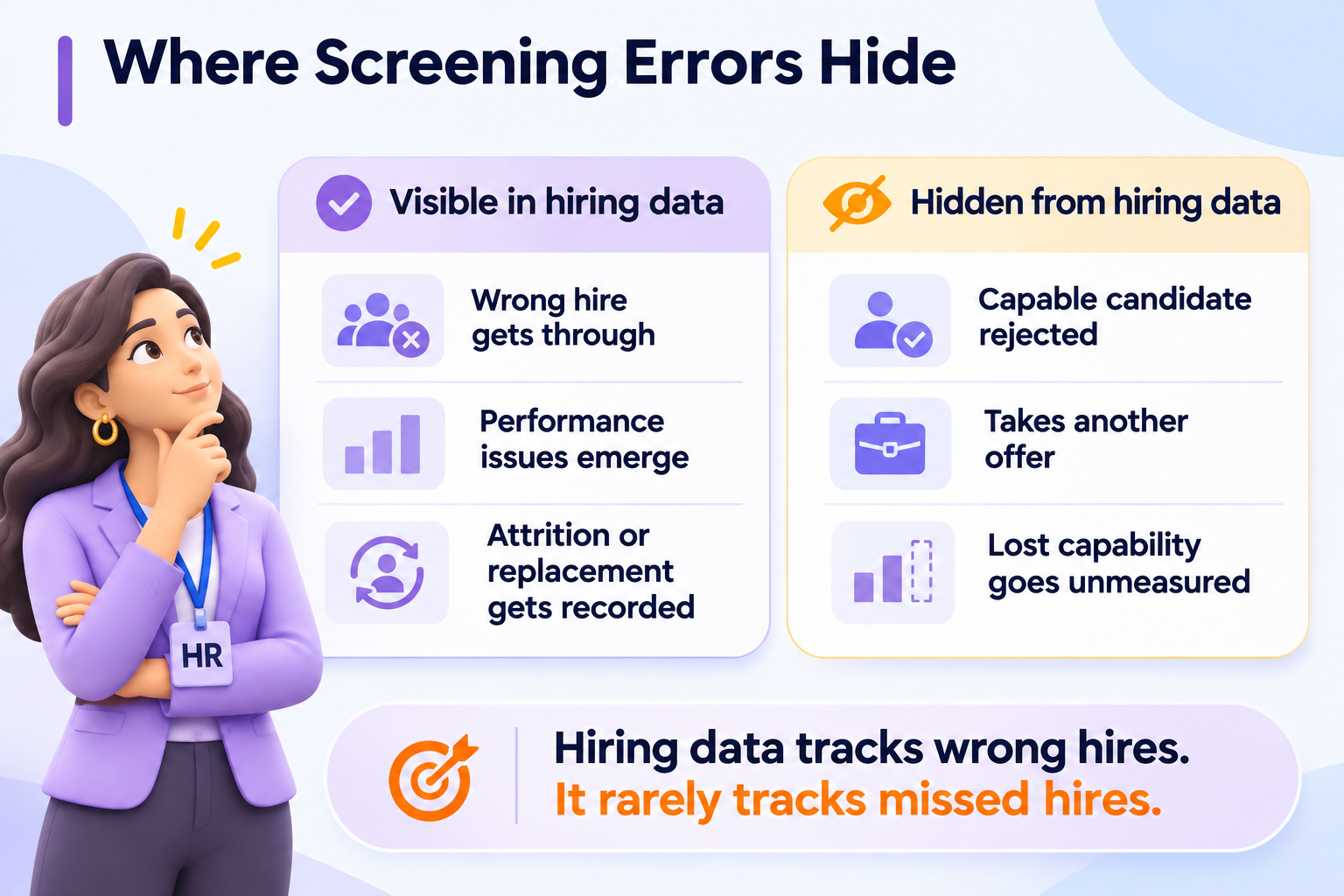
This is the asymmetry worth sitting with. A fraudulent application that passes screening creates one type of error. A capable candidate wrongly rejected creates another. Most hiring processes have mechanisms to identify the first, but far fewer measure the second.
The consequence is a measurement blind spot rather than a one-off loss. If your screen rejects 70% of applications and 10% of those rejections are wrong, you are discarding capable people at a rate nobody can state. In a role family screening 400 applications a month, that is 28 people every month, and the number never appears on a dashboard.
Can you tell whether an application was written by AI?
Not reliably, and the trend is against it. There is no stable signal separating a careful writer from a well-prompted model, and detection heuristics are trained against as soon as they are published. For a given detection model, adjusting the threshold to flag more suspicious applications can also increase the number of genuine candidates incorrectly flagged. Employers should evaluate both types of error rather than measuring detection rates alone.
The point is not that detection is useless. It is that tightening it costs the wrong people.
A filter tuned for fabricated applications also catches the careful writer, the candidate writing in a second language, and the candidate who used a tool to fix their grammar and changed nothing else. In India, where many frontline and voice candidates are not writing in their first language, that cost is not evenly spread across the pool. When spoken communication matters for the role, assess it directly through a structured voice and accent assessment rather than relying on resume wording. PMaps Voice & Accent Assessment helps employers evaluate job-relevant spoken communication skills.
What does a work sample assessment measure that a resume cannot?
A work sample assessment generates evidence in both directions. It can show that a candidate cannot do the work, and it can show that someone you were about to screen out can. A resume only ever produces the first kind, because no organization goes back to a rejected application to find out what it missed.
Underneath the whole problem sit two errors, and your systems record one of them.
A screen that admits someone who cannot do the work leaves a trail: a probation conversation, a rating, a manager escalating, a replacement requisition. The error comes back attached to a name, usually inside a year.
A screen that removes someone who could have done the work leaves nothing. They accept another offer, they do well somewhere else, and the organization that rejected them never finds out. No record, no owner, no number.
Without auditing rejected applicants, teams may focus on errors visible among people they hired. This is the practical case for putting a measurement in the funnel: a work sample, a scored simulation or a role-relevant assessment is the only part of a screening process that produces evidence about the people you were otherwise about to remove. However, the evidence only becomes useful when measured against the right requirements. A role-specific screening benchmark helps employers assess whether candidates demonstrate the capabilities their jobs actually demand.
What order should the candidate screening process run in?
Put the measurement before the document. Instead of reading resumes to decide who gets assessed, assess to decide who gets read. The same candidates enter in reversed order, and the screening bar becomes a written standard scored consistently rather than a reviewer's impression of a paragraph on a Tuesday afternoon.
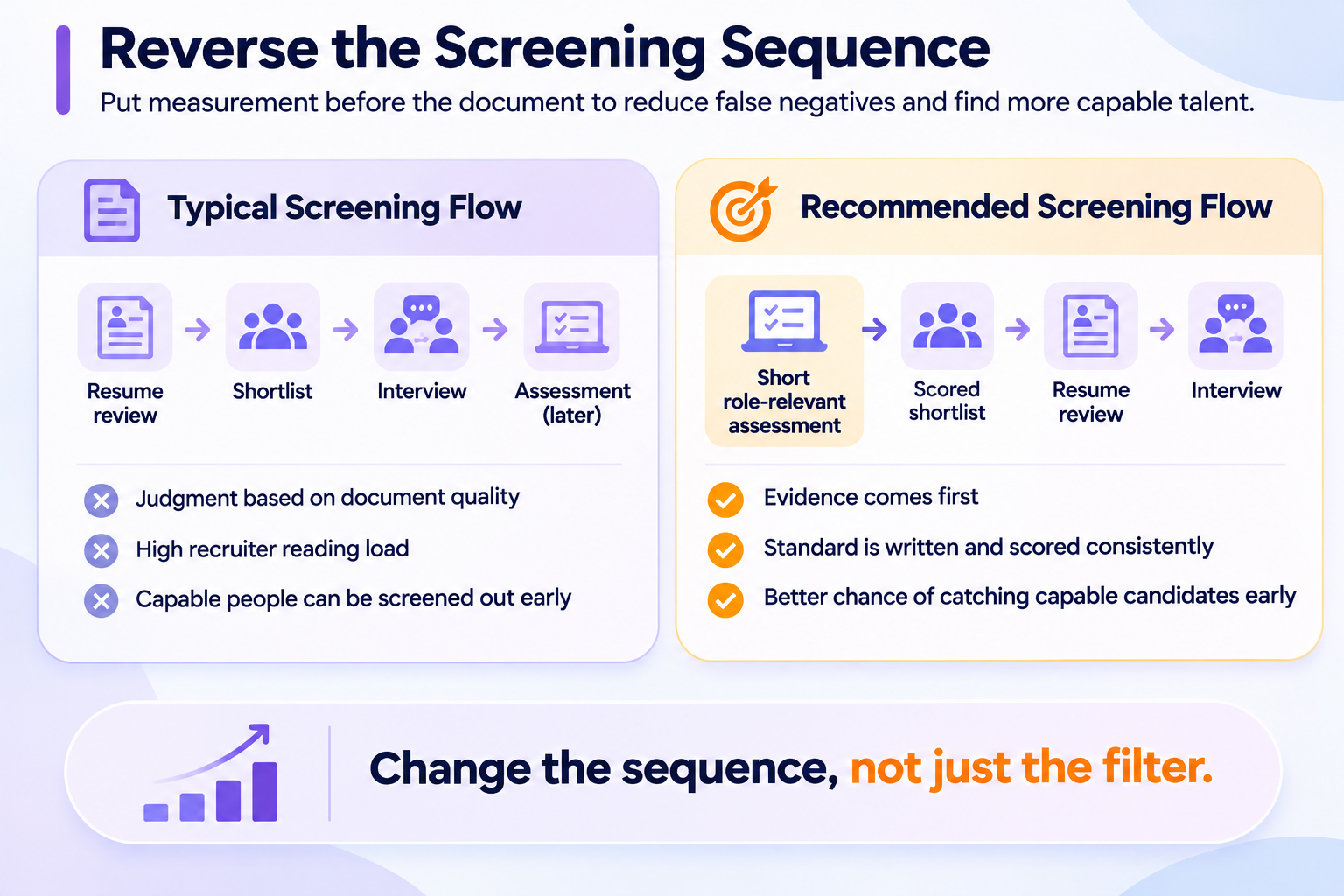
What changes in practice is sequence and consistency, not tooling.
Sequence. For one role family, run a short role-relevant assessment before resume review rather than after. Same funnel, reversed order. Then compare 90-day performance against the cohort you screened the usual way. To determine whether the new sequence improves hiring quality, validate the hiring assessment against actual job outcomes, including performance, retention and other role-relevant business measures.
Consistency. A written bar, scored by the same rubric every time, is what makes that comparison mean anything. This is also where campus intakes break down, because the volume arrives in a two-week window and the standard drifts under load - a pattern covered in fresher hiring and campus screening in India.
How do you measure your own candidate screening error rate?
Take one high-volume role, pull last quarter's rejected-at-screen applications, and draw 50 at random. Write down the three capabilities the role requires before you look. Score those 50 against those three only, with names and writing style removed, and count how many clear the bar. Divide the number meeting your review criteria by 50 to estimate the share of rejected applications worth further assessment. This is a screening-audit indicator, not a validated false-negative rate. Confirm candidate capability through relevant work samples or validated assessments.
Then audit what the extra stage caught. If you added an interview to catch fabrication, take the last 100 candidates through it and split rejections into two columns: rejected because the application did not hold up, and rejected because the person could not do the work. If few candidates are rejected because of verified fabrication, review whether the added interview provides sufficient value to justify its time and operational cost. Consider its impact on candidate experience, hiring speed and the quality of subsequent selection decisions.
How does assessment screening differ from resume screening software?
Resume screening software ranks documents faster. Assessment-based screening replaces the document as the evidence. PMaps scores candidates across cognitive, behavioral and psychometric assessments plus AI video and voice interviews, read against validated role benchmarks, under proctored conditions, so the result reflects measured performance rather than a ranked paragraph.
The practical difference is what the score is read against. A rank is relative to the other documents in the pile that week. A benchmark is fixed to the role, so a good score means suitable for this role rather than better than this batch. That distinction depends on assessment validity: whether the assessment measures the intended competencies and provides evidence relevant to performance in the target role.
PMaps delivers in 8+ Indian languages, which matters when the role is a voice process in Surat rather than a corporate function in Bengaluru. 200+ enterprise clients across 7 countries, including HSBC, Bajaj and Tata Consultancy Services, screen on it.
Pull 50 applications you rejected at screen last quarter, strip the names, and score them against three things the role actually requires. If more than a handful clear the bar, the screen is not too loose - it is pointed at the wrong question.