.webp)
.webp)


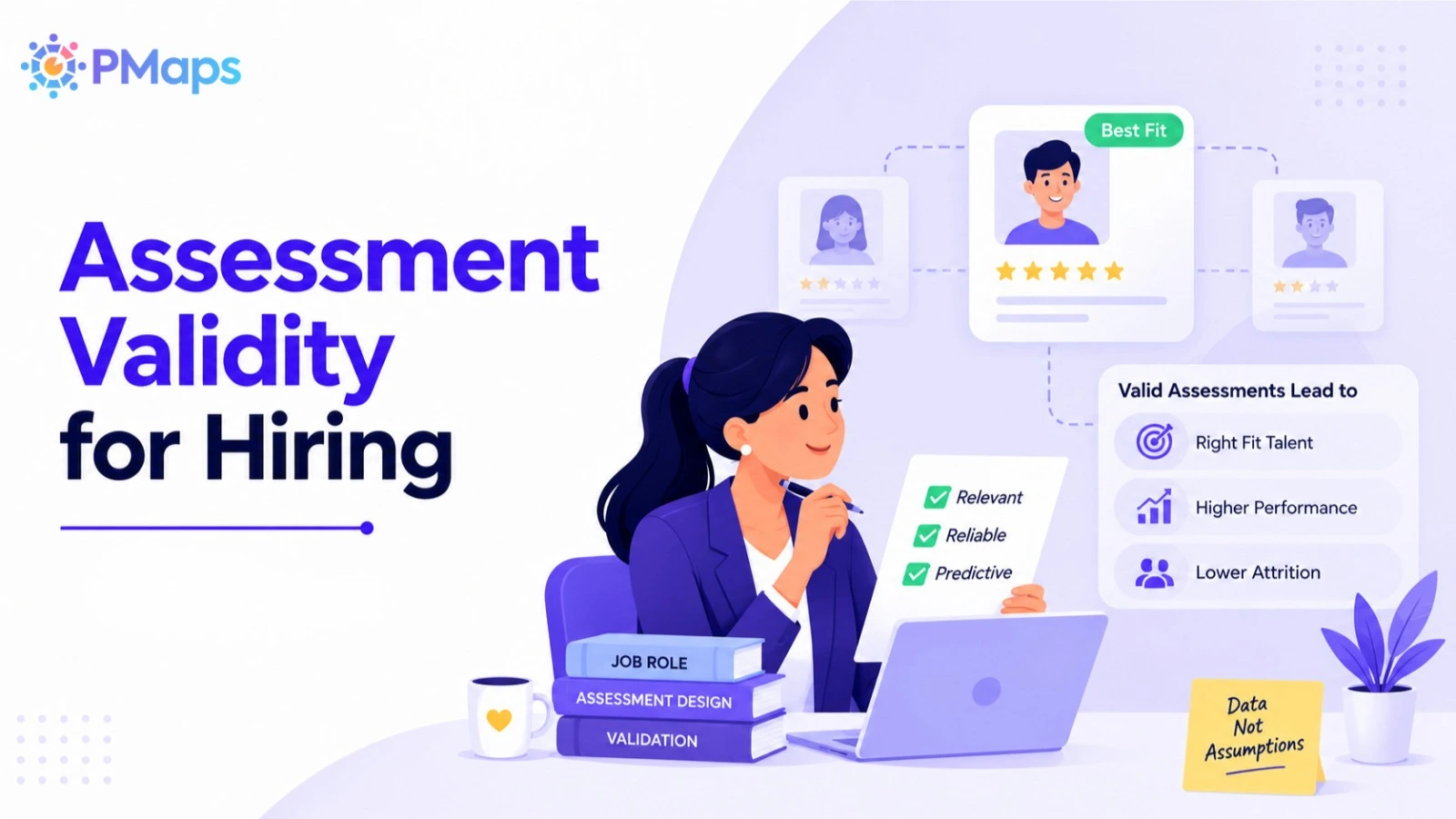
Assessment validity is the evidence that a hiring test's scores can be used for the decision you are making in this role, this population, this outcome. At PMaps we treat it as a question with an answer, not a label a vendor owns: valid for what, for whom, against which measure of performance?
That is where assessment validity matters.
What does assessment validity mean in hiring?
Validity is a property of a use, not of a test. Psychometric test validity is evidence supporting how assessment scores are interpreted and used, not a fixed label a test carries. In hiring, that means checking whether an employer's conclusions fit the specific role, population and decision, and asking "Is this valid for this use?" rather than assuming validity once and for all.
An assessment suited to one customer-service role may need different evidence, cut-offs or weighting for another with different performance demands.
This isn't a vendor opinion. The Standards for Educational and Psychological Testing (AERA, APA and NCME) and SIOP's Principles for the Validation and Use of Personnel Selection Procedures both define validity this way, and US employers work under the EEOC's Uniform Guidelines. India has no direct equivalent, so a vendor's own evidence is the only real check.
Types of Validity in Employment Assessment
Employment assessment validation draws on several forms of validity evidence, and typically leans on three main types: criterion validity, construct validity and content validity, each answering a different question about whether a test measures what a role actually requires.
Criterion validity: the practical idea
Criterion-related evidence asks whether assessment results meaningfully predict an outcome that matters outside the test itself, typically job performance.
A 2022 Journal of Applied Psychology re-analysis by Sackett, Zhang, Berry and Lievens found structured interviews and cognitive-ability tests operate at validity coefficients of .42 and .31 respectively.
It is useful, but well below older estimates. A correlation alone should not become a universal hiring rule; it needs interpreting alongside job relevance and context.
Construct validity: what the test is actually measuring
Construct validity asks whether an assessment measures the underlying trait it claims to, such as attention to detail or customer-service orientation.
Scale matters here, a 2024 Global Validation Study assessed construct validity across more than 1.4 million participants in 91 languages, one of the largest such efforts on record.
This confirms a trait is measured coherently, it does not by itself prove the trait predicts performance.
Content validity: does the test reflect real job content
Content validity checks whether test items represent the knowledge, skills and behaviours a job actually requires, established through expert review against a job analysis.
A 2024 study developing a workplace assessment tool put 63 candidate items through expert content-validity review, where 25 were eliminated and 38 retained, showing how rigorously item sets get trimmed before a test counts as content-valid.
Hence, content validity confirms a test resembles the job, however it does not replace outcome-based evidence single handedly.
Individually, none of these proves a test is valid. Together, they build a fuller picture of whether a test measures the right thing and predicts what matters. Gathering that criterion evidence follows one of two designs.
Concurrent Vs Predictive validation
Two approaches are common in employment settings: concurrent and predictive validation. Both examine the relationship between assessment scores and job performance, but they differ in when data is collected and how closely the sample matches the applicant population.
Neither approach should be selected merely for sounding more rigorous. The right design depends on the business question, data availability and practical constraints.
The validity questions an HR buyer should ask
Before evaluating a vendor's dashboard or test library, get specific about what you're actually trying to predict. "Improve hiring" isn't a job outcome but a wish. A job outcome is measurable: 90-day retention on a call center floor, ramp time to first independent sale, error rate on a QA line, manager-rated performance at six months.
Without naming this first, "validity" has nothing to be valid for, here a test can correlate with almost anything if you don't specify the criterion you're checking it against.
- What job outcome are we trying to improve? Define the business outcome before selecting the assessment. Depending on the role, that may include training success, quality scores, productivity, sales performance, customer-service outcomes, error rates, adherence or another defensible performance measure. Without a clear criterion, “predictive” becomes an attractive but vague claim.
- What does the assessment actually measure? The assessed constructs should make sense for the job. A BPO voice role, for example, may require a different combination of language, listening, cognitive, behavioral and role-specific skills than a back-office processing role. A good validation conversation starts with job requirements—not with the number of tests available in a vendor library.
- Is there evidence connecting assessment performance with job performance? One useful approach is criterion-related validation: examining the relationship between assessment scores and a relevant external criterion, such as job performance. This can be studied using existing employees where appropriate, or prospectively by following candidates after hiring. The exact design should depend on available data, sample characteristics and the decision the employer wants to support.
- Does the evidence apply to our population and workflow? A result from one role, geography, language group or hiring process should not automatically be assumed to generalize to every other context.Enterprise buyers should ask who was included in the evidence, what performance measure was used, how the assessment was administered and whether the operational process resembles their own.
- How will the evidence change the hiring decision? Validation should lead to an operational decision—not just a statistical appendix. The employer may use the findings to refine competency weights, reconsider a cut-off, combine multiple assessment signals, redesign a pilot or identify areas where more evidence is required.
What should a useful enterprise validation exercise contain?
A practical validation program normally needs a clearly defined role and population, a documented assessment framework, a defensible performance criterion, clean matching between assessment and outcome data, an appropriate analysis plan, transparent limitations and a decision on what changes, if anything, should follow.
The output should be understandable to both technical and business stakeholders. HR leaders need to know not only whether a statistical relationship exists, but whether it is strong and stable enough to inform the intended hiring workflow.
Common mistakes when evaluating assessment validity
Even well-designed validation efforts can go wrong in predictable ways. The patterns below show up across enterprise hiring programs, often when a plausible-looking number gets applied more broadly than the original evidence actually supports.
- Treating vendor-wide accuracy as proof for every role. A vendor-wide accuracy percentage is a marketing number, not validity evidence.
- Using a weak performance criterion. If manager ratings or operational KPIs are inconsistent, the validation exercise inherits that noise.
- Choosing the cut-off first and validating later. If the cut-off was chosen before the study, the study is a defence, not an analysis. The evidence should inform the decision rule rather than simply defend a pre-selected threshold.
- Ignoring role differences. The competency mix that matters for sales, collections, customer service and back-office work can differ materially.
- Confusing reliability with validity. Reliability tells you a test measures consistently; it tells you nothing about whether the thing it measures matters.
- Over-reading a single statistic. Statistical significance, effect size, practical usefulness and the quality of the underlying data are different questions.
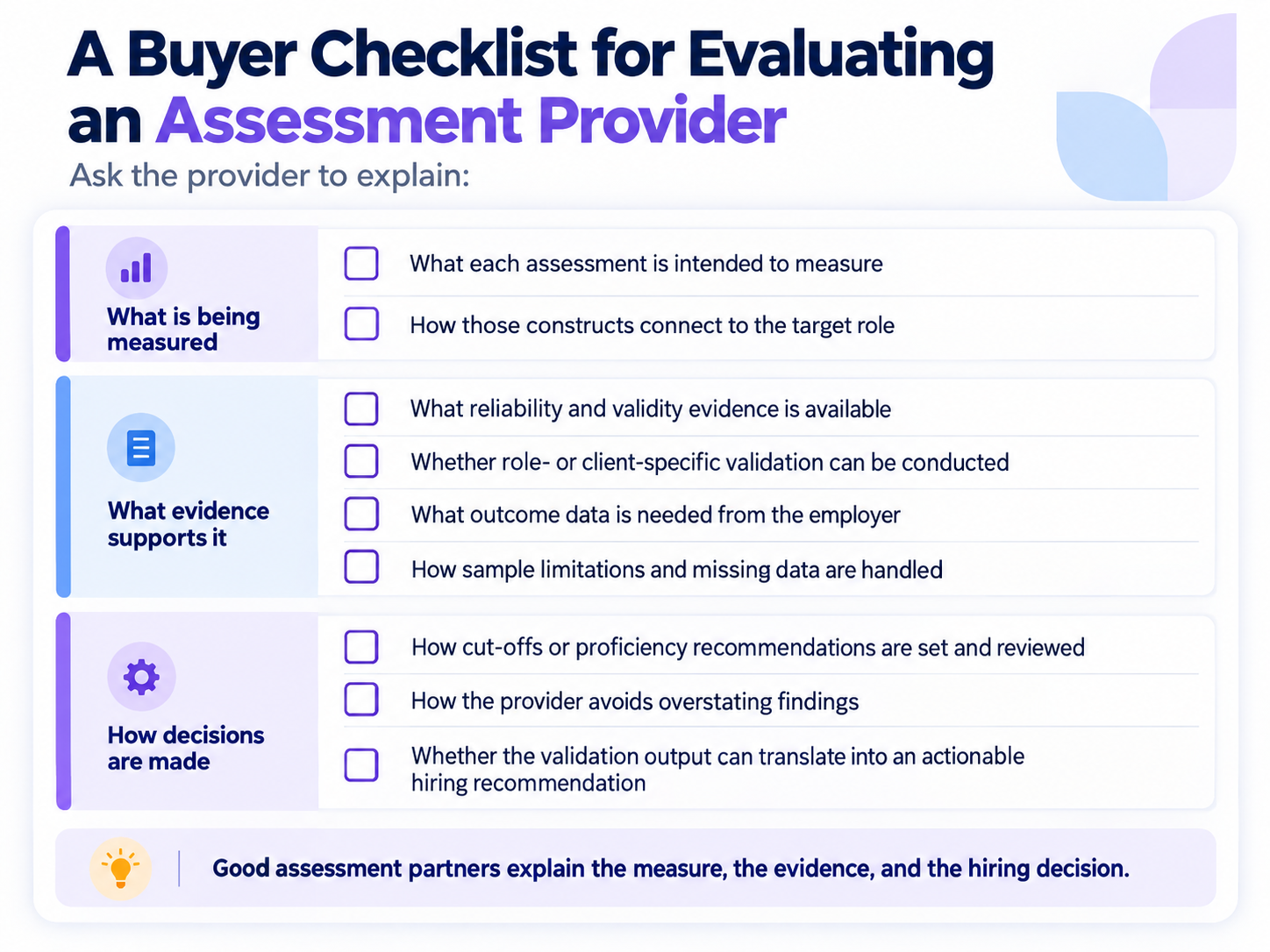
Rather than leaving these mistakes as warnings, the checklist below converts them into nine concrete questions. Working through them before signing a contract gives HR teams a structured way to test any vendor's evidence, not just their claims.
Where do pilots fit?
A pilot can be more than a product demonstration. When designed well, it can help the employer test the operational workflow, inspect score distributions, evaluate candidate experience, check reporting usefulness and establish what data would be needed for subsequent validation.
A pilot should begin with explicit success criteria. Otherwise, teams can finish a pilot with many test reports but no clear basis for a scale decision.
How can PMaps support a validation-led assessment program?
PMaps serves 200+ enterprise clients across 7 countries, scoring against validated role benchmarks, not general population norms, so 'good' means good for this role. It combines cognitive, behavioral, language and role-specific signals, aligned to each hiring context and available performance evidence.
This kind of employment assessment validation work is documented in PMaps’ leadership assessment validation case study, which sets out how methodology and criterion choices were handled for a senior hiring program.
Where a validation exercise is appropriate, the process should begin with the role, the intended decision and the quality of available outcome data. Any client-specific finding should be interpreted within that context rather than presented as a universal prediction claim.
Since behavioral assessments are often delivered through more than one format, psychometric test validity evidence should also confirm that results hold up whether a candidate completes a visual or a text-based version of the same assessment.
PMaps’ case study on establishing concurrent validity for its visual and text-based behavioral assessment sets out one example of how that comparison can be run.
This gives HR teams a more useful question to take into a pilot or vendor evaluation: not “How many tests do you have?” but “What evidence would make this hiring decision better?” The same logic applies when comparing vendors: the validity of psychometric tests should be judged case by case, not assumed from a vendor’s overall reputation.
PMaps’ banking leadership assessment validation case study for instance, shows this reasoning applied to a large-scale banking hiring program.
Turning that reasoning into something usable, the checklist below breaks it down into six practical questions. These are worth raising with any vendor before a pilot or renewal, regardless of how established their reputation already is.

The real question behind every validity claim
Every vendor can describe an assessment as valid. Fewer can show the evidence behind that claim for a specific role, population and decision. Before the next pilot or renewal conversation, the more useful question may not be whether a test is valid, but valid for what, exactly? Ask what was measured, for whom, against which outcome, and under what conditions.