.webp)
.webp)


Temporary hiring in India will grow 15-20% this festive season, and the median frontline associate is now 26.7 years old - down from 28.2 a year earlier (TeamLease, Festive Season Workforce Report 2026, 12 August 2026, from 60,000 frontline employment records).
High volume hiring is what an employer does when both of those are true at once. This page is written for HR and talent acquisition leaders running that process, not for candidates looking for seasonal work.
What is high volume hiring?
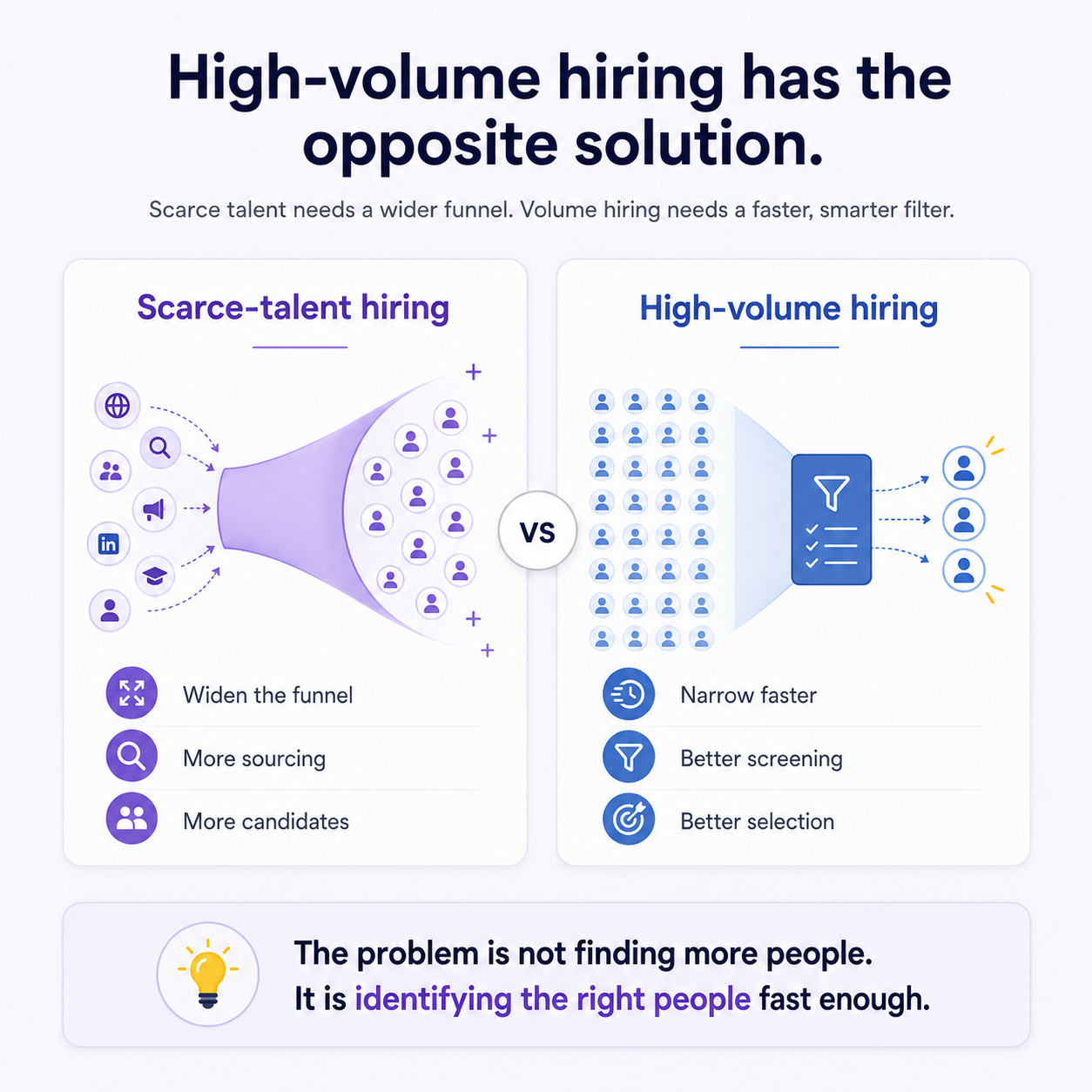
High volume hiring is recruiting for many identical or near-identical roles against a fixed deadline - typically frontline retail, warehouse, customer service, or field sales. It differs from ordinary recruitment in that the binding constraint is throughput rather than candidate scarcity, and the step that breaks under that constraint is almost always screening.
The distinction matters because the two problems have opposite solutions. Scarce-talent hiring is solved by widening the funnel. Volume hiring is usually solved by narrowing it faster and more accurately, which is the reverse of what pressure makes people do.
Why does screening break down at high volume?
Screening is the only step that looks optional when a deadline is fixed. The requisition cannot move and sourcing carries visible pressure, so the bar quietly drops: assessments waived for referred candidates, clearing scores set against whoever applied by Wednesday. The cost surfaces months later as attrition rather than as a vacancy.
That last clause is the whole mechanism. Every other failure in a volume hiring process announces itself inside the season - a channel underdelivers, a venue no-shows, an onboarding batch slips. A screening failure announces itself in the following quarter, by which time it is filed as a retention problem and handed to a different team.
There is a second, quieter compression. Under volume pressure, screening tends to be replaced by proxies that are faster to read: years of experience, a previous employer's name, an interviewer's impression in a four-minute conversation. Those are not lighter versions of assessment. They are different measurements, mostly of things that do not predict frontline performance.
What should you screen for in frontline roles?
Screen for the behaviors experience used to supply: reliability under repetition and composure with a difficult customer. Neither appears on a CV. As the pool gets younger - India's median frontline associate fell from 28.2 to 26.7 years in twelve months - those behaviors stop arriving pre-filtered by prior seasons.
That filtering effect is worth stating plainly, because it is the part most volume hiring processes were silently relying on. An associate who has worked two previous festive seasons has already been selected by them. They turned up on the fourteenth consecutive day. They handled a queue of irritated customers at 8pm on a Saturday. They came back the following year. That is a screen, applied by the labour market, at no cost to the employer.
A younger cohort has not been through it. So a screening process that was adequate in 2024 is doing materially less work in 2026 - not because it got worse, but because what it used to inherit is no longer there.
What to measure instead, for most retail, quick-commerce and customer-facing frontline roles:
Reliability under repetition. Not enthusiasm at induction, which everyone has. The capacity to perform an unvarying task to the same standard on day fourteen as on day two. Its absence shows up as a shift-attendance curve that decays in the third week, and it is visible in behavioral assessment long before it is visible in a roster.
Composure under customer pressure. The behavior that separates a frontline performer is not politeness at the counter - it is what happens in the second and third minute of a complaint, after the rehearsed apology has been used. A structured behavioral or situational assessment measures the decision; an interview mostly measures the rehearsal.
Language fit for the actual market. In tier II and tier III India, where roughly 45% of this season's frontline demand sits (Adecco India, 17 August 2026), screening in English measures English rather than capability. That is a bias problem and a talent-loss problem at the same time.
How do you screen thousands of candidates in days?
Use an assessment that runs asynchronously on the candidate's own device, in their own language, scored automatically against a validated role benchmark. Multilingual delivery matters most in tier II and tier III markets, where roughly 45% of India's festive demand sits. Most PMaps clients are live within 48 hours of deciding to move.
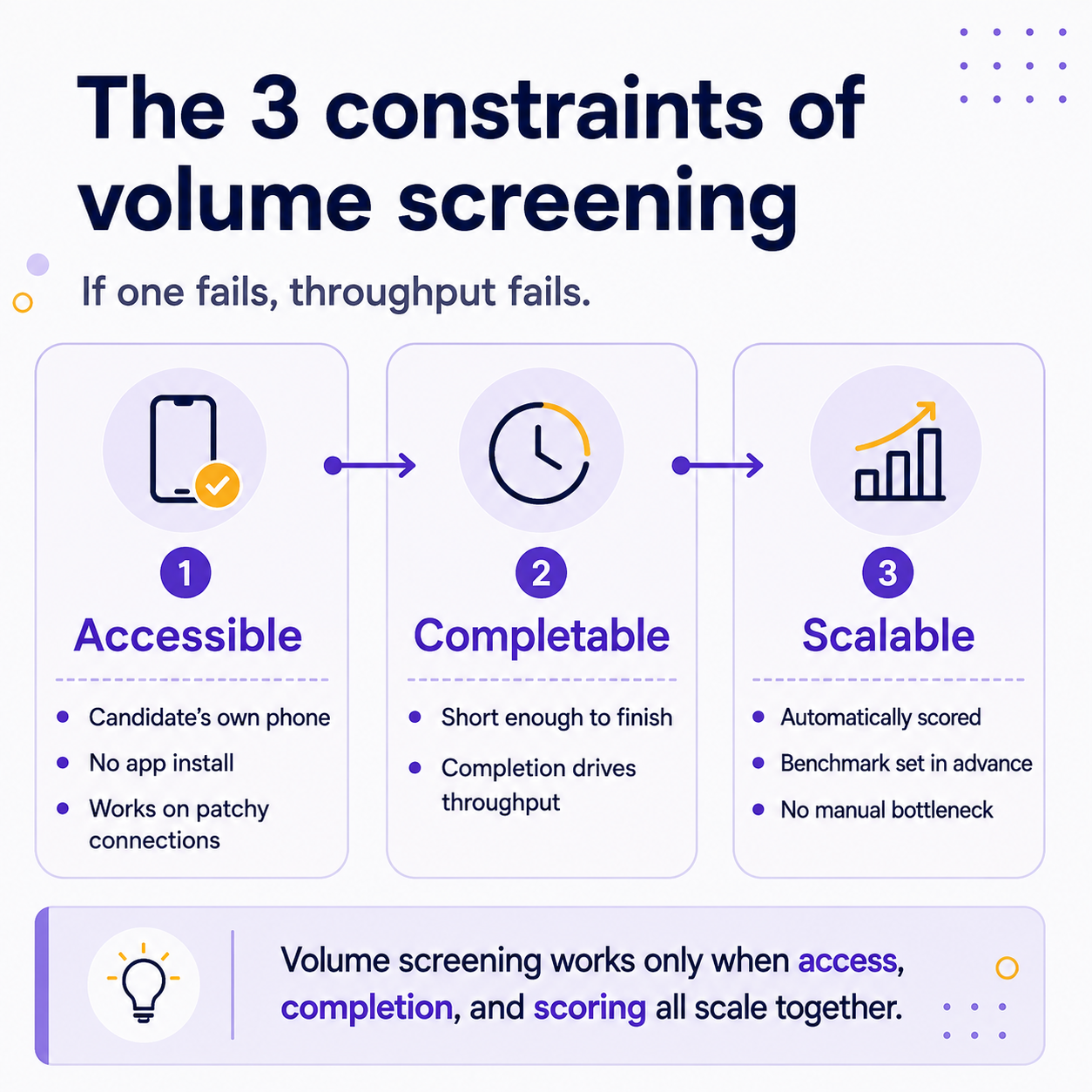
Three practical constraints decide whether a volume screening program works:
It has to run on the phone the candidate already owns, on a patchy connection, without an app install. Anything requiring a laptop or a desktop browser excludes a large share of the frontline pool before you have measured anything about them.
It has to be short enough to finish. Completion rate is the real throughput number in volume hiring, and a thorough assessment nobody finishes screens fewer people than a shorter one everybody does.
It has to score without a human in the loop, against a benchmark set in advance. Manual review reintroduces the bottleneck the automation removed.
For voice roles - collections, telesales, customer support - add a CEFR-rated voice and accent assessment for BPO hiring rather than judging language in the interview, where the assessment is unstructured and the interviewer is fatigued by candidate forty.
How do you set a clearing score before the season starts?
Take ten people already performing the role well, run them through the assessment, and use their score distribution as the benchmark. Set the cut-off from that, in writing, before the pipeline arrives. A bar set against whoever applied is a description of your pipeline, not a standard.
This is the cheapest item in any volume hiring programme and the one most reliably skipped. It costs an afternoon and it converts every subsequent screening decision from a judgement call into a comparison.
It also survives the pressure. When the pipeline underdelivers in week three - and it will - a written benchmark forces the trade-off to be made explicitly: lower the bar, extend the timeline, or open another channel. Without one, the bar drops by default and nobody records that it happened.
What does high volume hiring cost when it goes wrong?
Roughly 25% of India's seasonal hires convert to permanent (Adecco India, 17 August 2026). So a quarter of a festive intake is a permanent hiring decision made in the six weeks when the process is under the most pressure and applying the least rigour. The cost lands as first-quarter attrition and re-hiring.
And it is almost always misattributed. The conversion decision happens months after the screening decision, so the failure is recorded against retention, engagement, or the line manager - never against the September screening bar that produced the cohort.
The practical implication is a two-track standard. Find out which of your roles actually convert, because 25% is a national average and yours will not be spread evenly across roles. Screen the converting roles to your permanent standard. Let the genuinely temporary ones run lighter. Applying one bar to both means over-screening the warehouse pickers and under-screening the store associates you will still employ in March.
How does PMaps support high volume frontline hiring?
PMaps runs one integrated assessment covering cognitive, skills, and behavioral evaluation, delivered in 14+ Indian languages on any device, and scored against validated role benchmarks rather than against a general population.
For frontline volume hiring specifically: Voice and Accent assessment is CEFR-rated for voice processes, proctoring runs from basic through AI-based cheat detection depending on tier, and most clients are live within 48 hours of deciding to move. The fastest go-live on record was under an hour from demo to live screening.
Across deployments the pattern holds: 45% reduction in hiring costs, 8 days faster time-to-hire, and 72.5% candidate acceptance. Those are platform figures across sectors, not a single flattering deployment. 12 years, 4M+ assessments, 200+ enterprise clients across 7 countries.
Teams comparing platforms can start with our pre-employment assessment tests for job fitment.
One caution, since this is a category that invites overclaiming. Structured, competency-based assessment reduces bias relative to unstructured interviewing. It does not remove it, and a vendor telling you otherwise is describing a marketing position rather than a measurement one.
See how a competency profile is built for one volume role.
We run a 30-minute working session on a role you are hiring at volume. We map it against our job ontology and you leave with a competency profile you can hand to your screening team, whether or not you ever run an assessment with us. Book a Demo today!