.webp)
.webp)


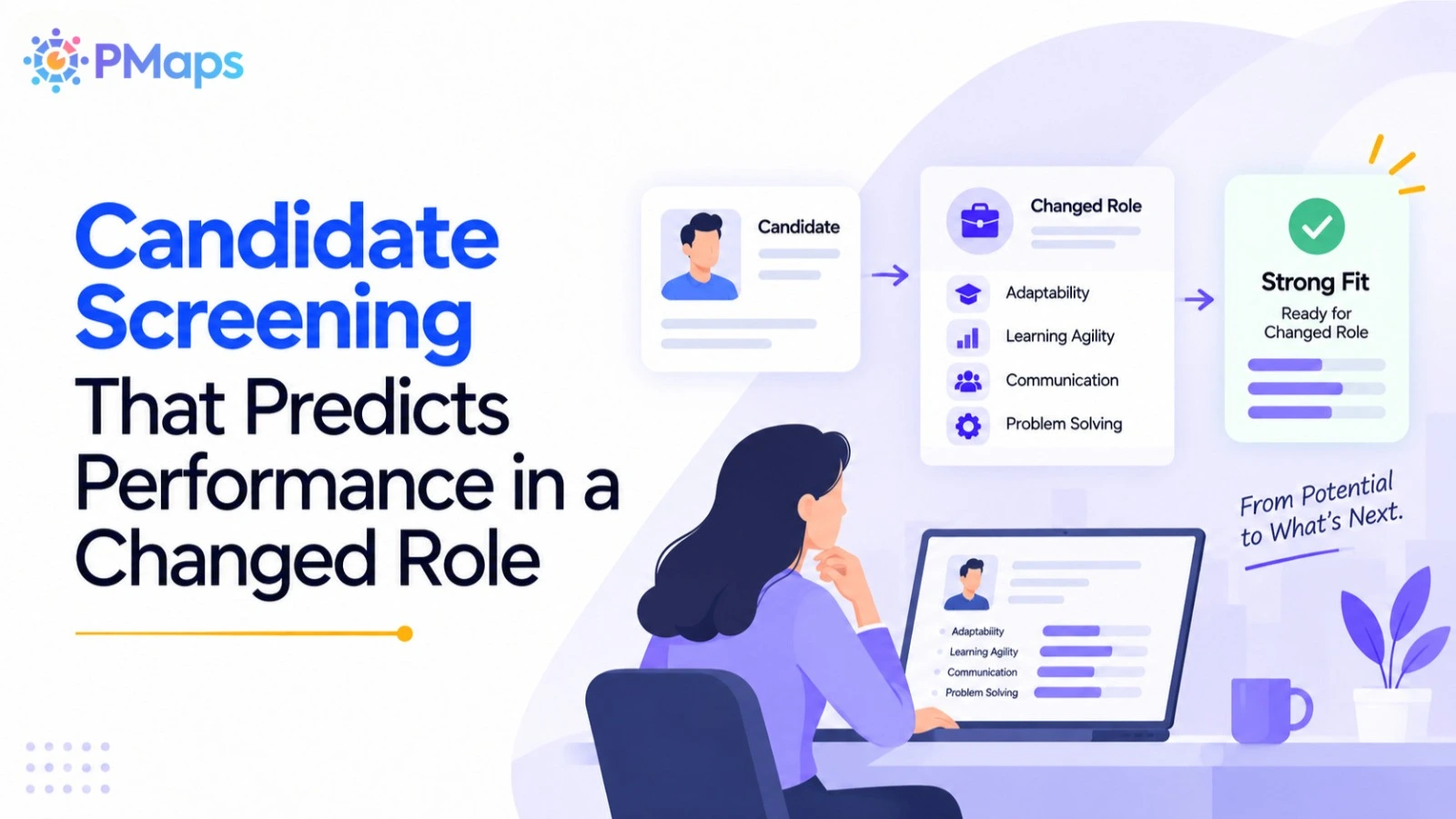
Candidate screening is the stage where an employer decides which applicants move forward, using a defined bar rather than a reader’s impression. This guide is written for talent acquisition and HR leaders at Indian enterprises whose roles have changed shape faster than their screening criteria have. It covers how to tell a backfill role from a new-shape one, how to set a bar when no incumbent exists, and how to back-test the screen you already run.
The timing matters. ManpowerGroup’s Employment Outlook Survey for Q4 2026, published on 8 September, put India’s Net Employment Outlook at 54% the highest of 42 countries, from 3,055 Indian employers. Among those hiring, 69% named changing roles and skills requirements as a reason, and 57% said their hiring now moves faster than a year ago. Screening volume and speed are both rising. The criteria underneath them mostly are not.
What is candidate screening?
Candidate screening is the process of filtering applicants against a defined standard before interviews begin, so that the people who advance are the people most likely to perform. It is a measurement step, not an administrative one. Its quality is decided entirely by whether the standard it applies actually predicts performance in the role being filled.
Most enterprise screens combine three filters: eligibility (qualifications, location, notice period), capability (aptitude, skills, role-specific knowledge), and behavior (how a person works, decides, and holds up under the conditions of the job). The first is a fact check. The second and third are predictions, and predictions can be checked against what happened. That is the part most organizations never do.
Why does candidate screening fail when a role changes?
Screening fails when the criteria describe a version of the role that no longer exists. Most screens were built from a job description written for the previous shape of the work, so they filter accurately against the old requirement and inaccurately against the new one. Speed makes this worse, not better, because it applies the wrong standard more times.
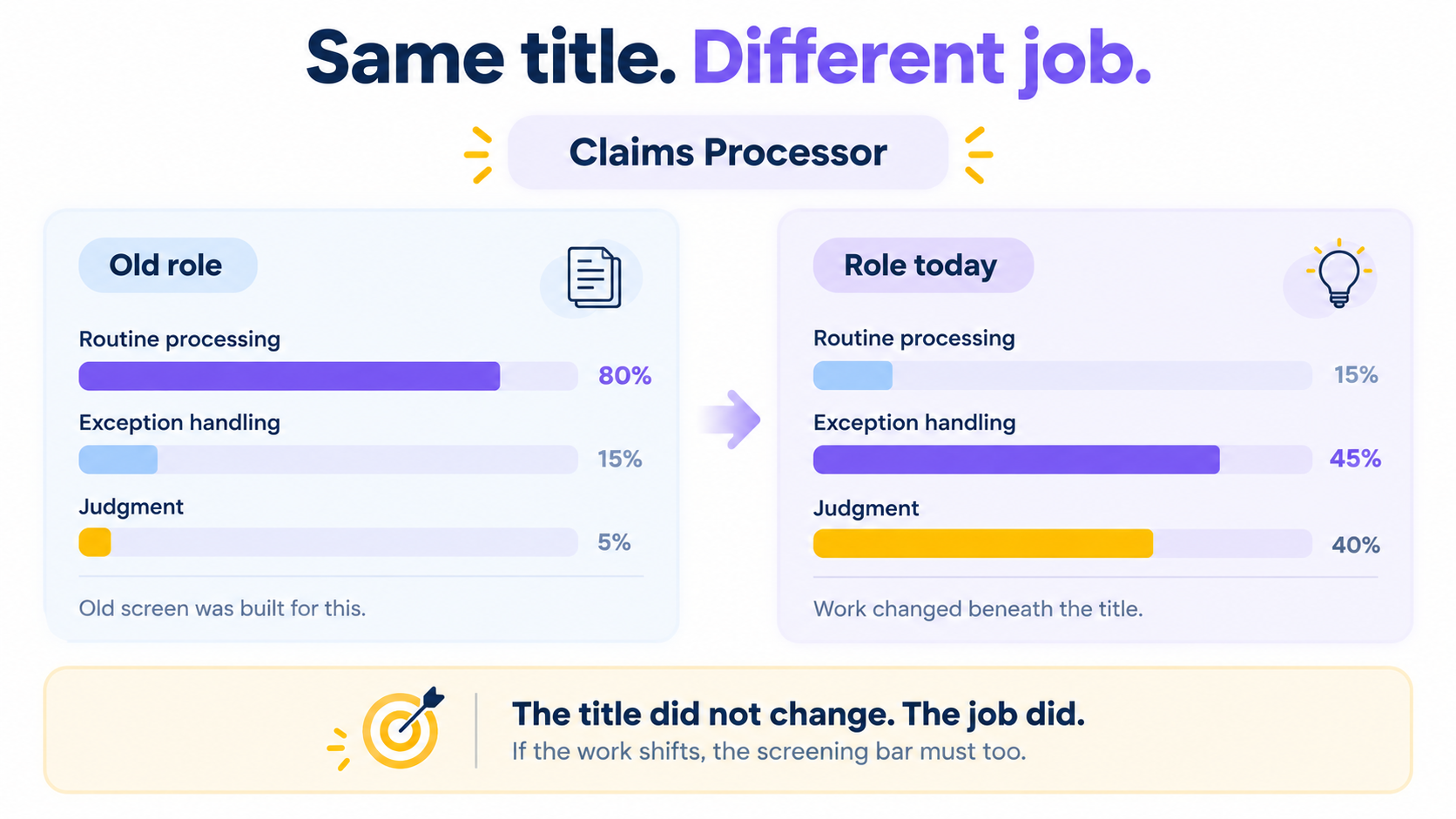
A relationship manager whose portfolio is now half-serviced by an app is not doing the job the old screen was built for. Nor is a claims processor whose routine files are auto-adjudicated and whose day is now entirely an exception, or a hospitality supervisor covering three functions that used to be three people. In each case the title survived and the work underneath it changed.
The screen, meanwhile, still tests what the old job needed. It is not broken in any way an audit would catch the questions are valid, the scoring works, the completion rates are healthy. It is simply pointed at the wrong target, and everything downstream inherits that error. A recruiter cannot see it, because the screen still returns a clean ranked list. Only outcomes reveal it, months later, usually recorded as attrition or as a performance problem rather than as a selection problem.
How do you tell a backfill role from a new-shape role?
A backfill role is one someone held in its current form, where you hold their performance record. A new-shape role has materially changed or never existed, so no validated benchmark sits behind it. The test is simple: can you name a person whose actual performance data tells you what good looks like here? If not, it is new-shape.
Run the distinction across your open requisition list and mark each one B or N. Teams doing this for the first time usually find two things. The N column is heavier than expected often a clear majority, which tracks with the ManpowerGroup finding that expansion (44%) and advancing technology (39%) outrank backfilling vacant positions (22%) as stated reasons for adding staff. And both columns are running through the same screen.
That second finding is the actionable one. A screen validated on a backfill role is carrying real evidence. The same screen applied to a new-shape role is carrying the assumption that the two roles are similar enough, which nobody has tested and which the role change itself argues against.
How do you set a screening bar without an incumbent?
Derive it from a person rather than a document. Find the closest thing you have to someone already doing the new work well, and spend forty minutes asking what separates a good day from a bad one, what they were never trained for, and what the old job description gets wrong.
Usually that is an internal employee whose job changed underneath them. Turn the conversation into four to six requirements, each one observable and each with a stated proficiency level. Four is the floor because fewer rarely separates a credible shortlist. Six is the ceiling because interviewers stop applying a longer list consistently.
Then apply two tests. The evidence test: name what a candidate could show or describe that would count as proof of each requirement. If nothing qualifies, the line is a value statement and belongs in the culture conversation instead. The separation test: ask whether a plausible but wrong candidate would fail this line. If every shortlisted candidate clears it, it is a threshold rather than a differentiator, and it is consuming screening time a real differentiator needs.
This is slower than editing last year’s job description. That is the point the speed you gave up is the accuracy you get back, and it is paid once per role rather than once per candidate.
How do you back-test a candidate screening process?
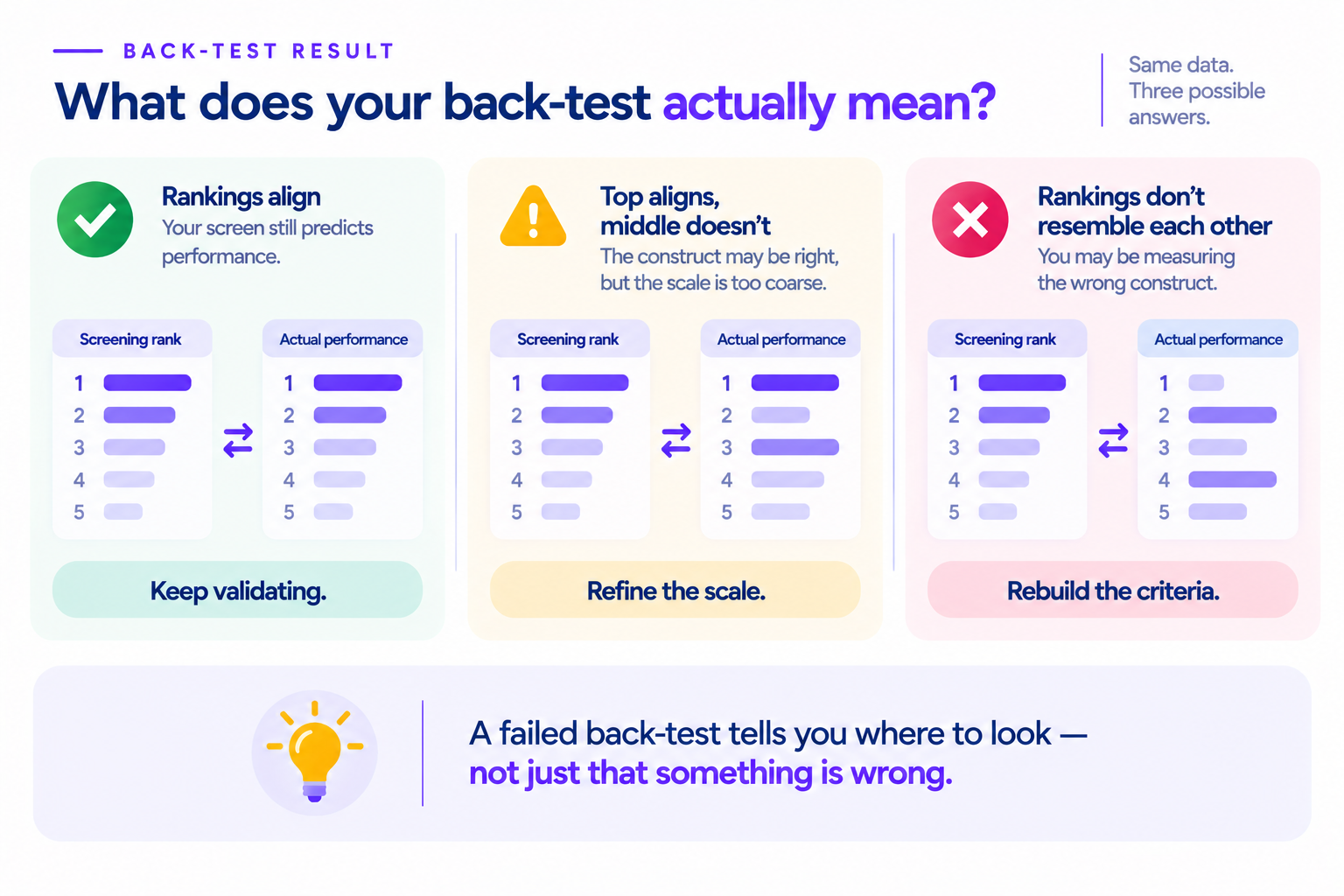
Pick fifteen people hired more than twelve months ago into a role that has since changed. Rank them by how they have actually performed. Then pull their original screening scores and rank them again. If the two orders do not resemble each other, the screen is not predicting performance in the role as it now exists.
The test costs an afternoon and it settles with evidence a question that is otherwise settled by seniority in a meeting. It also tells you which direction to fix in. If the screen ranks accurately at the top but not through the middle, the bar is roughly right and the scale is too coarse. If the orders are unrelated throughout, the criteria themselves are measuring the wrong construct and no amount of re-weighting will help.
Two practical notes. Fifteen is enough to see whether a relationship exists, not enough to quantify it treat the result as a direction to investigate, not a correlation coefficient. And run it where performance is recorded in something more specific than an annual rating, because a five-point scale that clusters everyone at 3 and 4 cannot rank anybody.
Organizations running pre-employment assessments for job fitment at the top of the funnel already hold the scores this test needs; the join between those scores and current performance data is usually the only missing piece.
What should an assessment measure at the screening stage?
At screening, measure the one or two requirements that decide performance and that a resume cannot show. For most changed roles that means judgment under ambiguity, adaptation when a familiar method stops working, and for customer-facing and frontline work the behavioral fit that determines whether someone stays past month three.
Eligibility filters do not need an instrument; a form handles them. Capability and behavior do, because both are predictions and both are easy to describe convincingly and hard to demonstrate on paper. That is the specific job a structured assessment is for at this stage.
A score is also only interpretable against the population it should be compared with. Competency-based assessment reads results against validated role benchmarks, so the question a hiring team answers is whether a score is good for this role rather than good in general which is exactly the question a changed role makes hard to answer by instinct. Structured measurement of this kind reduces bias relative to an unstructured screen. It does not remove it.
In high volume hiring screening the economics are different again: the same criteria run thousands of times, so a small error in the bar compounds into a large error in the cohort, and the return comes from validating the bar before scaling it rather than after.
How is candidate screening different from shortlisting?
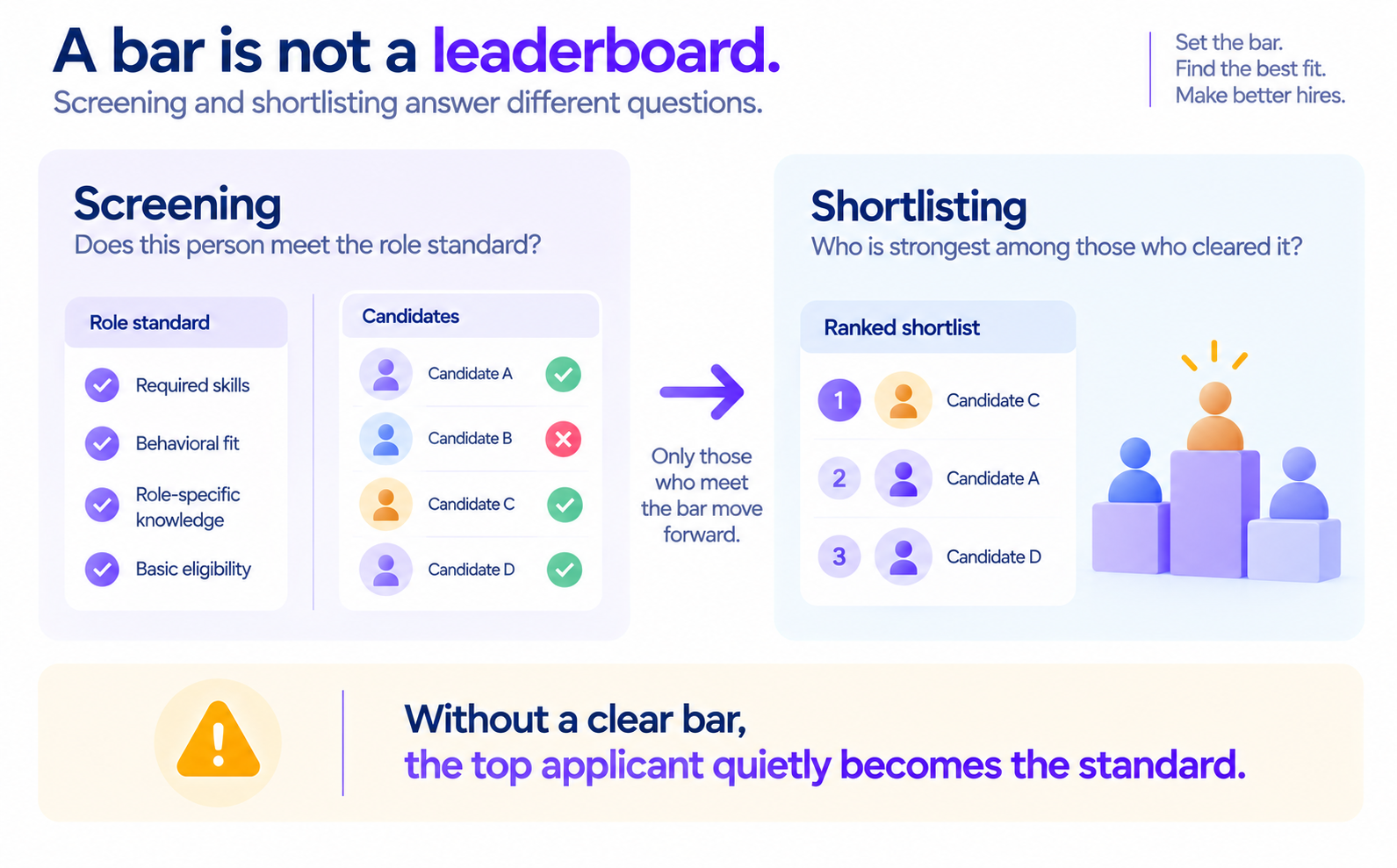
Screening applies a fixed standard to every applicant independently; shortlisting ranks the applicants who cleared it against each other. Screening asks whether this person meets the bar. Shortlisting asks who among these people is strongest. The two answer different questions and fail in different ways.
The failure mode worth naming is substituting the second for the first. When the bar is unclear which is what a changed role produces teams default to relative comparison, and the top of the current applicant pool becomes the standard. That produces a hire who is the best of those who applied this month, which is a different claim from a hire who can do the job. In a strong-supply quarter the two look identical on paper and diverge entirely in the first year.
Where to start
Split your open requisition list into backfill and new-shape, then run the back-test on one role from the new-shape column. That afternoon tells you whether your criteria still hold, using your own data rather than anyone’s claim.
For the measurement layer underneath it, explore how PMaps builds competency-based assessments and reads them against validated role benchmarks or book a demo on the one role that has changed most, and see the bar and the scoring applied to it.