A good 16PF score is not about being universally high or low — it is evaluated against role relevance, peer norm groups, and the overall trait pattern. What matters is fit: whether the profile aligns with the demands of the specific role and team context.
Scores reflect standing within real peer populations — not absolute responses to ideal behaviors. Every candidate benchmarked against relevant norm groups, so rankings stay meaningful.
Three response styles explicitly detected and flagged: impression-managing, over-consistency, and extreme response tendency. Know whether to trust the answer or probe further.
BEI probes mapped to each candidate's unique personality pattern. Easily clubbed with AI voice and video interview workflows.
Benchmarking socially desirable traits like Warmth, Emotional Stability, and Rule-Consciousness attracts over-endorsement. Real differentiation preserved between candidates where it matters most.
Built on Indian population datasets to reflect local communication styles, authority orientation, and workplace behavior. Reduces false positives/negatives from western-normed 16PF tests.
Four high-impact situations where the 16PF test helps you understand how people are likely to behave at work.
Match personality to role demands before day one. Reduce mis-hires and shorten onboarding ramp time.
Role-fit benchmarking · Structured interview probes · Pre-hire screening
Identify high-potential candidates early. Build succession pipelines from trait data.
Succession planning · Coaching plans · Hi-Po identification
Surface traits driving high-pressure performance. Focus on resilience, boldness, and influence.
BPO & contact centres · Sales teams · Customer success
Diagnose team-level trait patterns. Identify complementary and competing dynamics.
Team diagnostics · L&D planning · Culture mapping
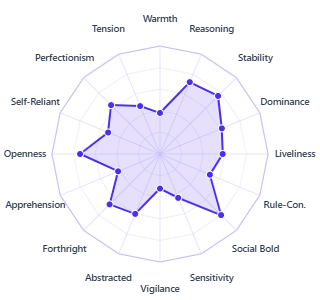
Measures interpersonal approach, empathy, and openness; low scorers stay reserved and formal, while high scorers appear warm, supportive, and engaging naturally.
Measures learning agility, conceptual thinking, and problem-solving; low scorers prefer practical, concrete tasks, while high scorers handle complexity abstractly better.
Measures emotional control, resilience, and stress tolerance; low scorers react quickly under pressure, while high scorers stay composed, steady, and consistent.
Measures assertiveness, influence, and social confidence; low scorers accommodate others easily, while high scorers take charge, challenge, and direct decisively.
Measures enthusiasm, spontaneity, and expressiveness; low scorers seem restrained and task-focused, while high scorers appear energetic, playful, and animated socially.
Measures compliance, dependability, and regard for standards; low scorers bend rules pragmatically, while high scorers follow structure, duty, and consistency closely.
Measures social confidence, risk-taking, and comfort with visibility; low scorers hesitate in unfamiliar settings, while high scorers engage boldly and readily.
Measures empathy, aesthetic sensitivity, and decision style; low scorers stay objective and tough-minded, while high scorers are compassionate, intuitive, and reflective.
Measures interpersonal trust, skepticism, and defensiveness; low scorers assume good intent, while high scorers stay alert, questioning, and cautious socially.
Measures practical focus, imagination, and mental orientation; low scorers stay grounded in realities, while high scorers think conceptually and imaginatively.
Measures self-disclosure, openness, and interpersonal transparency; low scorers share selectively and stay guarded, while high scorers communicate openly, readily, and honestly.
Measures self-doubt, confidence, and worry; low scorers feel secure and self-assured, while high scorers question themselves and anticipate criticism often.
Measures openness, experimentation, and flexibility; low scorers prefer familiar methods and conventions, while high scorers embrace novelty and change readily.
Measures affiliation, collaboration, and autonomy; low scorers prefer teamwork and belonging, while high scorers work independently and decide alone comfortably.
Measures organization, discipline, and detail focus; low scorers tolerate looseness and ambiguity, while high scorers prefer order, precision, and structure consistently.
The 16PF (Sixteen Personality Factor Questionnaire) is a scientifically grounded personality assessment developed by Raymond Cattell. It measures 16 distinct personality factors across cognitive, emotional, and interpersonal domains — providing a granular map of how a person thinks, behaves, and performs at work.
A good 16PF score is not about being universally high or low — it is evaluated against role relevance, peer norm groups, and the overall trait pattern. What matters is fit: whether the profile aligns with the demands of the specific role and team context.
Impression management refers to the tendency to present oneself in an overly favorable way. The PMaps 16PF includes response-style checks to detect this — flagging profiles where answers appear curated, so hiring managers know when deeper interview probing is needed.
The PMaps 16PF includes 144 questions and typically takes around 50 minutes to complete. This balances psychometric depth with practical usability in real hiring workflows.
Free versions of the 16PF lack the standardization required for accurate hiring decisions. PMaps offers a 7-day free trial so teams can experience a properly normed, India-validated 16PF assessment before committing.
Yes. The 16PF is highly effective for fresher and volume hiring — it standardizes screening, benchmarks candidates fairly against peer norms, and surfaces behavioral fit that resumes cannot reveal.
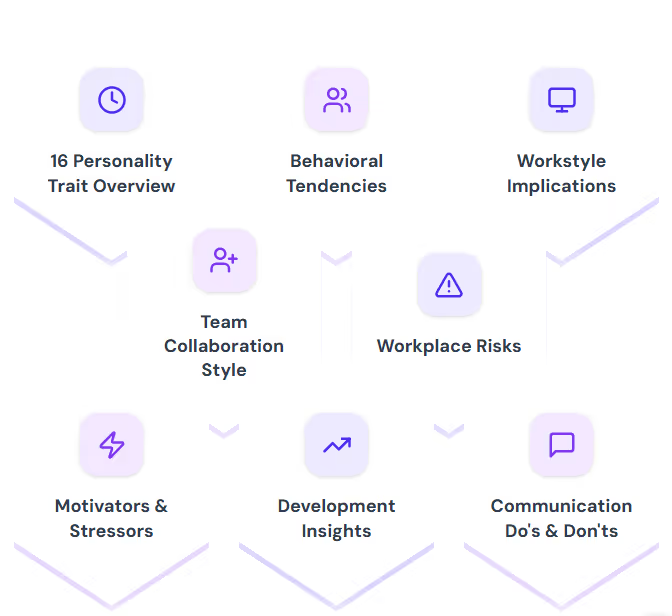
The 16PF adds structured personality insight beyond resume and interview signals. It assesses role fit through 16 distinct dimensions, reduces false positives in screening, generates behaviorally anchored interview probes, and supports evidence-based selection at every stage.
Yes. The 16PF identifies trait patterns linked to influence, resilience, decision-making, and openness to change — key markers for leadership readiness. It is especially powerful when combined with structured interview probes and manager observation.
Walk through a live demo tailored to your roles and hiring volume, download a sample report to see the output firsthand, or connect with our experts.
Live walkthrough tailored to your roles and hiring volume. See exactly how 16PF works for your team.
Click HereConnect with our specialists to norm the 16PF using your people data for higher accuracy.
Click HereDownload a sample 16PF report to see the output — traits, scores, behavioral insights, and interview probes.
Click Here
Need support? Fill out the form and we'll get back to you shortly.