.webp)
.webp)


When every hiring manager has a different definition of a “good candidate,” screening becomes slow, subjective, and hard to defend. Modern hiring teams need structured evidence on skills, behaviour, communication, role fit, and work readiness before final interviews.
SHRM’s 2025 Talent Trends report cites too few applicants, competition from other employers, applicant ghosting, and skill gaps as top hiring challenges. Here are the 10 screening methods modern hiring teams use, what each is good for, and how to combine them.
What Is Candidate Screening?
Candidate screening evaluates applicants before detailed or final interviews, helping recruiters judge whether a candidate meets role requirements and is worth progressing.
Traditional screening meant a CV check and a short call. Modern screening is structured and data-informed, using assessment platforms, video interviews, scoring rubrics, and AI-supported workflows.
Why Candidate Screening Matters
Hiring mistakes are expensive, slow processes increase drop-off, and CVs don’t always show real capability. Screening surfaces the gap between a strong CV and strong on-the-job ability, earlier.
NACE reports 70% of employers now use skills-based hiring for entry-level roles, up from 65% a year earlier. TestGorilla’s 2025 report found 3 in 5 employers saw skills tests cut time-to-hire, and 2 in 3 saw fewer mis-hires. Screening is now a strategic filter, not an admin step. PMaps clients see hiring costs drop 45% and time-to-hire fall by 8 days on average once structured screening replaces CV-only review.
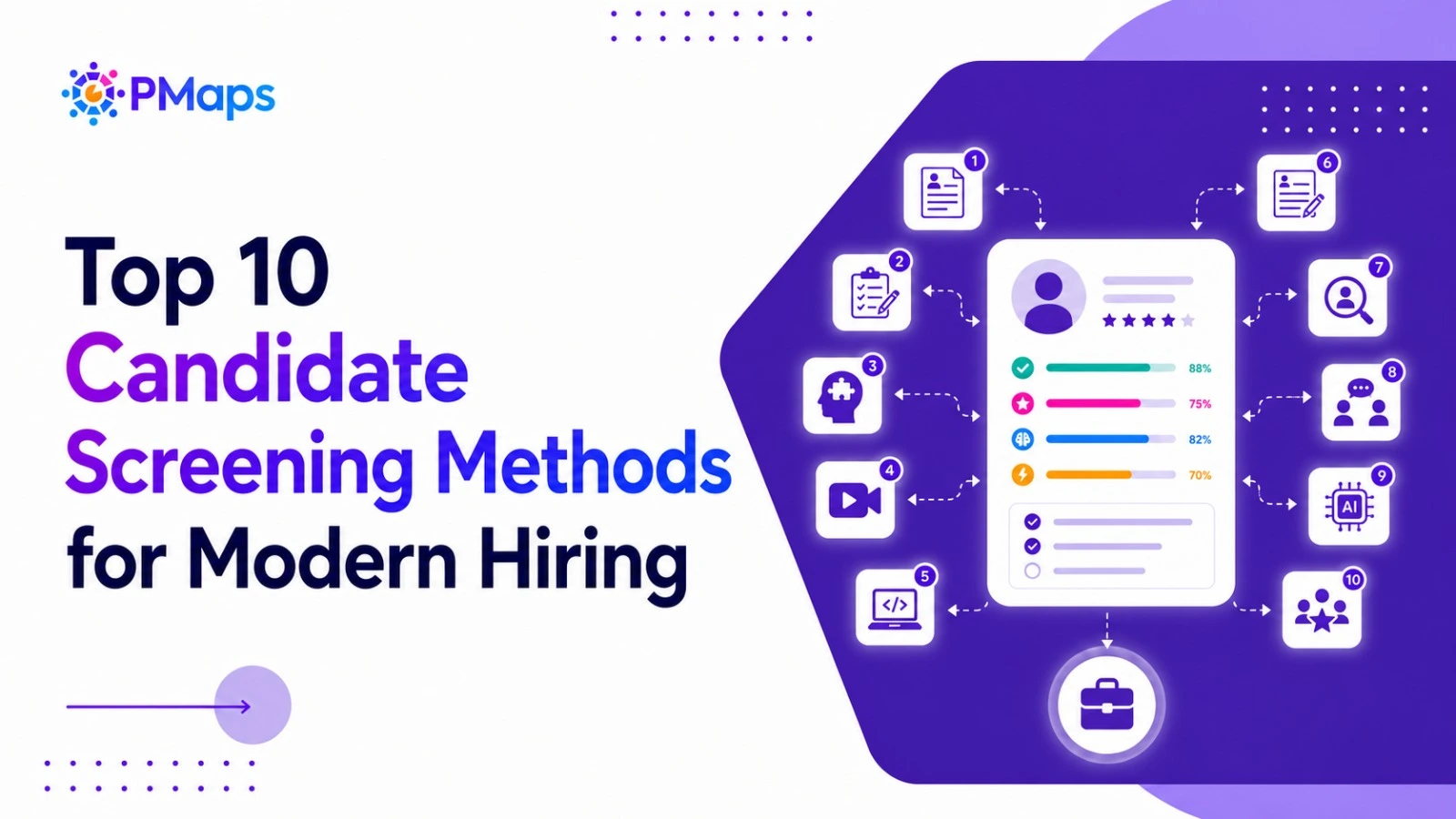
Top 10 Candidate Screening Methods
Modern candidate screening methods reduce hiring guesswork with structured evidence checks. They compare role fit, communication cues, and assessment data before recruiters spend time on live interviews or final panels.
1. One-Way Video Interviews for Candidate Screening
Candidates record answers to pre-set questions on their own schedule, and recruiters compare responses later using the same question set — useful for high-volume, remote, customer-facing, and graduate hiring, and first-round screening.
A tool like ScreeningHive works well here: it builds structured interviews, sends secure candidate links, and collects panel feedback in one place, with role-specific questions and mobile access.
Best practice: keep questions short, role-specific, and consistent per role.
Example prompts: a Sales Executive on handling a “too expensive” objection; a Support Executive on de-escalating an angry caller; a Team Lead on resolving team conflict.
2. Pre-Employment Assessments for Screening Candidates
Pre-employment assessments test aptitude, role knowledge, communication, attention to detail, and workplace behaviour before interviews — shifting screening from “seems good” to demonstrated ability.
Platforms such as PMaps can be used at this stage to assess readiness, aptitude, behavioural fit, and communication skills.
3. Candidate Screening with Psychometric Test
Psychometric testing reveals personality, motivation, decision-making style, and workplace fit, especially useful when a role needs more than technical ability.
It shouldn’t be the only decision factor, pair it with interviews, skills assessments, and manager feedback.
4. Voice and Accent Assessment Screening Test for Candidates
Voice and accent assessment matters wherever spoken communication shapes customer experience in BPO, support, sales, telecalling, hospitality. A voice analysis checks pronunciation, clarity, fluency, listening, and confidence — signals a CV can’t show.
This cuts unnecessary interview rounds for communication-heavy roles.
5. Screen Candidates with Skills-Based Testing
Skills-based testing checks whether candidates can do the actual job — coding or debugging for technical roles, mock pitches for sales, a short assignment for writing roles, spreadsheet or process tasks for operations. NACE’s Job Outlook 2025 Spring Update found almost two-thirds of employers use skills-based hiring to spot potential.
6. Candidate CV Screening
CV screening checks experience, education, skills, certifications, progression, and role relevance but shouldn’t be treated as final proof of ability; a polished CV doesn’t guarantee performance.
Sort candidates into strong matches, possible matches, and not suitable to stay organised.
Additional Source: Try Recruit AI on your next 50 shortlist, then check if automation surfaces the same strong profiles your recruiters picked manually.
7. Online Proctoring During Candidate Screening
Online proctoring protects assessment integrity for remote aptitude, technical, and certification tests, reducing impersonation and cheating risk through identity checks, webcam monitoring, and activity alerts.
Explain the proctoring process upfront so candidates understand what’s monitored.
8. Structured Interview Questions to Screen Candidates
Structured questions compare candidates fairly by asking every applicant the same role-related questions, improving quality of hiring feedback. Google’s re:Work guide links structured interviewing — planned questions, clear scoring rubrics — to higher predictive validity and reduced adverse impact.
Additional Resource: Check whether your interview feedback is clear or just confident with the PMaps Manual Scorecard.
9. AI-Based Candidate Screening and Shortlisting
AI shortlisting speeds up CV parsing, keyword matching, ranking, and summaries — but should support recruiter judgement, not replace it. The EEOC runs an active initiative on AI and algorithmic fairness in hiring.
10. Collaborative Hiring Feedback
Shared scorecards bring recruiters, managers, and panel members into one evaluation process instead of scattered notes, connecting opinions to actual evidence and speeding up decisions.
How to Choose the Right Method?
Match the method to your biggest risk: communication to video or voice assessment; performance and then to skills testing; here, consistency in structured interviews and rubrics matters the most.
Conclusion
Modern candidate screening isn’t about quickly rejecting CVs — it’s about surfacing the right signals before final interviews. Video interviews help assess communication and role fit early; assessments and skills tests show practical ability; psychometric tests reveal behavioural fit; structured interviews improve fairness; AI shortlisting saves time when supervised; collaborative feedback speeds decisions. Together, these methods cut guesswork and improve hiring quality without adding candidate friction.