.webp)
.webp)


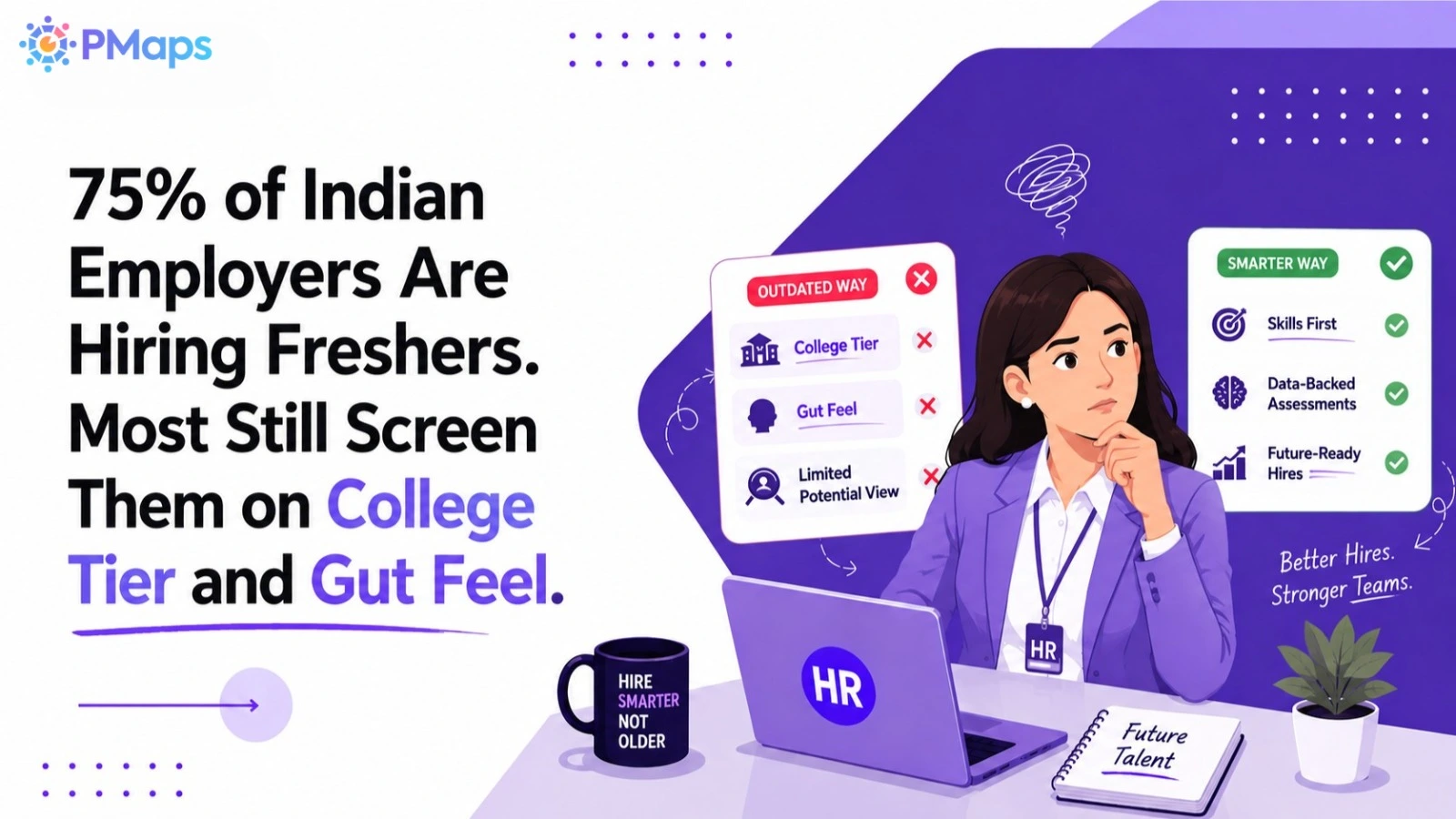
Fresher hiring in India is having a moment, and it's built on a blind spot.
75% of employers intend to hire freshers in the second half of 2026, up from 73% in the first half, according to a TeamLease EdTech report released this month covering 1,097 employers. The demand is broad and strong: e-commerce and tech startups and retail lead at 93% each, manufacturing at 89%, FMCG at 86%. Entry-level hiring is one of the healthiest signals in an otherwise cautious market.
Now the blind spot. A fresher is the single hardest candidate in the world to screen well because a fresher is the one hired with no track record at all. No performance history. No career arc to read. No previous employer whose name means anything. No references that reflect actual work. Every signal that experienced hiring leans on is, by definition, absent.
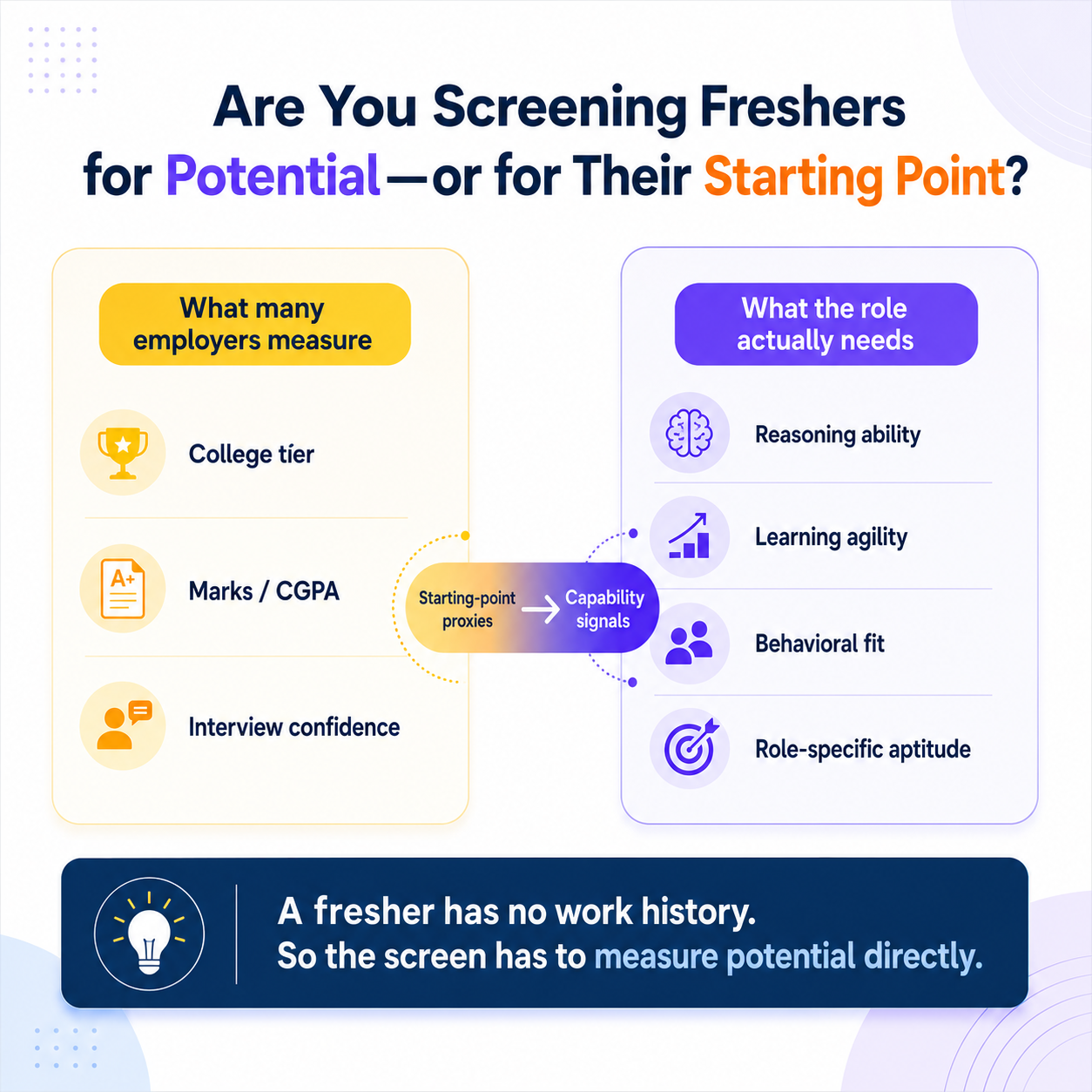
So what do most employers screen freshers on? Three things: which college they attended, their marks, and a short interview. And here's the uncomfortable part in 2026, those are close to the three least predictive signals available. Fresher hiring is booming, and most of it is running on proxies for privilege and polish, at exactly the volume where getting it wrong is most expensive.
Why college tier, marks, and interviews predict so little
Take each of the three in turn, honestly.
College tier predicts access, not performance. A candidate from a top-tier institution cleared a competitive entrance exam at eighteen. That tells you something about their test-taking at eighteen and the resources they had leading up to it. It tells you remarkably little about whether they'll perform in this role at twenty-two. And the India Skills Report 2026 makes the point structurally: national employability has climbed to 56.35%, with strong showings across states, not concentrated in a handful of elite campuses. The talent is broad. A tier filter doesn't find the best fresher it finds the fresher who had the smoothest runway to the entrance exam, and discards a much larger pool of capable people who didn't.
Marks predict conscientiousness, weakly, and little else. Academic scores correlate modestly with diligence, which matters. But the correlation between marks and on-the-job performance is loose for most roles, and it's confounded by everything from board to stream to grading inflation. For a specific role's specific demands reasoning under ambiguity, learning a new system fast, handling a customer, working in a team marks are a blunt and often misleading instrument.
The interview, for a fresher, is noisier than for anyone else. With an experienced hire, at least you can probe real past work. With a fresher, there's no work to probe so the interview collapses into an assessment of confidence, communication, and composure. Those feel like signals. But for a twenty-two-year-old, they correlate heavily with background: with English exposure, with the social capital to perform confidence, with having been coached. You end up rating who presents best, which tracks privilege far more than potential.
Stack the three together and the pattern is stark. You're screening the highest-potential, least-legible talent pool in your funnel almost entirely on proxies for where they started, not signals of where they'll go. And the "skills over degrees" shift that every 2026 report keeps naming isn't a slogan it's the market noticing exactly this gap.
The volume problem makes it worse
Fresher hiring isn't one-at-a-time. Its campus drives, bulk intakes, thousands of applicants for hundreds of seats concentrated in e-commerce, retail, manufacturing, BPO, exactly the sectors the TeamLease data shows leading.
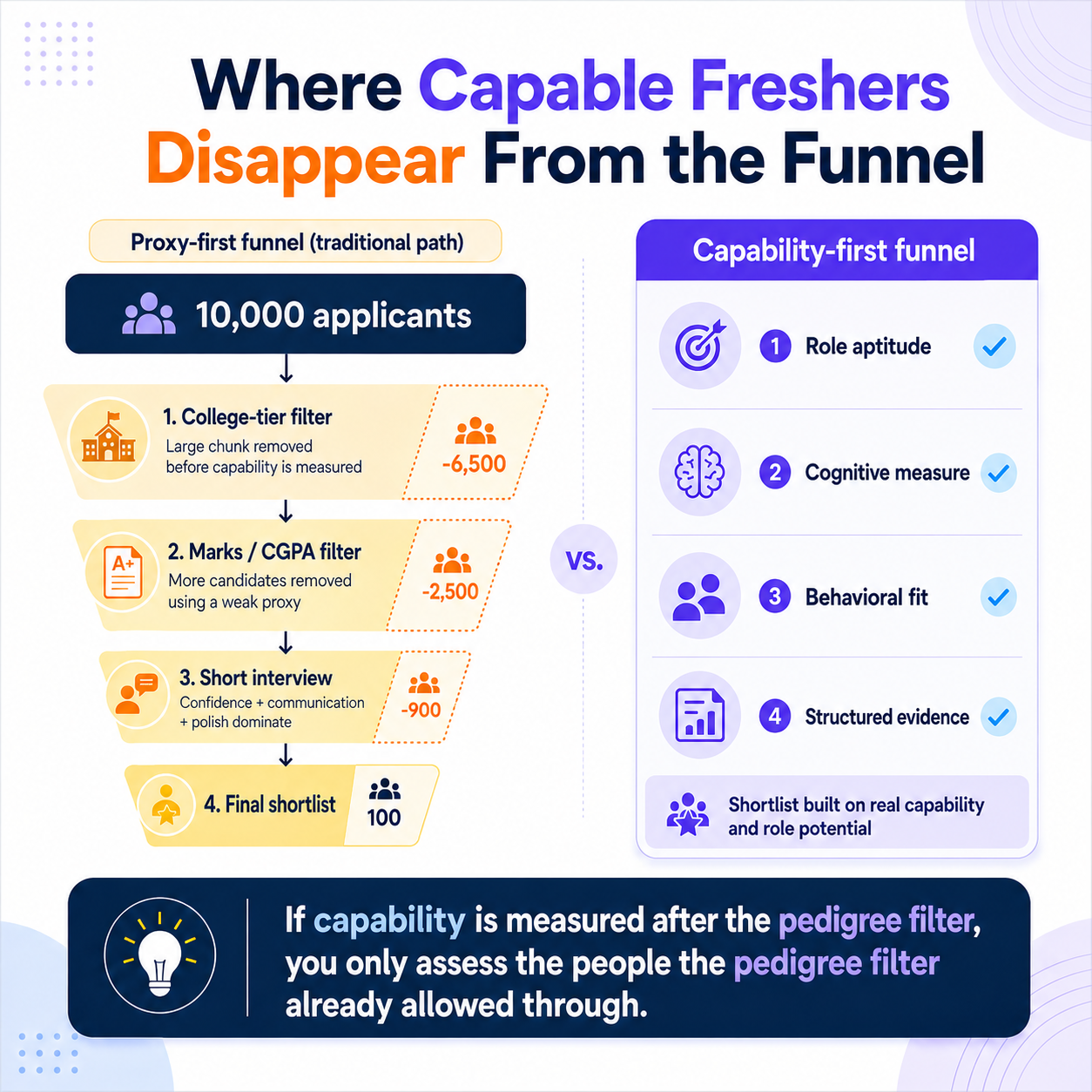
At that volume, interview-based judgment fails twice over. It doesn't scale you cannot interview ten thousand freshers with any consistency, so you fall back on tier filters to cut the pile, baking the privilege proxy in at the top of the funnel. And it isn't consistent the fortieth interview of the day is not the fourth, and the candidate who drew a tired panel at 5 pm is judged differently from the one at 10 am. Volume turns the interview's noise into a systematic bias, not just random error.
This is the setup where an objective, scalable measure isn't a refinement. It's the only thing that can be both fair and feasible across a campus intake.
The Fresher Signal Audit — run it on your biggest campus role
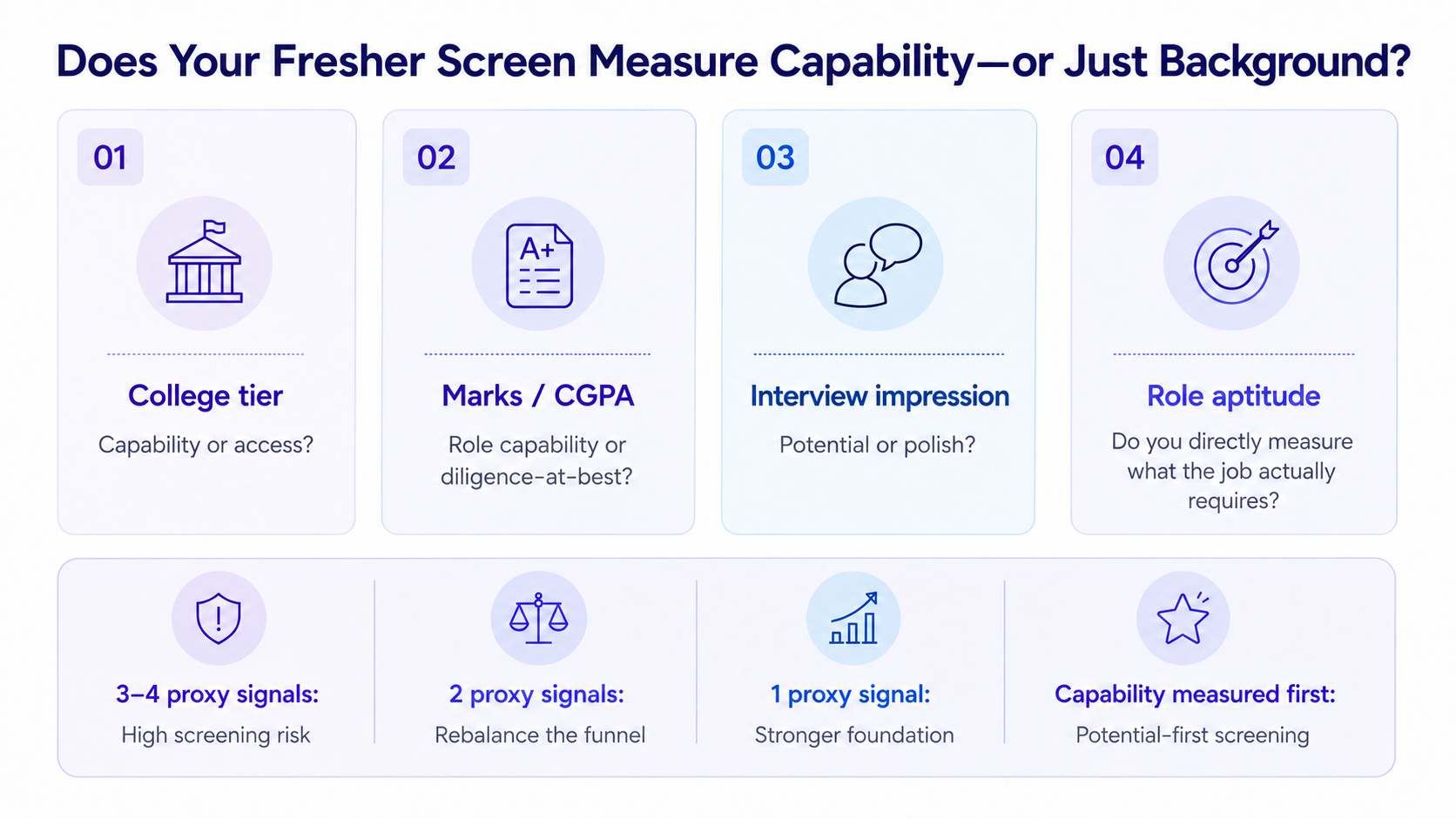
Take the fresher role you hire the most of. List every signal you currently screen on, in order, and mark each one: does it measure the capability the role needs, or does it proxy for the candidate's starting point?
1. College tier — capability, or access?
Be honest about where it sits in your funnel. If it's a hard filter at the top, it's doing the most damage, because it silently removes the largest pool before anything else runs. Mark it: access.
2. Marks / CGPA — capability, or conscientiousness-at-best?
Ask what the role actually demands and whether marks measure it. For most roles, marks are a weak proxy for diligence and nothing more specific. Mark it honestly.
3. Interview impression — capability, or polish?
For a fresher with no work history, name what the interview is actually rating. If the honest answer is confidence and communication, mark it: polish and note that polish correlates with background.
4. Anything that directly measures role aptitude — is it even here?
Look for a signal that measures what the job needs: reasoning, learning agility, behavioral fit, the specific cognitive demands of the role. For most fresher funnels, this line is blank. That blank is the entire finding.
Read your audit. If three of your four signals proxy for starting point and the capability line is empty, you aren't selecting for potential. You're selecting for who arrived at your funnel with the smoothest runway and calling it merit. The fix isn't to lower any bar. It's to add the one signal that measures the thing you actually care about, and to weigh it above the three that don't.
The BPO, retail, and high-volume cut
Two sector realities worth pulling out.
High-volume service sectors BPO, retail, e-commerce operations hire freshers in the largest batches and feel the language dimension hardest. Campus and bulk hiring in India is national and multilingual; a candidate who'll excel serving customers in their working language can be filtered out by an English-only aptitude screen that measures English comfort, not job capability. For these roles, the assessment has to meet the candidate in the language the job is actually done in, or it's measuring the wrong thing at scale.
Manufacturing and technical freshers 89% hiring intent in the data need specific reasoning and aptitude profiles that marks and tier reveal almost nothing about. A direct measure of spatial reasoning, mechanical aptitude, or structured problem-solving predicts far better than which college granted the degree. This is where the tier proxy is not just unfair but actively wrong, routinely passing over the candidate who'd have been strongest on the floor.
What to do in the next 30 days
- Run the audit on your largest campus role this week. Four signals, marked honestly. The blank capability line is the argument; you don't need to make it, just show it.
- Add one objective aptitude measure to one campus drive. Cognitive or behavioral, role-relevant, applied to everyone before the tier filter. Compare who it surfaces against who your tier filter would have advanced. The delta is the talent your old funnel was discarding.
- Move the objective measure earlier than the tier filter. Whatever you measure, if it runs after the college cut, it only ever sees the pre-filtered pool. Put capability first and let it widen the funnel, not just re-rank a narrowed one.
- Localize one high-volume screen. Offer one bulk fresher role's assessment in the working language and on mobile. Measure completion and downstream performance. The lift is real talent. Your format was turning away.
Where PMaps fits
The audit runs on paper. Filling that blank capability line with a measure that actually predicts, applied fairly across thousands of candidates is where it becomes a platform problem, because building assessments that are valid, scalable, and proctored at campus volume is a science.
That's the core of what PMaps does, and freshers are where the logic is cleanest: when there's no past to measure, you have to measure potential directly. PMaps runs cognitive and aptitude assessments that predict role performance, behavioral assessments for fit and working style, all read against role-specific benchmarks validated on real on-the-job outcomes so a strong score means strong for this role, regardless of which college granted the degree. Assessments run in 8+ Indian languages for national, multilingual campus intakes, and proctoring built for volume keeps large drives fair and secure. It's one platform across pre-hire and campus recruitment, so the capability signal runs from the first campus drive onward.
The credibility behind it: 3M+ assessments across 200+ enterprise clients in 7 countries, including Moder, Medusind, and IKS Healthcare high-volume operations that hire early-career talent at scale and need the screen to predict, not just to sort by pedigree.
Improve your hiring odds. Scientifically. Especially for the candidates whose résumé hasn't been written yet.
Book a 30-minute walkthrough bring your biggest campus role, and we'll show you what filling that blank capability line does to the quality, and the fairness, of who you hire.