.webp)
.webp)


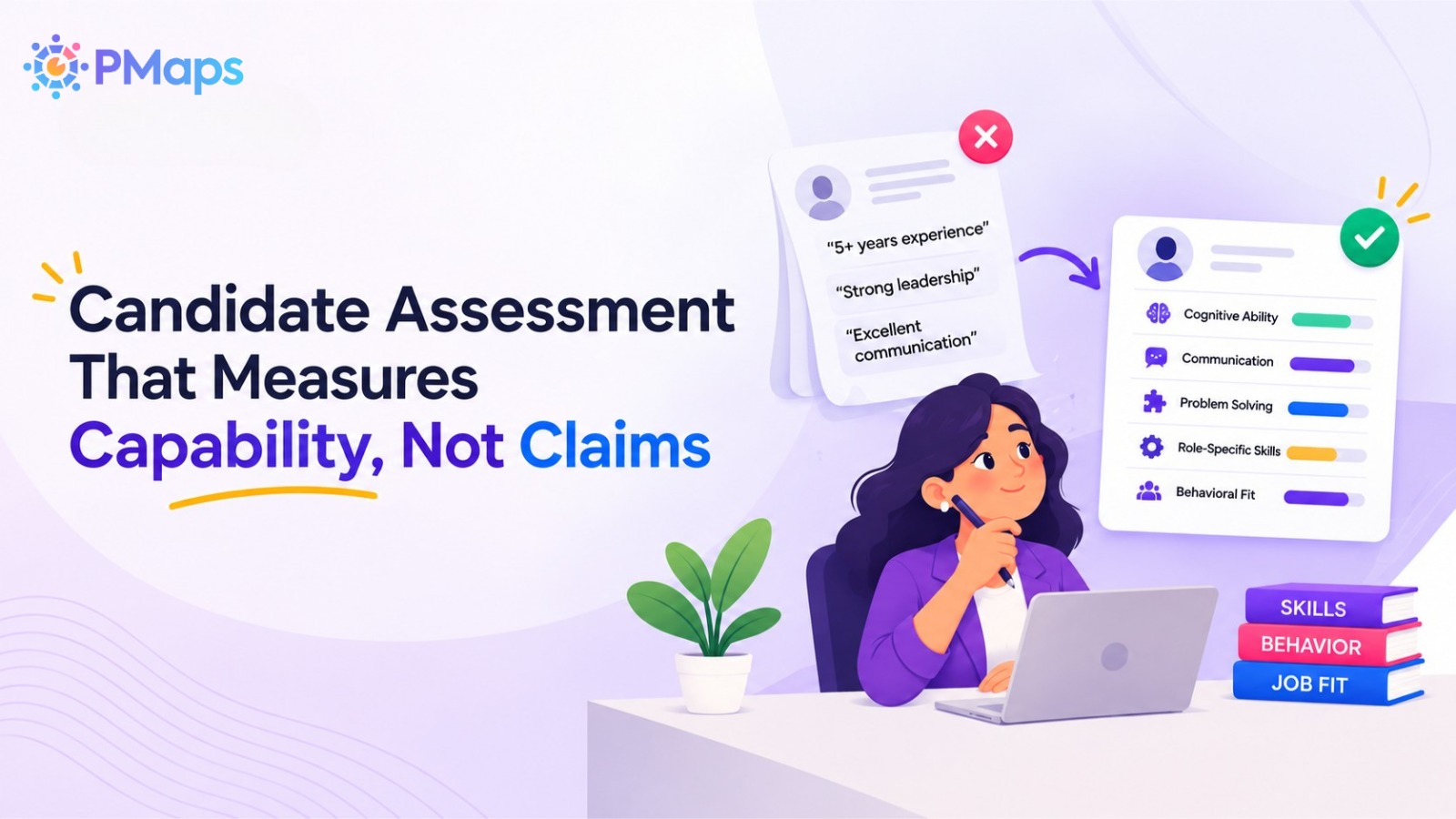
If you are hiring for a role that touches AI an analyst who will work alongside a model, an operations lead reviewing automated output, an engineer building with it your candidate assessment is probably still the one you calibrated last year. The roles changed faster than the instrument did. This page is for the employer running that screen: what to measure for AI-adjacent roles, how to tell capability from familiarity, and the one number in your own ATS that tells you whether your current screen is still working.
What is candidate assessment for AI-adjacent roles?
Candidate assessment for AI-adjacent roles measures what someone can do with a model review its output, catch where it is wrong, decide when not to use it not which tools they have used. It is a task-based measurement against a role benchmark, not a self-reported proficiency list, because the list is what an inflated pool is optimized to satisfy.
The distinction matters more this year than last, and the reason is in the market data rather than in anything about AI itself.
The number that changed the problem - AI and machine-learning roles in India grew 20% year-on-year in September 2026, while white-collar hiring overall grew 2%. Both figures come from the same dataset, counting the same unit: job postings. One category of role is being advertised ten times faster than the market containing it.
Source: Naukri JobSpeak September 2026 index, reported 2 October 2026.
Why did your candidate pool change without a hiring surge?
Because posting growth and capability growth move at different speeds. The number of people who can do AI-adjacent work grows at the pace of training and experience, which is slow. The number who present as able to do it grows at the pace of the label, which is immediate. The pool does not shrink. It widens, and its composition shifts.
That is a specific, checkable claim about your own funnel, and it has a consequence that most skills assessment tools are not set up to catch. A screen built on stated proficiency sorts the widened pool exactly as well as it sorted the old one — which is to say it keeps admitting at the same rate while the share of people who moved toward the label rises underneath it. Nothing in the process reports this. The pass rate looks normal because the screen is measuring the thing that inflated.
The composition change is concentrated, too. It is not spread evenly across your requisitions; it sits in the subset where demand ran ten times ahead of the market. Those are usually the requisitions with the most business attention on them.
How do you separate task capability from tool familiarity?
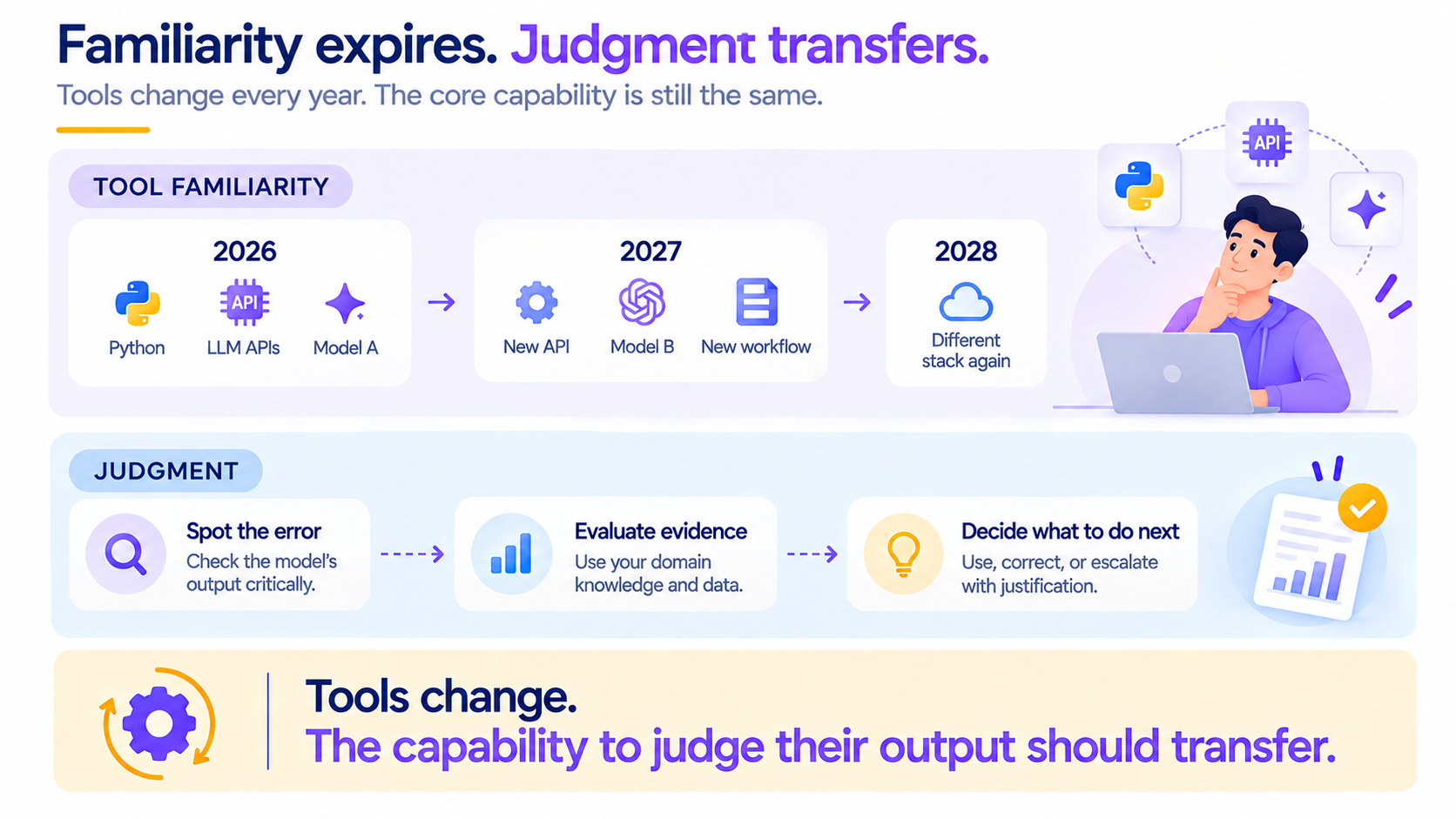
Ask for a judgment, not a recall. Tool familiarity answers which tools someone has used. Task capability answers a harder question: here is a model output on data like ours, what is wrong with it and what would you do next? The second cannot be satisfied by exposure or a certificate, which is why it still separates a widened pool.
In practice this is a change of unit. A pre employment assessment that lists Python, prompt engineering and three model APIs is measuring inventory. One that puts a flawed output in front of the candidate and scores their reasoning about it is measuring work.
The second takes no longer to administer and is considerably harder to game.
The same logic applies to the interview stage. A structured conversation that probes how someone handled a case where the model was confidently wrong tells you more than any tool inventory. PMaps runs this as an AI voice interviewer for volume roles, where the structure holds across thousands of candidates rather than drifting panel to panel.
Which signals should a first screen actually measure?
Four, for AI-adjacent roles: the judgment to evaluate a model's output on your own data; the behavioral disposition to escalate rather than accept a confident-sounding answer; the cognitive ability to work in a domain where the tool changes every quarter; and role-specific task performance scored against a benchmark rather than in the abstract.
What is deliberately not on that list is tool coverage. Breadth of tools used is the easiest signal to collect, the easiest to inflate, and the fastest to expire the stack a candidate learned eighteen months ago may not be the one you run next year. Measuring it feels rigorous and tells you almost nothing about the first week of work.
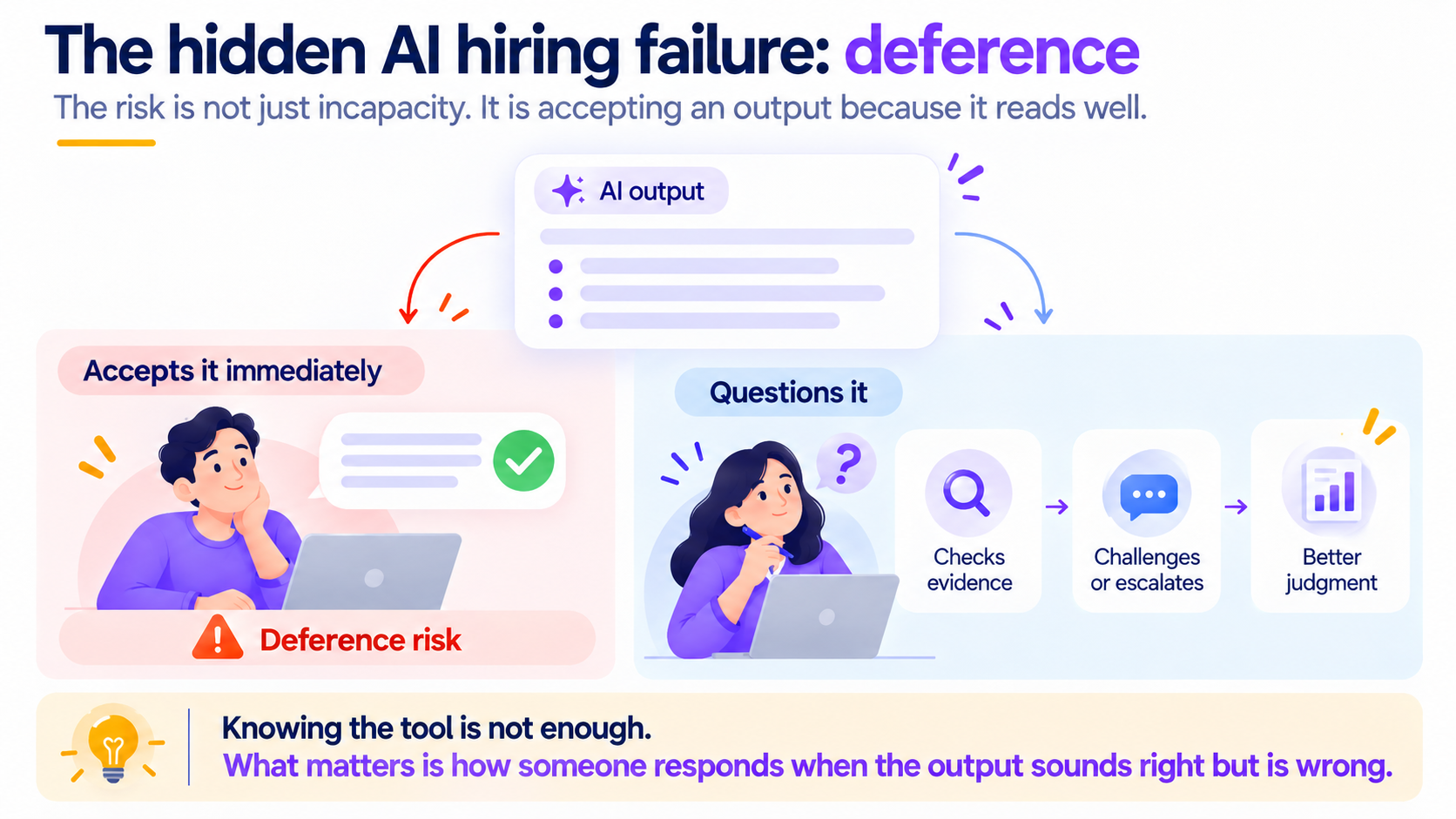
Most skills assessment tools will give you the first and third of those four. The behavioral signal is the one that gets skipped, and for AI-adjacent work it is doing more load-bearing work than usual, because the failure mode in these roles is rarely incapacity. It is deference accepting an output because it reads well.
How do you read a flat pass rate on a rising pool?
A flat pass rate on a rising application volume means your screen is admitting the inflation at the old rate. If applications for AI-adjacent requisitions rose sharply year-on-year and the share clearing the first screen held steady, the screen is not discriminating on the new population. A working screen shows a falling pass rate as the pool widens.
This is the diagnostic worth running this week, and it needs nothing bought. Pull two numbers from your ATS: the share of candidates who cleared the first screen for AI-adjacent requisitions this quarter, and the same share for the same quarter last year. Then pull application volume for both.
The first row is the common one, and it is the finding that produces an argument a business head will act on, because it is built from their own number.
What does a defensible AI-adjacent screen look like?
It starts from the task, not the tool. For each AI-adjacent requisition, write one sentence on what the hire must be able to do in week one and one sentence on what would prove it. Build the screen against those two sentences, score it against a role benchmark, and validate the benchmark against how people actually performed in the role.
In practice that is three steps, and none of them requires a platform to begin.
1. Split the requisitions. Mark every live requisition as AI-adjacent or not the description names AI, machine learning, automation, or working alongside a model. Count them. The AI-adjacent share is usually larger than assumed, because the language has spread into analyst, operations, customer service and content roles that are not engineering roles.
2. Write the task and the artifact. For each AI-adjacent requisition, one sentence on what the hire must do in week one, and one sentence on what would prove they can. "Can review a model's output on our own data and say where it is wrong" is a task. "Proficient in Python and LLM APIs" is an inventory.
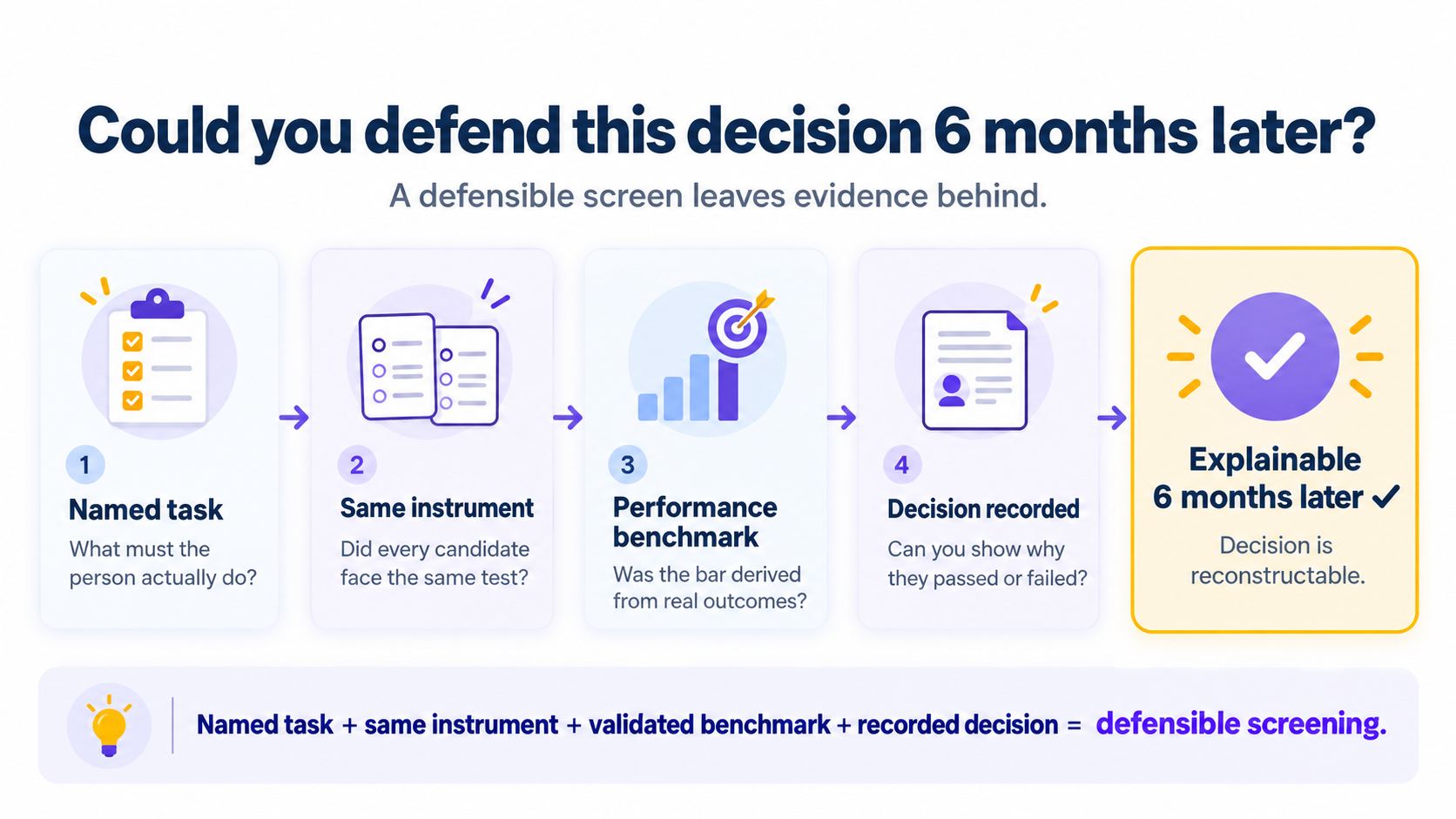
3. Score against a benchmark, not a panel. Set the threshold from how people actually performed in the role, administer the same instrument to every candidate, and record why each decision was made.
Defensible also means evidenced. A selection decision you cannot show your working on is an organizational risk, and it is increasingly one a CHRO is asked about directly. Three things make a screen defensible under that question: the measure is tied to a named task, the threshold is set from performance data rather than intuition, and the same instrument was administered to every candidate.
This is also where most talent assessment tools are judged incorrectly. The question is not how many test types a platform offers. It is whether its scores have been validated against on-the-job outcomes for roles like yours and whether you can reconstruct, six months later, why a particular candidate was screened out. Bias is reduced by structure and validation, not removed by them; any platform claiming otherwise is overclaiming.
How should you assess internal candidates for AI work?
Often it is the cheaper answer. A ten-to-one demand differential makes external AI-adjacent talent expensive and slow to secure, while the adaptability you need is often already on your payroll and unmeasured. Assess internal candidates for AI resilience how readily someone already doing the work adapts to working alongside a model before filling the requisition from outside.
The measurement is different from the pre-hire one in an important way: you already hold performance data on these people. That makes the benchmark tighter, because you are not predicting from a cold start. PMaps measures this through career elevation assessments, which score existing employees against role benchmarks for the role they could move into rather than the one they hold.
The reason this gets skipped is not cost. It is that nobody has measured the bench for anything except the job it already holds.
Where PMaps fits
PMaps is an AI-powered, bias-reducing, multi-lingual talent assessment platform built to improve hiring odds scientifically. Since 2014 12 years PMaps has completed 4M+ assessments across cognitive, behavioral and psychometric measures plus AI video and voice interviews, scored against validated role benchmarks and real on-the-job performance outcomes. For AI-adjacent roles, Test Creator builds the task-based screen described above, and career elevation assessments measure AI resilience in the people already on your payroll. PMaps is trusted by 200+ enterprise clients across 7 countries and is delivered in 8+ Indian languages for frontline roles.
See how PMaps measures AI-adjacent roles see what a task-based screen and a validated role benchmark look like for a role you are hiring for now. If you would rather talk it through, book a demo: 30 minutes on one AI-adjacent requisition, what it actually requires, and what a defensible screen for it looks like. Bring the requisition.