.webp)
.webp)

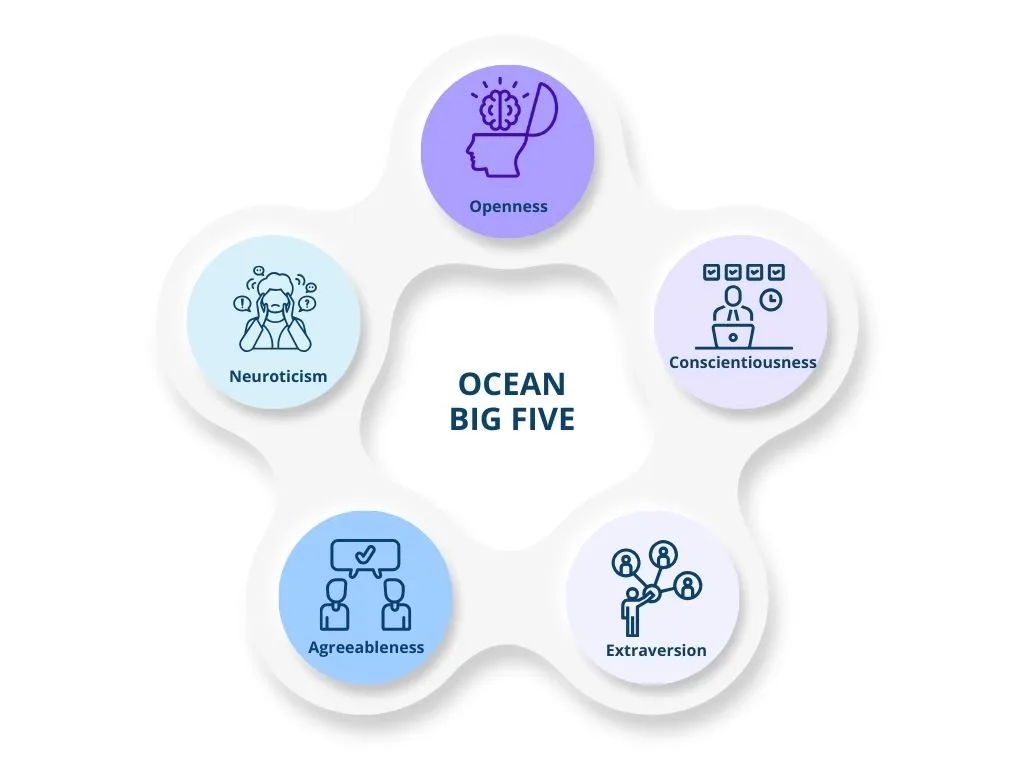
If you ask, what is the Big 5 OCEAN model, it refers to five broad personality dimensions or behavioral aspects that remain stable over time and influence decision-making, collaboration, and performance. These traits are relatively stable across a person’s lifetime and are shaped by both genetics and environment, with heritability estimates ranging between 30% and 60%.
Unlike surface-level approaches, the OCEAN/CANOE model focuses on observable patterns rather than subjective opinions. It provides a common language for discussing personality across hiring teams. Let us examine these traits in more detail.
What are the big 5 traits in the OCEAN framework?
The OCEAN big 5 personality traits, developed by researchers such as Paul Costa and Robert McCrae, include measurable traits within openness, conscientiousness, extraversion, agreeableness, and emotional stability. The five factors explain how individuals think, behave, and respond across workplace situations, thereby supporting structured, consistent hiring decisions.
Origin and Evolution of the Five-Factor Model
The Big Five personality model evolved from linguistic research by Gordon Allport and Raymond Cattell, later structured into five dimensions and popularized as the OCEAN acronym, with extensions such as the NEO-PI enabling measurement. Today, platforms like PMaps translate these insights into role-specific hiring decisions. Let's understand these five dimensions more closely.
Trait 1: Openness to Experience
Openness personality traits reflects how individuals approach change, ambiguity, and new ideas. It influences learning agility, innovation, and adaptability, making it relevant for roles that require exploration, problem-solving, and working in evolving business environments.
Table
Profiles Requiring High Openness
- Product managers handling evolving customer needs and market shifts
- Marketing strategists designing creative campaigns and experimentation-led initiatives
- Consultants solving unstructured business problems across industries
- Innovation and R&D roles working on new product or process development
Trait 2: Conscientiousness
Conscientiousness personality traits reflects execution discipline, reliability, and attention to detail. It determines how consistently individuals plan, track, and deliver work, thereby directly influencing productivity, accountability, and performance in structured, deadline-driven roles.
Table:
Profiles Requiring High Extraversion
- Sales professionals engaging clients and driving revenue conversations
- Business development managers building partnerships and networks
- HR business partners managing stakeholder relationships
- Customer success roles handling ongoing client interactions
Trait 4: Agreeableness
Agreeableness reflects how individuals manage relationships, collaboration, and conflict. It influences trust-building, teamwork, and interpersonal alignment, making it critical for roles that require coordination, empathy, and stakeholder management.
Table
Profiles Requiring High Agreeableness
- HR professionals managing employee relations and engagement
- Team leaders are responsible for collaboration and cohesion
- Customer service roles handling sensitive interactions
- Cross-functional coordinators aligning multiple stakeholders
Trait 5: Neuroticism (Emotional Stability)
Neuroticism personality traits reflects emotional response to stress, pressure, and uncertainty. It determines how individuals handle setbacks, maintain focus, and perform in demanding environments that require stability and resilience.
Profiles Requiring Low Neuroticism (High Stability)
- Customer support roles managing difficult or escalated interactions
- Leadership roles handling uncertainty and high-stakes decisions
- Operations roles managing continuous pressure and deadlines
- Crisis management or frontline roles requiring emotional control
Assessing Big 5 Personality Traits for Hiring and Talent Management
The Big 5 personality model provides a structured framework for evaluating behavioural fit across roles and teams. It connects personality patterns with job expectations, improving hiring accuracy and long-term workforce planning.
Organizations can use these behavioural insights to move beyond resume-based screening and build more consistent hiring decisions. A structured personality assessment for hiring approach helps translate these patterns into measurable and comparable outcomes.
Understanding Candidate on the OCEAN Personality Framework
Evaluating candidates through openness, conscientiousness, and emotional stability helps identify how they approach learning, execution, and pressure, creating a clearer picture of behavioural fit before hiring decisions are made.
The benefits of using big 5 tests for leadership:
- Clarifies learning agility by assessing openness toward new ideas and the ability to adapt across unfamiliar and evolving role requirements.
- Evaluates execution reliability through conscientiousness, ensuring candidates can plan, prioritize, and consistently deliver expected outcomes.
- Assesses stress response using emotional stability to determine how candidates handle pressure, ambiguity, and demanding work environments.
- Improves behavioural predictability by combining multiple traits into a structured and comparable evaluation framework.
Team Compatibility with the Five Factor Personality Model
Balancing extraversion, agreeableness, and conscientiousness within teams helps improve communication, reduce conflict, and maintain execution consistency across functions, especially in environments requiring collaboration and shared accountability.
Advantages of the OCEAN Personality test for team dynamics:
- Improves communication flow by aligning extraversion levels with role requirements for interaction, visibility, and stakeholder engagement.
- Reduces interpersonal conflict by understanding agreeableness and its impact on collaboration, negotiation, and team harmony.
- Strengthens accountability within teams by ensuring conscientiousness aligns with task ownership and delivery expectations.
- Enables structured team composition by combining complementary behavioural traits across roles and responsibilities.
5 Big Personality Traits of Leaders
Leadership effectiveness depends on emotional stability, conscientiousness, and openness, which influence decision-making under pressure, execution discipline, and adaptability in uncertain business environments requiring long-term strategic thinking.
- Strengthens decision-making under pressure by evaluating emotional stability and the ability to remain composed in high-stakes situations.
- Improves execution discipline through conscientiousness, ensuring leaders maintain accountability, structure, and consistency across teams.
- Enhances adaptability by assessing openness, allowing leaders to respond effectively to change and evolving business conditions.
- Supports long-term leadership success by aligning personality traits with strategic thinking and organizational expectations.
Administering and Interpreting the Big Five Personality Traits Test
Using the Big Five personality traits test in hiring requires more than completion and scoring. The value lies in how traits are selected, interpreted, and linked to role expectations, team needs, and broader talent decisions.
Select a Validated Assessment Tool
Start with a scientifically validated tool built on the Big Five framework. A reliable Big 5 assessment for hiring improves consistency, reduces interpretive errors, and provides hiring teams with a structured basis for discussing behavioural patterns across candidates.
- Example: Use a single tool for all sales applicants to compare traits on a common scale.
- Example: Avoid mixing self-made questionnaires with validated Big Five measures.
Choose Benchmarking your Traits
Trait interpretation becomes more useful when linked to role requirements. Benchmarking helps teams decide which traits matter more for success, whether the role demands adaptability, precision, collaboration, or emotional control.
- Example: A compliance role may need higher conscientiousness and lower risk-taking.
- Example: A consulting role may need higher openness and emotional stability.
Pair Big 5 Assessment with Domain-Specific Tests
Personality insights work best when viewed alongside job-relevant skills. Pairing the Big 5 assessment with domain-specific tests gives a more complete picture of whether a candidate can both do the work and succeed in the environment.
- Example: Pair personality traits with Excel and analytics tests for analyst hiring.
- Example: Combine trait insights with voice or communication tests for customer-facing roles.
Interpret Test Results
Results should be read as behavioural indicators, not final judgments. The purpose is to understand likely work patterns, compare fit across candidates, and support balanced decisions when combined with interviews, skills, and role context.
- Example: High extraversion may suit sales, but not automatically every leadership role.
- Example: Low openness may fit process-driven work better than change-heavy roles.
Conclusion
The Big 5 personality model provides HR teams with a practical way to understand behaviour beyond resumes and interviews. When traits are read in role context, hiring decisions become more consistent, team fit becomes clearer, and leadership planning gains stronger direction. For role-ready assessment support, contact 8591320212 or assessment@pmaps.in