.webp)
.webp)


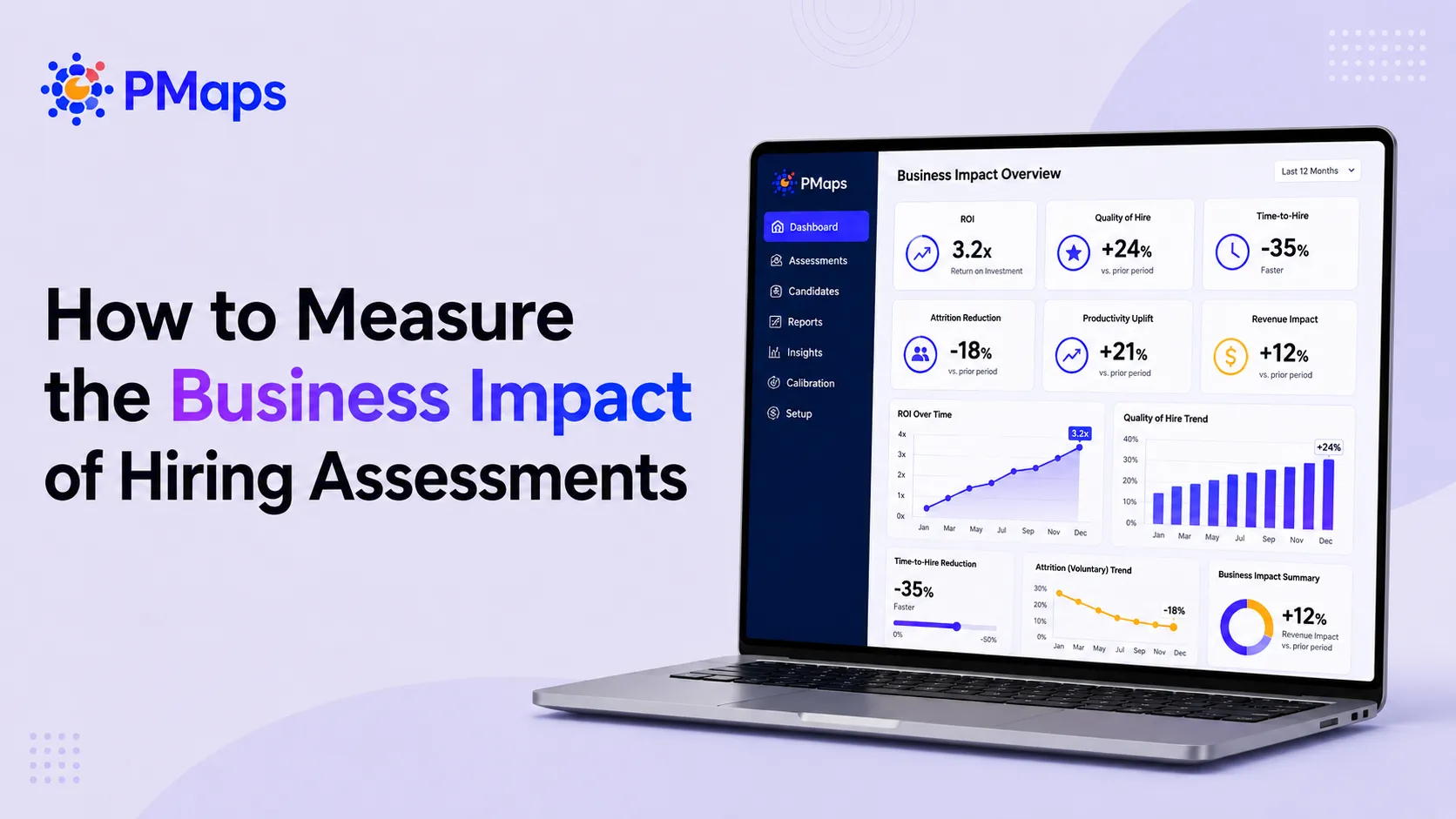
Most companies run a hiring assessment for years without ever checking the one thing that matters: do the scores predict who actually performs? A test can look rigorous, feel rigorous, and still have no measurable link to on-the-job results. The only way to know is to validate it against your own business outcomes — and that's a process you can run in-house.
This guide walks through a six-step framework to do exactly that, the same loop PMaps used to validate a tele-sales assessment across 1,118 hires at a leading BFSI lender. It's a quarter of focused work, not a year-long research project.
In short: To validate a hiring assessment, pick one objective business outcome (like sales or retention), pull a cohort of past hires whose results you already know, split them into high and low performers, check whether their pre-hire scores separated the two groups, set your cut-scores on the competencies that did the separating, and re-validate every cycle. If higher scorers performed better, the assessment is valid for that role.
What "validating against business outcomes" actually means
Validation is not asking candidates if the test felt fair, and it is not trusting a vendor's global benchmark. Those are face validity and reputation — useful, but not proof for your roles.
Validating against business outcomes means establishing predictive validity (or its faster cousin, concurrent validity): a measurable link between an assessment score and a real performance result inside your organization. The score is the prediction; the business outcome is the truth you check it against. When the two move together — higher scorers deliver better results — the assessment earns the right to gate your hiring.
Two study designs get you there:
- Predictive design: score candidates now, hire across the range, and measure outcomes later (say, 6–12 months on). Cleanest evidence, but slower.
- Concurrent design: score a cohort of current employees whose performance you already know, and check whether scores track results. Faster, because you don't wait for outcomes — and the right choice when you already have an assessed population with history.
Both answer the same question: does the score predict the result?
The 6-step validation framework
Step 1 — Define one objective outcome
Pick a single, objective measure of on-the-job success your business already tracks — sales disbursed, revenue, retention, conversion, CSAT, error rate. Avoid subjective manager ratings; they smuggle in bias and make the validation unfalsifiable. This metric becomes the ground truth everything else is checked against.
In the BFSI study, the outcome was cumulative disbursement — the objective measure of what a tele-sales agent's role exists to produce. One metric, no opinions.
Output: one agreed outcome metric and a threshold that separates "high" from "low."
Step 2 — Assemble a cohort whose outcomes you know
Pull a population of hires you can tie to that outcome. Bigger and more balanced is better: a near-even split between high and low performers is the strongest possible test bed, because an assessment that cleanly separates two equal-sized groups is showing real signal, not an artifact of one group dominating the sample.
The study used 1,118 hires measured over a full 12-month window, splitting almost evenly — 51% high performers, 49% low. That balance is what made the result trustworthy.
Output: a labeled dataset of hires, each tagged high or low on the outcome.
Step 3 — Bring in the pre-hire scores and split the groups
Now line up each person's assessment score (recorded before they were hired) against which group they landed in. The question is blunt: did the people who became high performers score higher at the pre-hire stage? Compare section by section, not just on the total score — you want to see where the separation comes from.
Across all four sections of the BFSI assessment, the high-performer group had recorded higher pre-hire scores. The signal held across the board, not on a lucky subset.
Output: a high-vs-low score comparison for every section of the assessment.
Step 4 — Find the competencies that do the predicting
Not every section pulls its weight. Some separate high from low performers sharply; others barely move. Identify which competencies carry the predictive signal — and be ready for the answer to surprise you. For relationship-driven sales roles, behavioral fit usually beats raw aptitude.
This is also where factor loading matters: the share of the final score each section actually drives. A section can take 30% of test time and contribute almost nothing to the prediction. Validation exposes that imbalance so you can fix it.
In the study, two competencies — behavioral fit and attention to detail — carried 84% of the predictive weight. A spoken-language section consumed roughly a third of test time for 1% of the weight: a clear candidate to streamline.
Output: a ranked view of which competencies predict and which are dead weight.
Step 5 — Set cut-scores on what predicts
Now calibrate the gate. Set the passing bar primarily on the competencies that discriminate, weighted by how much they predict — not on equal weighting across every section. Treat low-signal sections as developmental inputs for onboarding, not as reasons to reject. A passing bar built this way raises the floor on every hire that follows.
Once you've identified the competencies that genuinely predict performance, the next challenge is deciding where to draw the passing line. Setting the bar too high can shrink your talent pool unnecessarily, while setting it too low weakens the assessment's predictive power A structured approach to set your cut-scores helps you balance hiring volume with quality, ensuring your assessment screens out the right candidates instead of relying on arbitrary percentage thresholds.
Output: validated cut-scores you can deploy at the top of the funnel, before interviews.
Step 6 — Protect the signal and re-validate every cycle
A score is only valid if it was honestly earned, so enforce proctoring — integrity flags quietly corrode any validity claim built on top of them. Then re-check the score-to-outcome link each hiring cycle. Roles drift, markets shift, and a gate that was sharp last year can dull. When the role changes, your cut-scores should change with it, and the loop returns to Step 1.
Output: a re-validated model that stays honest over time.
A validated assessment becomes a sourcing lens, too
There's a bonus once your assessment is validated: its high-performer classification becomes a clean way to grade your sources. Tag every hire by channel and track high-performer yield per vendor or center. You'll often find quality varies far more by source than you expected — and rebalancing intake toward proven channels lifts hire quality before you change a single test question.
In the study, high-performer yield ranged from 40% to 75% across sourcing centers — the best center yielded nearly double the weakest.
Common validation mistakes to avoid
- Validating on a manager rating. Subjective scores bias the whole study. Use an objective business metric.
- Equal-weighting every section. If you haven't measured factor loading, you're probably gating on the wrong things.
- Validating once and walking away. A model decays. Re-validate each cycle.
- Ignoring integrity. Scores from un-proctored or flagged assessments can't be trusted, no matter how strong the correlation looks.
- Too small or too lopsided a sample. A near-even high/low split with enough volume is what makes the signal credible.
How often should you re-validate?
At minimum once per hiring cycle, or whenever the role, market, or candidate pool shifts noticeably. Re-estimating which competencies predict on each fresh cohort keeps the model current — the gate stays trustworthy instead of slowly drifting out of alignment with the job.
See the framework in action
PMaps ran this exact loop for a leading BFSI lender: one objective outcome, 1,118 hires, a validated gate, and a clear read on where to source and where to tighten. Read the full predictive validity study to see each step with real numbers.
→ Read the predictive validity case study
Why PMaps
PMaps is an AI-powered talent assessment platform that helps enterprises improve their hiring odds — scientifically. Scores are validated against real on-the-job performance, so you hire for outcomes instead of gut feel.
Want to validate a hiring gate for your priority roles? Book a 30-minute walkthrough and we'll map the loop to your goals.