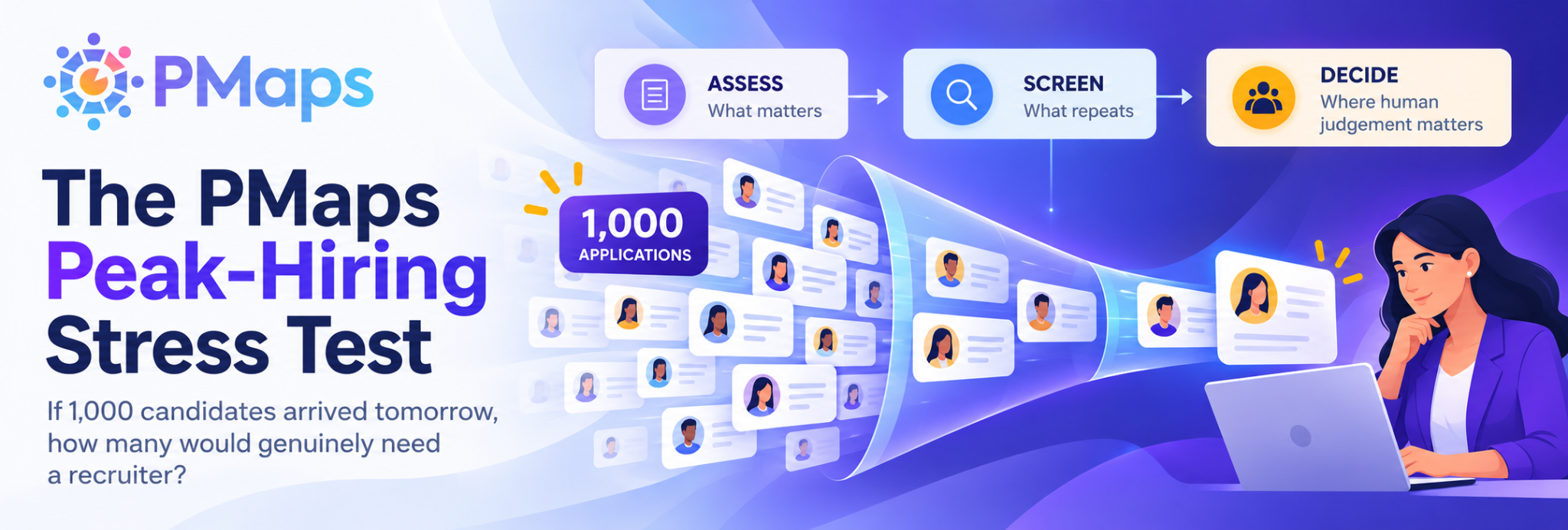
Peak hiring does not create broken processes. It exposes them.
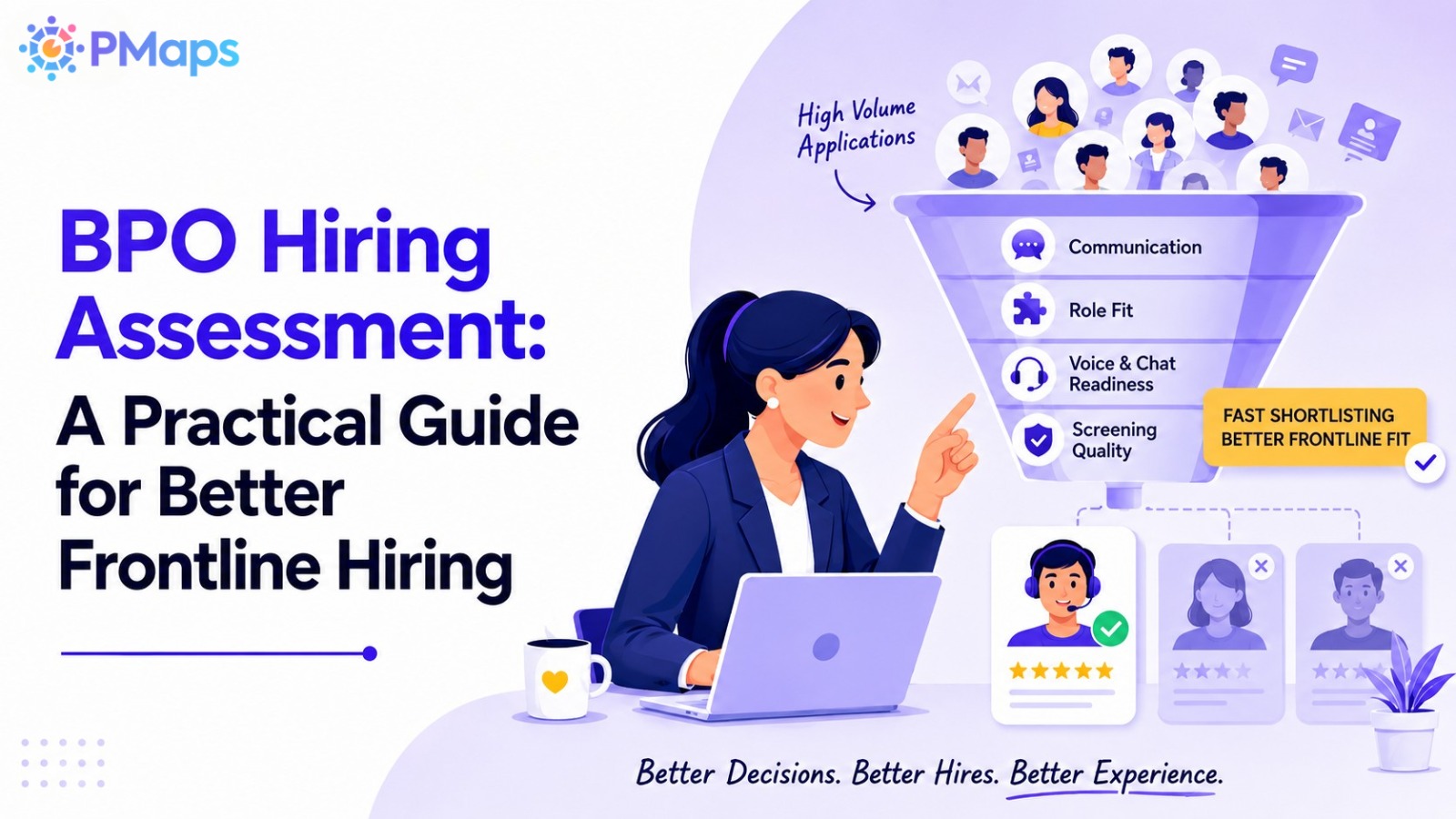
When hiring volume suddenly doubles, attracting candidates is rarely the hardest part. The pressure starts once applications enter the funnel: repetitive screening calls, eligibility checks, interview scheduling, multi-location coordination and constant pressure to close positions faster.
As volume rises, inconsistent screening decisions, slow candidate responses and unnecessary recruiter involvement create bottlenecks. Adding more recruiters, or more automation, doesn't automatically fix them. The smarter approach starts by separating the work that needs human judgment from the work that structured assessment and screening can handle.
Before your next hiring campaign, ask one question: What evidence should we collect before a recruiter spends time?
Hiring more candidates shouldn't automatically mean more manual work. Before scaling high-volume hiring, organizations need to examine how candidate screening, assessment and final decisions work today. The PMaps Peak-Hiring Stress Test uses three practical questions to find where your process will slow down, where structured screening can improve consistency, and where human judgment adds the most value.
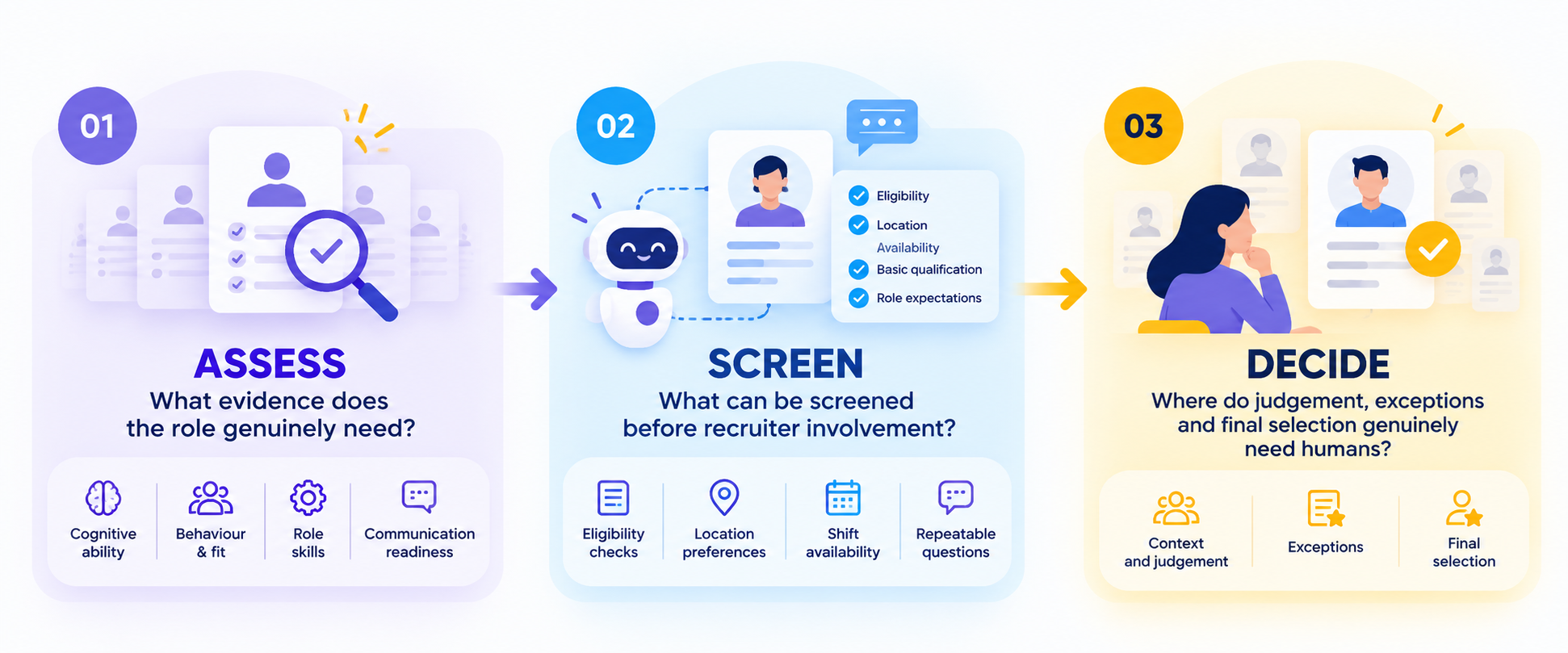
What evidence does the role genuinely need?
Not every role needs the same criteria. Identify the skills, cognitive abilities, behaviors, communication capabilities and job-specific competencies that matter before you select an assessment. The aim is relevant evidence of suitability, not reliance on resumes or interview impressions.
Which checks and conversations are repeatable?
List the questions recruiters ask over and over: eligibility, location preference, shift availability, basic qualifications and role expectations. Decide which of these a consistent screening step can handle before a recruiter is involved, so your team can focus on candidates who need deeper evaluation.
Where do judgement, exceptions and final selection genuinely need humans?
Technology can organize evidence and handle repeatable tasks. Contextual interpretation, complex situations and final hiring decisions still need people. Recruiters and hiring managers should spend their time on meaningful evidence, exceptions and informed decisions, not on repeating administrative screening. More technology is not automatically better. Better evidence at the right stage is.
The principle is simple: ASSESS what matters → SCREEN what repeats → DECIDE where judgement matters.
Eligibility. Location. Availability. Shift comfort. Basic qualifications. Repetitive first-round questions.
These checks are essential. But should every candidate need a recruiter-led conversation to complete them? In high-volume hiring, recruiters often ask the same preliminary questions across hundreds of applications. That slows candidate progression and leaves less time for the interviews that matter.
PMaps AI Voice Interviewer runs a structured first-level conversation before recruiter involvement. It collects consistent information on eligibility, availability and role requirements, so recruiters can see which applicants should progress. For distributed teams, this can include selected Indian-language and natural mixed-language conversations, making AI recruitment screening workable for multilingual hiring across locations.
The goal isn't to remove recruiters. It's to remove the repetition, so recruiters can focus on suitability, exceptions and the decisions that need human judgment
Automate what is repeatable. Keep people where judgement matters.
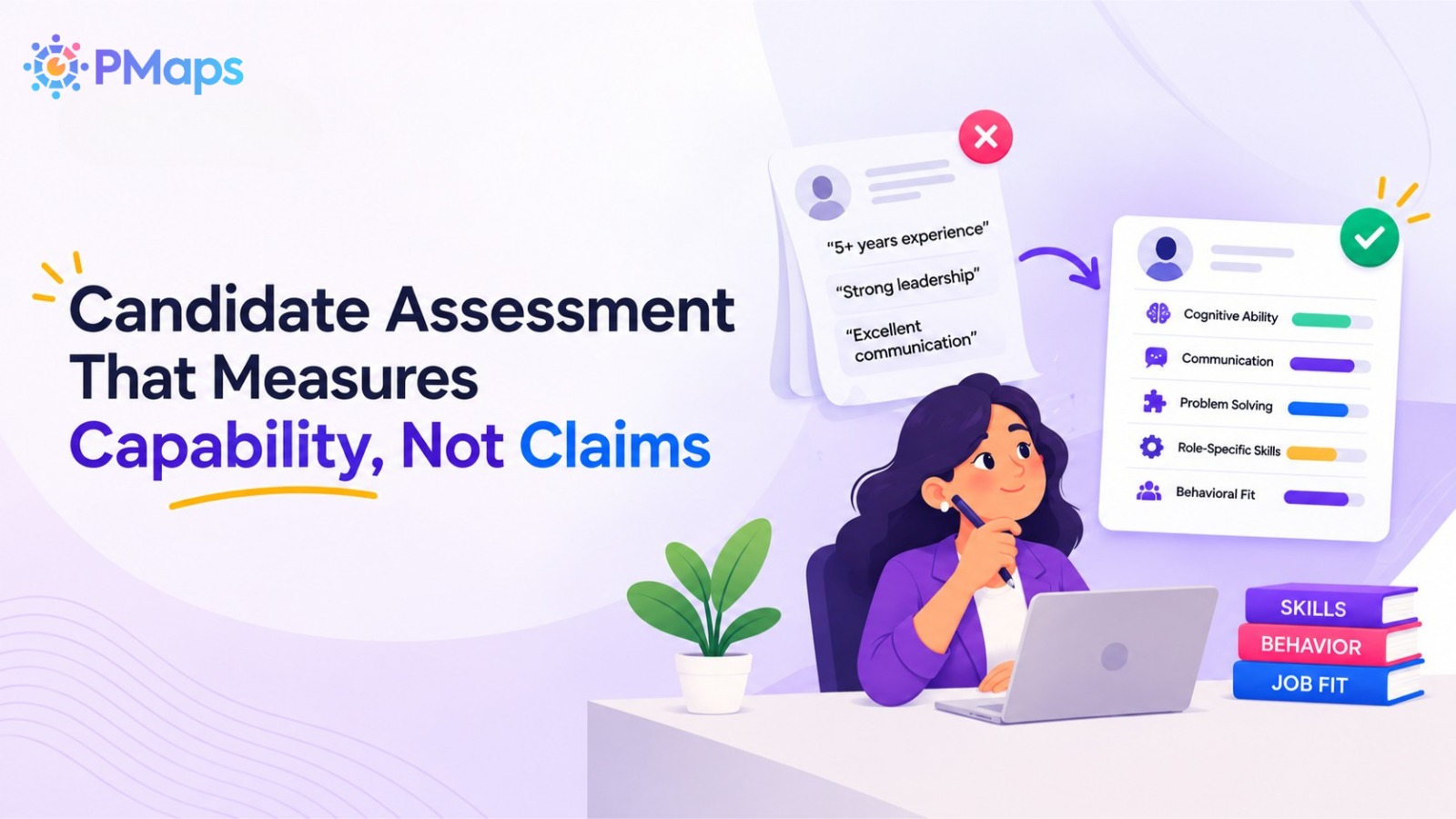
A Customer Service Executive, Sales Officer and Team Leader may all enter the same hiring funnel, but they should not be evaluated using identical assessment criteria. A customer-facing role may prioritize communication and listening. A sales role may need persuasion, situational judgment and customer handling. A leadership role may demand stronger decision-making, problem-solving and behavioral competencies.
Role-based assessment evaluates the capabilities that matter for job performance. Depending on the position, that evidence may include cognitive ability, behavioral traits, domain knowledge, technical skills, situational judgment and communication readiness. For communication-heavy roles, a voice assessment adds another layer of evidence before live interviews. PMaps eVA (English Voice and Accent Assessment) shows whether a candidate can hear, understand and respond clearly enough for the role, instead of relying on resume claims or conversational confidence.
Together, these give structured communication assessment evidence for voice-based and customer-facing roles. Results inform recruiter judgment; they don't replace it.
The useful question is not “Which test should we give?” It is “What do we need to know before we spend human interview time?”
A resume shows qualifications and experience. An assessment gives structured evidence of specific capabilities. Neither always shows how a candidate explains an idea, responds to a practical situation or approaches an unfamiliar problem.
For roles involving customers, problem-solving or stakeholder communication, those capabilities shape the hiring decision. Recruiters need to see how candidates explain their thinking before committing to lengthy interviews.
PMaps Video Interview adds a structured, asynchronous interview stage. Candidates answer predefined, role-specific questions on video, at a time that suits them, without a live recruiter conversation. Recruiters and hiring managers review the responses to see how each candidate communicates, articulates ideas and approaches practical scenarios.
For distributed or high-volume teams, this collects comparable interview evidence before any live discussion is scheduled. Standardized questions also reduce variation in what candidates are asked in early rounds. Responses should be judged against clearly defined, job-related criteria, not presentation style or appearance. Human reviewers interpret the responses, consider context and decide who progresses.
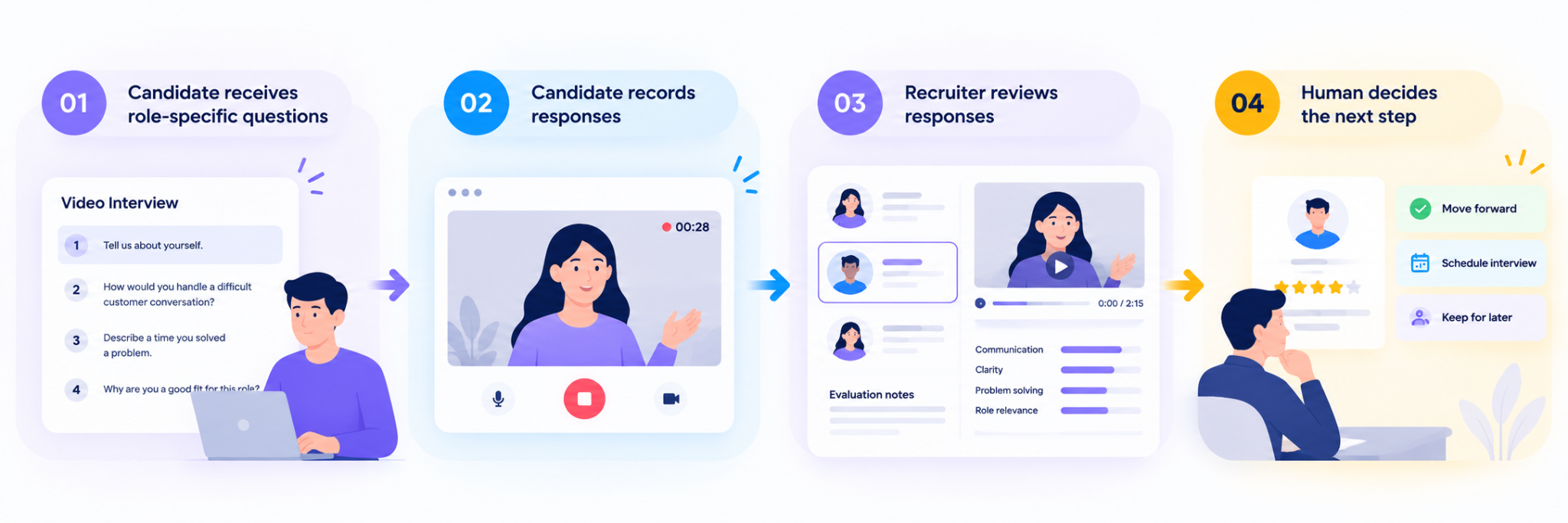
Use Video Interview when seeing a candidate respond adds meaningful evidence not simply to introduce another screening step.
A process that works for a Customer Service Executive may not suit a Sales Officer or Operations Associate. Instead of running every applicant through the same sequence, build role-specific workflows that collect the right evidence at the right stage.
Eligibility → eVA → AI Telescreen → Recruiter
For customer service and voice-based roles, communication is essential. Start with eligibility checks, assess communication readiness through eVA, and use AI Telescreen for structured first-level conversations. Recruiters then focus their interviews on customer handling, situational judgment and overall role fit.
Role Assessment → Video Interview → Hiring Manager
A confident interview doesn't prove sales capability. Sales roles may need customer understanding, persuasion, problem-solving and sound judgment in practical situations. Start with a role-based assessment, then use structured video responses to job-related scenarios so hiring managers see each candidate's approach before the live interview.
Eligibility → AI Telescreen → Role Assessment → Human Decision
For operations roles across multiple locations, repetitive screening questions and inconsistent criteria slow hiring. Start with eligibility checks, use AI Telescreen to collect structured information on availability and role requirements, then assess the relevant operational competencies. Recruiters and hiring managers weigh the evidence, handle exceptions and make the final call. The goal isn't more steps. It's making sure every stage adds meaningful evidence to the hiring decision.
Scaling hiring capacity doesn't always need more recruiters, more tools or a full process overhaul. Often the biggest gains come from removing unnecessary steps, standardizing screening criteria and making better use of the recruiters you already have.
1. Audit your first-round screening activities. List the tasks recruiters perform for every candidate, from eligibility verification to preliminary conversations and scheduling.
2. Separate repetitive checks from human decisions. Identify which activities follow standard criteria and which require contextual evaluation, exceptions or recruiter judgement.
3. Define role-specific assessment criteria. Determine the skills, behaviours, competencies and qualifications that genuinely matter before selecting assessment methods.
4. Evaluate communication skills earlier. For voice-based and customer-facing roles, assess relevant communication capabilities before committing to live interviews.
5. Standardise repeatable screening conversations. Use consistent questions and evaluation criteria to collect comparable information across candidates, locations and hiring teams.
6. Use Video Interview where it adds evidence. Introduce structured video responses only when observing how candidates communicate or approach job-related situations supports better evaluation.
7. Retain human oversight for final decisions. Ensure recruiters and hiring managers review relevant evidence, consider exceptions and remain accountable for selection decisions. A scalable hiring process should help recruiters spend less time repeating routine activities and more time evaluating candidates who require meaningful human interaction.
Efficient screening is not “less human”. It is using human time where it adds the most value.
One role. One practical screening workflow.
Every role has different screening needs. Share one role you're hiring for now, and we'll send a one-page PMaps Screening Map showing where to collect candidate evidence, which checks can happen before recruiter involvement, and where human judgment should stay.
01 — What to ASSESS
The role-specific skills, behaviours, competencies and communication capabilities that deserve evaluation.
02 — What to SCREEN
The repeatable eligibility checks and preliminary conversations that can happen before recruiter involvement.
03 — Where humans DECIDE
The interview stages, exceptions and selection decisions that require recruiter or hiring-manager judgement.
No generic product deck. One role. One practical workflow.
Get informed when we create and distribute a webinar on the right topics, delivered live, or right to your mailbox
Get informed when we create and distribute a webinar on the right topics, delivered live, or right to your mailbox
Get informed when we create and distribute a webinar on the right topics, delivered live, or right to your mailbox
Get informed when we create and distribute a webinar on the right topics, delivered live, or right to your mailbox

It's been a fabulous partnership. PMaps automated our entire recruitment workflow — from screening to operations interview to candidate engagement. It significantly reduced manual effort, improved turnaround time, and made high volume hiring far more efficient and scalable. We definitely recommend P


Whenever I ask, they are there, they kind of respond very quickly. They understand the requirement and they give me the timelines, and mostly it is done in the given timelines.


PMaps has been the ultimate solution to our hiring challenges. The platform provides us with quick and convenient evaluation reports, streamlining our hiring process effectively.



Need support? Fill out the form and we'll get back to you shortly.