
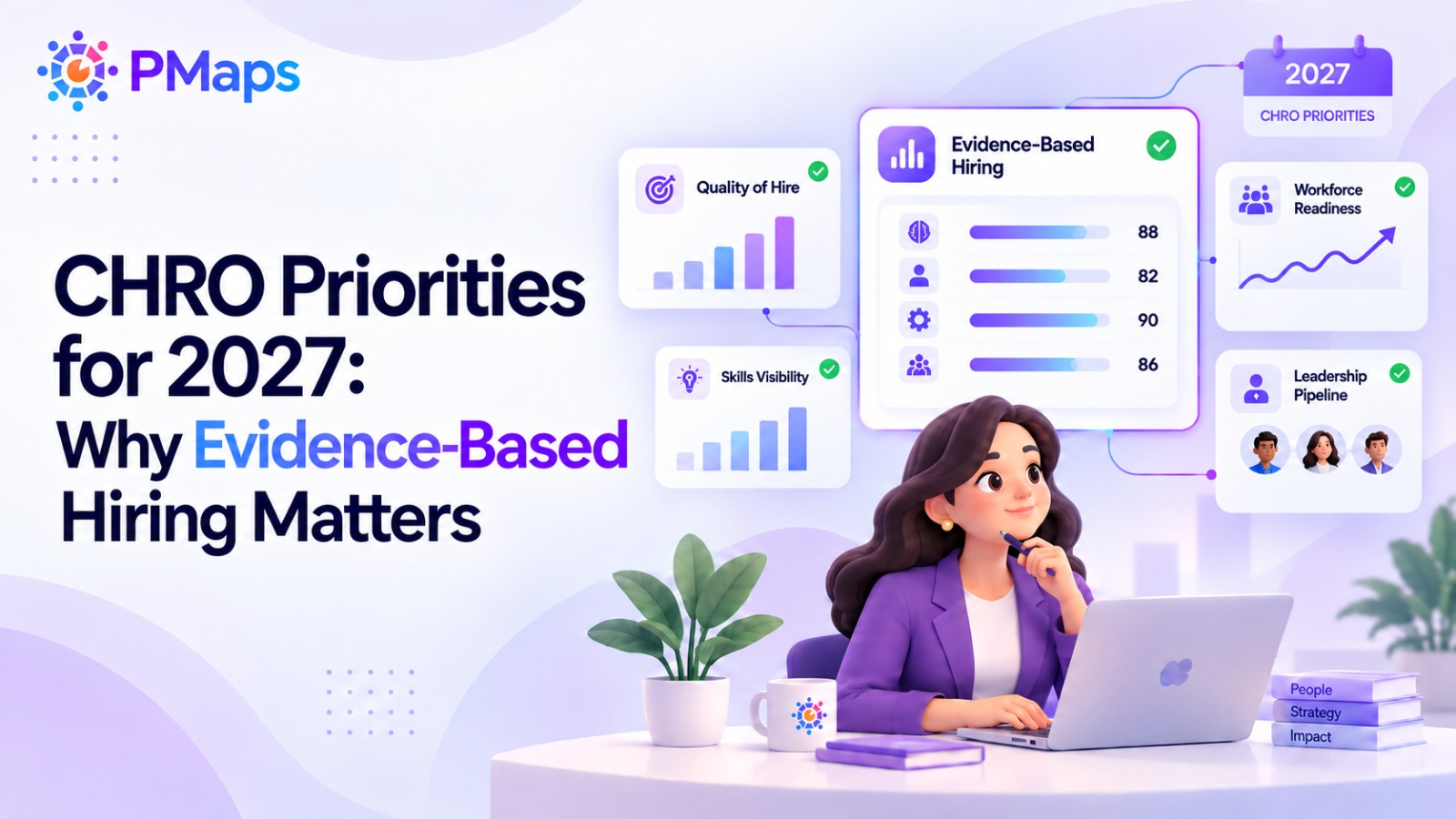
CHRO priorities for 2027 are changing how HR leaders prove hiring quality, workforce productivity, and business impact. Filling vacancies is no longer enough. CEOs increasingly expect CHROs to demonstrate whether recruitment decisions contribute to stronger workforce performance and measurable business outcomes.
Yet a significant challenge remains: how can organizations demonstrate that selected candidates possess the capabilities their roles demand?
Gartner's October 6, 2026 announcement identifies four priorities: faster business value, human accountability for AI, differentiated workforce skills, and leadership readiness.
Evidence-based hiring helps CHROs address these priorities through structured talent assessments, consistent scoring, documented decisions, and post-hire performance reviews.
What Are the Top CHRO Priorities for 2027?
CHRO priorities for 2027 emphasize business value, workforce capabilities, AI governance, and leadership effectiveness. Gartner identifies four areas requiring executive attention. Each influences how organizations assess talent, evaluate workforce readiness, and measure HR decisions.
Recruitment speed remains important. However, CHROs must also examine whether selection methods identify the capabilities their businesses need. That requires clear competency standards, consistent evaluation practices, and measurable hiring outcomes.
Why Is Evidence-Based Hiring Important for CHROs?
Evidence-based hiring uses job-relevant assessments, standardized interviews, and documented criteria to support consistent recruitment decisions.
Traditional hiring often depends on resumes and interviewer judgment. Although useful, these methods can produce inconsistent evaluations across teams and locations.
How Structured Evaluation Improves Consistency
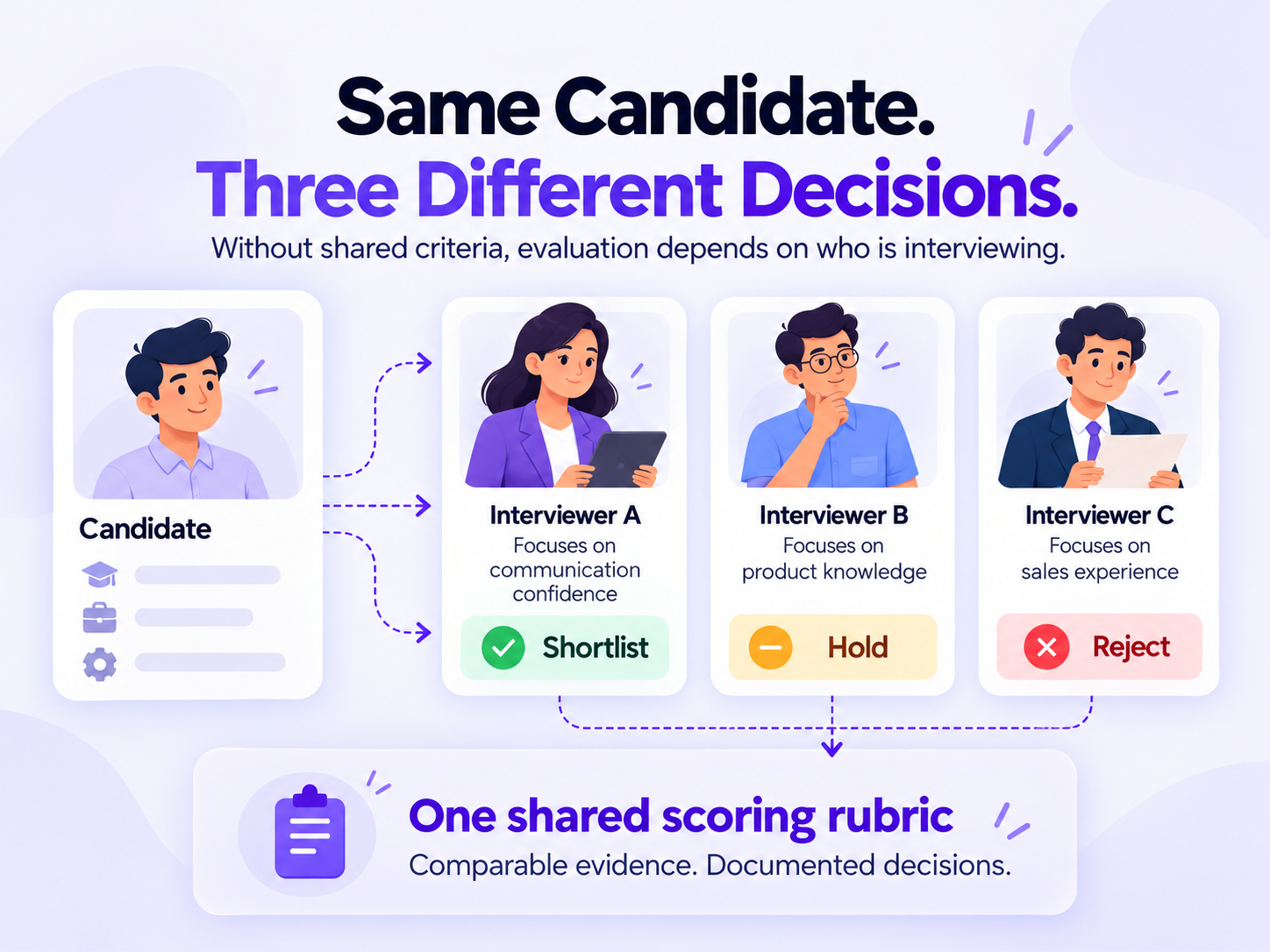
Consider a banking organization recruiting relationship managers across multiple branches.
Interviewer A prioritizes communication confidence. Interviewer B focuses on product knowledge. Interviewer C evaluates sales experience.
Without common criteria, three candidates with similar capabilities may receive significantly different evaluations. A structured approach establishes four competencies before interviews begin:
- Customer communication: Explain financial products clearly.
- Banking knowledge: Demonstrate relevant product and process understanding.
- Problem-solving: Respond appropriately to customer scenarios.
- Compliance awareness: Recognize regulatory and procedural requirements.
Each interviewer uses the same competency definitions, role-relevant questions and documented scoring rubric.
For example, candidates might respond to a scenario involving a customer questioning unexpected account charges. Evaluators score the response against predefined criteria, including explanation accuracy, customer handling, and procedural judgment. This makes candidate comparisons more consistent and helps hiring managers explain their recommendations. CHROs can periodically review scoring differences between interviewers to identify calibration needs.
How Does AI Accountability Affect Recruitment in 2027?
AI accountability requires organizations to assign human responsibility for automated recommendations and consequential decisions. Gartner's July 2026 survey of 297 CHROs found that only 24% of leadership teams were aligned on accountability for AI agents.
This finding concerns enterprise AI governance rather than recruitment specifically. However, the underlying accountability challenge is relevant to AI-supported hiring.
AI can assist with screening, structured interviews, and assessment analysis. Human reviewers must still evaluate job relevance and interpret recommendations appropriately.
What Should Human Oversight Include?
Human oversight should establish responsibility across recruitment stages.
Organizations should define when human review is mandatory, how exceptions are handled, and which records must be retained.
These controls help HR leaders maintain accountability as recruitment technology evolves.
Why Do Differentiated Skills Matter for Workforce Planning?
Differentiated workforce skills are capabilities that contribute directly to important job requirements and organizational performance.
Gartner reports that 67% of surveyed CHROs faced increased expectations for employee productivity.
This creates a practical question: which capabilities should organizations prioritize when evaluating candidates?
How Can Organizations Identify and Assess Job-Related Competencies?
Consider a BPO recruiting customer support agents. Rather than evaluating communication confidence alone, the hiring team reviews actual customer interactions and identifies recurring performance requirements.
These may include:
- Listening accuracy and comprehension
- Customer issue resolution
- Process adherence
- Written communication
- Situational judgment
The organization then selects evaluation methods aligned with each competency.
For example, a candidate may communicate politely but fail to identify the customer's actual problem.
A customer service assessment can examine whether the candidate recognizes the issue and selects an appropriate next step. Recruitment teams should validate these competency requirements with role managers and performance data. This creates a clearer connection between assessment design and actual work expectations.
How Can Talent Assessments Reduce Hiring Risk?
Talent assessments support hiring decisions by providing structured evidence about relevant candidate capabilities. Assessment effectiveness depends on job relevance, suitable validation, consistent administration, and responsible interpretation.
A Practical Framework for Evaluating Hiring Effectiveness
CHROs can establish an evaluation process around four connected dimensions.
This framework helps organizations evaluate the quality of recruitment decisions beyond vacancy closure.
How PMaps Supports Consistent Hiring Decisions
PMaps provides psychometric assessments, cognitive and technical tests, and AI-supported voice and video interviewing capabilities. Its assessment reports and competency information can support three important CHRO requirements.
- Consistent evaluation: Role-relevant tests help recruiters apply common assessment criteria across hiring locations.
- Candidate comparison: Assessment scores and applicable benchmarks provide additional evidence when reviewing applicants.
- Decision visibility: Consolidated reporting helps hiring teams review results and document the evidence considered.
These capabilities should complement structured interviews, human judgment, and other appropriate selection methods.
For example, Joyce Varghese from Strategic HR, Jana Bank, describes the value of detailed assessment reports. She highlights access to consolidated candidate information without needing to collect multiple separate reports. This example demonstrates a practical reporting use case: making assessment information easier for HR teams to access and review. It does not independently establish improved quality of hire, reduced attrition or increased employee productivity.
The distinction matters when CHROs evaluate both technology usability and measurable hiring outcomes.
Why Is Leadership Readiness a CHRO Priority for 2027?
Leadership readiness reflects an individual's capacity to make decisions, manage stakeholders, and adapt during organizational change.
Gartner reports that 63% of surveyed CEOs and senior business executives were radically redesigning operating models to accelerate AI-related financial returns.
These changes increase the need to evaluate leadership capabilities beyond technical expertise and previous job titles.
How Can Leadership Assessments Evaluate Real Business Decisions?
Consider a regional operations manager whose organization introduces an AI-supported customer service workflow.
The implementation promises operational improvements, but employee concerns and customer escalations are increasing. The candidate must decide how to respond while balancing service quality, implementation deadlines, and employee readiness.
A structured leadership assessment could evaluate three competencies:
- Decision-making: Does the candidate prioritize customer risk and operational requirements?
- Adaptability: Can the candidate revise the implementation plan when new evidence emerges?
- Stakeholder management: Does the candidate address concerns from employees, technology teams, and senior management?
Evaluators can use behaviorally anchored scoring criteria to assess the candidate's proposed actions.
PMaps leadership assessment capabilities can support structured evaluation of relevant leadership characteristics. Results should be interpreted alongside performance history, experience, and organizational requirements.
How Should CHROs Measure Hiring Effectiveness?
Hiring effectiveness should examine recruitment decision quality, assessment consistency, and measurable employee outcomes.
Time-to-hire provides information about process speed. It does not establish whether newly hired employees meet performance expectations.
Four Hiring KPIs CHROs Should Review
How Should CHROs Interpret These Results?
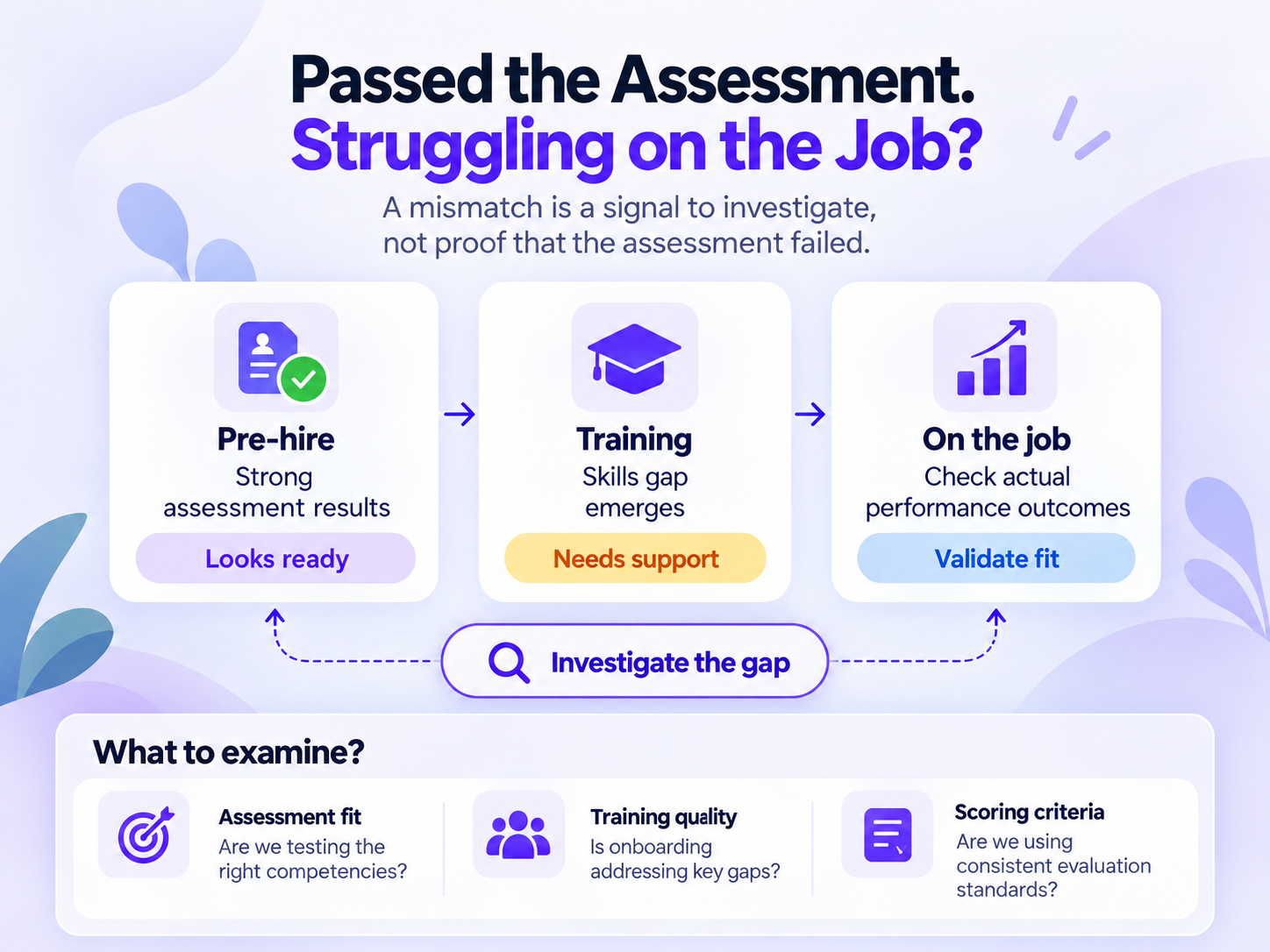
Suppose a customer support organization finds that candidates perform well in assessments but struggle during initial training. CHROs should investigate whether the assessments reflect actual job requirements, whether training is adequate, and whether scoring criteria need revision.
Similarly, increased early attrition does not automatically indicate ineffective recruitment. Compensation, management practices, workload, and working conditions may also contribute.
PMaps assessment reporting provides pre-hire information that organizations can examine alongside appropriate performance and workforce records. A quarterly review can identify evaluation methods that require recalibration or further validation.
The objective is to determine whether hiring evidence remains relevant after employees begin working.
Conclusion
CHRO priorities for 2027 place greater emphasis on workforce productivity, responsible AI adoption, differentiated skills, and leadership readiness.
For recruitment teams, the practical response is to strengthen competency definitions, standardize candidate evaluations, document selection decisions, and examine post-hire outcomes.
PMaps supports these activities through psychometric assessments, role-based testing, AI-supported interviews, and assessment reporting. These capabilities can help organizations make hiring evidence more consistent and accessible without replacing human judgment.
See how PMaps assessments, role-based benchmarks, and consolidated candidate reporting can support structured recruitment decisions.