.webp)
.webp)


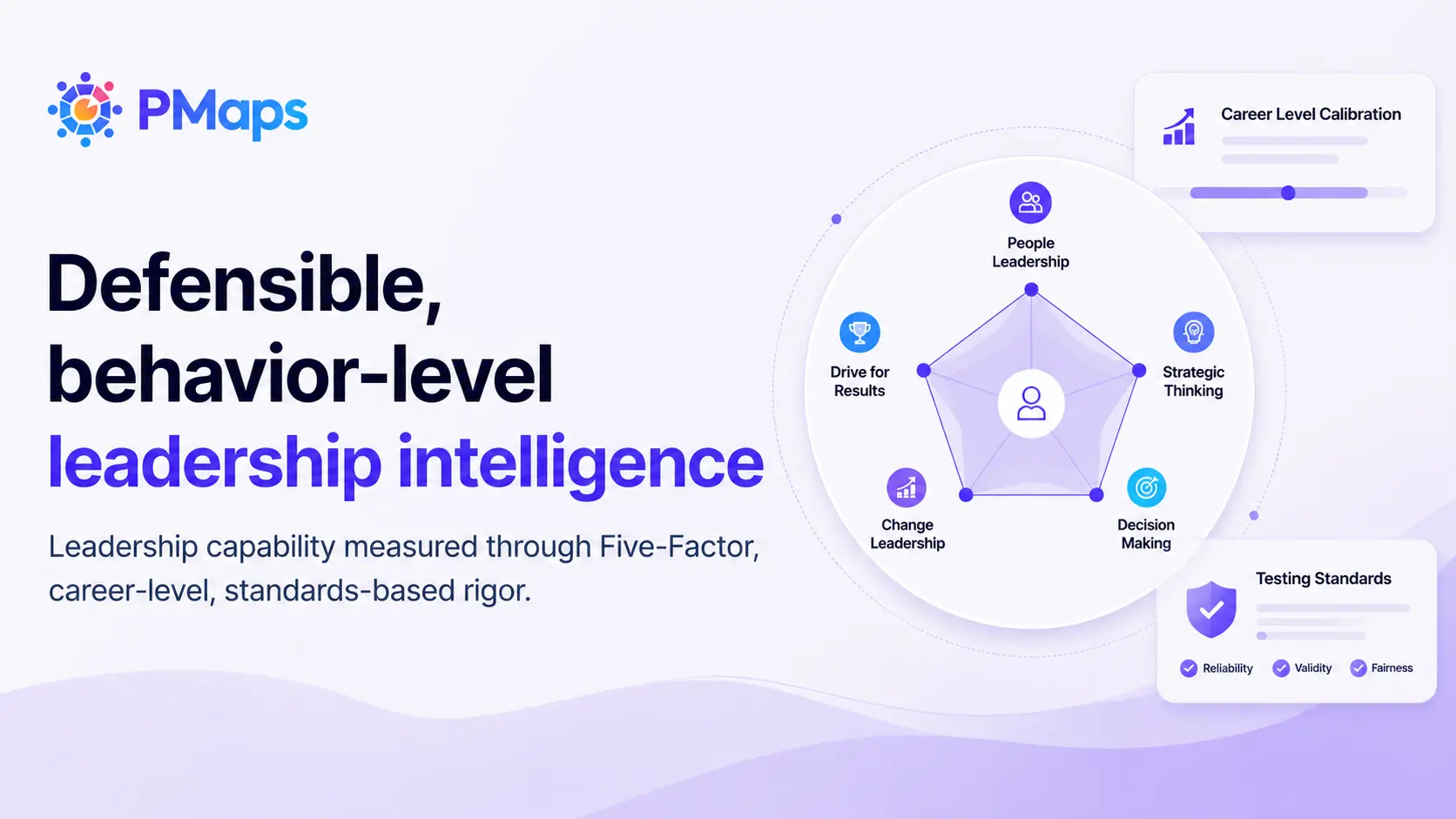
Defensible, behavior-level leadership intelligence
Leadership decisions need more than generic scores. They need clear behavioral evidence, structured competency mapping, and a framework strong enough to support hiring, development, and succession conversations.
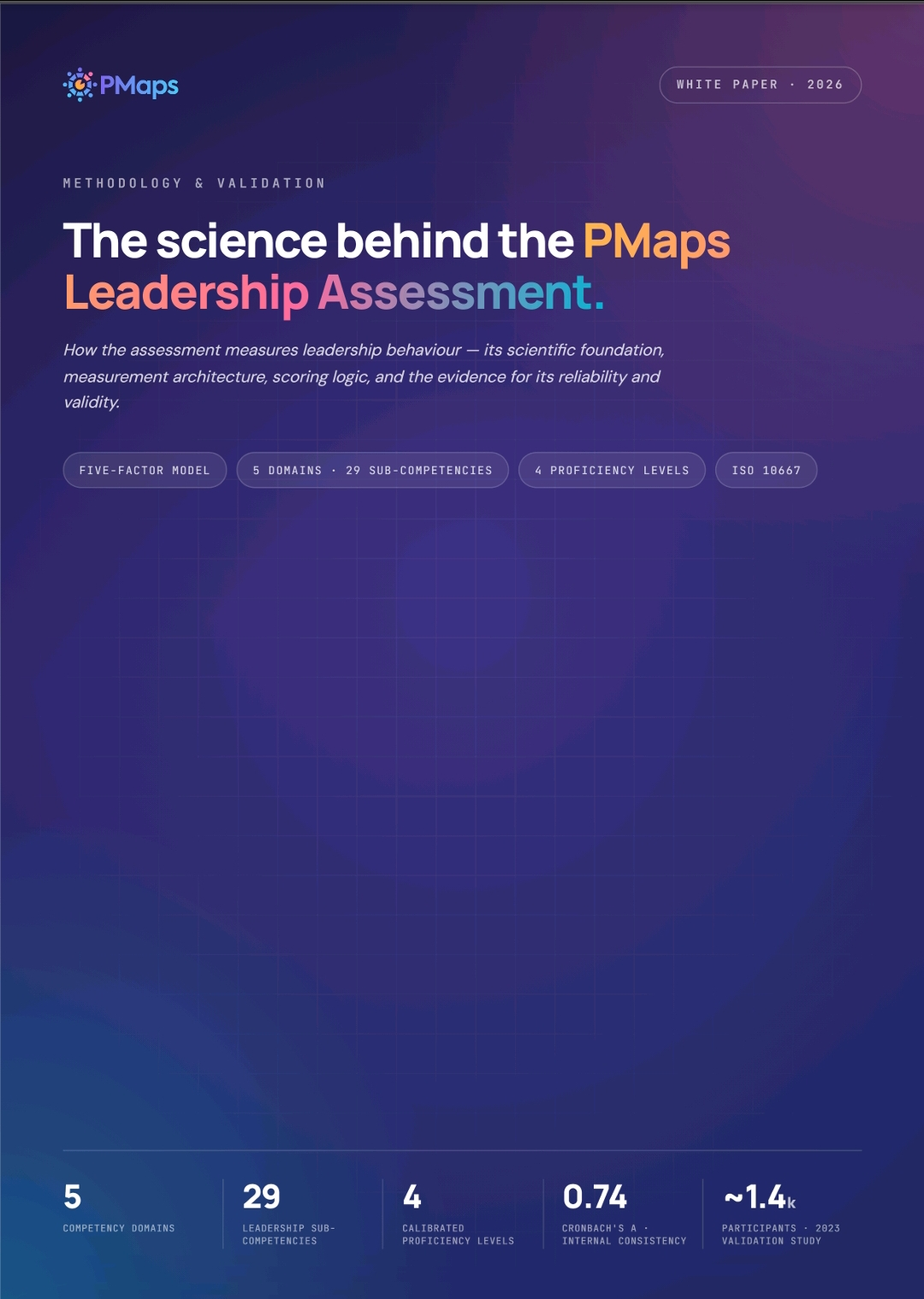
The PMaps Leadership Assessment is built on 5 leadership domains and 29 sub-competencies, mapped across 4 calibrated proficiency levels to show not just where a leader stands, but how they lead in real workplace situations.
With an internal consistency of 0.74 α and alignment with ISO 10667 standards, the assessment brings defensible, behavior-level leadership intelligence into every talent decision. Read the white paper to see the methodology, validation approach, and framework behind the assessment.
Leadership decisions are among the highest-stakes, lowest-feedback decisions an organization makes
A wrong senior hire is expensive, slow to surface, and damaging across every team the leader touches — yet most leadership selection still rests on unstructured judgment and self-report tools that sophisticated candidates can shape at will.
The PMaps Leadership Assessment was built to bring measurement discipline to that decision. It's a behavioral assessment grounded in the Five-Factor Model of personality, organized into a hierarchical competency architecture, calibrated to the candidate's career level, protected by a response-style safeguard, and benchmarked against a norm-referenced comparison sample.
We state what the evidence supports today — reliability, content validity, construct validity, and concurrent validity — and we're explicit about what remains on the validation roadmap: criterion (predictive) validity. Transparency about evidence is itself a mark of a credible instrument.
Three reasons leadership is uniquely hard to measure
The assessment is designed around each one.
- Self-presentation. Senior candidates are the most practiced self-presenters in any process. A tool that simply asks leaders to describe themselves rewards impression management, not leadership — so a credible instrument has to detect socially desirable responses.
- Level mismatch. Leadership isn't one construct measured once. The behaviors of an effective individual contributor differ from those of an effective enterprise leader. A single, blended reference population systematically misjudges leaders at the extremes of the pipeline.
- Construct ambiguity. "Leadership potential" as a single number tells a hiring manager almost nothing actionable. Useful measurement resolves leadership into specific, observable behaviors that can be developed, interviewed against, and tracked.
Built on the Five-Factor Model — measured at the facet level
The assessment is grounded in the Five-Factor Model (FFM) of personality — the most extensively researched and cross-culturally replicated framework in personality science. Rather than measuring the five broad domains alone, the instrument measures at the facet level — the narrower trait units beneath each factor — because facet-level measurement carries more specific, work-relevant signal than broad factors alone.
The choice is deliberate and evidence-based. Meta-analytic research has established that Five-Factor traits predict job performance and leadership emergence and effectiveness across roles and industries. Building leadership competencies up from validated personality facets — rather than asking candidates to self-rate on competencies directly — grounds each competency score in stable, theory-backed measurement.
A hierarchical model — from personality facets to one Leadership Quotient
Measurement begins at the foundational personality level and aggregates upward into progressively more interpretable units, which is what lets the assessment express results at whatever altitude a decision requires:
- Foundational personality facets — stable, theory-backed units beneath each Five-Factor domain.
- Leadership sub-competencies (29) — specific, definable behaviors with level-appropriate indicators.
- Leadership competency domains (5) — enterprise-relevant areas of leadership capability.
- Leadership Quotient — one aggregate index of behavioral leadership effectiveness.
Results speak at three altitudes: a single Leadership Quotient for a fast screen, five domain scores for a capability profile, or 29 sub-competency scores for development planning and interview design. Each sub-competency carries a defined operational definition and observable behavioral indicators — which is what lets the assessment output behavioral narratives and structured interview probes rather than bare scores.
Five domains, 29 sub-competencies
Domain table
- Personal Effectiveness (7) — Adaptability · Learnability · Dealing with Uncertainty & Ambiguity · Self-Awareness · Role Model · Work Ethics · Stress Management
- People Management (7) — Approachability · Empathy · Delegation Skills · Inclusive Mindset · Managing Biases · Conflict Management · Coaching & Mentoring
- Driving Results (6) — Achievement Orientation · Business Acumen · Decision Making · Execution Skills · Growth Mindset · Partnership & Collaboration
- Driving Change (4) — Change Management · Consultative Behaviour · Crisis Management · Agile Thinking
- Thought Leadership (5) — Organizational Awareness · Market Intelligence · Openness to Perspectives · Strategic Thinking · Global Mindset
One framework, calibrated across four leadership levels
A single competency framework is calibrated across four proficiency levels spanning the talent pipeline. Each level is measured against a dedicated norm group with level-appropriate behavioral anchors and benchmarks:
- Individual Contributor
- First-Time Management
- Middle Management
- Senior / Enterprise Leadership
This addresses the level-mismatch problem directly. A senior leader's scores are interpreted against a senior-level reference population, not a general-population baseline — which prevents the score inflation that occurs when executive candidates are compared to the broad workforce. "High" means high among true-level peers.
Norm-referenced scoring, with a built-in genuineness check
Scoring proceeds by norm-referenced, weighted aggregation. Facet-level measurement combines into sub-competency scores, which roll up into domain scores and an overall Leadership Quotient. Every score is interpreted against the level-specific comparison sample and classified into one of three bands — Low, Average, or High — with thresholds calibrated to observed real-world score distributions rather than naïve equal thirds.
The Leadership Quotient is designed to support fit and potential judgments, not replace them. Throughout, the assessment is positioned as one input into a leadership decision, alongside structured interviews, functional evidence, and references.
To address self-presentation, the assessment embeds a validated Impression Management (IM) scale that detects the tendency to respond in a socially desirable manner. A high IM score flags a "Not Genuine" response style, signaling that competency scores should be interpreted with appropriate caution before any decision is made. This safeguard matters most precisely where it's needed most — at the senior level, where candidates are the most sophisticated self-presenters and the cost of a false-positive hire is highest.
The evidence — strengths and current limits alike
We organize the evidence using the validity framework of the Standards for Educational and Psychological Testing, and report it transparently.
The leadership instrument demonstrates internal-consistency reliability of Cronbach's α = 0.74 across its item pool — an acceptable level for a multidimensional behavioral instrument. The broader PMaps behavioral assessment program on which the facet measurement is based has reported higher internal consistency (α = 0.89) in a large-sample validation study, providing additional support for the underlying measurement approach.
Validity table
- Content validity — Established. Through SME panel review of competency definitions, behavioral indicators, and item relevance.
- Construct validity — Supported. The factor structure underlying the behavioral measurement has been examined using factor-analytic methods (PCA and confirmatory factor analysis) in a 2023 validation study of ~1,400 participants, conducted under academic supervision.
- Concurrent validity — Supported. The 2023 study established concurrent agreement across visual and text-based delivery formats; and PMaps' 90° measurement design — pairing assessment-based scores with independent manager ratings on the same competencies — provides a direct, ongoing means of evaluating concurrent validity in live deployments.
- Criterion validity — On the roadmap. Direct evidence that scores predict future on-the-job leadership performance is not yet established for this instrument. We state this plainly.
The broader literature establishes that Five-Factor-based methods as a class carry meaningful predictive validity for performance and leadership outcomes — but that describes the method class, not this specific instrument. Establishing instrument-specific predictive validity — linking scores to subsequent performance, promotion, or retention — is the defined next phase of the validation program.
Built and documented to recognized standards
No global authority certifies the scores of any psychometric assessment. Credibility rests on building to recognized standards and publishing transparent evidence. The PMaps Leadership Assessment is developed and documented with reference to:
- ISO 10667 — assessment service delivery: procedures and methods to assess people in work and organizational settings.
- Standards for Educational and Psychological Testing (AERA, APA & NCME, 2014).
- ITC Guidelines on Test Use (International Test Commission).
PMaps is an AI-powered, bias-reducing, multi-lingual talent assessment platform that helps enterprises hire the right people and develop the ones they already have. Since 2014, PMaps has completed 2M+ assessments and is trusted by 200+ enterprise clients across 7 countries — including HSBC, Bajaj, Adani, and Tata Consultancy Services. Its assessments are backed by behavioral science and validated against real hiring outcomes.
Bring measurement discipline to your highest-stakes decisions
Read the full methodology and validation white paper, or book a 30-minute walkthrough to see how the PMaps Leadership Assessment measures leadership capability — at the level of the individual leader and the whole cohort.
| Book a demo |