.webp)
.webp)

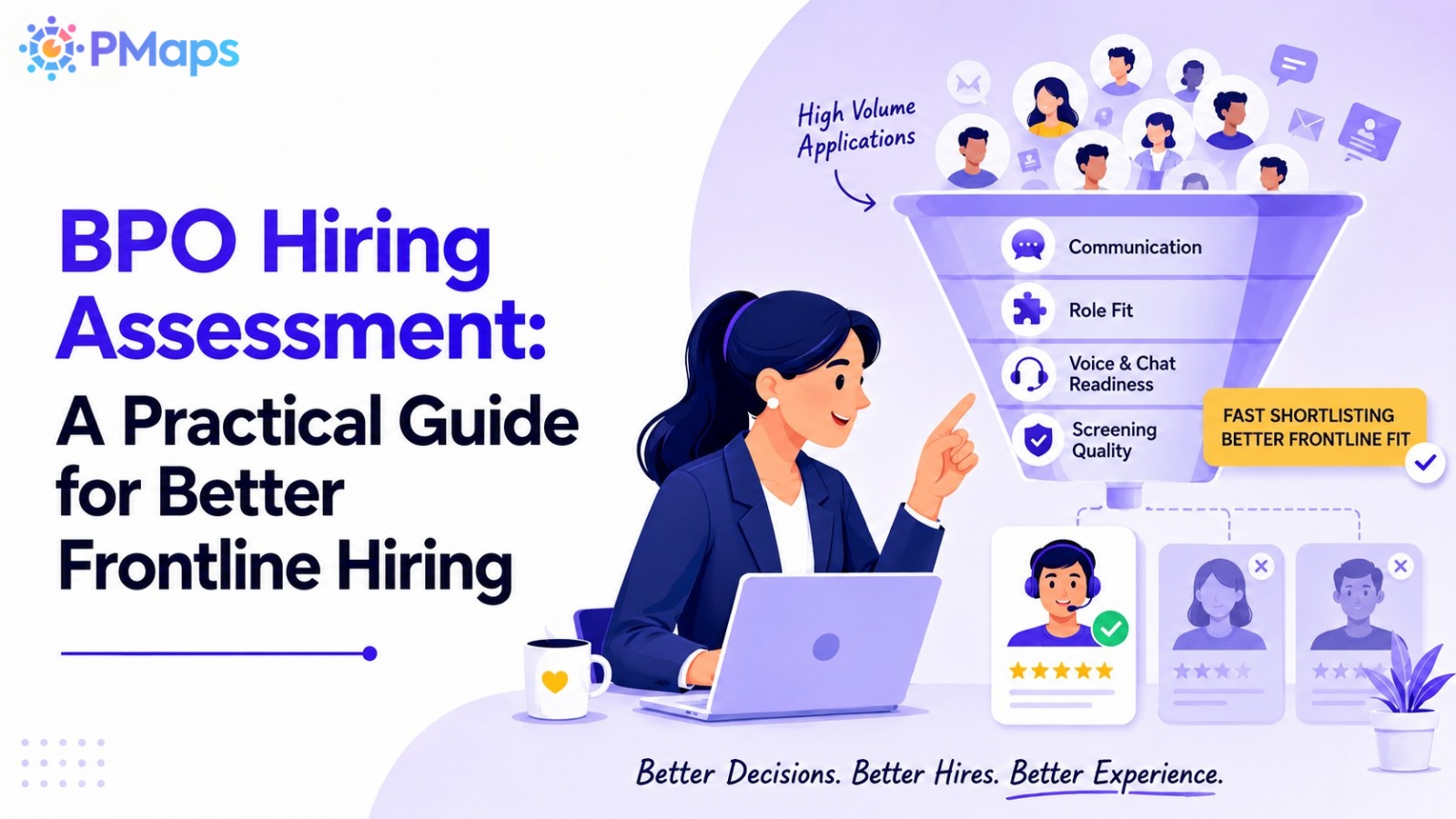
BPO hiring assessment helps HR teams move from test scores to job-readiness signals. It checks language proficiency, customer orientation, reasoning, process discipline, and technical compatibility in one view.
This becomes important due to the bulk nature of BPO hiring, where speed can weaken judgment. The assessment keeps screening consistent and identifies candidates who can handle customer pressure without service drops.
That is why a BPO hiring assessment should answer a more useful question than “Can this candidate pass a test?” It should help the hiring team understand whether the candidate has the combination of communication, reasoning and service behaviours required for the actual role.
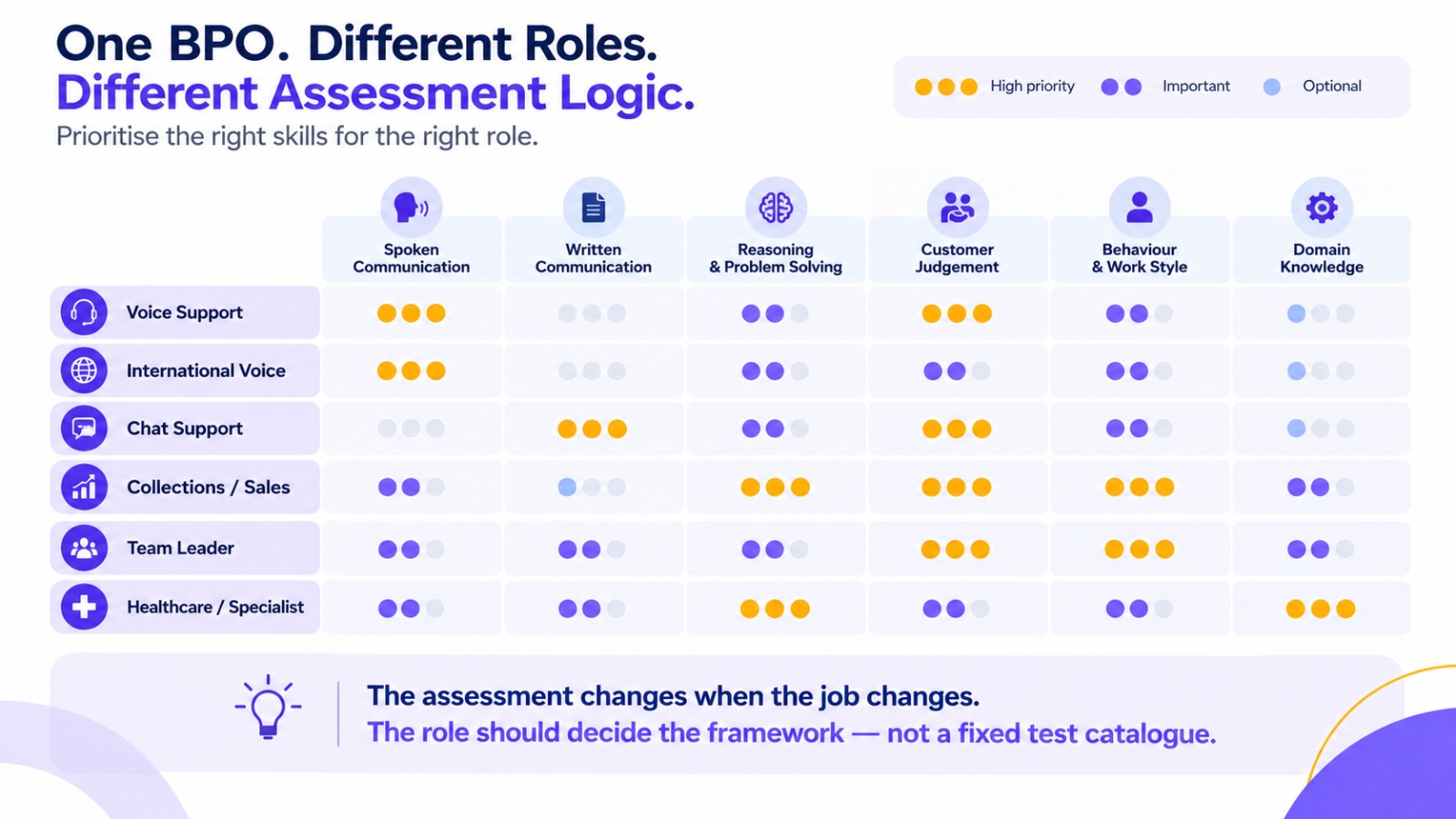
For voice processes, that often means spoken-English clarity, listening, comprehension, fluency and pronunciation alongside cognitive and behavioural indicators. For chat or non-voice processes, written communication test section, response judgement section, comprehension, typing or chat-specific skills may matter more. For specialised processes, domain knowledge can be added to the same screening framework.
The strongest assessment strategy therefore starts with the role and the customer interaction, and not with a fixed catalogue of tests.
What should a BPO hiring assessment measure?
There is no universal BPO assessment that should be applied identically to every process. A useful framework separates the hiring requirement into a small number of measurable capability areas.
1. Spoken communication and language proficiency
For voice-based processes, recruiters need more than a candidate’s self-reported fluency. A communication assessment should help evaluate whether the candidate can understand spoken information and communicate clearly enough for the target customer environment.
Depending on the role, this can include pronunciation, fluency, grammar, vocabulary, listening and comprehension, sentence construction and free speech. Where the process serves a specific geography, the evaluation framework may also need to reflect the expected English variant or pronunciation requirements.
The goal should not be to reward an artificial accent. It should be to identify whether speech is understandable, consistent and suitable for the communication demands of the role.
2. Listening and comprehension
Customer-service work frequently requires candidates to listen, extract relevant information and respond without losing context. This is different from merely speaking fluent English.
A candidate may pronounce words well but miss the meaning of a customer request. A BPO hiring assessment should therefore distinguish between speech production and comprehension wherever the role demands both.
Listening assessment tasks can use audio-based scenarios, spoken instructions or customer situations to examine how accurately the candidate understands and interprets information.
3. Cognitive and problem solving skills
Many BPO roles involve rapid decisions within a defined process. Agents may need to identify the real issue, compare possible actions, use numerical information, detect patterns or apply a policy correctly.
The most relevant cognitive assessment depends on the process and abilities you measure, but common areas can include verbal reasoning, numerical reasoning, logical reasoning, abstract reasoning, problem solving and learning agility.
The important design principle is relevance. A process that requires billing calculations may justify stronger numerical evaluation; a support role built around troubleshooting may place more weight on logical reasoning and problem solving.
4. Customer-service judgement and behavioural fit
Successful customer interactions depend partly on what a candidate knows and partly on how the candidate responds when the situation becomes difficult.
For customer-facing roles, hiring teams may want evidence around empathy, composure, conscientiousness, customer orientation, adaptability or other role-relevant behaviours. Situational judgement scenarios can also help evaluate how candidates are likely to prioritise actions in realistic service situations.
Customer service assessment should not be used as a vague personality filter. It is most useful when the competencies are explicitly linked to the requirements of the target role.
5. Written communication and chat readiness
For chat and non-voice roles, spoken communication may become less important while written accuracy and response quality become more important.
Recruiters may need to evaluate written comprehension, grammar, email or chat response judgement, typing speed and accuracy, and the ability to communicate clearly within a limited response window.
This is why a call centre assessment should not simply be reused for a chat-support role.
6. Domain or process knowledge
Some BPO processes require specialised knowledge from day one. Healthcare RCM, collections, insurance, banking, technical support and other process-specific roles may need an additional domain layer.
Rather than running unrelated screening rounds, hiring teams can combine communication, aptitude test and domain knowledge into a structured assessment flow when that reflects the actual job.
A practical BPO assessment framework by role:
- Voice customer support: Evaluate spoken English, pronunciation and fluency, listening and comprehension, verbal reasoning, problem solving and customer-service judgement. Add behavioural competencies when they are linked to the operating environment.
- International voice process: Include spoken-language evaluation aligned to the target customer environment, listening and comprehension, communication consistency and role-relevant cognitive skills. If the organisation has a specific requirement around English variant or pronunciation, define that before configuring the assessment.
- Chat support: Prioritise written English, comprehension, grammar, response judgement, typing or chat simulation, problem solving and customer orientation. Spoken-language testing may be unnecessary unless the role is blended.
- Collections or sales process: Combine communication with persuasion or solutioning-related judgement, numerical or analytical reasoning where relevant, persistence-related behavioural indicators and process/domain knowledge.
- BPO team lead or process management: Include escalation handling, SLA discipline, coaching judgement, queue ownership, process adherence and performance-tracking ability. You can check PMaps BPO Management Test sections for instance.
- Specialised BPO or healthcare process: Combine communication, cognitive ability and job-specific domain knowledge. When hiring outcomes matter enough to justify it, use pilot data and performance evidence to calibrate benchmarks rather than relying indefinitely on generic cut-offs.
Why does one generic cut-off create the wrong hiring decision? A single overall score can hide useful differences between candidates.
Consider two applicants who achieve the same total result. One may be very strong in communication but weak in problem solving; the other may show the reverse pattern. Their suitability could be very different depending on the process.
For this reason, enterprise assessment design often benefits from section-level evaluation, configurable weightages and role-specific decision rules. Some capabilities may be mandatory while others can be trainable. In other cases, a composite score may still be useful but should be interpreted alongside the underlying competency profile.
The question is not simply “What is the pass mark?” It is “Which weaknesses can the organisation train, and which are critical on day one?”
Should you combine language, cognitive and behavioural assessments? Combining them can make sense when the job itself requires all three.
A fragmented hiring process may ask the candidate to complete one English language assessment, return for an aptitude round and then complete another behavioural or domain test. This adds operational steps and makes it harder to interpret the candidate as a whole.
A structured multi-section assessment can create a single screening journey while still preserving section-level results. The design should remain modular: include only the competencies that matter to the role, define the relevant weightages and allow the hiring team to review individual capability areas rather than depending on one opaque score.
Hiring BPO agents? You can use our BPO interview question compilation to spot frontline service-ready candidates more accurately!
How to choose the right BPO hiring assessment?
Before comparing vendors or tests, define the hiring decision you need the assessment to improve. A useful evaluation process asks:
- Which roles and processes are being hired for?
- Is the voice, non-voice, chat or blended?
- Which customer geography or communication environment is relevant?
- Which capabilities are mandatory at entry and which can be trained?
- Does the role require domain knowledge?
- Do you need standard benchmarks or organisation-specific calibration?
- How will recruiters interpret section scores and recommendations?
- What candidate volume and turnaround time must the process support?
- What level of assessment integrity or proctoring is required?
- Can the assessment fit into the existing hiring workflow and HR technology stack?
These questions are more important than selecting a test simply because it has a familiar name.
Pilot before you scale
For high-volume hiring, a pilot can be more useful than immediately adopting a fixed benchmark. A pilot allows the organisation to examine the candidate journey, section-level score patterns, recruiter usability and the practical relationship between proposed cut-offs and the people it would actually select or reject.
Where reliable employee-performance data is available, organisations can go further by examining whether assessment results are associated with relevant job outcomes. This type of validation can help the assessment framework evolve from a generic screening tool toward an organisation-specific hiring decision system.
The benchmark should therefore be treated as something that can be calibrated, but not as an unquestionable number supplied once and used forever.
.jpeg)
Looking to upgrade your frontline pool? Try BPO recruitment strategies that actually make a difference.
What should the BPO assessment report show?
A useful report should make the hiring decision easier to understand. Depending on the assessment design, recruiters may need:
- Overall recommendation or fitment guidance;
- Section-wise scores;
- Competency-level interpretation;
- Language or communication performance;
- Cognitive and domain performance;
- Behavioural insights were included;
- Assessment-integrity or proctoring evidence where required; and
- Enough detail to identify whether a weaker area is critical or potentially trainable.
The report should support a decision, and not create another task of analysis for the recruiter. Here’s a sample report of our on-demand BPO Voice and Accent tool for you to check.
How can PMaps support BPO hiring assessments?
PMaps enables organisations to configure role-specific assessment journeys rather than forcing every BPO role through the same test.
A hiring framework can combine relevant modules such as English-language or Voice & Accent test, cognitive assessment, behavioural competencies, customer-service or chat skills, domain knowledge and assessment-integrity controls. The precise construct can vary by process, geography and level.
For example, a voice-support role may combine spoken communication, comprehension, problem solving and customer-service behaviours. A chat role can shift the emphasis toward written communication and chat readiness. A specialised process can add relevant domain knowledge.
In a live Moder deployment covering 2,500+ role-mapped assessments, the client reported a 15–20% improvement in behavioral alignment of shortlisted candidates, with the shift completed in 45–60 days.
This approach gives hiring teams a more coherent view of candidate readiness while reducing dependence on disconnected screening rounds.