.webp)
.webp)


The short answer
What is AI hiring fraud? It is the use of generative AI to fabricate the elements a hiring process screens on resumes written by reading the job description back, generated headshots placed into stolen identity documents, and voice-changing software used during live interviews. It works because conventional screening measures presentation rather than demonstrated capability, and presentation is now cheap to fake.
The evidence is documented, not speculative
In July 2025 the U.S. Department of Justice announced a sentencing in a case where 309 U.S. businesses and two international businesses were defrauded by candidates using 68 stolen identities, generating more than $17 million. In March 2026, Microsoft Threat Intelligence published a technical account of how the fraud is built. The findings matter to any hiring team, not only to those exposed to state-sponsored activity:
Gartner projects that by 2028, one in four candidate profiles worldwide could be fake.
The pattern underneath
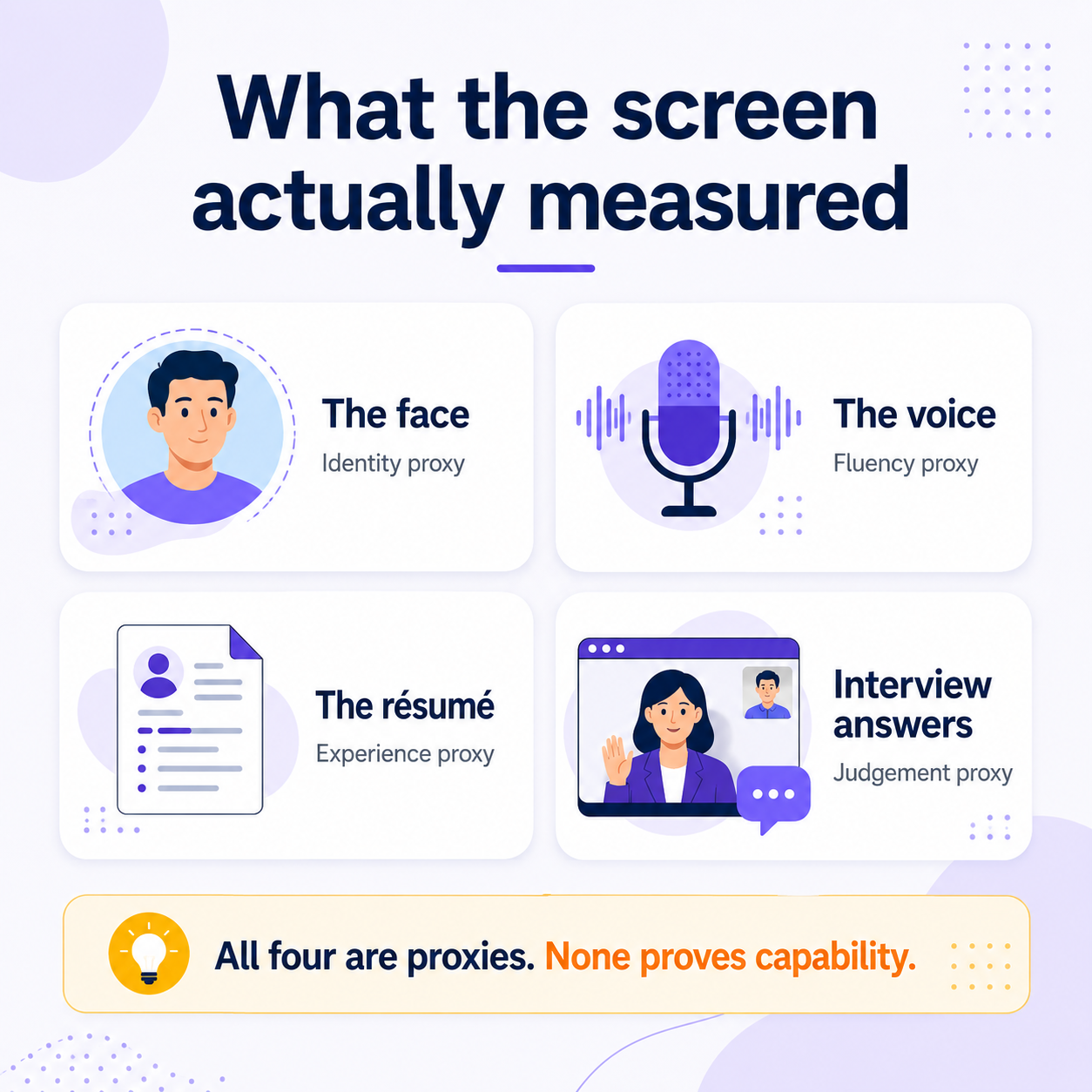
Four things were fabricated: the face, the voice, the resume, and the interview answers. Each one is a proxy for capability rather than capability itself. A resume stands in for experience. An interview answer stands in for judgement. These substitutions were accepted because measuring the real thing was harder and once a proxy becomes cheap to fake, it carries no information.
The final row of that table is the one hiring teams tend to miss. The fraud continued after the offer letter, because the operatives could not fabricate the work itself in advance. They had to keep generating it, indefinitely. A screening process built from proxies admitted them, and then the job began asking a question the screen never had.
Why detection is the wrong response
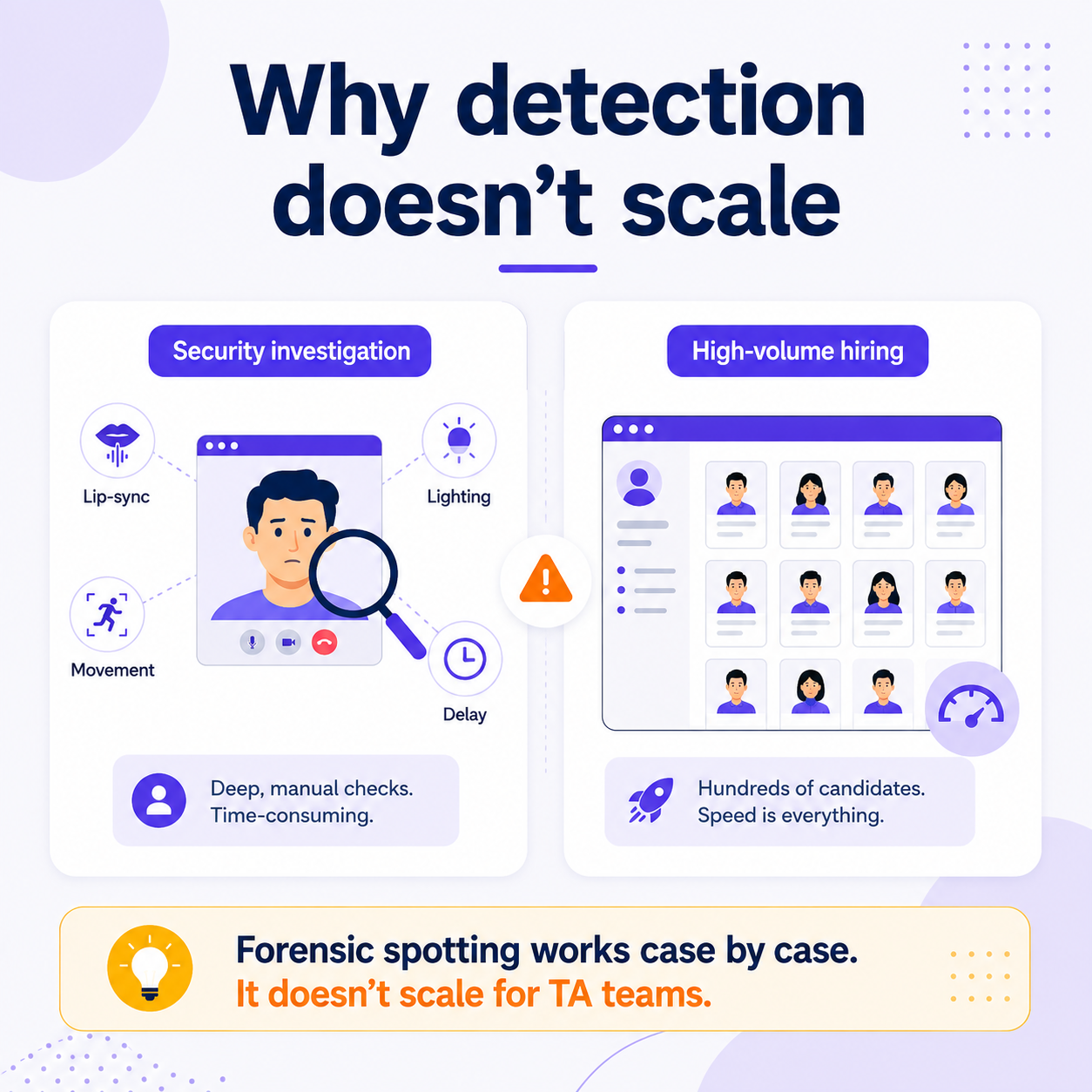
Microsoft's guidance for identifying fabricated video suggests watching for temporal inconsistency during rapid movement, faces that fail to reconstruct correctly when partially obscured, lighting that does not adapt, and delays between lip movement and speech. That is appropriate guidance for a security team examining one suspicious hire. It does not transfer to a talent acquisition team screening several thousand candidates a week, and it sits on the wrong side of an arms race in which generation improves faster than detection.
There is also a false-positive cost that rarely gets priced in. Nervous candidates, non-native English speakers, and people on poor connections all produce the same surface signals.
The alternative: measure the work, not the presentation
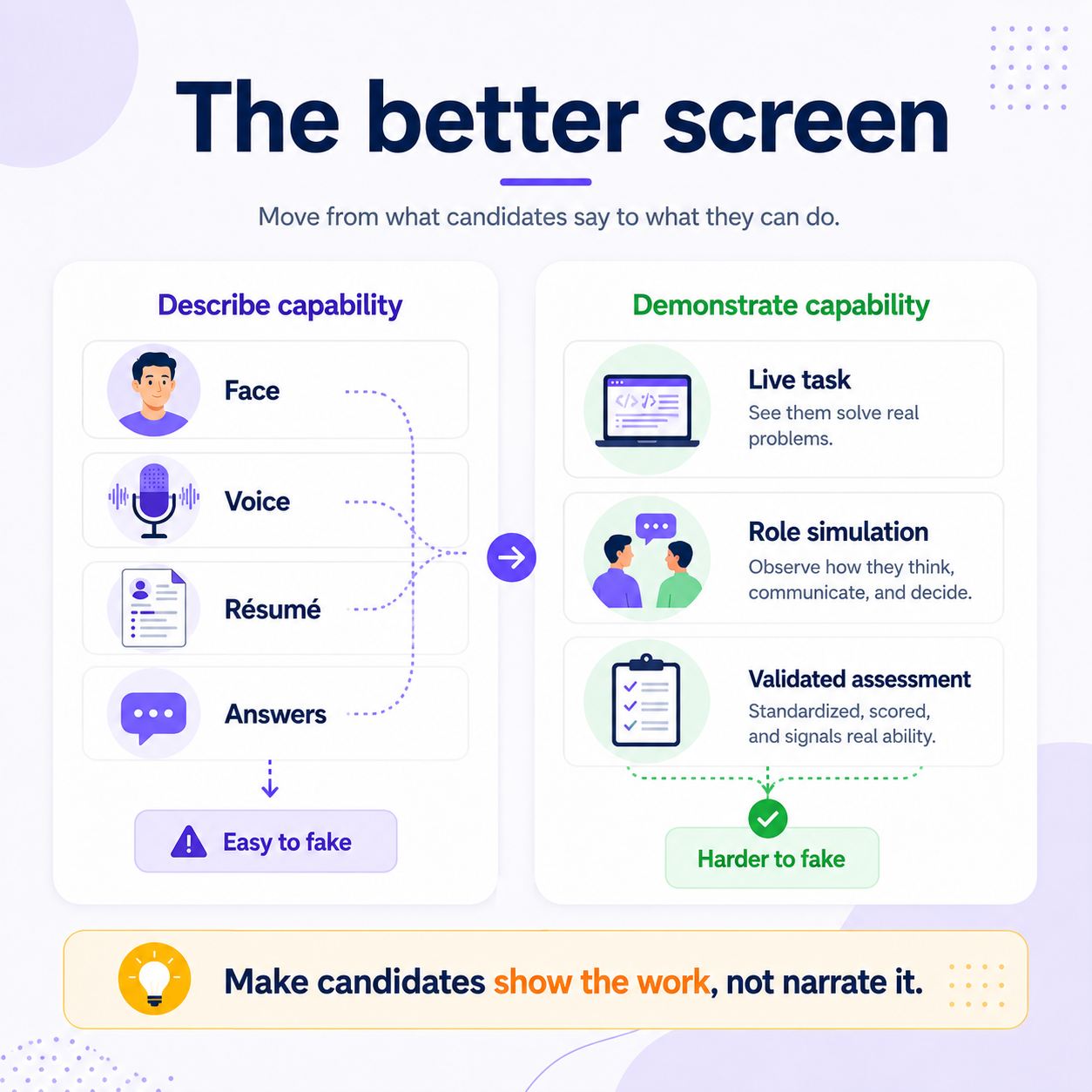
The reliable move is to change what screening measures. A competency-based assessment does not ask a candidate to describe capability. It places them in situations the role contains and scores the behavior against a benchmark for that role. Questions are drawn from a job ontology covering 255 live roles across six job families at four seniority levels, so a call centre representative and a customer service manager are measured against different competencies the ones that predict performance in each.
The framework spans 73 competencies grouped into 15 factors, covering behavioral traits, domain skills, and cognitive ability together. Screening on one of the three describes a third of the job. None of this can be pre-written from a job description, because none of it is asking a question a job description anticipates.
High Good and High Poor: the distinction that catches fabricated answers
Most scoring runs on a single scale from poor to excellent. That single axis is precisely what a generated answer is optimized to win. Ask a language model how to handle an escalating customer and it will maximize every virtue at once complete empathy, complete ownership, unlimited persistence, no trade-offs and no point of escalation. On a one-to-five scale, that is close to perfect.
PMaps scores each competency against four written behavioral anchors at each proficiency level:
- High Good — the competency at strength, with calibration
- High Poor — the same competency at full intensity, without calibration
- Low Good — functional within familiar conditions
- Low Poor — the competency absent
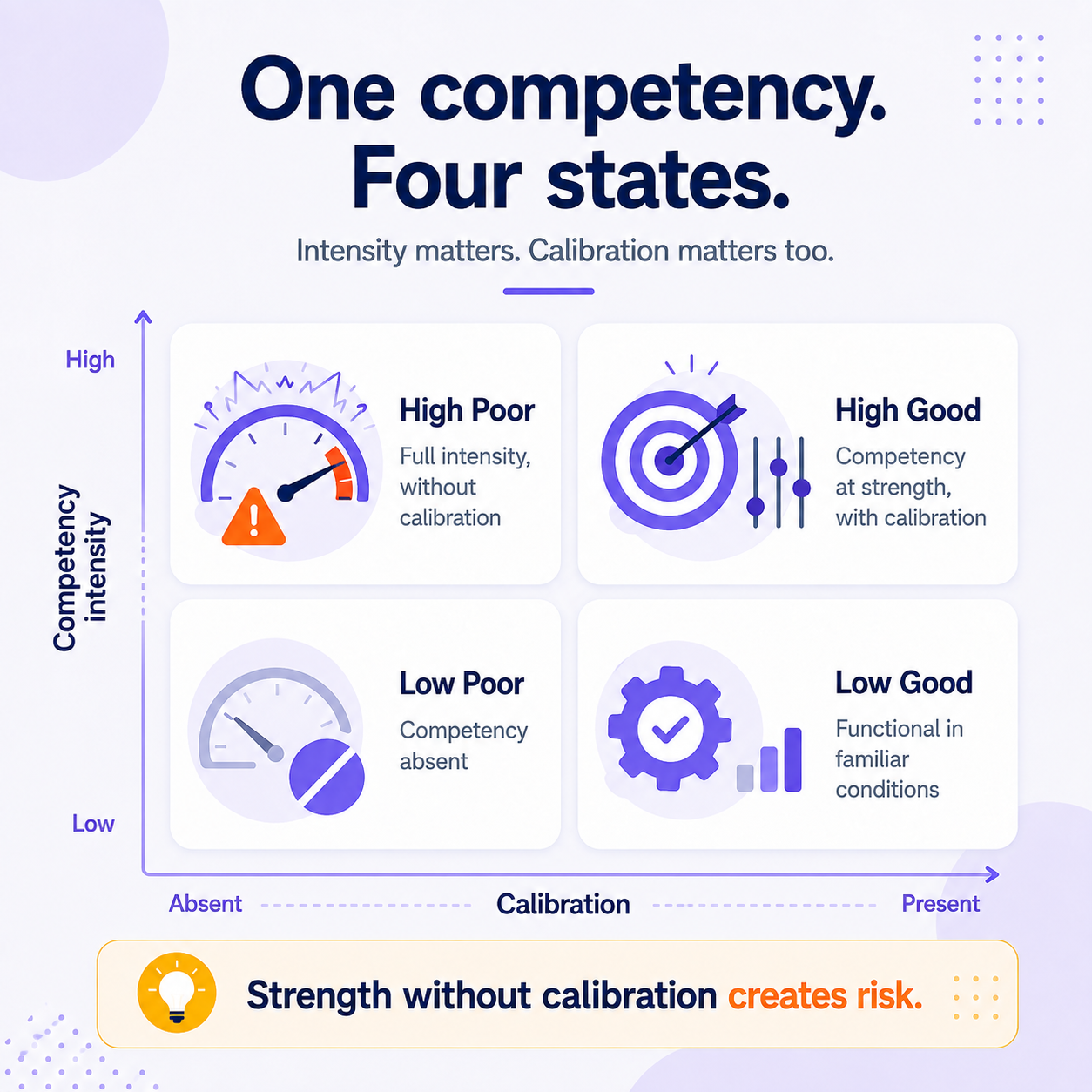
Result orientation at High Good sets demanding goals and adjusts the method when it fails. At High Poor it escalates goals continually and persists with a failing approach while absorbing pressure. Both read as "high" on a conventional scale. One predicts strong performance; the other predicts attrition.
The generated answer above is not a High Good response. It is a textbook High Poor response maximum intensity with no calibration is the definition of the maladaptive pattern. The fabricated answer does not evade the scoring. It lands in the category built to identify it. The output is a profile rather than a number: which competencies sit High Good, which sit High Poor, and where the risk is. Every score traces to a specific question, a defined ideal answer, a weight, and a recording.
What PMaps does, and what it does not
The AI Video Interview runs continuous identity verification for the duration of the interview rather than a single check at the start. A proxy candidate, a substitution partway through, an unknown face entering frame, or a person coaching off-camera are all flagged. On the secure desktop application, running AI assistant applications are detected and AI browser extensions are blocked.
What competency-based measurement changes is the value of the fraud. When a score reflects demonstrated behavior against a validated role benchmark, faking the presentation layer produces no advantage which is what forced the operatives in the Microsoft report to keep fabricating performance every day after being hired.
Try it on one of your own roles
PMaps is running 10 free pilots for hiring teams who would rather evaluate the tool on live data than in a demo. One role you are hiring for now, your candidates, your report at no cost, with no commitment.
Email ssawant@pmaps.in to begin, or book a walkthrough.
Sources: U.S. Department of Justice, Office of Public Affairs (24 July 2025) · Microsoft Threat Intelligence, AI as tradecraft: How threat actors operationalize AI (6 March 2026) · Gartner.