.webp)
.webp)


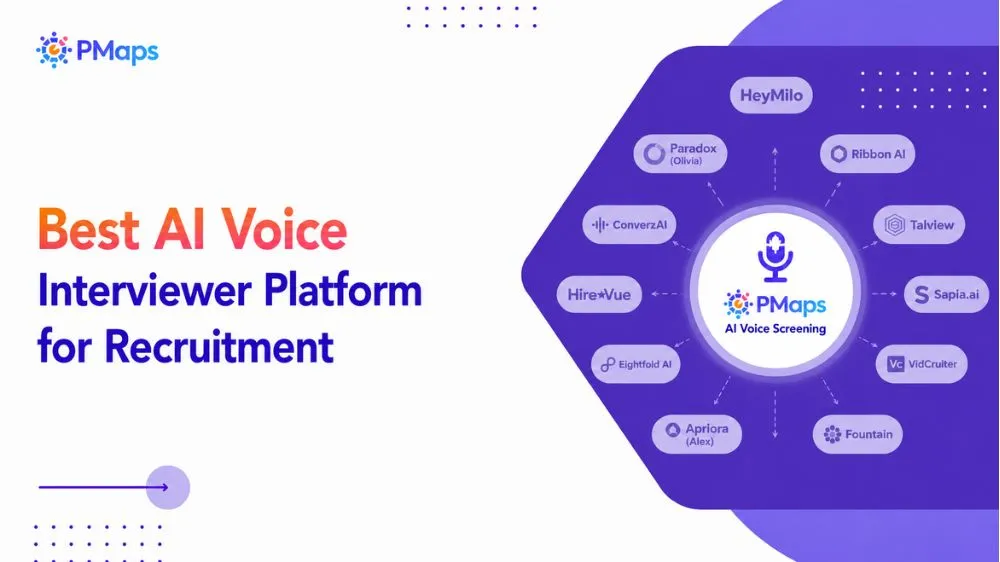
Choosing the best AI voice interviewer platform now shapes how fast companies can screen at scale without losing the signal that predicts on-job performance. The market has moved quickly: platforms that once offered basic voice bots have evolved into systems capable of structured conversational interviews, real-time scoring, multilingual support, and ATS-integrated reporting. This guide maps the leading tools, what each does well, and the criteria that actually matter when selecting for your hiring context.
What Separates a Genuine AI Voice Interviewer from a Voice Bot
The distinction matters practically. A voice bot follows a script and captures responses. An AI voice interviewer conducts an adaptive conversation, evaluates what the candidate says against structured criteria, and produces a scored, rankable output. The first reduces coordination cost. The second replaces the first-round human interview with a consistent, scalable evaluation.
The platforms worth evaluating sit firmly in the second category — they don't just automate outreach, they generate hiring intelligence.
Best AI Voice Interviewer Tools
1. PMaps EVA
PMaps EVA is an AI voice interviewer purpose-built for high-volume, communication-intensive hiring in BPO, customer service, sales, and allied sectors. EVA conducts structured telephonic interviews at scale — calling candidates, running adaptive screening dialogues in the candidate's preferred language, evaluating verbal fluency, tone, composure, and response coherence, and delivering ranked scorecards to recruiters without requiring a single manual call. The platform supports multilingual screening across Indian regional languages including Hindi, Tamil, Telugu, Kannada, Marathi, and Bengali, making it particularly well-suited for domestic frontline hiring where language diversity is a real operational challenge. EVA integrates with PMaps' broader assessment ecosystem, meaning voice screening results can be combined with psychometric, cognitive, and domain assessment data into a unified candidate profile. Automated follow-up through email, WhatsApp, and SMS reduces candidate drop-off, and a bot tele-call re-engagement feature reactivates candidates who go quiet mid-funnel.
2. HireVue Voice
HireVue extended its core video interviewing platform into voice-based assessment, primarily for telephone-first markets and roles where a video setup creates friction. The voice component leverages HireVue's established NLP infrastructure to evaluate verbal responses against structured criteria, though the depth of voice-specific scoring is less developed than its video analysis capabilities. HireVue is strongest in enterprise environments where its existing ATS integrations and compliance frameworks justify the platform cost.
3. Interviewer.AI
Interviewer.AI offers AI-driven voice and video screening with a candidate-facing interface that is notably accessible. Its voice assessment evaluates communication quality, enthusiasm, and response depth, with outputs structured for rapid recruiter review. The platform is positioned toward mid-market hiring teams that need structured AI screening without the implementation overhead of enterprise tools. Its scoring transparency is a practical strength — recruiters can see what the AI evaluated and why, which supports defensible shortlisting decisions.
4. Curious Thing
Curious Thing is an AI voice interview platform built specifically for phone-based candidate screening. It conducts outbound calls, runs structured interview dialogues, and delivers summary reports including sentiment analysis and response quality scoring. Curious Thing is well-suited for roles where phone interaction is the primary job communication channel — contact center, sales, and customer-facing positions — because it screens in the same medium candidates will actually use in the role. The platform handles high call volumes and operates across time zones without recruiter involvement.
5. Sapia.ai
Sapia.ai (formerly PredictiveHire) offers AI-powered chat and voice screening with a strong emphasis on candidate experience and bias reduction. Its voice interview format is conversational and relatively brief, designed to reduce candidate anxiety while still generating predictive personality and communication signals. Sapia is particularly adopted in sectors with large frontline hiring volumes — retail, logistics, and hospitality — where candidate experience at the screening stage affects employer brand and offer acceptance rates.
6. VoiceScreen (Vedantu / custom deployments)
Several enterprise deployments have built custom AI voice screening infrastructure on top of speech-to-text and NLP APIs, particularly in the EdTech and BFSI sectors in India. These custom implementations offer maximum control over evaluation criteria and data handling but require significant technical investment and ongoing maintenance. They are relevant primarily for organizations with dedicated HR technology teams and specific compliance requirements that off-the-shelf platforms cannot meet.
How to Choose the Right AI Voice Interviewer
The decision criteria that matter most depend on your hiring context, but a few consistently separate platforms that deliver value from those that generate noise.
Volume and Speed Requirements
If you're processing hundreds or thousands of candidates per role per week, you need a platform that can initiate and complete calls at that volume without degrading. Batch outreach capability, parallel call handling, and automated retry logic for unreachable candidates determine whether the platform actually removes the screening bottleneck or just partially automates it.
Role Type and Communication Assessment Depth
For roles where communication quality is a primary job requirement — BPO, customer service, sales, collections, field support — you need a platform that evaluates verbal fluency, tone, composure, and response coherence, not just whether the candidate completed the call. Platforms that produce a binary pass/fail output without scoring these dimensions don't deliver enough signal to improve hiring decisions.
Multilingual Capability
For domestic Indian hiring, regional language support is a real differentiator. A platform that can only conduct structured evaluation in English will consistently misrepresent candidates whose communication competence is strongest in Hindi, Tamil, Kannada, or another regional language. Verify whether multilingual support means translation or native-language conversation — they produce meaningfully different candidate experiences and evaluation quality.
ATS Integration and Reporting
An AI voice interviewer that creates a separate data silo will be abandoned quickly. Verify that assessment results flow directly into your ATS or HRMS, that candidate scorecards are in a format hiring managers can act on, and that the platform exports data in a structure your downstream systems can consume.
Candidate Experience
Drop-off at the screening stage is a real cost. Candidates who find the AI interview process confusing, overly long, or impersonal don't complete it — particularly in competitive hiring markets. Evaluate the candidate-facing experience directly before deploying at scale: the call initiation process, dialogue quality, call length, and follow-up communication all affect completion rates.
The Evaluation Shortcut
The fastest way to evaluate AI voice interviewing platforms is to run a parallel pilot: screen the same candidate pool through your current process and through the AI voice tool, then compare shortlist quality, time-to-shortlist, and recruiter time investment. Most reputable platforms will support a structured pilot on a live role. Run a pilot on a live role.
PMaps' voice agent for interviewing conducts conversational, structured screening calls at scale and delivers scored results hiring teams can act on.

.webp)