.webp)
.webp)


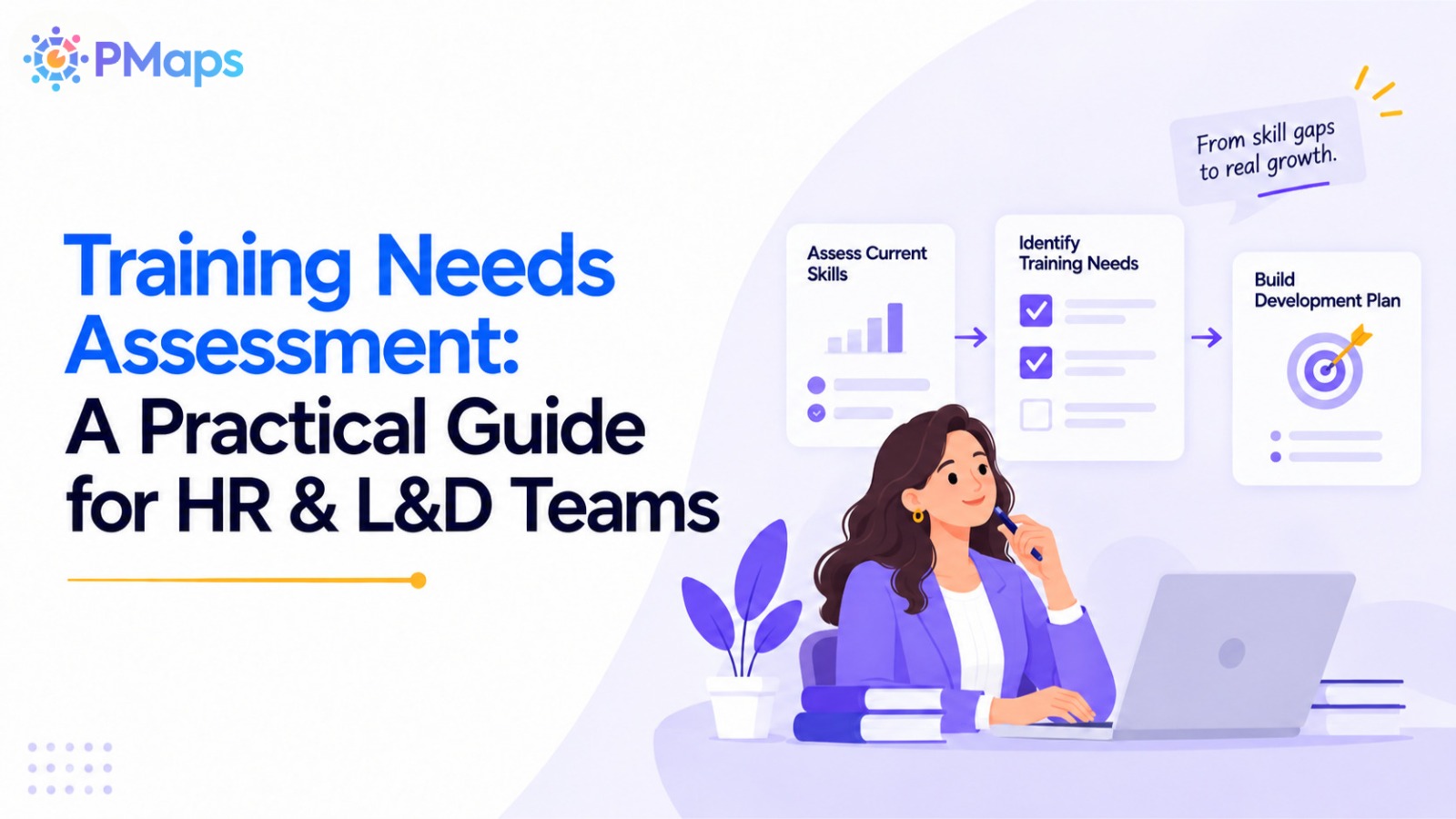
A training needs assessment helps HR and L&D teams decide what capability must improve before training begins.
Many training programmes start with a course calendar. A better approach starts with evidence. It asks where performance is falling short, why the gap exists, and which employees need support.
This makes training more precise. It reduces wasted learning budgets, avoids broad programmes, and connects development to measurable business outcomes.
What Is a Training Needs Assessment?
A training needs assessment is a structured process for identifying the gap between current employee capability and required performance standards.
It can be used at an organisation, team, or individual level. The goal is not to ask employees what training they want. The goal is to find what skills, knowledge, behaviours, or judgement areas are missing.
A useful training needs assessment combines role expectations, performance data, manager input, employee self-assessment, customer outcomes, quality metrics, and direct skill measures.
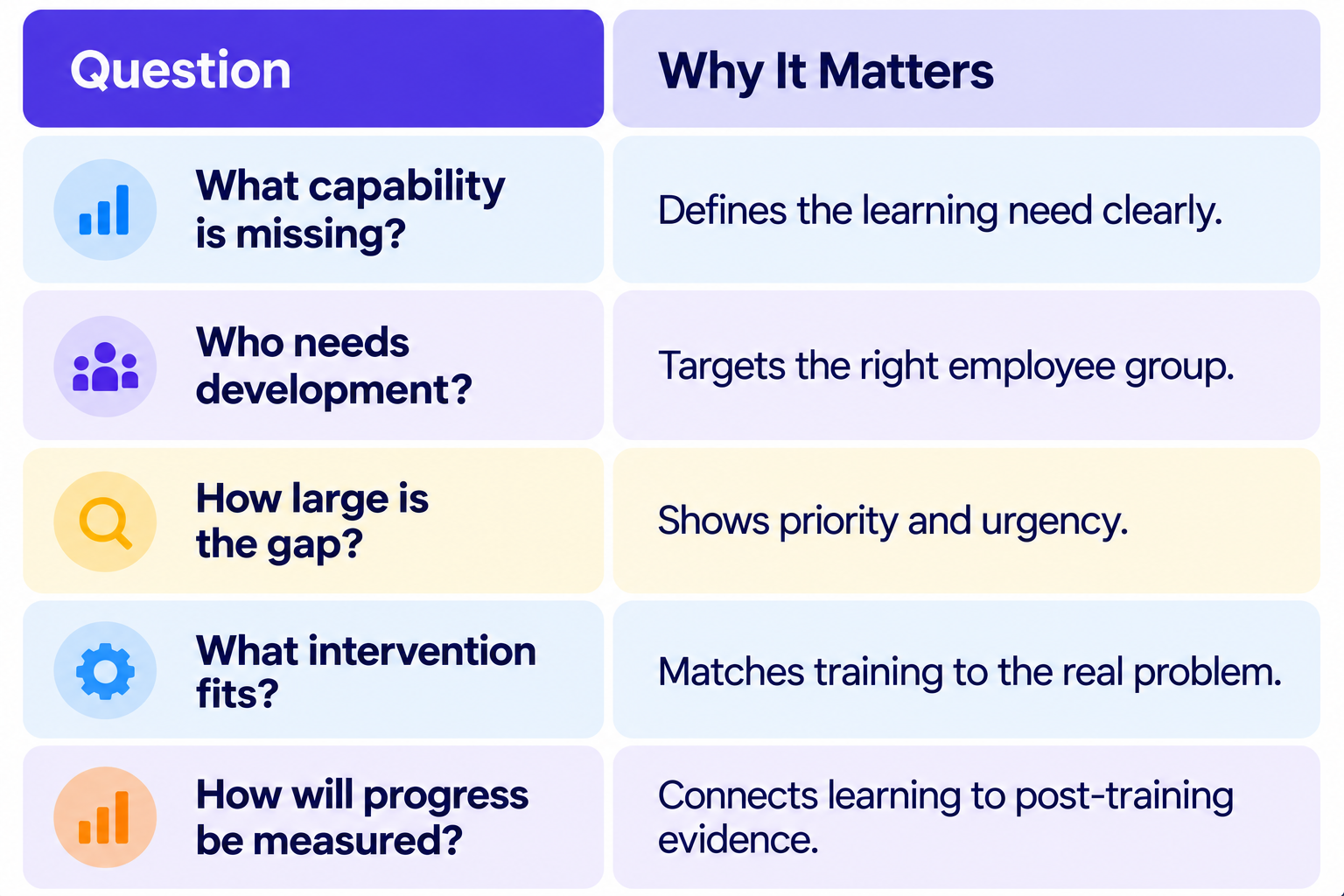
The final output should answer five practical questions:
- What capability is missing?
- Who needs development?
- How large is the gap?
- What intervention fits?
- How will progress be measured?
Training Needs Assessment vs Training Evaluation
A training needs assessment happens before learning, while training evaluation happens during and after learning. Both improve L&D decisions, but they answer different questions. A needs assessment identifies the performance gap, its cause, the target learners, and the baseline.
Training evaluation happens during and after the intervention. It checks whether the program was delivered well, whether participants learned, whether behavior changed, and whether the organization saw a useful outcome.
A strong L&D process connects both. A training needs assessment helps HR decide what training should happen. Training evaluation helps HR decide whether the training worked.
When Should You Run a Training Needs Assessment?
Run a training needs assessment when a performance issue is important enough to need evidence, not assumptions, before training decisions are made.
Common triggers include:
- A new role, process, product, or technology is being introduced.
- Quality, productivity, sales, or customer metrics are below expectation.
- Employees are moving into first-time manager or leadership roles.
- A business unit is scaling, and role expectations are changing.
- Compliance, risk, or process errors show repeated capability gaps.
- A large learning program needs objective pre/post measurement.
- Internal mobility or succession decisions require development evidence.
These triggers help HR teams decide when training needs structured diagnosis before program design.
The Three Levels of Training Needs Assessment
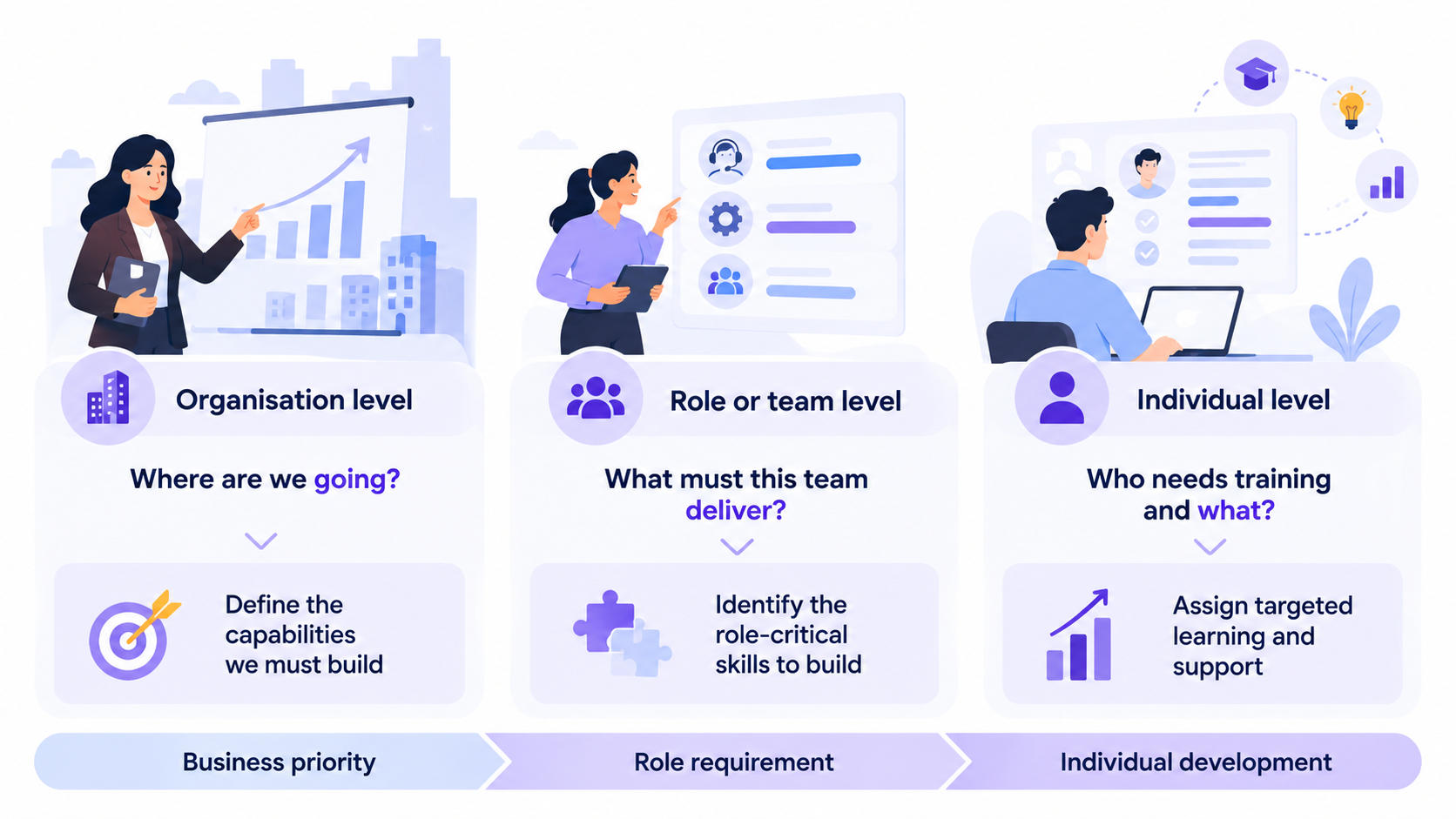
The three levels of training needs assessment show where capability gaps exist. HR can review capability at organizational, operational, and individual levels before deciding the right learning response.
Organization level
The organization-level studies broad business goals, culture shifts, technology changes, and industry trends. It answers where the company wants to go and which institutional skills are required. This level helps HR align training with expansion, digital adoption, compliance risk, customer expectations, and future workforce planning across teams.
Role or team level
The role or team level examines departments, job descriptions, daily tasks, and core competencies. It asks what skills or technical proficiencies a team needs to perform reliably. This level helps HR design role-specific training for sales, customer service, operations, technology, leadership, and other function-based performance needs.
Individual level
The individual level looks at personal performance, learning preferences, and exact skill gaps. It answers who needs training and which competencies need improvement. This level helps managers assign targeted learning, coaching, assessment-based development plans, or post-training support based on each employee’s strengths and capability gaps.
How to Conduct a Training Needs Assessment
A training needs assessment works best when each step connects business goals, capability gaps, evidence, training design, and post-training measurement.
Step 1: Start with the business outcome
Define the result that needs improvement. Avoid broad goals such as “improve communication.” Use specific outcomes, like reducing customer escalations or improving delegation quality.
Step 2: Define the required capability
Convert the business outcome into clear knowledge, skill, judgement, or behaviour. A sales programme may need probing, objection handling, and commercial judgement.
Step 3: Establish the current baseline
Use the strongest available evidence. This may include tests, simulations, work samples, manager ratings, customer metrics, behavioural measures, or performance data.
Step 4: Separate skill gaps from other causes
Not every performance issue needs training. Low performance may come from unclear processes, weak tools, unrealistic targets, missing data, or poor role design.
Step 5: Prioritise the gaps
Rank gaps by business impact, frequency, risk, and ease of improvement. This stops one programme from trying to teach everything at once.
Step 6: Match the intervention to the gap
Knowledge gaps may need instruction and practice. Judgement gaps may need scenarios. Behavioral gaps may need feedback. Technical gaps may need simulations.
Step 7: Define the post-training measure early
Decide how improvement will be tested before training starts. The post-training assessment should use the same capability framework as the baseline.
What Should a Pre and Post-Training Assessment Measure?
Pre and post-training assessments show whether the targeted capability changed after learning. The measure must match the learning objective, role context, and baseline competency framework for fair comparison across cohorts.
- For knowledge programmes, measure role-relevant concepts through objective questions or applied case questions.
- For technical programmes, measure job readiness through work samples, simulations, coding tasks, or structured problem-solving tasks.
- For manager development, measure judgement, decision-making, delegation, feedback quality, and situational response.
- For communication programmes, measure spoken, written, or scenario-based responses that reflect real workplace tasks.
The key principle is comparability. Pre and post-training assessment results must follow the same competency structure, so HR can track improvement at both participant and cohort level.
Example Training Needs Assessment Framework
A training needs assessment framework shows how evidence moves from business need to learning action. This example explains how HR can structure manager development with clear baseline and post-training measures.
- Business outcome: Improve first-line manager effectiveness.
- Required capabilities: Assess delegation, feedback, conflict handling, decision-making, and prioritisation.
- Baseline evidence: Use manager scenario assessment, self-input, manager input, and performance indicators.
- Intervention: Build a targeted manager programme around the largest capability gaps.
- Post-training measure: Use an equivalent scenario assessment mapped to the same competencies.
- Final decision: Continue, reinforce, coach, or redesign based on improvement evidence.
Common Mistakes to Avoid
A training needs assessment can lose value when evidence is weak or actions are unclear. These mistakes make training broad, hard to measure, and disconnected from actual capability gaps quickly.
- Starting with a training catalogue instead of a business problem.
- Using only employee self-ratings as evidence.
- Measuring attendance and satisfaction, but not capability.
- Testing generic knowledge that is not tied to the role.
- Using different frameworks before and after training.
- Treating every performance issue as a training problem.
- Collecting assessment data without deciding the next action.
How PMaps Can Support Training Assessment
PMaps helps HR teams build training needs assessment programmes around role-specific competencies, not generic test scores.
For L&D teams, the first value is baseline clarity. PMaps assess cognitive ability, behaviour, communication, technical skills, role fit, and scenario-based judgement before training begins. This helps HR identify who needs development and which capability gaps need priority.
After the learning programme, HR teams can run post-training assessments using the same competency framework. This makes improvement easier to compare across employees, cohorts, teams, and roles.
PMaps also supports training decisions through psychometric tests, skills assessments, voice and video interviews, analytics dashboards, and employee feedback tools. These inputs help HR understand capability, behaviour, communication, engagement, and development readiness in one system.
This makes PMaps useful for training diagnosis, manager development, internal mobility, and post-training measurement. The final design should follow the learning objective and the decision HR needs to make from the results.
Training Needs Assessment Checklist
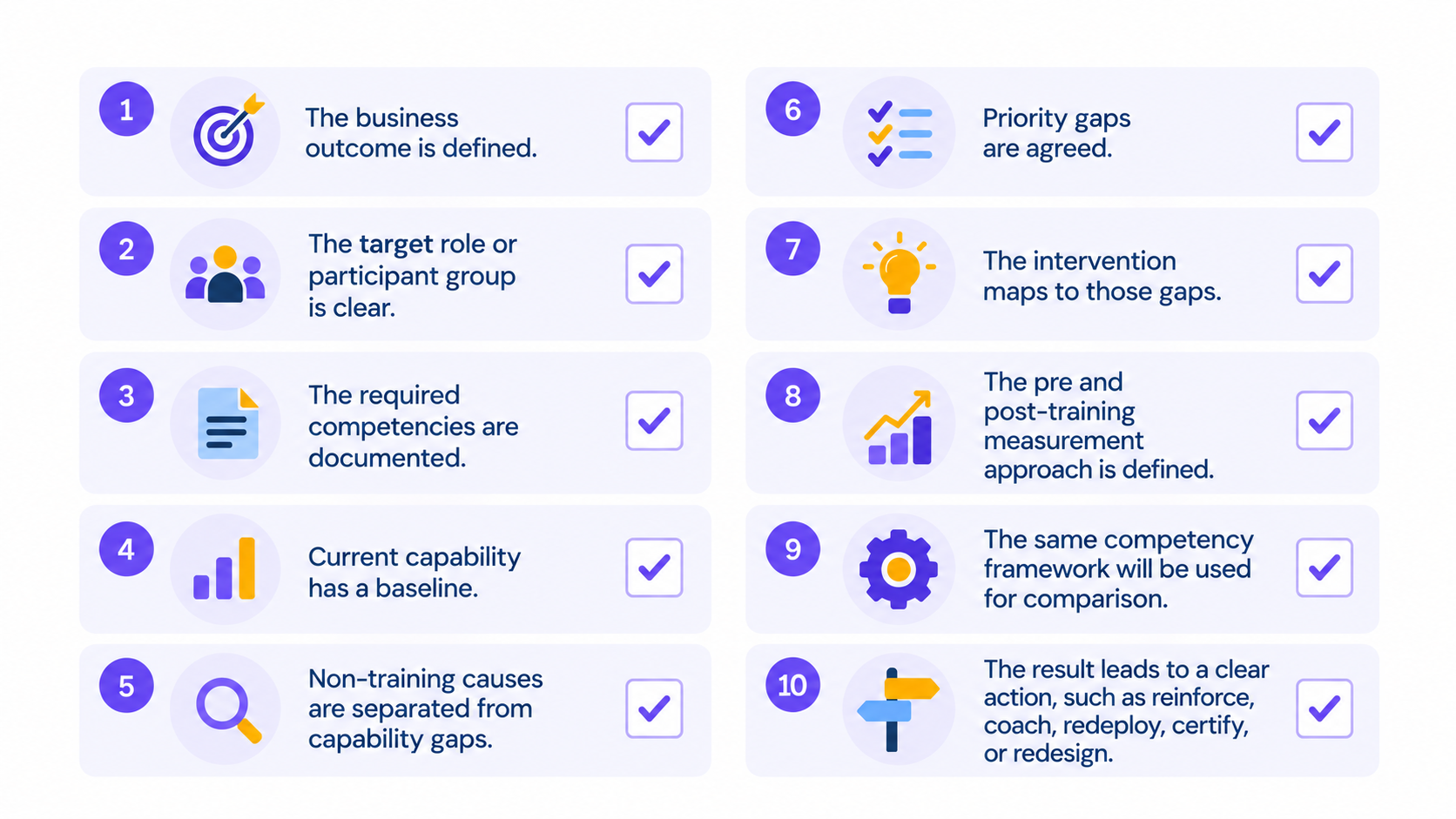
Before launching training, use this training needs assessment checklist to test readiness. Confirm the outcome, target group, competency gaps, measures, and follow-up actions before committing time or budget.
- The business outcome is defined.
- The target role or participant group is clear.
- The required competencies are documented.
- Current capability has a baseline.
- Non-training causes are separated from capability gaps.
- Priority gaps are agreed.
- The intervention maps to those gaps.
- The pre and post-training measurement approach is defined.
- The same competency framework will be used for comparison.
- The result leads to a clear action, such as reinforce, coach, redeploy, certify, or redesign.
Final Takeaway
A training needs assessment helps HR and L&D teams move from broad training plans to focused capability improvement.
The strongest approach starts with a clear business outcome. It then defines the required capability, measures the current gap, and sets the post-training measure before learning begins.
This gives HR a practical answer to two questions: what training should we run, and did capability actually improve?
Planning a role-specific training or manager-development programme? Book a demo with PMaps to build competency-based pre and post-training assessments for role-specific development.