.webp)
.webp)


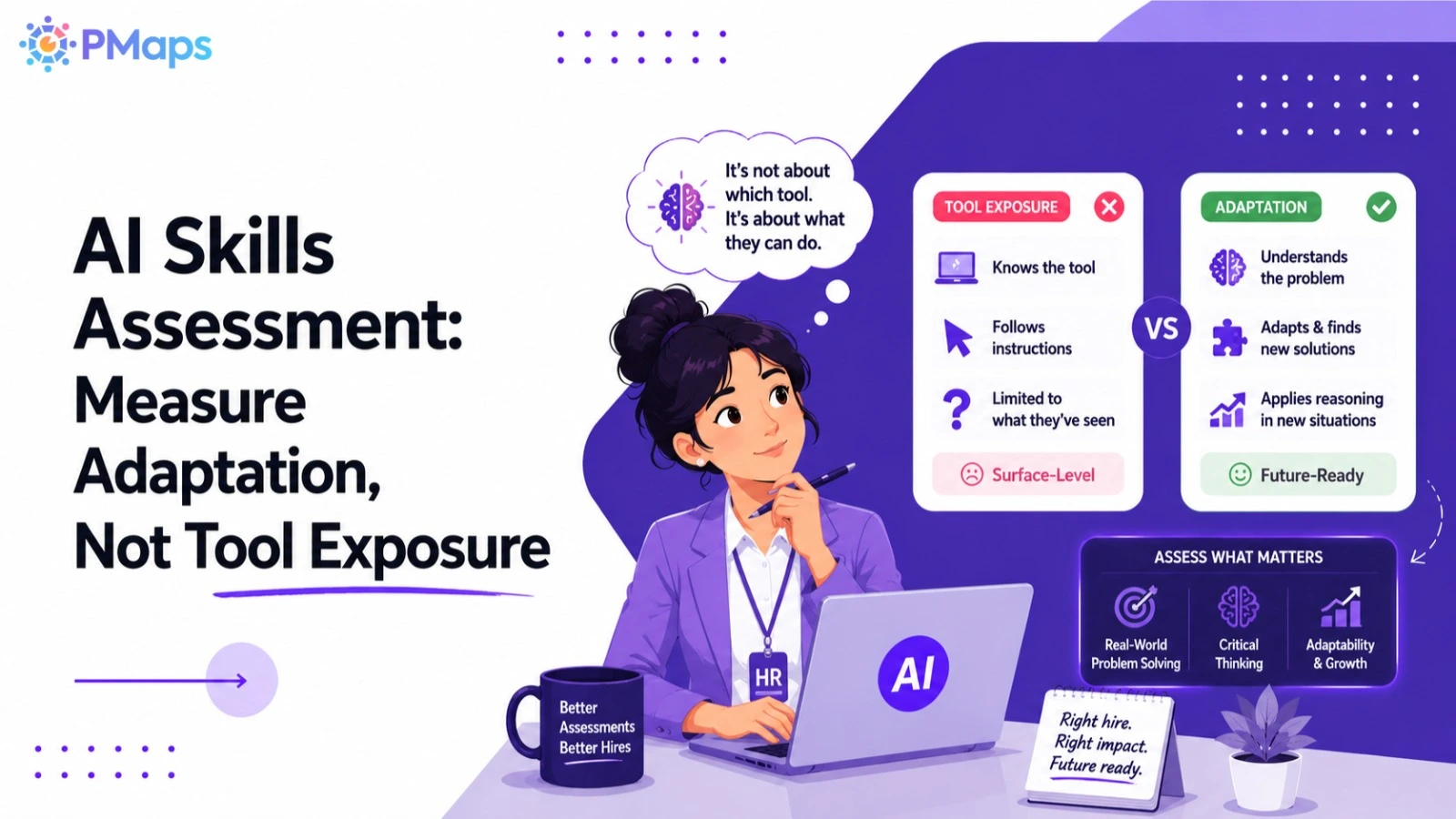
Gartner expects that by 2027, 75% of hiring processes will include certifications and tests for workplace AI proficiency. Most enterprises will meet that forecast by asking candidates which AI tools they have used. That measures exposure, and exposure is not the thing that predicts performance.
An AI skills assessment is for employers deciding who to hire and who to develop. It is not a self-test, and this page is written for HR and talent acquisition leaders rather than for candidates.
What is an AI skills assessment?
An AI skills assessment measures how effectively a person works alongside AI tools in a specific role. The useful version tests adaptation whether someone can absorb a capability that changes under them and keep their judgment intact rather than which tools they have already used. That distinction is the whole subject of this page, because the two things look similar on a scorecard and behave nothing alike on the job.
Gartner named two forces behind its forecast. The first is candidate fraud: AI has made it straightforward to produce a polished answer to a predictable question, so hiring teams need a way to verify a capability is real. The second is that the work has changed, and enterprises need to know whether a person can do it alongside AI rather than in spite of it. Both are real problems. A tool inventory solves neither.
Why does testing AI tool knowledge fail?
Tool knowledge goes stale on the vendor's release schedule. An assistant behaves differently six months apart, so a candidate scored on the old version has been scored on something that no longer exists. The test also rewards recency, favoring whoever most recently worked somewhere well-tooled.
Consider what that means in practice. Two candidates apply for the same analyst role. One left an employer with a mature AI stack last month and can name six tools fluently. The other has spent three years at an organization that deployed nothing, learning unfamiliar systems without support each time the finance team changed platforms. An AI proficiency test built as a tool inventory ranks the first candidate higher. The second is the one who will absorb whatever you deploy next year.
A skill is something a person can list. A competency is something you can watch them do. AI proficiency, tested as a tool inventory, is a list.
There is a second failure mode, and it is the more expensive one. A tools test is easy to prepare for. Any assessment that a candidate can rehearse from a job description is an assessment that measures preparation, which is precisely the fraud problem Gartner cited as a reason to test in the first place.
What should an AI skills assessment measure instead?
It should measure adaptation under change, judgment retained under automation, and learning without support. The failure mode in AI-assisted work is rarely refusal to use the tool. It is uncritical acceptance of what the tool returns, and that shows up around month four rather than in week one.
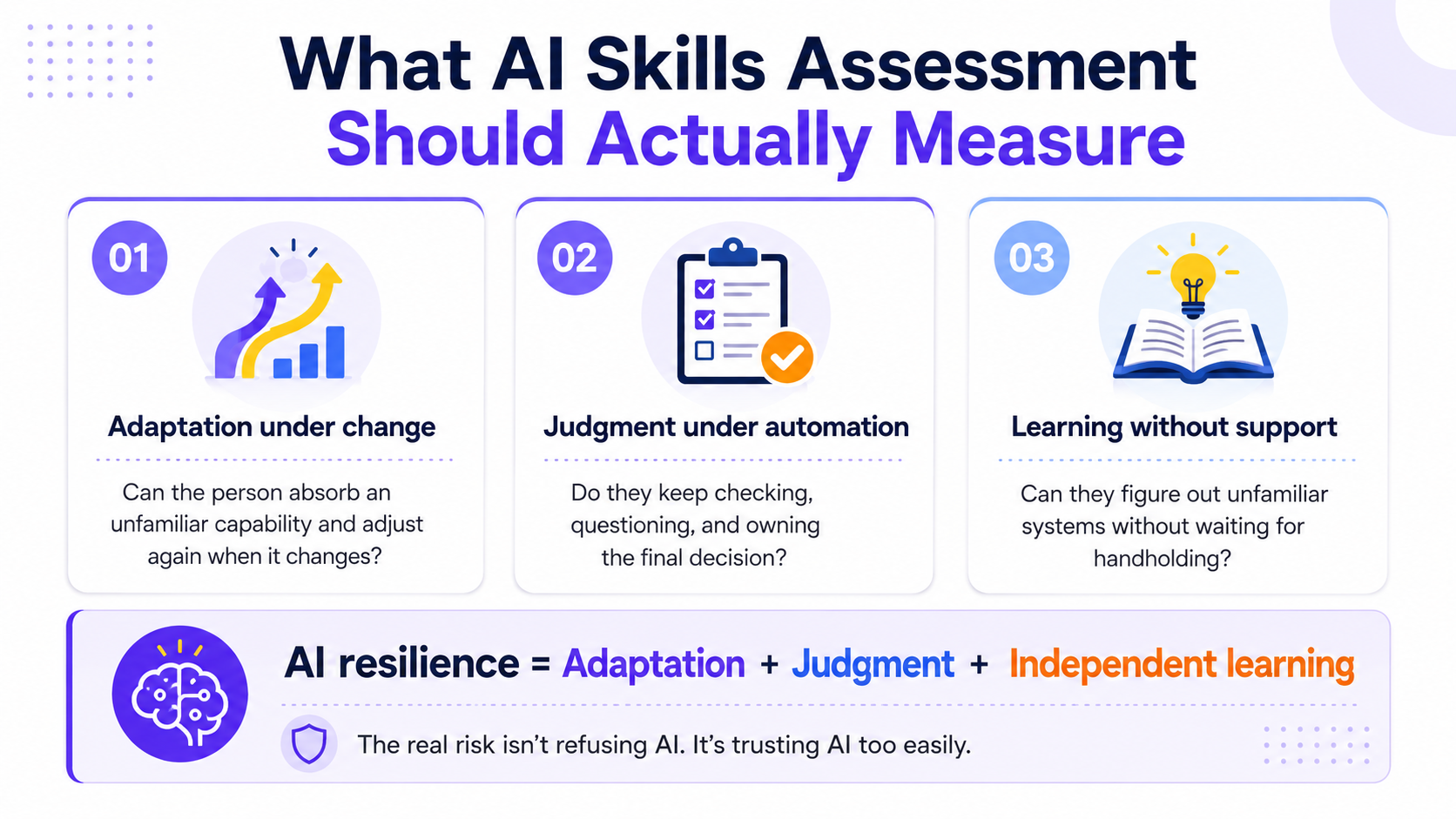
Three behaviors carry most of the predictive weight.
Adaptation under change. Can the person take on an unfamiliar capability without being walked through it, and do it again when the thing changes six months later. During onboarding, when learning is the job and everyone is patient, almost everyone adapts. The question is what happens under delivery pressure with no handholding.
Judgment retained under automation. An analyst who stops sanity-checking a number because the output arrived formatted and confident. A support lead who ships a drafted response that is fluent and wrong. Neither refused the tool. Both stopped owning the decision, and the decision was the part of the job that was theirs.
Learning without a teacher. Ask someone how they learn and you will get enthusiasm. Ask them what they had to learn last year that they did not want to learn, and who taught them, and what they did before that person was available, and you will get a method or you will get nothing.
None of these are new competencies invented for AI. They are established behaviors that AI adoption has made commercially urgent, which is why they can be assessed with validated instruments rather than with a novel test nobody has benchmarked.
How do you assess AI skills in your existing workforce?
Run the same adaptation questions against people already doing the role well, and use their answers as the benchmark. AI skills gap analysis then tells you who can absorb a changed role rather than which functions are exposed — a different and far more actionable finding. This is the half of the subject that hiring-focused coverage tends to miss, and it is the larger half.
Nomura reported on 10 August 2026 that AI-linked hiring in India has outpaced AI-linked displacement by more than 51,000 roles, framing AI as a job transformer rather than a job destroyer. Read that carefully, because it is not the reassurance it appears to be. If roles are transforming rather than disappearing, the pressure does not land on recruitment. It lands on redeployment.
Redeployment requires something most enterprises do not have: a view of who can absorb a changed role, held at the level of the individual rather than the job title. Most organizations can name which functions are exposed. Very few can name which people within those functions will adapt, and only the second version of that question can be acted on.
Practically, that means an assessment program that runs against employees as well as applicants, feeding promotion, internal mobility, and targeted upskilling rather than only screening. Our approach to competency-based behavioral assessment for hiring uses the same instruments in both directions.
What interview questions reveal AI adaptation?
Ask what the person's team changed in its tooling last year, what they did in the first week after it changed, and what they stopped trusting it to do. The third clause is where strong answers separate from rehearsed ones. Listen for a method rather than for enthusiasm.
Three questions worth adding to an existing interview, and they cost nothing to run.
One. "Describe something your team's tooling changed in the last year." Neutral opener. You are establishing that a change happened and that the person noticed it.
Two. "What did you do in the first week after it changed?" You are listening for specific action. Weak answers describe a feeling about the change. Strong answers describe what the person read, who they asked, what they tried and abandoned.
Three. "What did you stop trusting it to do?" This is the question that works, and almost nobody asks it. A person who has genuinely integrated a tool into their work has found its edges and can name them. A person who has read about the tool cannot, because its limits are not documented in the marketing.
Before running any of this, write down what "working with AI" concretely means in the role this quarter not the tools, the judgment. What decision does the person still own after the tool has done its part? If you cannot write that down, you cannot test for it, and any assessment you buy will measure something else.
How is this different from an AI readiness assessment?
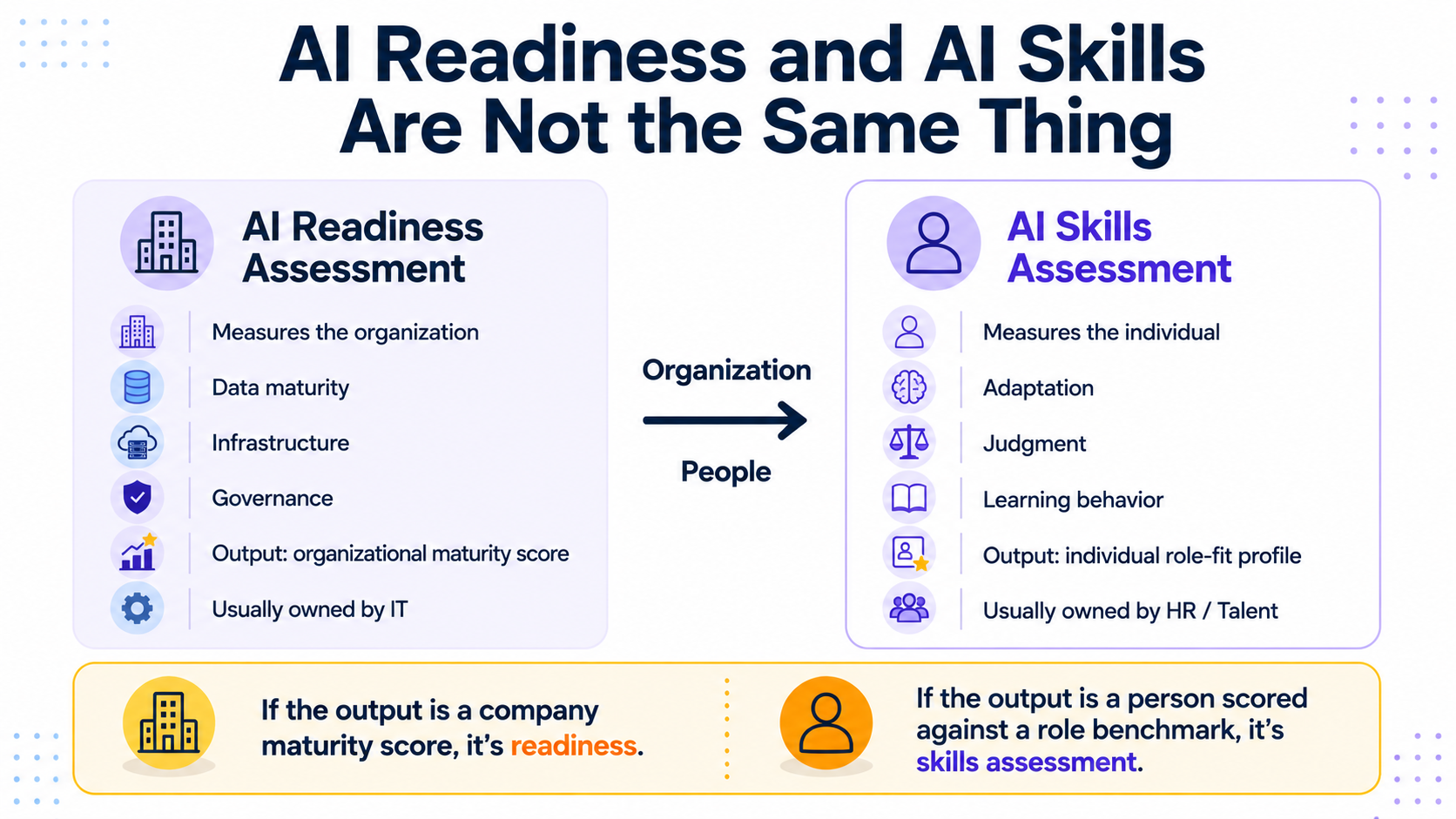
An AI readiness assessment usually evaluates an organization's data, infrastructure, and governance maturity. An AI skills assessment evaluates people. Vendors use the terms interchangeably, but they answer different questions and are bought by different teams IT for the first, HR for the second.
The distinction matters when you are shortlisting vendors. Search for AI readiness assessment and you will mostly find systems integrators and consulting firms scoring your data estate. That is legitimate work and it is not talent assessment. If the output is a maturity score for your organization, it is a readiness assessment. If the output is a profile for a named individual against a role benchmark, it is a skills assessment.
An AI readiness assessment for employees the people-side variant sits closer to skill-gap analysis than to infrastructure scoring, and belongs with whoever owns workforce development rather than with whoever owns the data platform.
How does PMaps assess AI skills and adaptation?
PMaps assesses AI resilience how readily a person adapts to working with AI as part of Career Elevation Assessments, alongside skill-gap analysis. That placement is deliberate: it runs against your existing workforce, not only against applicants. Three things make a PMaps score a prediction rather than a result.
We measure across several modes cognitive, behavioral, and psychometric assessments plus AI Video Interview and EVA, our AI Voice Interviewer so a score reflects the whole person rather than one narrow test.
Every score is read against validated role benchmarks, so a good score means good for this role rather than good in the abstract. And scores are checked against real on-the-job performance and attrition outcomes across sectors, not against theory.
12 years. 4M+ assessments completed. 200+ enterprise clients across 7 countries. For teams comparing platforms, our pre-employment assessment tests for job fitment cover the screening half of this.
One caution, since this is a category that invites overclaiming. Structured, competency-based assessment reduces bias relative to unstructured interviewing. It does not remove it, and a vendor telling you otherwise is describing a marketing position rather than a measurement one. Gartner's date is 2027. The useful work defining what the role actually requires is available to you this quarter, and it is the part no vendor can do for you. See how a competency profile is built for one role
We run a 30-minute working session on a role you are struggling to hire. We map it against our job ontology and you leave with a competency profile you can hand to your interview panel, whether or not you ever run an assessment with us.