.webp)
.webp)


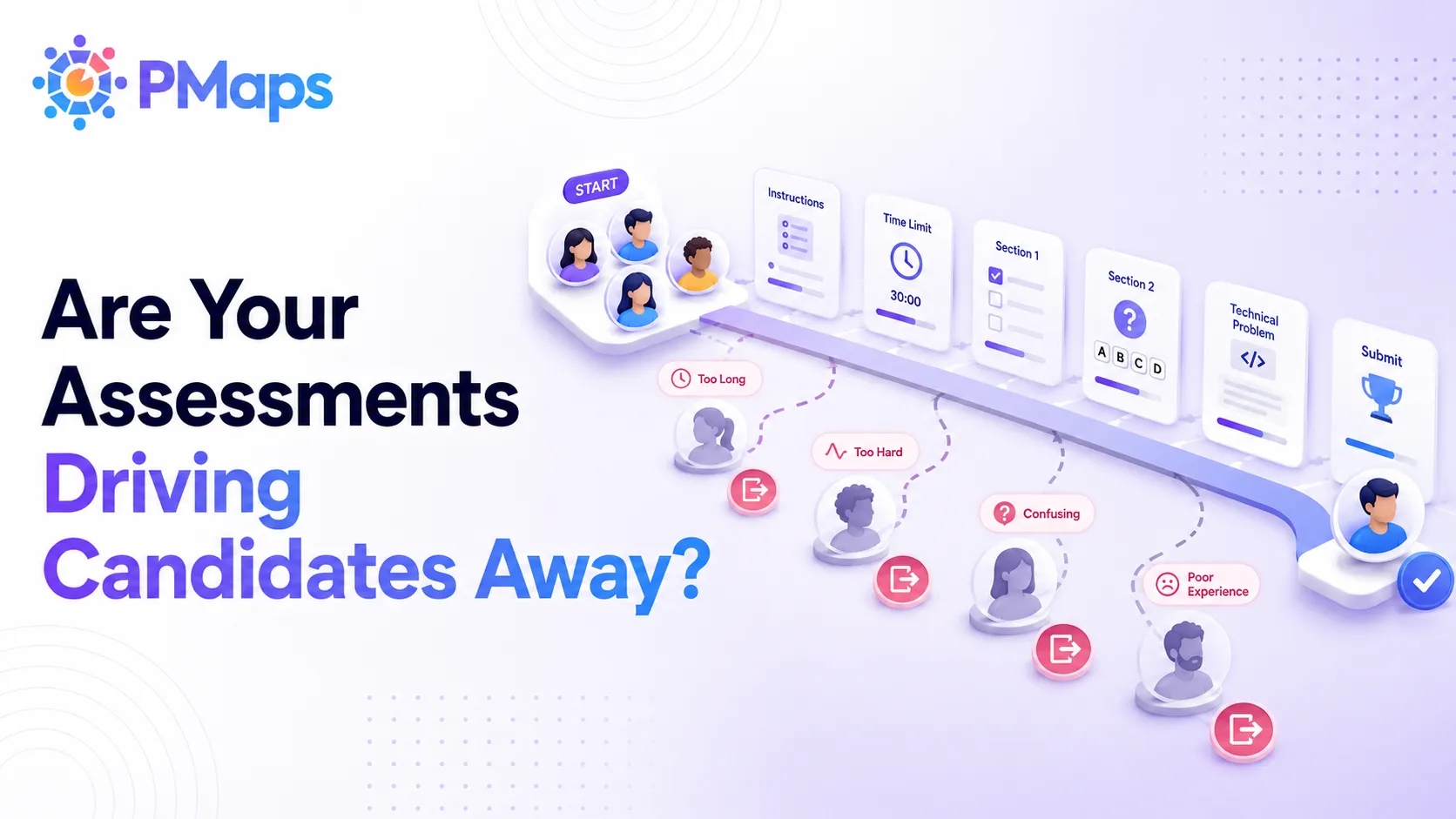
There's a quiet tension in every hiring assessment: thoroughness pulls one way, candidate experience pulls the other. Add sections to feel rigorous, and you bleed candidates — the good ones especially, because they have other offers and less patience. Strip it down for speed, and you risk losing the signal that makes the test worth running. Most teams resolve this by guessing, and most guess long.
The better answer isn't shorter or more accurate — it's both. Because predictive power concentrates in a few competencies, you can cut length from the parts that don't predict and keep the parts that do. This guide covers how long an assessment should actually be, what extra length really costs, and how to trim it without losing validity.
In short: Most pre-hire assessments should run about 20–30 minutes; beyond that, completion rates fall and stronger candidates drop off fastest. You can shorten safely by weighting the test on the competencies that predict performance and trimming or relocating low-signal sections — keeping the predictive power while cutting the minutes. Length should be set by signal, not by a sense that longer equals more thorough.
What extra length actually costs
Every minute you add to an assessment has a price, and it's usually invisible until you measure it:
- Drop-off rises. Completion rates fall as length climbs, and the curve gets steep past the half-hour mark. Candidates abandon mid-test, and you never see them again.
- You lose the best candidates first. High-demand candidates have options. They're the most likely to walk away from a long, tedious assessment — so length quietly skews your funnel against the people you most want.
- Your employer brand takes a hit. A bloated, irrelevant test signals that the company doesn't value the candidate's time. That impression outlives the application.
A long assessment doesn't just cost minutes; it costs candidates, quality, and reputation.
The myth: longer means more rigorous
The instinct that more sections equals more rigor is exactly backwards. Rigor comes from measuring the right things well, not from measuring more things. A test can run 40 minutes and still rest its decision on a handful of competencies — because predictive power isn't spread evenly across sections. (See why hiring assessments shouldn't be equally weighted.)
When PMaps validated a tele-sales assessment for a leading BFSI lender, two competencies carried 84% of the predictive weight, while one section consumed roughly a third of total test time for about 1% of the weight. Streamlining the low-signal section could shrink the battery from 40 minutes toward roughly 28 — faster for candidates, cheaper at volume — while keeping 84%+ of the predictive power intact. The shorter test wasn't the weaker one.
So how long should it be?
There's no universal number, but a useful rule of thumb is 20–30 minutes for most pre-hire screening, with the exact length set by three factors:
- Role stakes. A senior or specialized role justifies more assessment than a high-volume frontline one.
- Funnel volume. The higher the applicant volume, the more a shorter test pays off in completion and cost.
- What actually predicts. Length should follow signal — keep what discriminates, trim what doesn't.
For high-volume frontline hiring, lean toward the shorter end; protecting completion and recruiter time matters more there than squeezing out a marginal section.
How to shorten without losing validity
1. Weight on what predicts
Build the score on the competencies that discriminate high from low performers. Once you know which sections carry the weight, the candidates for cutting become obvious. (See how to validate a hiring assessment.)
2. Trim or relocate low-signal sections
A section with high time cost and low predictive value should be shortened, dropped, or moved to a post-offer developmental check rather than gating every candidate up front.
3. Use role-relevant, well-calibrated items
Tight, role-specific items measure more in less time than generic ones. Calibrated difficulty avoids both wasted easy questions and demoralizing impossible ones.
4. Make it mobile-first and multi-language
Frontline candidates often test on a phone, in their own language. A mobile-friendly, localized assessment reduces friction and drop-off without lowering the bar.
5. Set expectations and show progress
Tell candidates up front how long it takes and why it's relevant, and show a progress indicator. Perceived length matters as much as actual length; clarity keeps people in.
Measure it, don't guess
- Completion rate — the headline candidate-experience metric.
- Drop-off by section — shows exactly where candidates abandon, so you know what to fix.
- Time-on-task — actual vs. expected duration.
- Predictive power retained — confirm validity holds after any trim.
Common mistakes
- Equating length with rigor. Accuracy comes from measuring the right things, not more things.
- Gating on low-signal sections. They cost time and candidates without improving the decision.
- Ignoring mobile. A desktop-only test silently filters out frontline applicants.
- Never measuring completion. If you don't track drop-off, you can't see what length is costing you.
- Trimming without re-checking validity. Cut the right parts and confirm the signal survives.
How PMaps helps
PMaps is an AI-powered talent assessment platform that helps enterprises improve their hiring odds — scientifically. Role-specific, validated, mobile-first assessments in 8+ Indian languages keep candidates engaged — PMaps assessments see high completion rates because they measure what predicts and respect the candidate's time. Trusted by 200+ enterprise clients across 7 countries. [confirm current approved figures, incl. completion rate, before publish]
Want a shorter, sharper assessment for your roles? Book a 30-minute walkthrough and we'll trim to signal.