
An education services company in India assessed candidates for communication-heavy roles over one quarter, July to September 2026. AI proctoring flagged 45% of all attempts for review. That included 46% of candidates who had scored well enough to be rated fit for the role.
Without proctoring, recruiters reviewing candidates who met the assessment benchmarks would have missed potential integrity concerns in 46% of those attempts. This post looks at what the test measured, what separated strong candidates from weak ones, and what the integrity data means for anyone hiring at volume.
Why do education companies struggle to screen for communication?
Education companies hire at volume for roles where spoken English decides performance: counsellors, academic advisors, student support and sales. A resume says nothing about how someone speaks, and a phone screen for every applicant does not scale. Online tests solve the scale problem but bring a new one: you cannot see who is taking them.
That second problem is bigger than most teams assume. A HirePro study of 9 lakh Indian job assessments found that 30% to 50% of entry-level candidates cheat, and that cheating rises 80% to 100% when there is no effective proctoring (People Matters, 2023).
What did the assessment measure?
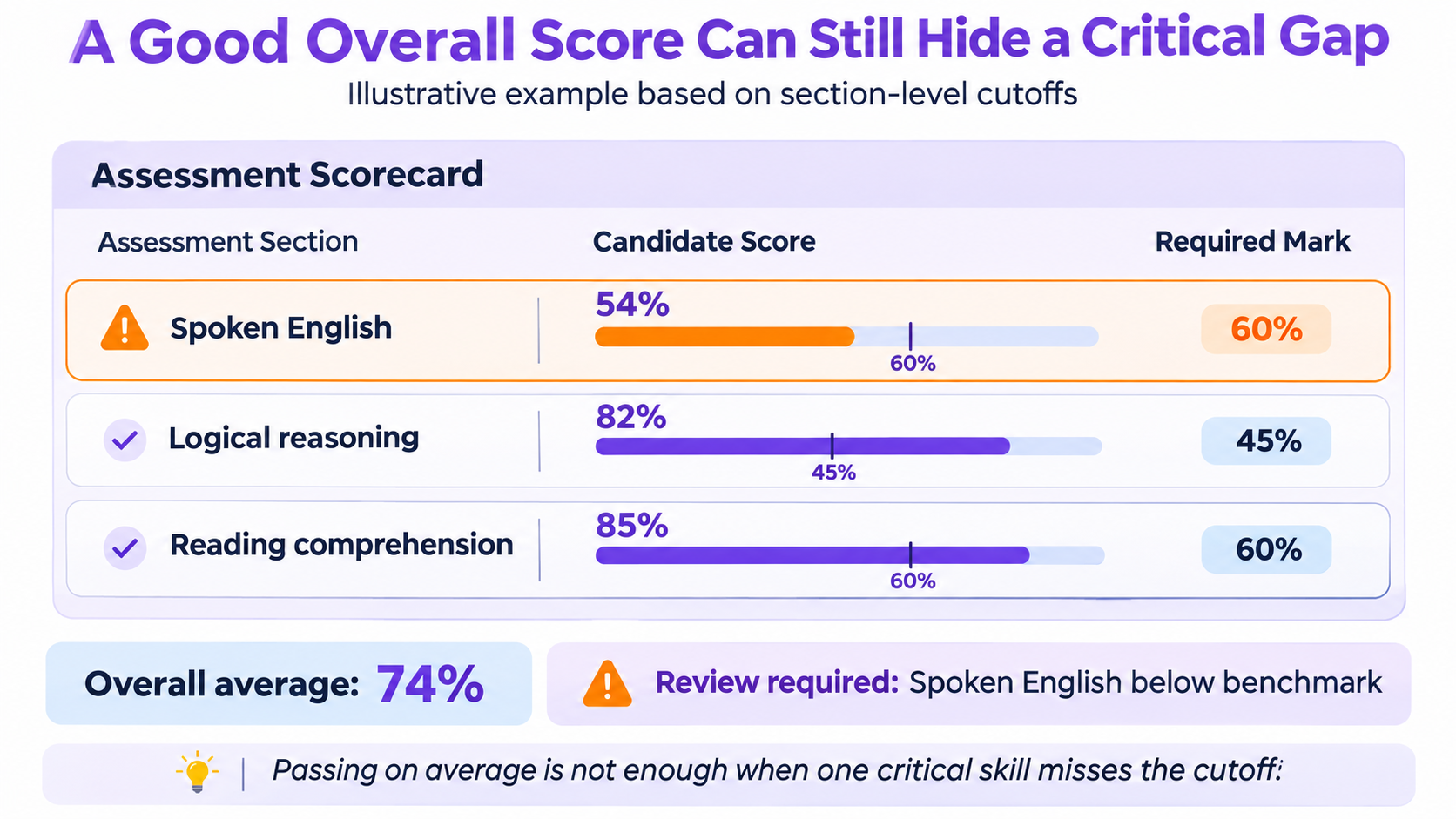
The company used a single 46-minute communication assessment test with four sections. Each section had its own pass mark, so a candidate had to clear every skill the role needed, not just score well on average.
The spoken section works like a spoken English and accent screen: candidates answer out loud, and the AI scores how they speak as well as what they say.
What separated fit candidates from the rest?
Skill scores showed larger differences than the personality traits measured. Fit candidates scored at least 20 percentage points higher on four skill measures, while the reported personality trait differences were much smaller.
Two findings stand out. First, logical reasoning showed the largest gap between fit and unfit candidates, at 28 percentage points. Second, spoken comprehension and vocabulary each showed a 22-point gap. For roles involving conversations with students and parents, assessing spoken English provides evidence that a written grammar test alone cannot capture.
Fit candidates also attempted more of the test (97% vs 93%) and finished slightly faster (34.2 vs 35.1 minutes).
What did AI proctoring flag during the assessments?
AI proctoring rated every attempt as genuine, moderately suspicious, or suspicious. Across all candidates, 55% were genuine, 18% moderately suspicious and 27% suspicious.
The split by result is the more useful number:
Note: Percentages are rounded and may not total 100%.
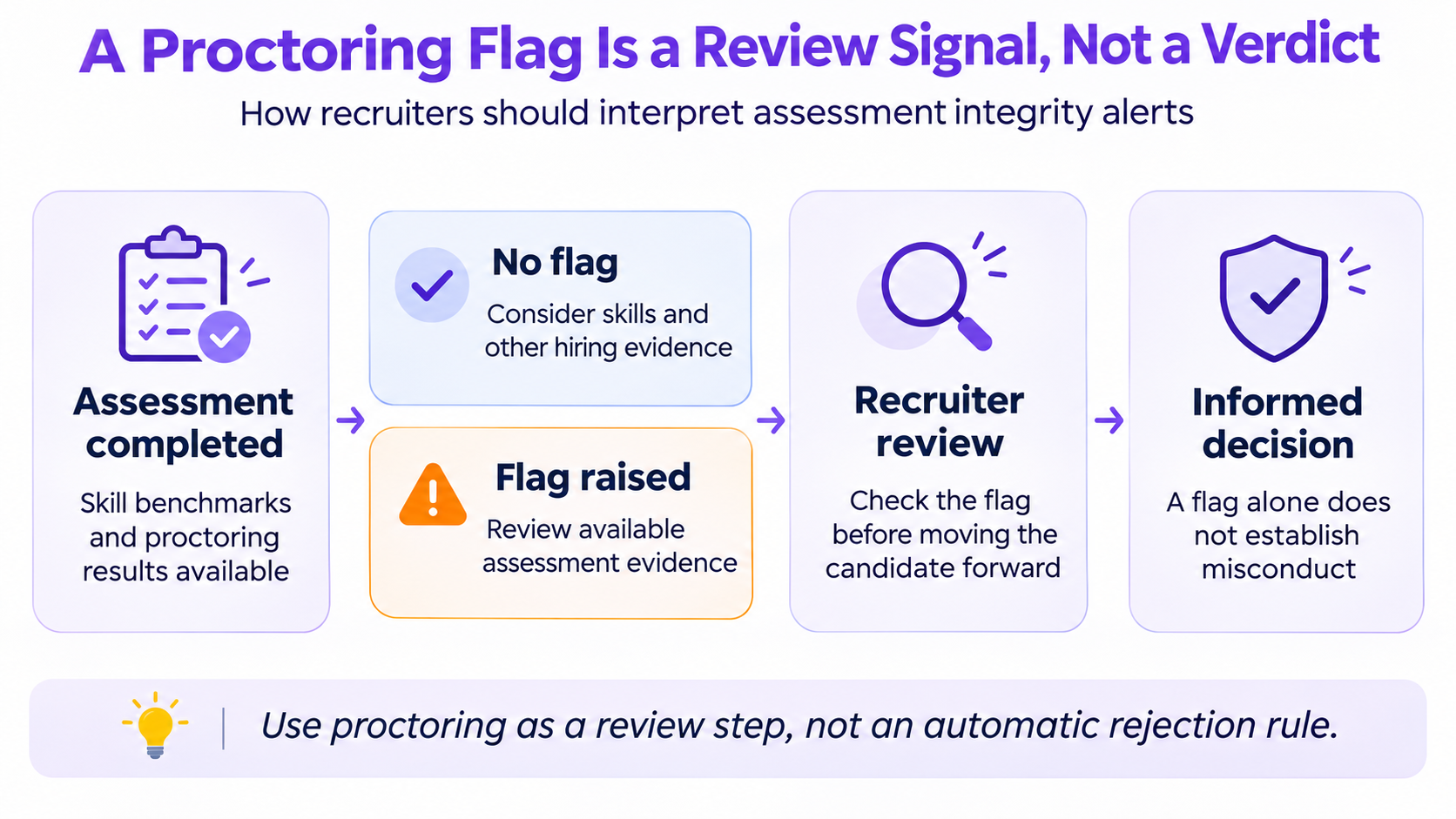
Among candidates who scored as fit, 46% were flagged. These candidates had met the assessment benchmarks and were eligible for further consideration. Proctoring flags gave recruiters an additional signal to review before deciding who should proceed to interviews. A high score with a suspicious proctoring flag is not a hire signal. It is a prompt to check before spending an interviewer's hour on the candidate.
The 45% flag rate shows why remote assessments need an integrity review process. However, a proctoring flag does not confirm misconduct, and flagged attempts should be reviewed before recruiters make decisions.
What should a proctored assessment for education hiring include?
A proctored assessment for education hiring should test spoken English out loud, check reasoning and reading in the same sitting, set a pass mark per section, and monitor every attempt for potential integrity concerns. Recruiters can then prioritize candidates who meet the role benchmarks and whose assessment integrity concerns have been reviewed.
In practice, that means:
- Test speaking, not just grammar. The widest language gaps here were in spoken comprehension and vocabulary.
- Set a bar per section. A strong reader with weak spoken English should not pass on an average.
- Proctor every remote attempt. The 45% flag rate highlights why assessment scores should be considered alongside integrity checks before making hiring decisions.
- Review flags before you reject. Moderately suspicious is not proof of cheating. It tells the recruiter where to look.
PMaps is an AI-powered talent assessment platform that helps enterprises improve their hiring odds, scientifically. Trusted by 200+ enterprise clients across 7 countries, with 4M+ assessments completed.