
Evaluating Communication Readiness Through Skill Benchmarks and AI Proctoring
A leading Indian education services company faced the challenge of screening large applicant pools for roles requiring strong spoken and written English. Resumes could not demonstrate communication proficiency and individual phone interviews were difficult to scale consistently.
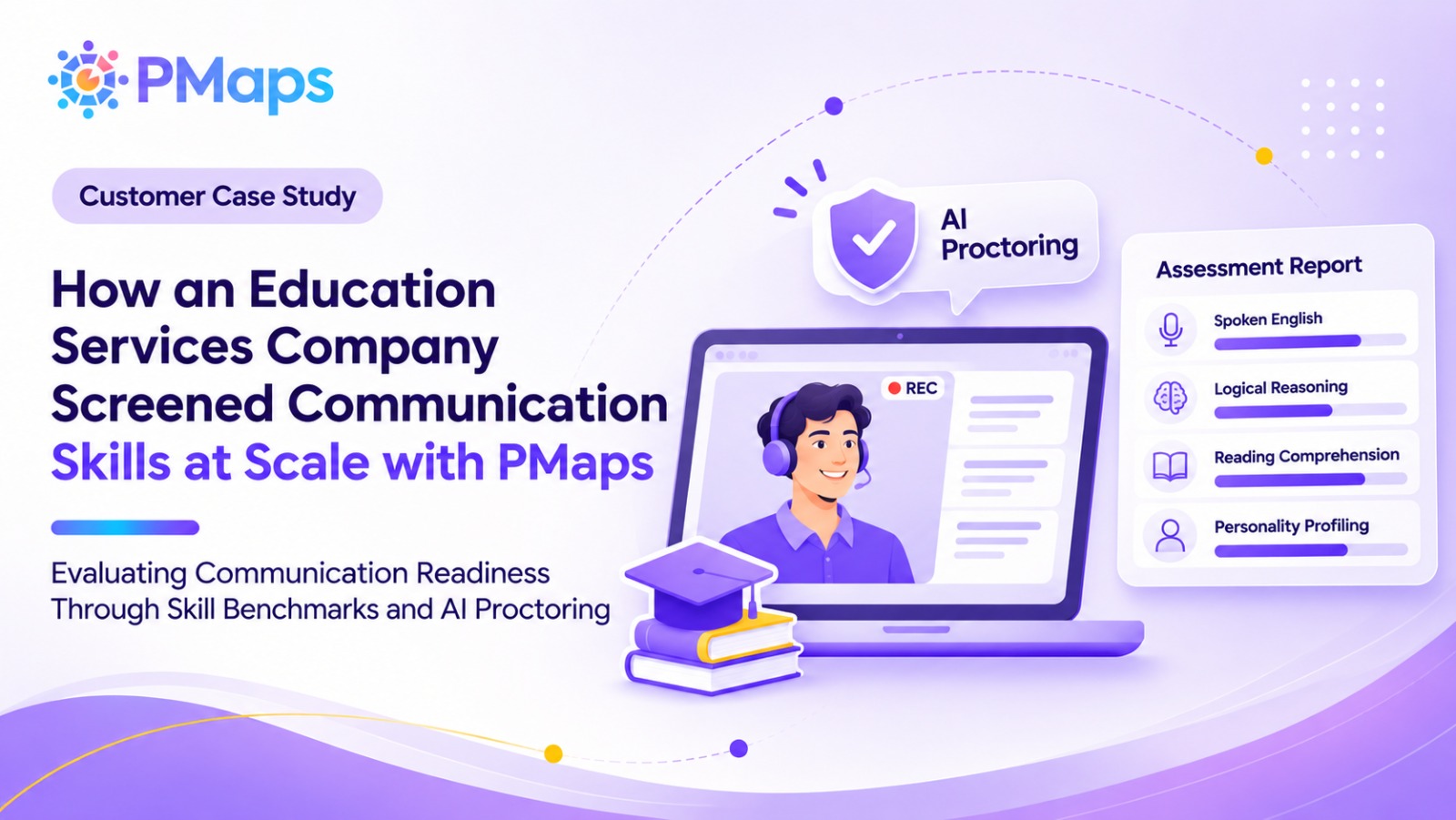
The company implemented PMaps Communication Assessments, using a 46-minute, AI-proctored test covering spoken English, logical reasoning, reading comprehension, and personality profiling.
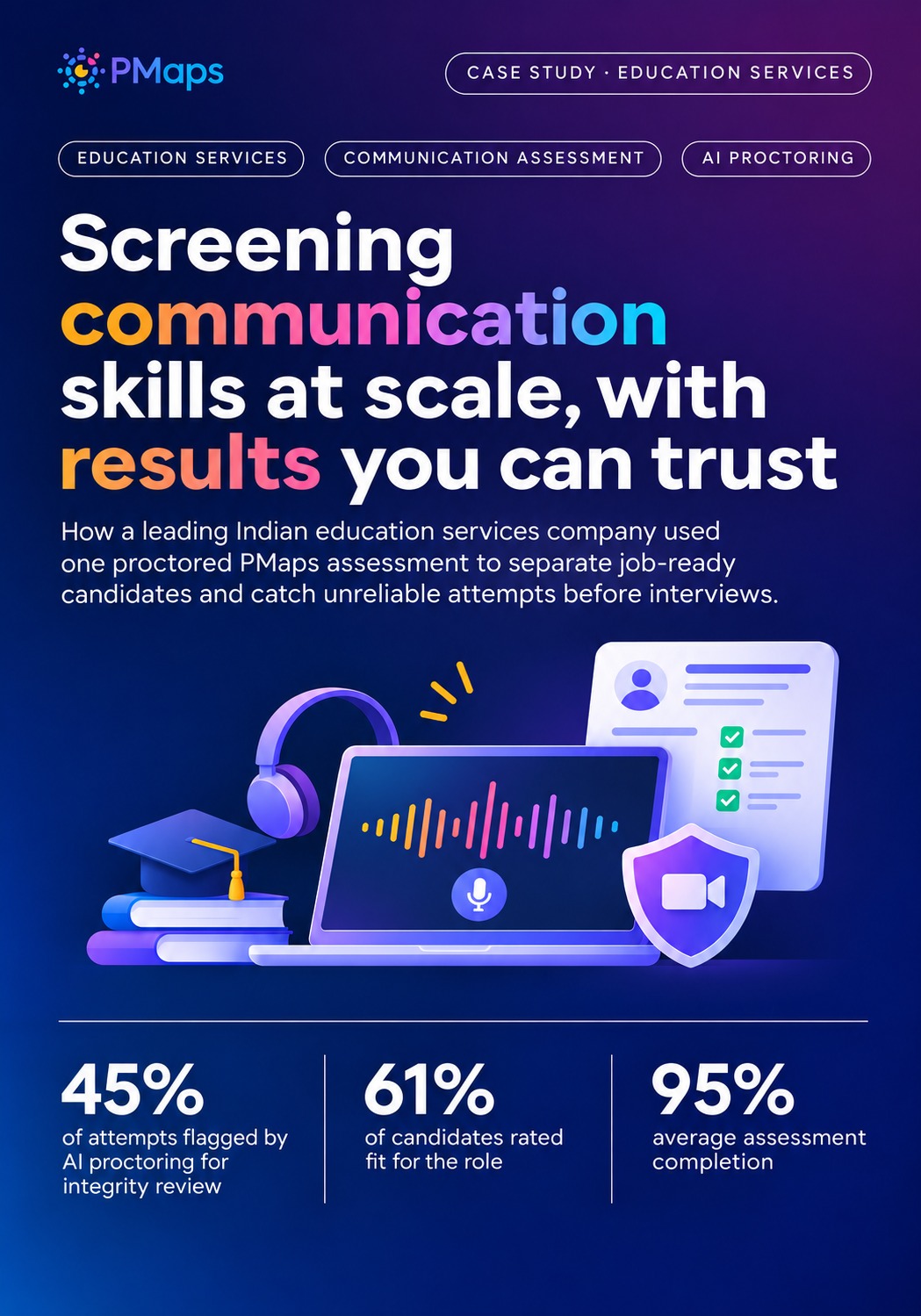
The assessment rated 61% of candidates fit, achieved 95% average completion, and flagged 45% of attempts for integrity review.
The Challenge Identifying Communication-Ready Candidates in High-Volume Hiring
The education services company needed to screen large applicant pools for roles where spoken and written English directly influenced job performance. Resumes offered limited evidence of communication skills, and individual interviews were difficult to manage at scale.
Key Hiring Challenges
The existing screening approach made it difficult to compare candidates consistently. The organization needed reliable communication evaluations, clear skill benchmarks and safeguards against questionable assessment attempts.
- Limited Evidence from Resumes: Academic qualifications and work experience could not confirm spoken English proficiency. A Voice and Accent Assessment could measure communication skills directly.
- Manual Screening at Scale: Individual phone interviews for every applicant required considerable recruiter time.
- Multiple Competencies to Evaluate: Screening needed to measure speaking, logical reasoning, and reading comprehension together.
- Assessment Integrity Concerns: Remote assessments required safeguards to identify suspicious attempts before interviews.
- Consistent Hiring Standards: Each skill needed a defined benchmark rather than relying on overall scores alone.
The client needed one structured assessment that supported consistent, credible hiring decisions.
The Solution One 46-Minute Communication Assessment with Skill-Specific Benchmarks
PMaps implemented a 46-minute, AI-proctored Communication Assessment to evaluate multiple job-related competencies in one sitting. The assessment combined spoken English, logical reasoning, reading comprehension, and personality profiling.
Each skill section had its own evaluation criteria, helping recruiters identify candidates who met the communication and reasoning requirements of the role.
The Four Assessment Components
The assessment measured language proficiency, cognitive ability, and behavioural traits through four sections. Each section followed a defined duration and question structure, with separate benchmarks for essential skills.
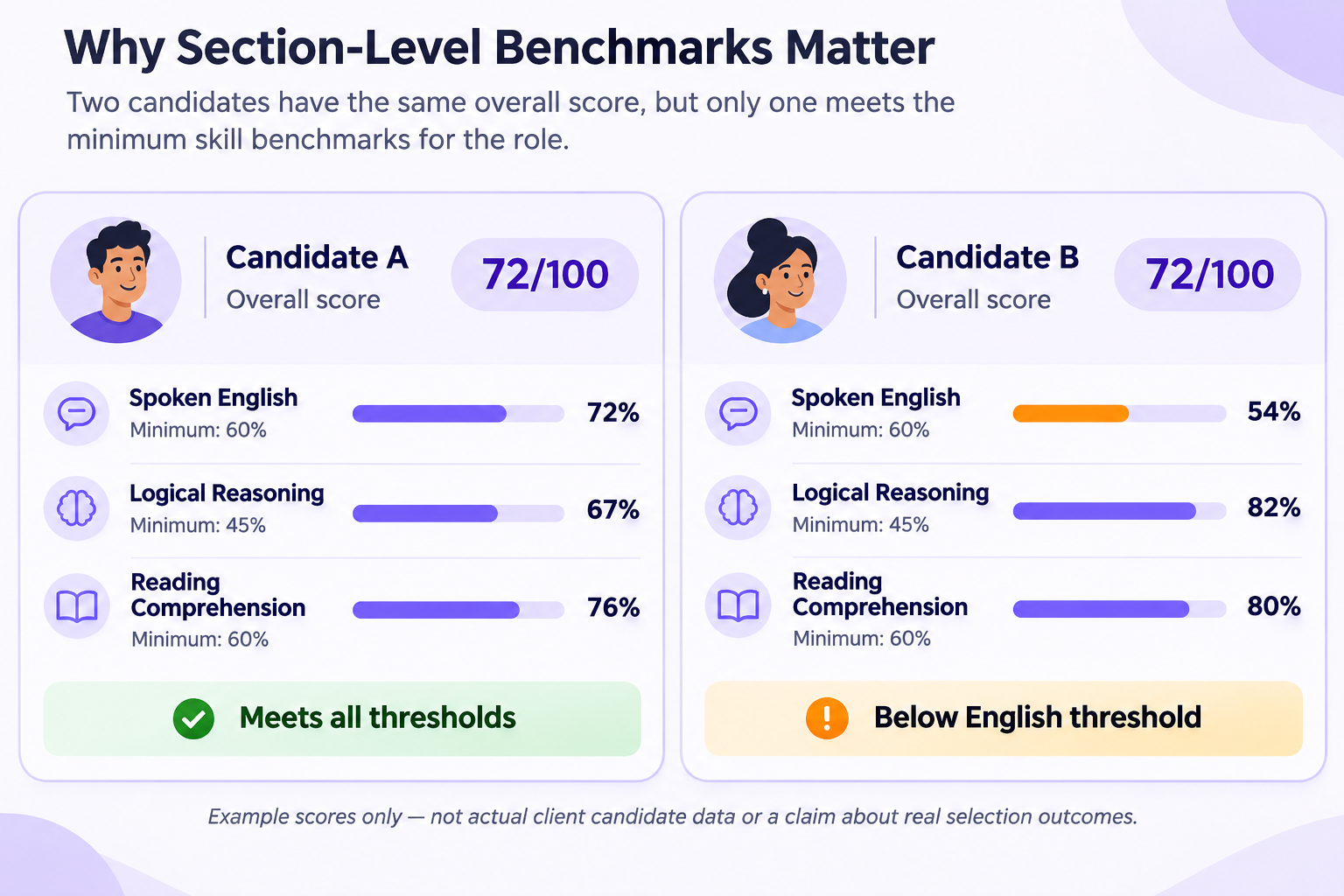
Why Section-Level Benchmarks Matter
Section-level benchmarks prevented strong overall scores from hiding weaknesses in required competencies. Candidates needed to meet individual skill thresholds rather than compensate for weak spoken English through stronger reasoning scores.
AI Proctoring for Remote Assessment Integrity
AI proctoring classified each attempt into three categories:
- Genuine: No suspicious behaviour identified.
- Moderately Suspicious: Potential integrity concerns requiring review.
- Suspicious: Attempts flagged for closer examination.
Flagged attempts required recruiter review and did not automatically establish misconduct. The assessment combined skill evaluation, personality profiling, and integrity monitoring within one structured process.
The Results — 61% of Candidates Met the Role-Fit Criteria
The PMaps Communication Assessment rated 61% of candidates fit for the role, with an average assessment completion rate of 95%. Based on the client's descriptive assessment report from July to September 2026, fit and unfit candidates showed differences across communication, reasoning, and behavioural competencies.
Key Assessment Outcomes
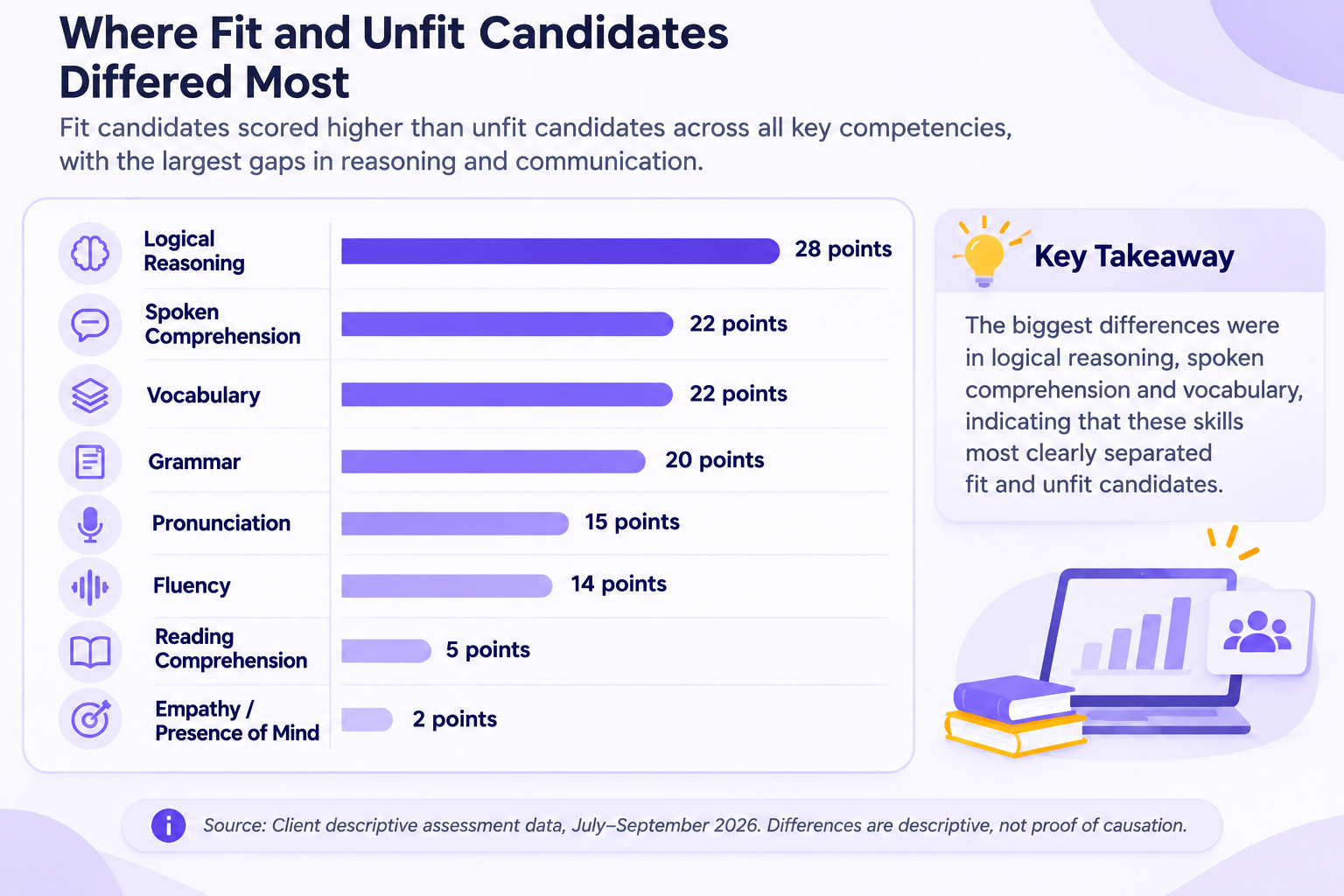
The assessment identified stronger reasoning and language performance among fit candidates. Empathy and helpfulness showed much smaller differences, indicating that job-related skills were the main factors separating the two groups.
Where Fit and Unfit Candidates Differed Most
The largest differences between fit and unfit candidates appeared in logical reasoning, spoken comprehension, vocabulary, and grammar. These findings highlighted the competencies where assessment performance differed most between the two groups.
Assessment Engagement and Completion
Fit candidates attempted 97% of the assessment, compared with 93% among unfit candidates. They also finished slightly faster, averaging 34.2 minutes against 35.1 minutes.
The findings gave recruiters clearer evidence of communication and reasoning skills than a grammar-only screening approach.
The Integrity Finding — 45% of Assessment Attempts Needed Review
PMaps AI proctoring flagged 45% of assessment attempts for integrity review. The findings showed why meeting skill benchmarks alone was insufficient to establish assessment reliability.
What AI Proctoring Identified
The proctoring system classified attempts by their level of suspicion, helping recruiters identify results requiring closer examination before interviews.
Source: PMaps client descriptive assessment report, July–September 2026. Flagged attempts include moderately suspicious and suspicious classifications. Percentages may vary slightly due to rounding.
Why High Scores Alone Were Not Enough
Nearly half of candidates rated fit had assessment attempts requiring integrity checks. Although these candidates met the assessment's role-fit criteria, their proctoring classifications indicated that some attempts required additional review. Such classifications did not establish cheating or misconduct.
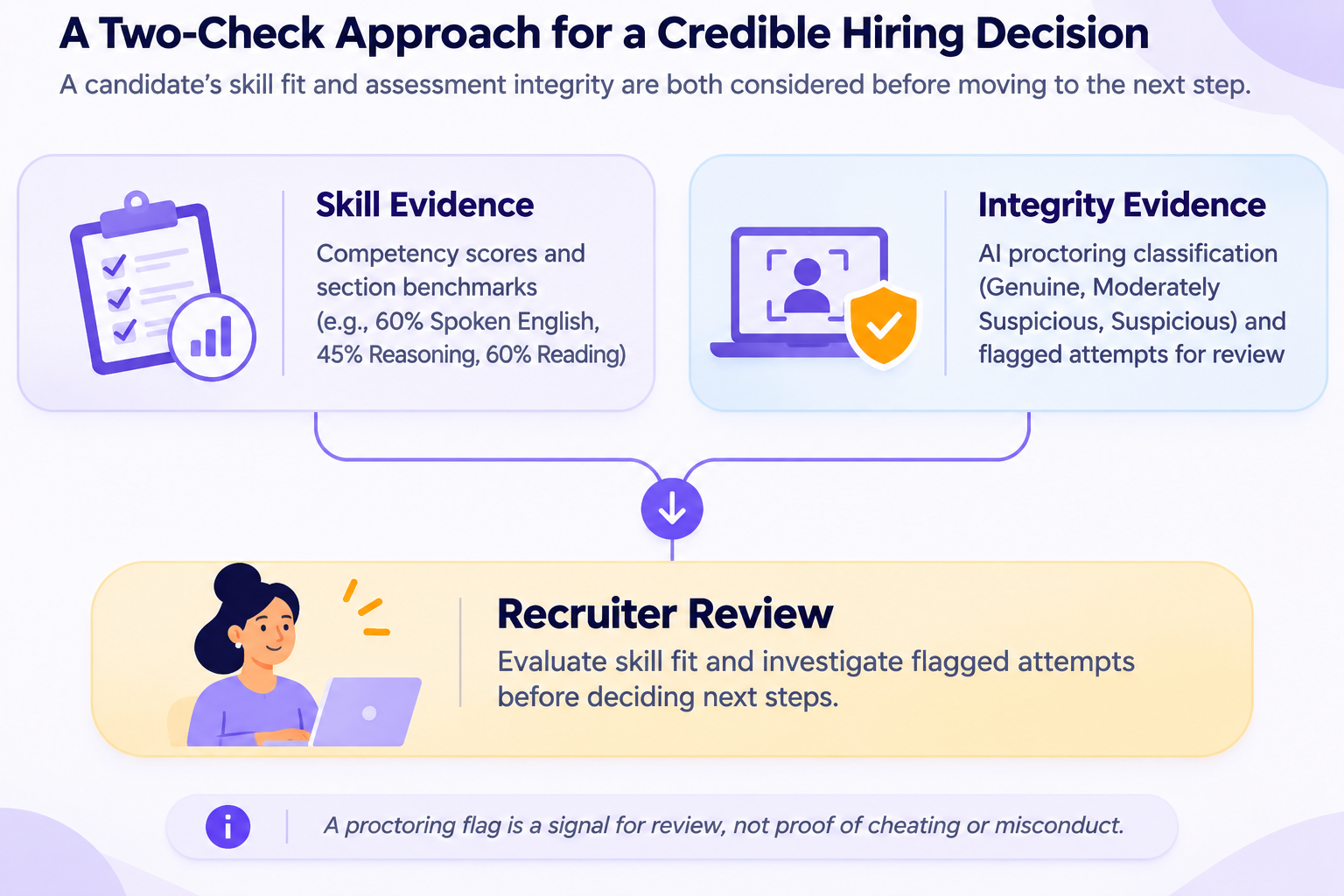
By combining skill scores with integrity ratings, PMaps gave hiring teams additional evidence for candidate evaluation.
What the Results Mean for Education Sector Hiring
The education services case study highlights three practical lessons for hiring teams evaluating communication skills at scale. Its findings show why spoken English, individual skill benchmarks, and assessment integrity deserve separate attention.
Lesson 1 — Test Speaking, Not Just Grammar
Spoken comprehension and vocabulary showed 22-point gaps between fit and unfit candidates. Pronunciation and fluency showed differences of 15 and 14 points.
The Voice and Accent Assessment offers a relevant approach to evaluating spoken communication.
Lesson 2 — Set Individual Benchmarks for Critical Skills
Section-level benchmarks prevented stronger scores from compensating for weaker competencies. The assessment applied thresholds of 60% for spoken English, 45% for logical reasoning, and 60% for reading comprehension.
The Logical Reasoning Assessment addresses one of these measured competencies.
Lesson 3 — Review Assessment Integrity Alongside Performance
AI proctoring flagged 45% of attempts, including 46% of candidates rated fit. These findings required human review, not automatic misconduct conclusions.
PMaps Online Remote Proctoring provides an additional layer of assessment oversight.
Are Your Hiring Teams Struggling to Evaluate Communication Skills at Scale?
High-volume education hiring requires more than resume screening and written English tests. Consider whether these challenges reflect your current recruitment process:
- Are recruiters conducting phone screens to evaluate every candidate's communication skills?
- Are candidates passing written English tests but struggling in spoken conversations?
- Do strong overall assessment scores sometimes hide weaknesses in essential competencies?
- Are you concerned about the integrity of remotely completed assessments?
- Do you need consistent screening standards across high-volume education hiring?
PMaps helps hiring teams evaluate communication, comprehension, and reasoning through skill-specific benchmarks, with AI proctoring identifying assessment attempts requiring human review.
Ready to Assess Communication Skills with Greater Confidence?
The education services company used PMaps to evaluate spoken English, reasoning, and comprehension through one structured assessment. Results showed 61% of candidates rated fit, 95% average assessment completion, and 45% of attempts flagged for integrity review.
Section-level benchmarks and AI proctoring gave recruiters clearer evidence of candidate skills and assessment authenticity.
PMaps is an AI-powered talent assessment platform helping organizations make evidence-based hiring decisions. With 200+ enterprise clients across seven countries and more than four million assessments completed, PMaps supports structured competency evaluations for diverse hiring requirements.