.webp)
.webp)


Two hiring markets are running in India right now, and they are moving in opposite directions.
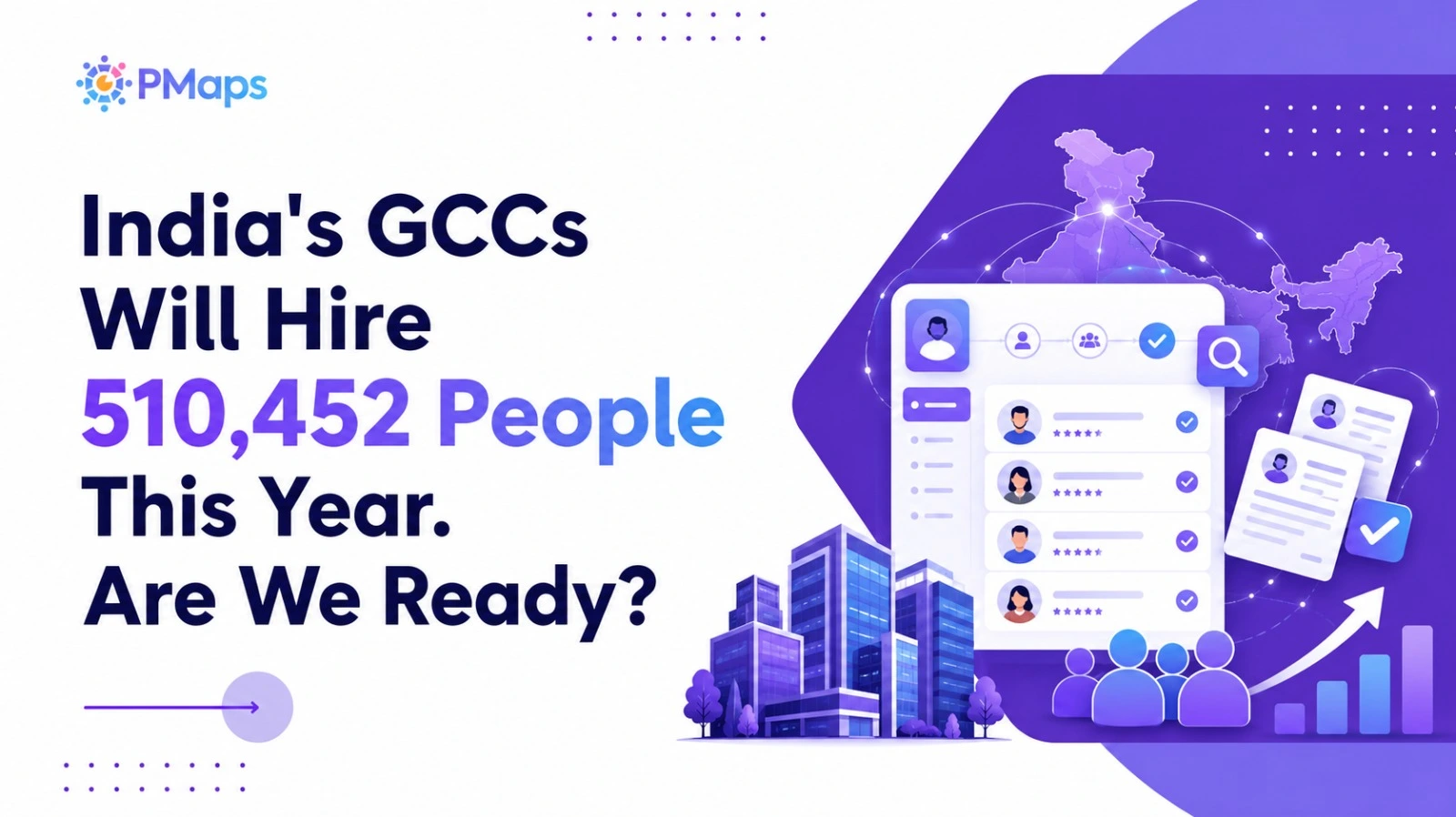
In June 2026, overall white-collar hiring in India fell 5% month-on-month and 9% year-on-year, according to the Foundit Insights Tracker. In the same market, India's Global Capability Centres are on track to hire 510,452 people in 2026 — the first time GCC hiring has crossed the five-lakh mark, and a 3.4-fold increase since 2021. India now hosts roughly 2,120 GCCs. In the first half of 2026 alone, they hired 227,991 people.
If you lead talent at a GCC, this is not a story about a hot market. It is a story about a bar.
When hiring contracts everywhere else and expands in your centre, you are no longer competing for candidates against a shortage. You are inheriting the candidates every other employer just passed on — at volume, at speed, into roles where the cost of a wrong hire compounds across a global delivery footprint. The screening bar is the only thing standing between a counter-cyclical hiring plan and a counter-cyclical attrition problem.
Most GCC screening bars were designed for a market that no longer exists.
What the 2026 numbers actually tell you
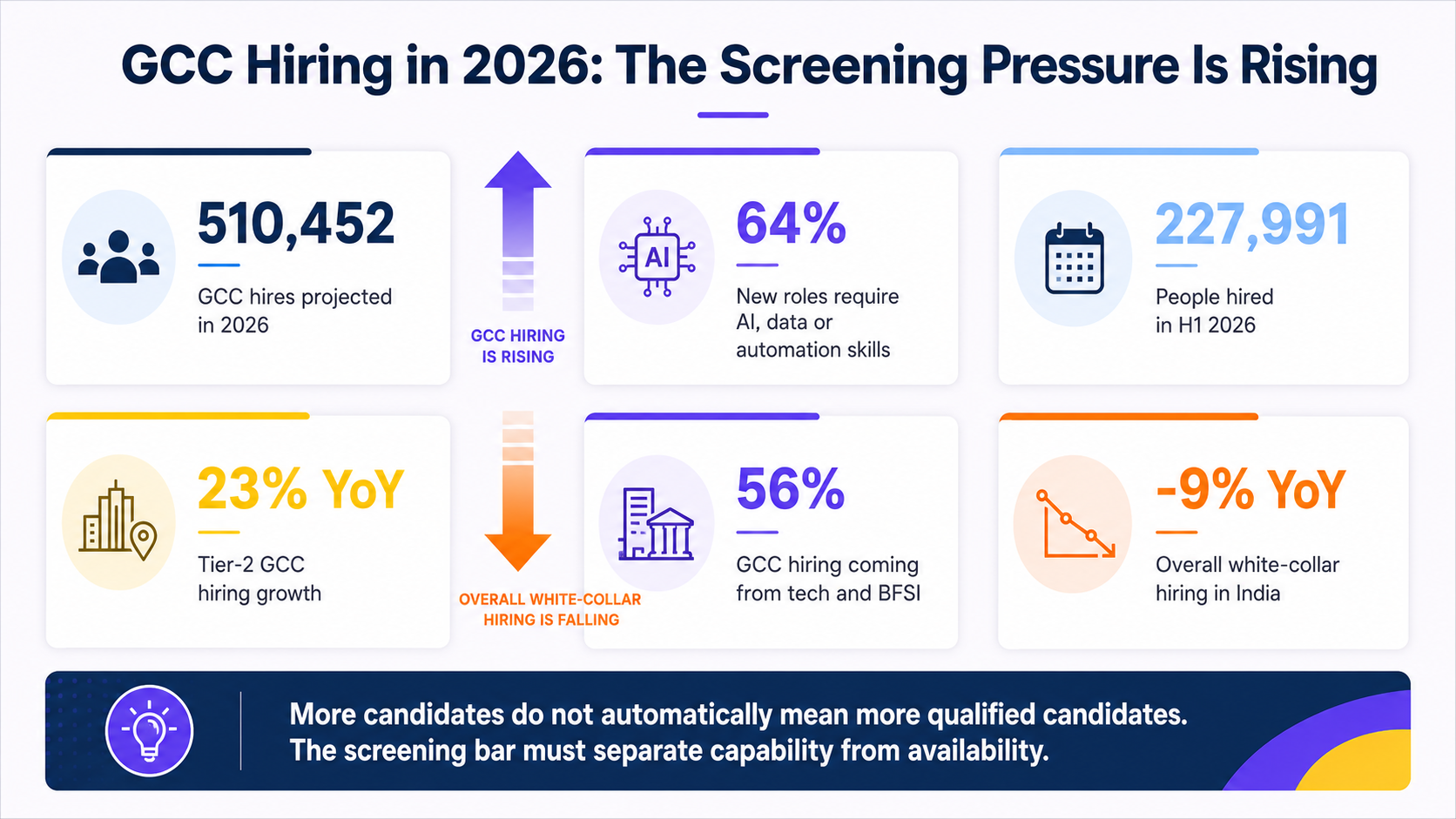
Read the 64% figure twice. Two in three new GCC roles this year require AI, data science, or intelligent automation skills — capabilities that barely existed as a resume line three years ago. There is no ten-year track record to screen against. There are no reliable proxy credentials. There is a resume that says "AI" and a market that has learned exactly how to write one.
That is the structural problem. The screening methods that worked when you hired for known skills against known career paths do not transfer to roles where the capability is new, the supply is unproven, and the volume is high.
The three shifts that break an old screening bar
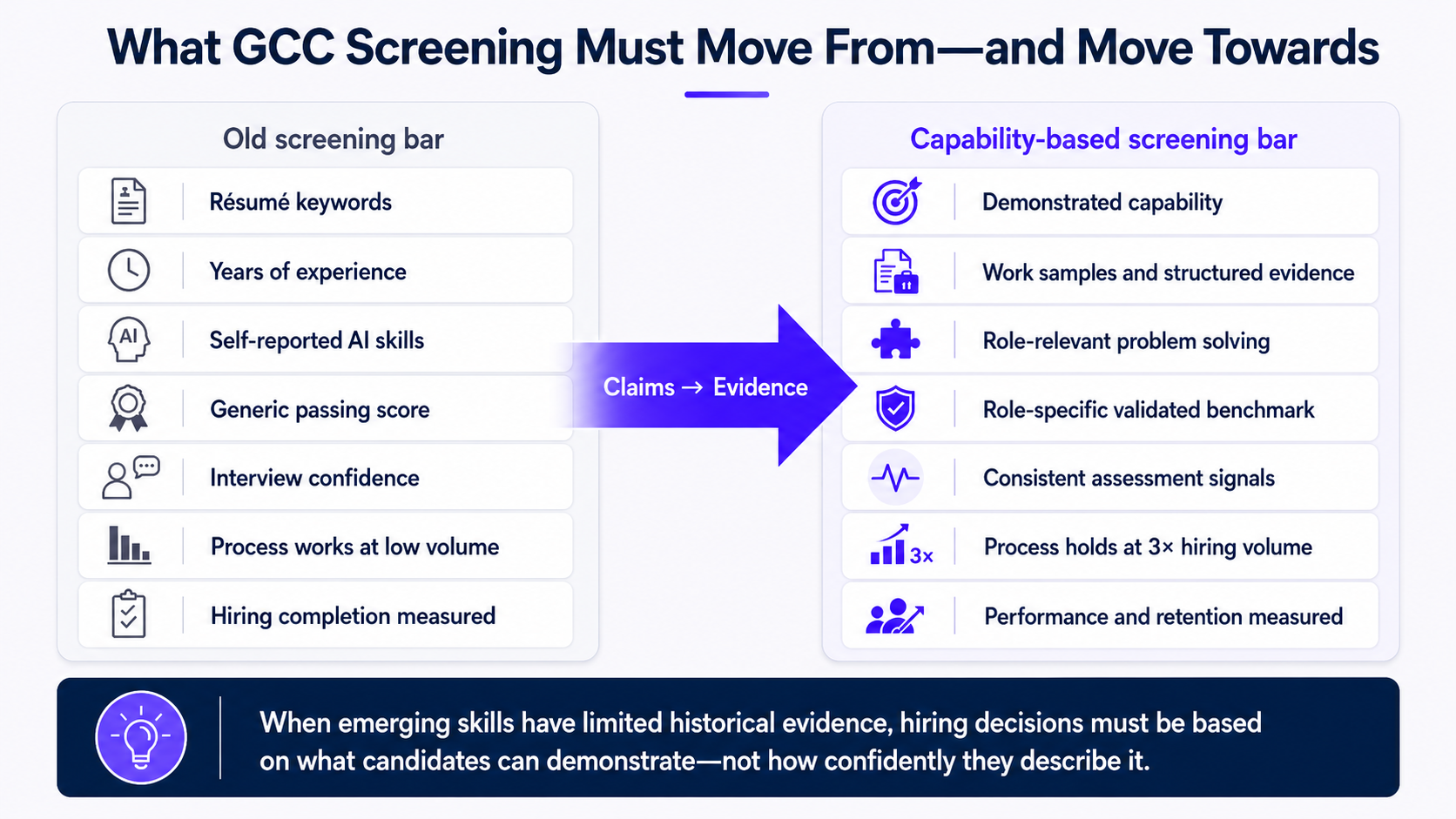
1. The resume stopped being a signal. When 64% of roles require capabilities that are two or three years old, the resume is a claim, not evidence. Every candidate in the funnel can name the same tools. Screening on stated experience selects for people who are good at describing AI work, not people who are good at doing it. The gap between those two populations has never been wider — and it is invisible until the third sprint.
2. Your applicant pool changed composition without telling you. A pool fed by a contracting market is not the same pool you calibrated your bar against in 2023. It contains stronger candidates who were displaced and weaker candidates who are being passed over everywhere — mixed together, both highly motivated, both interviewing well. A bar set against a tighter market will read this pool as uniformly excellent. It is not. It is more variable, and a static bar cannot see variance.
3. Speed and Tier-2 expansion removed your safety nets. GCC hiring in Tier-2 cities is growing 23% year-on-year. New geography means no local benchmark, no hiring history, no manager intuition built over five years of watching who worked out. The informal calibration that quietly rescued a weak formal process is gone — exactly when volume is highest.
The Capability Bar Audit —four questions, run it this week
You do not need a new platform to start. You need honest answers to four questions about the process you already run. Take one high-volume GCC role — the one you'll hire fifty of by December — and answer these in writing.
Question 1: What happened to the people you hired for this role last year?
Start here. Everything else is guessing until you answer it.
Pull your 2025 hires for this role. Get their current performance rating and whether they're still with you. Now line that up against their screening scores. If you cannot do this — because the scores weren't kept, or performance data lives in a system nobody joins to the ATS — that is your finding. You have been running an unvalidated bar for a year and calling the output "quality of hire."
A screening score that does not correlate with subsequent performance is not a bar. It is a ritual.
Question 2: Are you measuring the capability, or the description of it?
Take your current screening stage for this role and mark each step: does it observe the candidate doing something, or does it ask them to describe doing something? Résumé screen, self-reported skills, years of experience, "tell me about a time" — all description. Work sample, structured cognitive measure, live problem, voice assessment under load — observation.
For any role in that 64% bucket, count the ratio. If description outweighs observation, you are selecting for articulacy. In an AI-role market, articulacy is the single most abundant and least predictive trait in the pool.
Question 3: Is your passing score a benchmark, or a number someone chose?
Ask whoever owns the requisition where the cutoff came from. If the answer is "that's what we've always used," or "it's the top 30%," or a shrug — you have a threshold, not a benchmark. A benchmark is role-specific and validated: it says this score predicts performance in this role at this centre, and it was derived from outcomes, not from a percentile that felt reasonable.
Generic thresholds fail hardest in exactly your situation: new roles, new cities, a shifted applicant pool. All three move the underlying distribution. A fixed number applied to a moved distribution produces confident, systematic error.
Question 4: Can your bar hold at the speed the requisition moves?
Map the calendar days between application and screening decision for this role. Now map what happens when the req count triples in Q3 — because for most GCC plans, it will.
Most bars don't get lowered by a decision. They get lowered by Thursday. A hiring manager needs twelve people by month-end, the structured process takes eleven days, and someone waives a stage "just for this batch." If your bar only survives at low volume, you don't have a bar. You have a bar-shaped intention. A screening process that cannot run at peak volume will be abandoned at peak volume — which is precisely when it matters most.
The BFSI and tech cut
Technology and software plus BFSI together account for 56% of all GCC hiring in 2026. If you sit in either, two things follow.
First, you are hiring against the same shortlist as every other GCC in your city, so your bar is your differentiation — not your employer brand, not your comp band. Both of those are matched within a week. A screening process that identifies capability your competitors' processes miss is the only durable edge in a matched market.
Second, BFSI GCCs are expanding beyond core technology into operations, finance and accounting, HR, and sales — functions with high volume, frontline-adjacent profiles, and the largest gap between "interviews well" and "performs." These are the roles where unvalidated screening costs the most, and where they are historically least likely to have a validated benchmark, because they were never the centre's marquee hire.
What to do in the next 30 days
- Run Question 1 on your highest-volume role. Join screening scores to performance and retention for 2025 hires. If the join is impossible, fixing that is the project.
- Count the observation-to-description ratio on your top three GCC roles. Replace one description step with one observation step. One. Measure what changes.
- Ask where every cutoff came from. Document the answer. Undocumented cutoffs are the cheapest thing on this list to fix and the most expensive to leave alone.
- Stress-test the bar at 3x volume on paper before Q3. Identify which stage gets waived first and pre-decide whether you'll defend it or redesign it. Deciding under pressure means deciding badly.
Where PMaps fits
Everything above can be run with a spreadsheet and an honest afternoon. Where it stops being a spreadsheet problem is validation and scale — building role benchmarks that hold up against real outcomes, and running observation-based screening at GCC volume without the process collapsing on a Thursday.
That's what PMaps is built for. For 12 years, PMaps has measured candidates across cognitive, behavioral, psychometric, video, and voice assessments — validated against real on-the-job performance, not against theory. 3M+ assessments across 200+ enterprise clients in 7 countries, including Tech Mahindra, Glenmark, and IKS Healthcare. Benchmarks are role-specific, so a good score means good for this role at your centre — which is exactly the gap Question 3 exposes. Assessments run in 8+ Indian languages, which matters as GCC hiring moves into Tier-2 cities at 23% year-on-year. EVA, our AI Voice Interviewer, and VnA Assessment handle the observation-at-volume problem for voice and conversational roles.
Improve your hiring odds. Scientifically.
Book a 30-minute walkthrough — bring one role, and we'll show you what a validated benchmark for it looks like.