
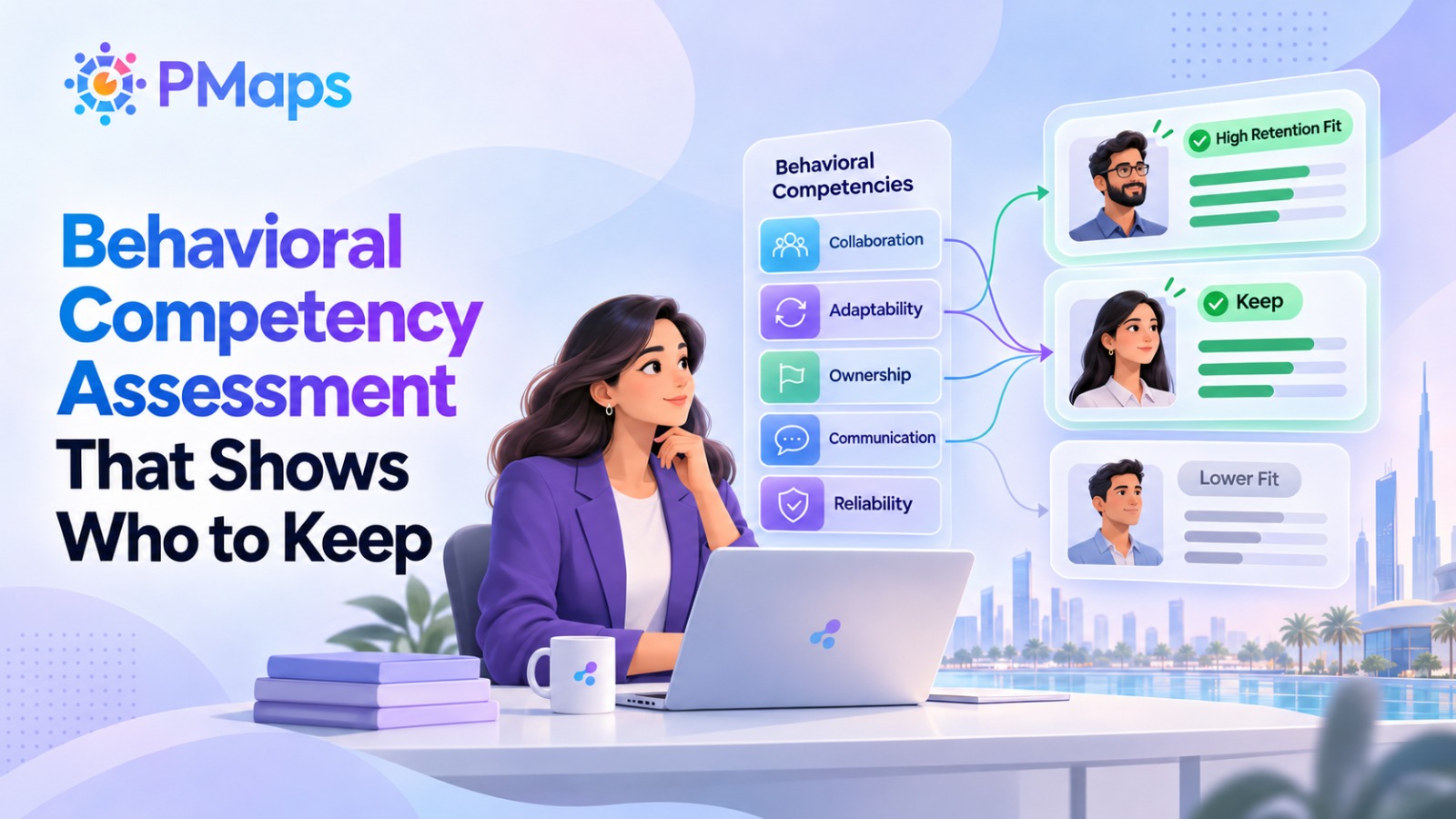
A behavioral competency assessment measures how a person applies judgment, communication and decision-making to the work in front of them, scored against a benchmark for the role rather than against the rest of the group. It is built for employers CHROs, heads of talent acquisition and heads of L&D who need to know what capability their workforce holds before they change the shape of it. This page sets out what such an assessment contains, why a role redesign needs one first, and how to run a defensible first pass on a single role family.
The reason this question has become urgent has a date on it. On 28 October 2026, Gartner predicted that by 2029, 30% of employees terminated and replaced by AI will be rehired, often at a higher cost. The same release reported that in a July 2026 survey of 297 CHROs, only 19% said their workforce planning effectively shows how work is changing, accounts for AI's impact and realigns talent with business goals.
Those two numbers belong together. A rehire at a premium is not what happens when a technology underperforms. It is what happens when an organization cannot name what is left.
What is a behavioral competency assessment?
A behavioral competency assessment measures the behaviors a role requires judgment, influence, resilience, service orientation — and scores each against a validated benchmark for that role. It differs from a knowledge test because it measures decisions rather than recall, and from a self-report questionnaire because the response is scored, not accepted.
In practice an assessment of this kind presents situations the role actually produces and asks the person to act. A collections agent is given a reluctant customer, not a definition of empathy. A team lead is given a missed deadline and two competing escalations. The score records what the person did and how that compares with the benchmark for people who go on to perform in that role, which is the only comparison that supports a decision about the future.
This matters for a capability question specifically because the behaviors are the part of a role that does not move when the tooling changes. A process can be automated. The judgment about when the process should not be followed cannot be, and it is rarely written down anywhere.
Why does an AI-driven role redesign need one first?
A role redesign changes which tasks a job contains without changing its title, so the role inventory in your HRMS reads exactly the same before and after. Any reduction planned on that inventory removes bundles of tasks, and afterward no record shows which capabilities went with them. That is the gap a behavioral competency assessment closes.
Sequence is the whole argument. Gartner's Caitlyn McDonough, the vice president analyst who presented the research, put it as organizations deciding "how many people to let go before they understand what it will take to get work done." The order is reversible, and it is much cheaper to reverse before the decision than after.
Consider the counterfactual. If an organization knew which capabilities sat in which people, at what proficiency, it would protect or replace them deliberately. Nobody pays a market premium to buy back something they measured on the way out. The premium is the price of identifying a capability only once the work stopped getting done which is to say, the price of never having had a capability inventory at all.
Gartner also reports that organizations with effective workforce planning are 1.4 times more likely to exceed revenue goals and 1.5 times more likely to exceed cost goals. Effective, in that finding, means planning that accounts for how the work itself is changing.
What does a capability inventory actually contain?
A capability inventory records which measured proficiencies exist in the organization, held by whom, at what level, read against a benchmark for the work. Four columns, and the fourth is the one that makes it an inventory rather than a list: without a benchmark, a score says a person did well relative to colleagues, not relative to the role.
Most enterprises have something they call a skills inventory, and it is usually a different object. A spreadsheet of self-declared skills, or a tagged field in the HRMS populated at onboarding, records what people said about themselves at a moment when saying it was in their interest. It is a claim register. A capability inventory is a measurement register, and the difference shows up precisely when a decision depends on it.
Three properties make the difference practical. Every entry has a level, not a yes or no. Every level is defined before anyone is assessed, not inferred from the results which is what a competency assessment framework is for. And every entry has a date, because a proficiency measured three years ago describes a job that may no longer exist.
4M+ assessments completed the dataset PMaps role benchmarks are validated against.
Why can a performance rating not stand in for it?
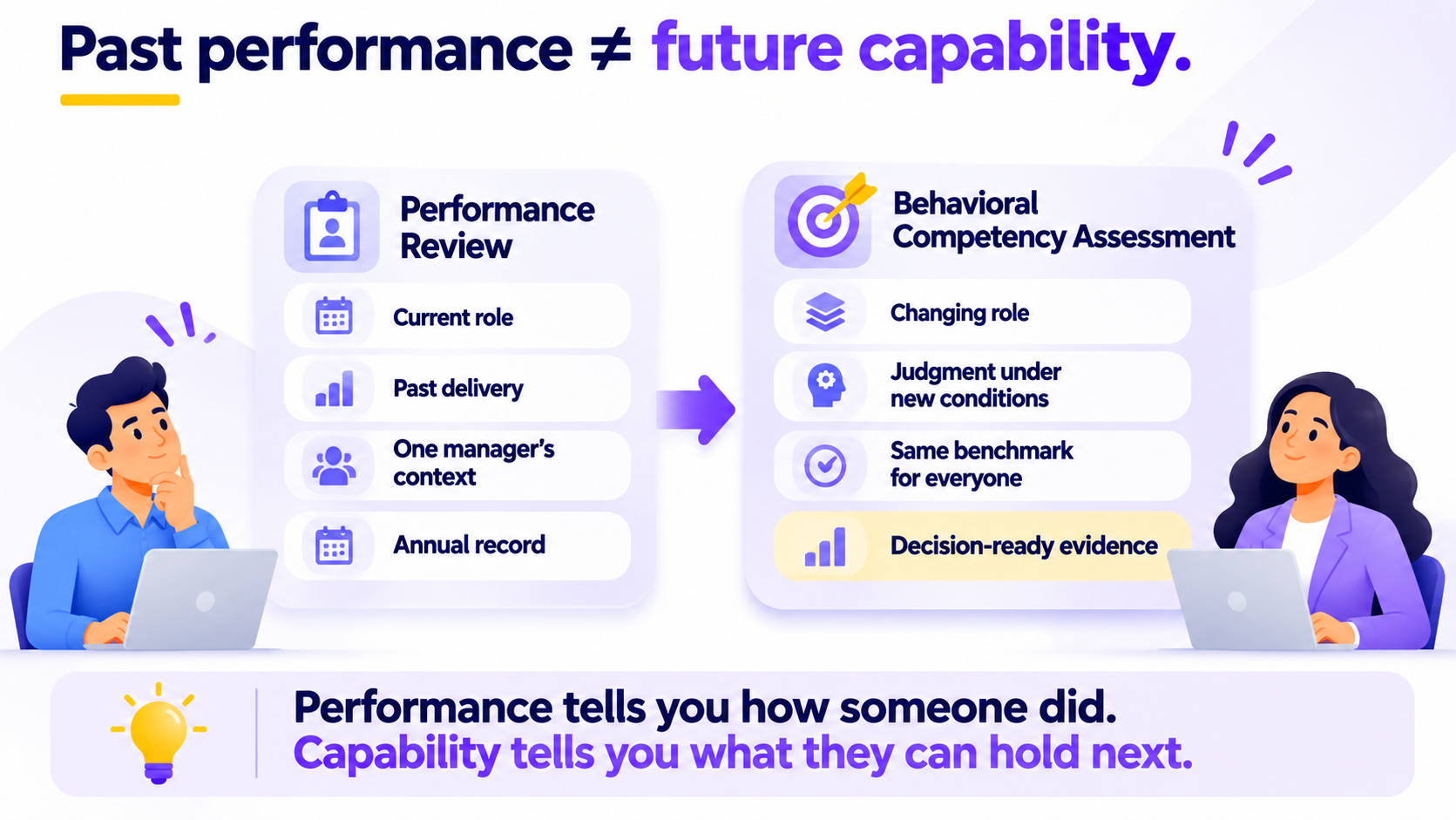
A performance rating measures how someone has delivered in the job they currently hold, under a manager who knows them. It is a record of past output in a fixed context. A capability measure asks what the person is able to do, including in a role whose task mix is changing a different question with a different answer.
The failure is visible in the structure of the data. Ratings are relative to a cohort and often to a forced distribution, so two people with the same rating in different functions are not comparable. They are assigned by one observer, so they carry that observer's standard. And they are produced annually, which makes them a lagging record of a role that is being redesigned now.
None of this makes ratings worthless. It makes them unusable for the one job being asked of them here. The same applies to the other stand-ins: tenure measures exposure, a resume line measures what someone chose to write, and a manager's confidence measures familiarity. For hiring decisions the equivalent problem shows up at the front of the funnel, which is why a validated candidate screening benchmark does work that an interview panel's impression cannot.
Which competencies survive when AI unbundles a role?
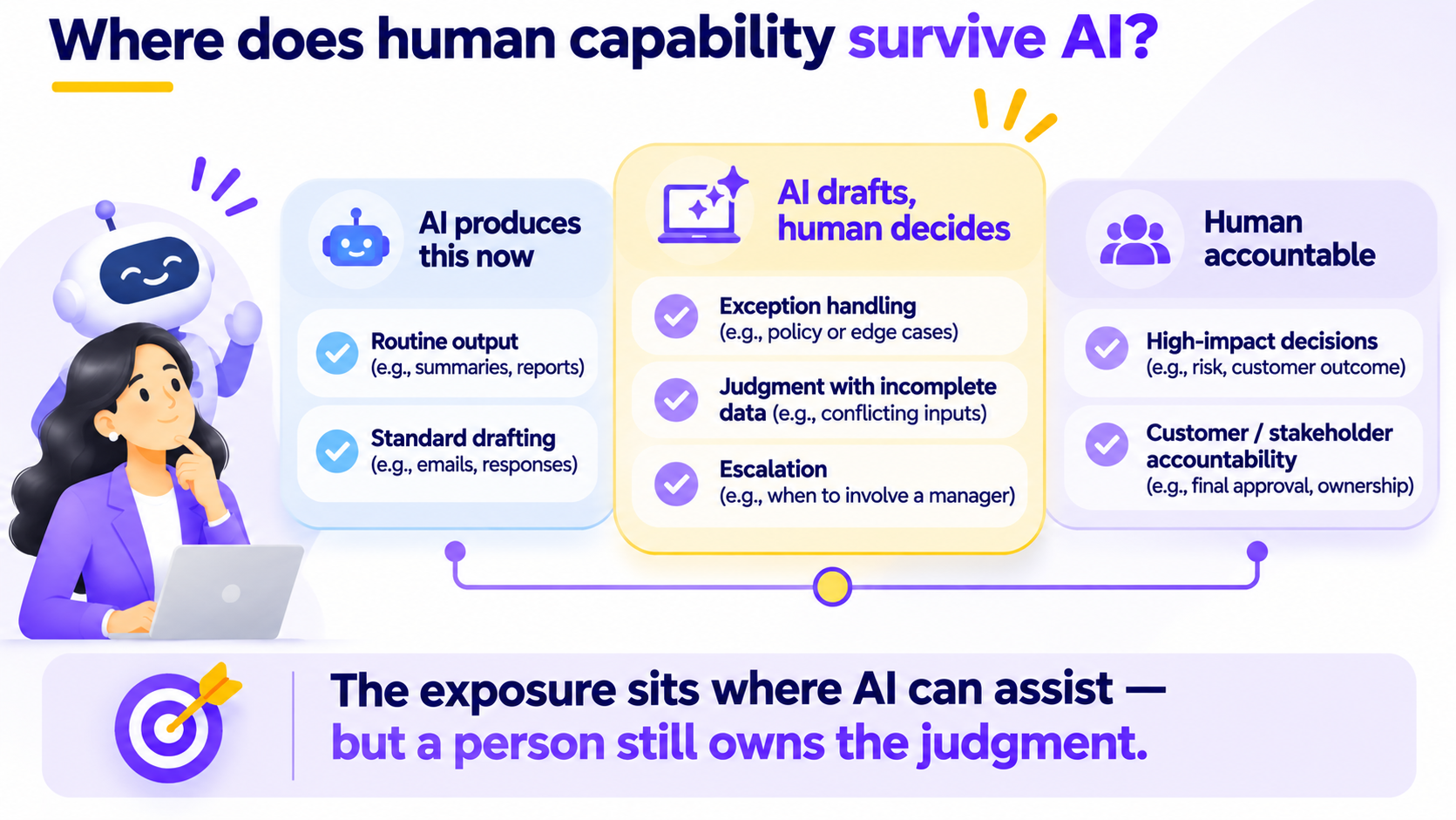
The competencies that survive are the ones where a person remains accountable for a judgment: deciding when the standard process does not apply, handling a customer whose situation is not in the playbook, and choosing which of two defensible answers to act on. Routine production moves first, supervision of production stays longest, and the exceptions never leave.
A practical way to see this in your own roles is to sort each required capability into three buckets. AI produces it now, if the output is acceptable with no human edit. AI drafts and a person decides, if a person is accountable for the judgment. A person does it, if AI cannot produce it or cannot be trusted with it.
The second bucket is where the exposure concentrates, and it is the bucket organizations measure least. Nobody has a score for "decides well when the data is incomplete," because that capability never appeared in a job description — it appeared in the gap between the job description and the work. This is also the bucket a behavioral competency assessment is designed for, which is why it is the instrument that fits an AI-driven redesign rather than a technical skills test.
How do you run a first assessment on a one role family?
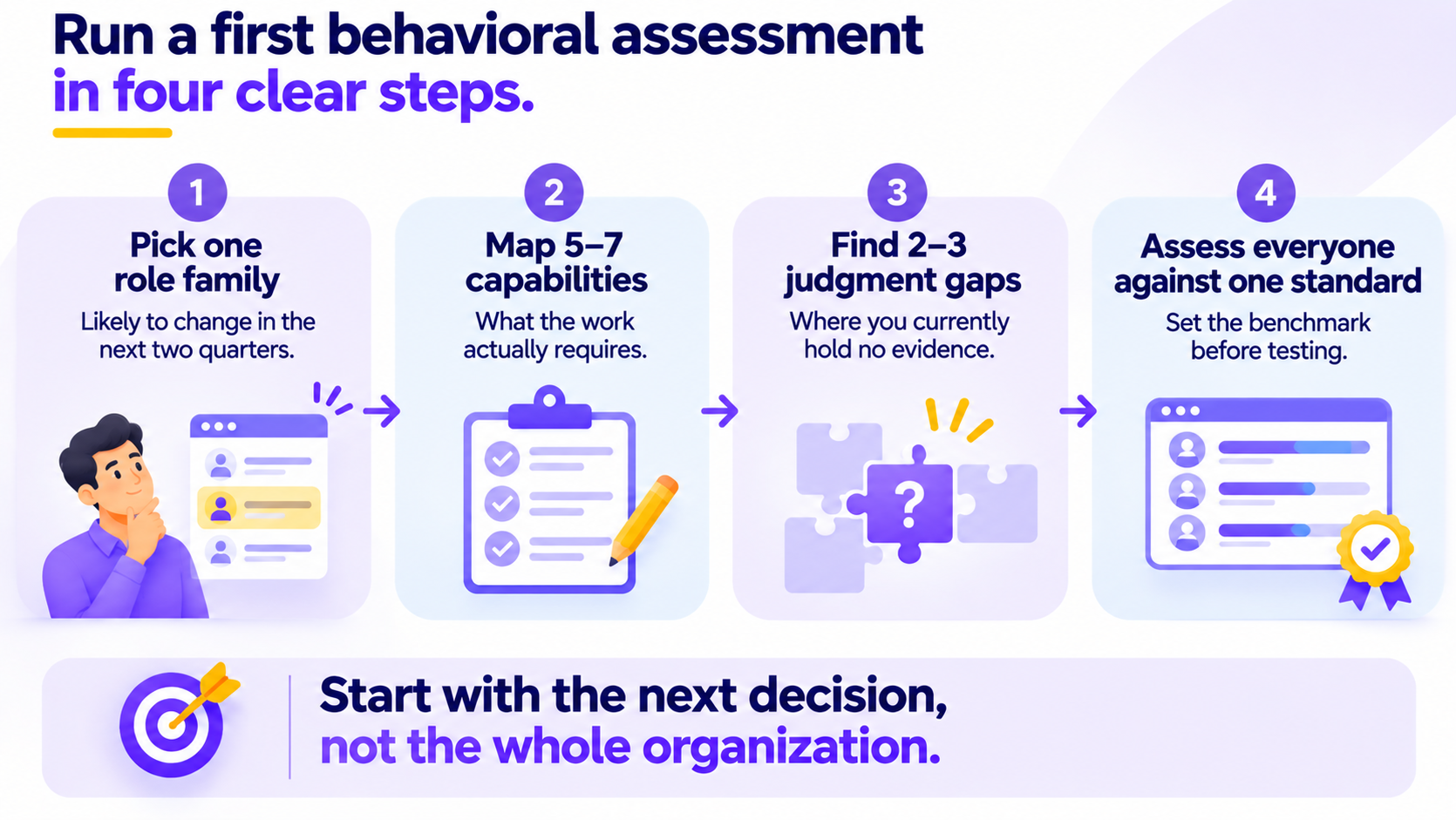
Pick the role family most likely to be reduced or redesigned in the next two quarters, list the five to seven capabilities the work requires, sort them into the three buckets, then measure only the two or three in the judgment bucket where you hold no evidence. A first pass takes days, not a quarter.
Two rules keep the first pass defensible. Set the standard before anyone is assessed: write what a sufficient response looks like at each level, and agree it with the people who own the work. Then assess the whole incumbent population for those capabilities rather than a sample of volunteers, because volunteers are not a random draw and the resulting distribution will flatter the group.
What changes as a result is not the headcount number. It is the question in the room. "Which forty roles" and "which capabilities we cannot afford to lose" produce different lists, and only the second one survives contact with 2029. For organizations that want to extend the same measurement to promotion and redeployment decisions rather than reductions alone, PMaps runs this as skill gap analysis for existing employees, including an AI resilience assessment that measures how readily a person adapts to working alongside AI.
How is this different from a skills inventory template?
A skills inventory template gives you the columns; a behavioral competency assessment gives you the contents. The template is a document, completed in an afternoon and populated by self-declaration or manager opinion. The assessment is a measurement, producing a score against a role benchmark that holds up when someone asks how the number was reached.
The distinction is not pedantic, because the two objects fail differently. A populated template fails silently: it looks complete, and nobody discovers the entries were claims until a decision made on them goes wrong. A measurement fails loudly and early, usually by returning a distribution nobody expected, which is information.
Competency assessment tools vary widely in which of these two they actually produce. The question to ask a vendor is not what the platform can display but what the score is validated against, and whether that validation used performance outcomes from roles like yours.
Where PMaps fits
PMaps is an AI-powered, bias-reducing, multi-lingual talent assessment platform. For 12 years it has measured candidates and employees across cognitive, behavioral, psychometric, video and voice assessments, scored against validated role benchmarks and checked against real on-the-job performance. Employee competency assessment and staff competency assessment work runs on the same platform as pre-hire screening, so the measure of an incumbent and the measure of a replacement are the same instrument — which is the comparison that shows whether a change is upgrading or degrading the workforce.
Delivery covers 8+ Indian languages, which matters for frontline and high-volume populations where an English-only instrument measures reading ability as much as capability. Across deployments PMaps has recorded 8 days faster time-to-hire and a 45% reduction in hiring costs. 200+ enterprise clients across 7 countries use the platform, including HSBC, Bajaj Housing Finance, Adani and Tata Consultancy Services. Bias is reduced through competency-based design, role benchmarks and proctoring for authenticity; it is reduced relative to unstructured interviewing, not removed.
If a role family is on the table for redesign this quarter, Book a Demo for a 30-minute working session on what a measured capability baseline would need to cover. Either way you leave with the map.
About the Author
Aagya Gupta writes about hiring, assessment and recruitment strategy at PMaps. She turns assessment science and hiring trends into practical guidance for talent acquisition teams. Connect with her on LinkedIn or write to agupta@pmaps.in.