
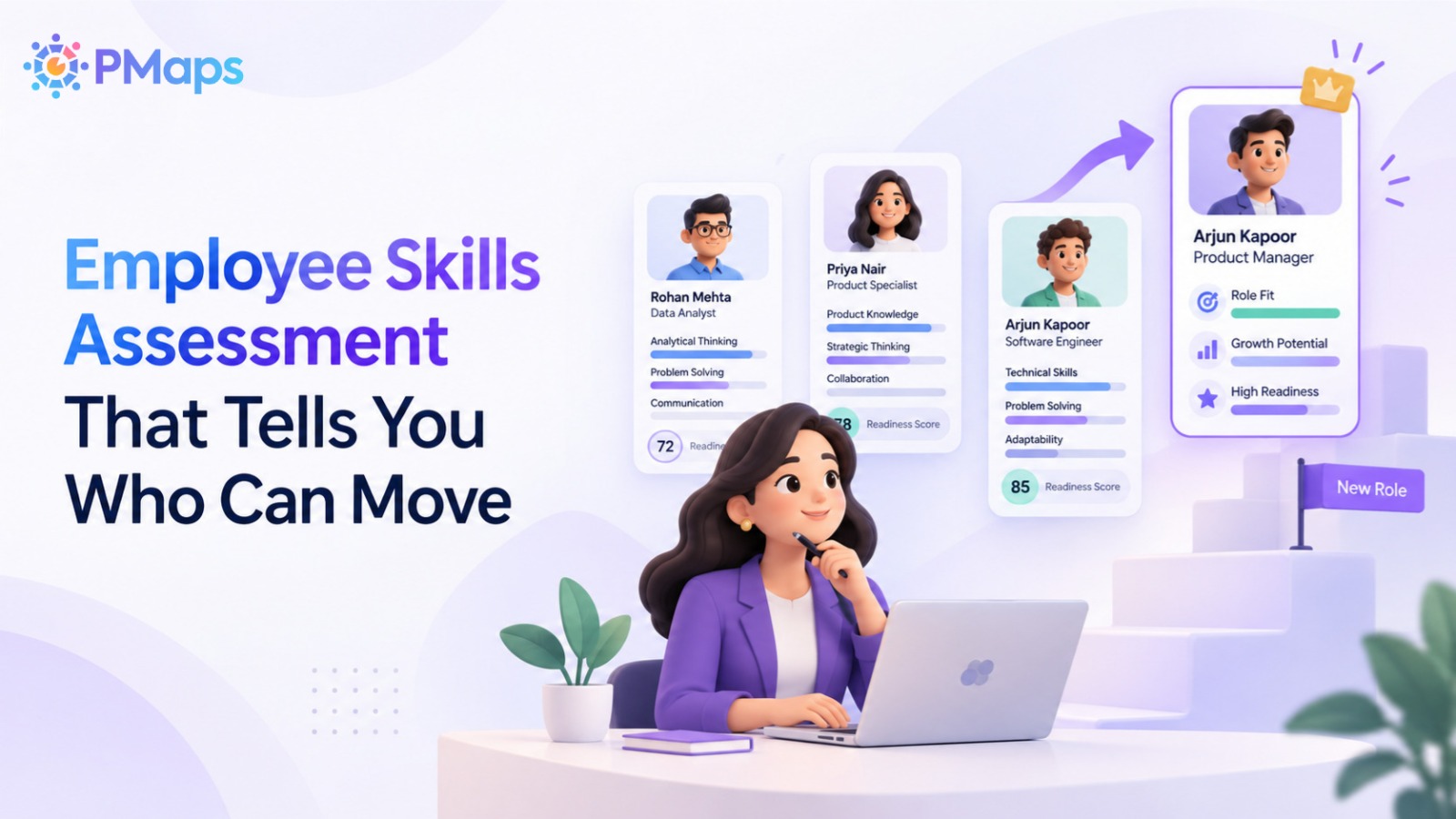
An employee skills assessment scores what the people already on your payroll can do, measured against the benchmark for a role rather than against their own description of themselves. The reason this matters now is that India's largest employers are giving up their benches. TCS added 4,258 people net last quarter, onboarded 10,000 freshers, and told the market it will hire on demand rather than build ahead of demand. HCLTech added 6,450 its largest quarterly addition in sixteen quarters with attrition rising to 12.8%. Hire on demand replaces a stock of people with a stock of knowledge about people. Most organizations have not measured the second. (TCS Q2 FY27 results, reported 8 October 2026, HCLTech Q2 FY27 results, reported 12 October 2026)
What is an employee skills assessment?
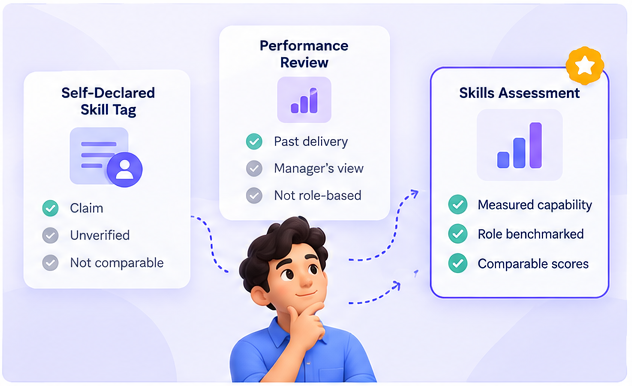
An employee skills assessment measures the current capability of people you already employ, scored against a validated benchmark for a role. It differs from a performance review, which rates past delivery in the job someone already holds, and from a self-declared skill tag, which records a claim. Its output is a score you can compare across people.
That comparability is the whole point, and it is what a performance rating cannot give you. A rating of "exceeds expectations" tells you how someone did against the expectations of one manager in one role. It does not tell you whether that person could hold a different role next quarter, because nothing in it was measured against that role's requirements.
An assessment built for this purpose does three things a review does not. It applies the same instrument to everyone in scope, so the scores sit on one scale. It scores against a role benchmark rather than against a cohort average, so "strong" means strong for the work. And it is dated, so you know how stale the reading is.
How is a skills baseline different from a skills inventory?
A skills inventory is a list of claims with a date on it. A skills baseline is a set of scores against role benchmarks. They render identically in a dashboard, and only one of them supports a staffing decision. The difference is the origin of each entry: a claim records what someone said, a baseline records what someone demonstrated.
This distinction is the most expensive one in workforce planning, because the two objects are stored in the same place and named the same thing. Open any HRMS and you will find a skills field. Ask where its contents came from and you get four possible answers.
The employee typed it in. A manager noted it during a review. Someone completed a course. Or someone was measured against a benchmark for that skill and scored. The first is a claim. The second is a recollection. The third is attendance. Only the fourth is evidence of capability and in most skills databases it is the rarest of the four by a wide margin.
Then there is decay. At 12.8% annual attrition, roughly one person in eight leaves within the year. An inventory nobody refreshes loses that share of its accuracy every twelve months before anyone's actual skills have changed at all. A bench depreciated in cash, where finance could see it. An inventory depreciates in accuracy, where nothing on the dashboard moves.
4M+ assessments completed the dataset PMaps validates its role benchmarks against.
Why does hire-on-demand depend on measuring your own people?
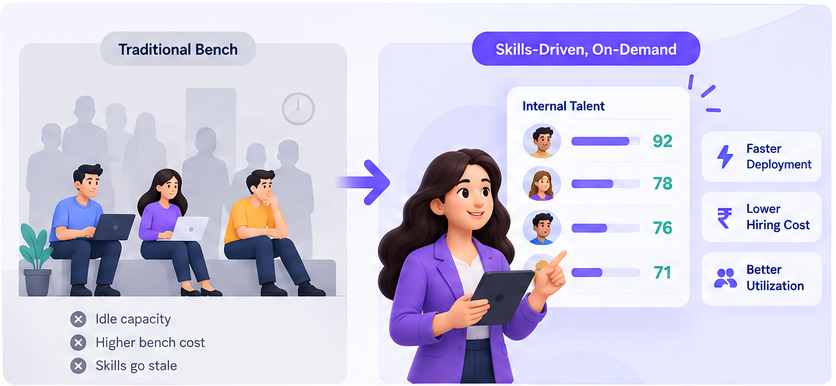
Because removing the bench moves the staffing question from "who is free" to "what can the people who are not free already do." The first is answered by a utilization report. The second can only be answered by a measurement. Hire on demand is a bad trade if that measurement does not exist.
Consider what the decision actually looks like. A client win lands in November and needs eight people in a role family by January. With a bench, someone checks availability and the answer arrives the same day. Without one, there are two paths: hire eight people externally at market speed and market price, or redeploy from inside.
Redeployment is faster and cheaper every time, and it is only available if you know who is redeployable. Not who is *tagged* as redeployable who has been measured. If the only evidence is a self-declared skill field, the redeployment decision is a guess wearing a dashboard, and the cost of being wrong lands on a client deliverable rather than on a recruitment budget.
This is also why the external option keeps getting chosen even when it is worse. It is not that leaders prefer to hire. It is that the external path produces evidence — an interview, an assessment, a reference while the internal path produces a tag. Given a choice between weak evidence about an expensive option and no evidence about a cheap one, people buy the expensive option. Fixing the evidence changes the decision.
How do you run a skills coverage check on your own data?
Pick one role family you would have to fill on demand next quarter. Pull the count of people tagged in your HRMS as holding its core skill. Then record where each tag came from and count only the measured ones. Divide measured by tagged. That ratio is your skills coverage, and it is usually in single digits.
The check takes about a day and needs no platform. Three steps.
Step one — set the denominator. Choose a real role family, not a hypothetical one: somewhere a client win or project start would force a requisition within ninety days. Pull the tagged count across the whole organization. Write it down. That number is what your capacity plan is implicitly relying on, whether or not anyone has said so out loud.
Step two — classify the origins. For each tag, record which of the four origins produced it: self-declared, manager-noted, course-completed, or measured against a benchmark. If your HRMS does not store the origin most do not sample fifty records and ask the owners. Then count only the fourth bucket.
Step three — date-stamp the survivors. Of the measured records, how many were measured within the last eighteen months? A score from four years ago, in a role whose definition has moved, is closer to a claim than to a measurement. Report the ratio and the recency together, because one without the other overstates the position.
Step three is what makes the finding fundable. It converts "we should assess our bench" into a specific gap with a specific denominator, built from a number the business already uses. Teams that have built this discipline on the hiring side will recognize the logic it is the same reasoning behind candidate screening benchmarks for high-volume hiring, applied to people you have already hired.

Which employees should you assess first?
Start where redeployment is most likely and evidence is weakest: role families with open or imminent requisitions, adjacent roles one step away from them, and anyone flagged as high-potential on manager judgment alone. Assessing the whole organization first is the most common way this work stalls before it produces anything useful.
The sequencing error is predictable. A skills baseline sounds like an enterprise-wide data project, so it gets scoped as one, costed as one, and then deferred because the business case for measuring everyone is weak. The business case for measuring one role family against one imminent requirement is strong, immediate, and provable within a quarter.
So invert it. Measure the population you are about to make a decision about. The coverage ratio from that one family is also the argument for the next one, because it is the first piece of evidence anyone in the organization has seen about how much of its skills data is real.
High-potential identification deserves a specific note, because it is where unmeasured judgment does the most damage. A high-potential list built from manager nomination measures visibility, not potential it reliably favors the people whose managers are better at advocacy. A measured baseline does not remove judgment from the decision; it gives the judgment something to argue with.
What does an employee skills assessment measure?
A complete assessment covers three layers: cognitive ability, which predicts how quickly someone absorbs work they have not done before; behavioral and psychometric measures, which predict how they work under pressure and with others; and role-specific skills, measured against the benchmark for the target role rather than the current one.
The third layer is the one most organizations attempt and the first two are the ones that carry the redeployment decision. Role specific skill is the easiest thing to measure and the fastest thing to go stale, because it is tied to tools and processes that change. Cognitive and behavioral measures are stable properties of a person and they are what predict whether someone will cope with a role they have not held.
For roles that now involve working alongside AI systems, there is a fourth reading worth taking: AI resilience how readily a person adapts to working with AI rather than around it. That is a measurable property, and it is a better predictor of who survives a role redefinition than any current tool proficiency, because tool proficiency is what gets redefined. Career Elevation Assessments for internal mobility and skill-gap analysis cover all four readings, along with high-potential identification and succession planning.
Delivery matters for frontline and regional populations. PMaps delivers assessments in 8+ Indian languages, which is the difference between measuring a frontline bench and measuring the English proficiency of a frontline bench.
How is this different from a skills matrix or an LMS report?
A skills matrix is a format and an LMS report is an attendance record. Neither is a measurement. A matrix organizes claims into a grid, which makes gaps visible but does not make the entries true. An LMS report confirms course completion, which evidences exposure rather than capability. An assessment produces the scores a matrix should hold.
This is not an argument against either tool. A skills matrix is genuinely useful once it is populated with scores rather than self-ratings it is the right way to display a baseline. An LMS is the right way to deliver the training a baseline tells you to run. The failure is using either as the baseline itself, and it is a common failure because both produce a complete-looking artifact.
The practical test for any tool you are evaluating, including an assessment platform: ask whether it can tell you the distribution of scores across your bench for one named role benchmark, and when each score was taken. Most talent assessment tools are built for the hiring funnel and can answer that question only for candidates. Ask it about employees before you buy.
See the assessment library to see how role benchmarks are built for specific role families, or book a demo for a 30-minute working session on one role family you would have to fill on demand next quarter what it requires, and what a defensible baseline for it would look like. If you would rather start with a question than a call, email us at ssawant@pmaps.in or call +91 8591320212.