.webp)
.webp)


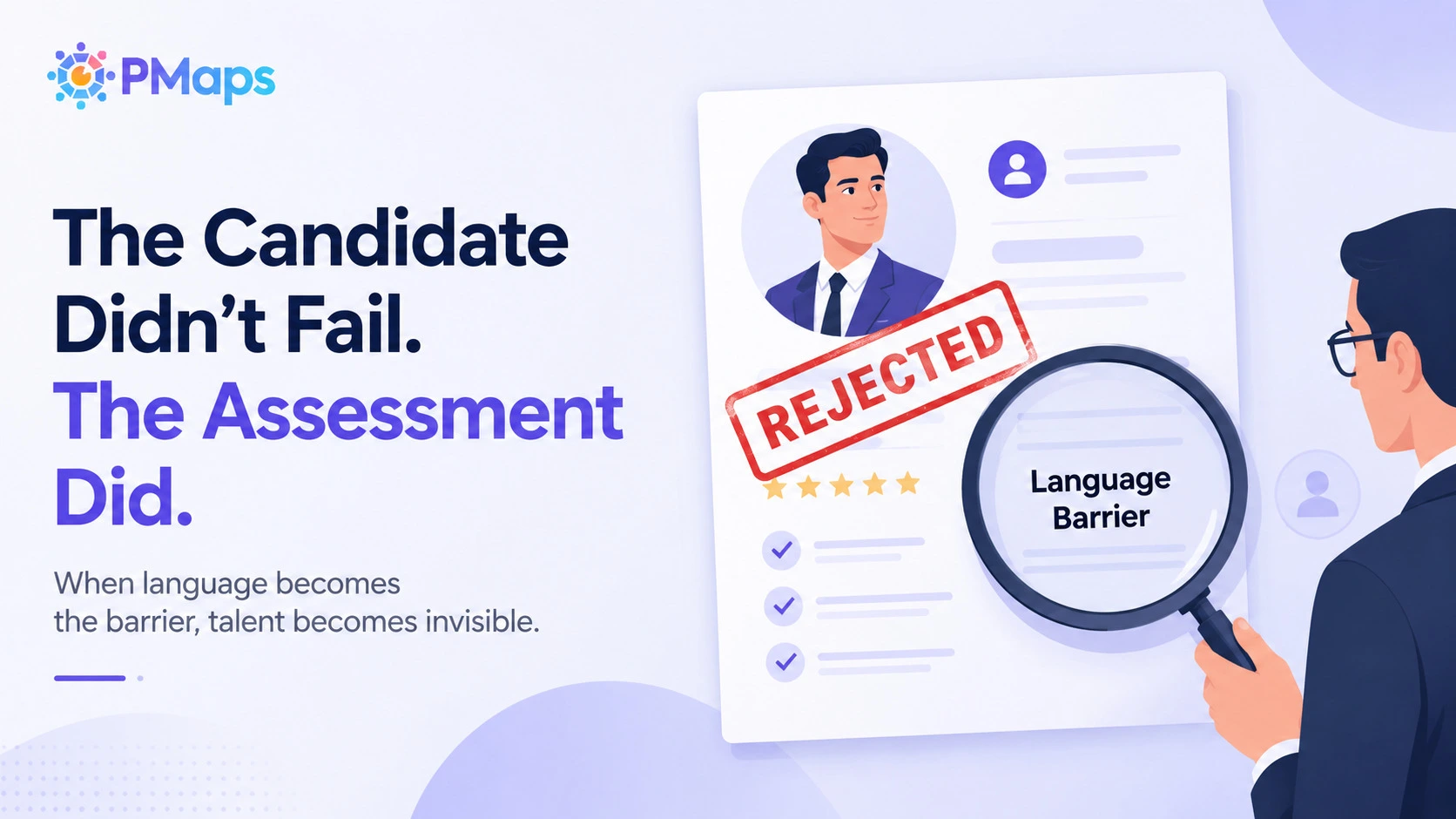
Picture two candidates for the same frontline collections role. Both are good at the job. One grew up speaking English; the other thinks, sells, and persuades in Tamil. Hand them the same English-only aptitude test and you learn something — but not the thing you meant to. You measure how comfortable each one is reading English under time pressure. You do not measure who will actually recover more accounts on the floor.

That gap is not a small one. For frontline, regional, and high-volume hiring across India, language is not a presentation detail. It quietly decides who clears your screen — and it is often measuring the wrong thing.
PMaps was built for the way hiring actually happens here: in many languages, at scale, where the right hire frequently is not the strongest English speaker in the room.
Assessments in the language the candidate actually thinks in
Every PMaps assessment is available out of the box in 14+ languages:

This is not a single product translated once. It spans the full platform — cognitive and behavioral assessments, the psychometric suite, AI Video Interview, and EVA, our AI Voice Interviewer. A candidate can take a reasoning test in Bengali, complete a behavioral assessment in Marathi, and have a conversational voice interview with EVA in their own language. The role is measured the same way every time; only the language changes.
And when you need a language that isn't on that list, we don't make you wait for a roadmap. Our in-house Multi-Language Translator can localize any assessment into any requested language — which means a global rollout or a region-specific role isn't blocked by a vendor backlog.
Translation is the easy part. Keeping the test valid is the hard part.
Here is the trap most "multilingual" assessment claims fall into: swapping the words is trivial. Keeping the measurement intact is not.
A psychometric assessment is a calibrated instrument. Each item is written to measure a specific construct — conscientiousness, numerical reasoning, customer empathy — at a known level of difficulty. Translate that item carelessly and you can change what it measures without anyone noticing. An idiom that lands in English falls flat in Gujarati. A word that signals "assertive" in one language reads as "aggressive" in another. The test still looks fine. It just stops predicting what it used to predict. Your scores drift, and you have no way of knowing.
So at PMaps, a translated assessment clears two checks before it goes anywhere near a candidate.

Language experts review the translation itself. Native specialists check that every item reads naturally in the target language — correct register, the right idiom, no awkward literal phrasing that confuses a candidate or changes the question's intent. The goal is an item that feels like it was written in that language, not converted into it.
Our psychology team protects the reliability of the test. This is the step that separates a real assessment platform from a translation tool. Before a localized version is cleared, our psychologists confirm that each item still measures the same construct, at the same difficulty, as the original. The score a candidate earns in Telugu means the same thing as the score a candidate earns in English — so you can compare them fairly and benchmark them against the same role standard.

That second check is the whole point. A PMaps score is a prediction — validated against real on-the-job performance — and a prediction is only as good as the instrument behind it. We won't ship a translation that weakens it.
What this looks like in practice
This is not theoretical. PMaps already runs multilingual hiring at volume across some of India's largest hiring floors.
For 1Point1, we built India's first Hinglish (Hindi + English) AI voice interview — opening structured, scalable screening to a semi-skilled workforce that simply wasn't being assessed well in English-only formats. For BPO and insurance clients hiring thousands of frontline agents a month, regional-language delivery is what makes high-volume screening both fair and accurate.

The pattern repeats across sectors: when candidates are assessed in the language they work in, completion rates climb, drop-off falls, and — most importantly — the scores start predicting performance instead of language fluency.
Why this matters for the people doing the hiring

Multilingual delivery does three things for a talent team at once:
- It widens your real talent pool. You stop screening out strong candidates for the wrong reason and start measuring the competency you actually hire for.
- It reduces a hidden source of bias. Forcing one language onto a multilingual workforce systematically disadvantages whole groups of capable people. Removing it makes the process measurably fairer.
- It keeps your data comparable. Because reliability is protected through translation, a candidate in Kochi and a candidate in Kolkata can be scored against the same validated benchmark — in their own languages — and you can trust the comparison.
The bottom line
Plenty of platforms can change the words on a screen. Far fewer can promise that the test still measures what it's supposed to once the words change. PMaps does both - our assessments support 14 languages, with any language available through in-house translation. Each version passes linguistic and psychometric review, so teams can assess candidates fairly across regions. To see multilingual assessments and EVA voice interviews in your hiring languages, call +918591320212 or email assessment@pmaps.in.

.webp)

.webp)