.webp)
.webp)


.webp)
An AI voice interview is an automated screening process where a candidate has a conversational, spoken dialogue with an artificial intelligence. Acting like a virtual recruiter, the AI asks job-related questions over the phone or via a web browser, listens to your answers, and scores your responses.
Experience it before deploying the PMaps AI Voice Interviewer and see how it screens candidates in real time.
According to SHRM's 2025 Talent Trends report, 89% of HR professionals say AI saves them time or increases efficiency — with speech analysis in recruitment and automated candidate qualification growing as the fastest-expanding application in what is an AI voice interview in hiring.
How Does AI Voice Interview Work?
You may wonder how AI conducts voice interviews without a human recruiter, well it's pretty simple. The candidate joins a scheduled call or browser session. The AI then asks questions, listens to responses, captures speech signals, and scores answers objectively against role-specific criteria.
Here’s the step by step process of conduction:
- Invitation and scheduling — The candidate receives a link or confirmed call time. No recruiter coordination is needed; the system books, reminds, and confirms across time zones automatically.
- Question delivery — The AI asks structured, role-specific questions aloud. Depending on the agent type, questions may follow a fixed sequence or adjust dynamically based on the candidate's previous answer.
- Speech capture — Responses are recorded in real time. The system captures tone, pace, vocabulary, and clarity alongside the content of what was said.
- NLP analysis and scoring — Natural language processing evaluates the spoken response against predefined competency markers. Each answer is scored consistently, without interviewer mood or fatigue affecting the result.
- Report generation — A structured candidate report is produced immediately after the call. Hiring managers receive ranked shortlists with score breakdowns — ready for review without a single follow-up call.
Understanding how AI Voice Interview works at scale means recognizing that this entire process runs across hundreds of candidates simultaneously — the same questions, the same scoring logic, no scheduling gaps, no interviewer inconsistency.
If every interview runs remotely, how do you verify identity and prevent malpractice? That’s exactly why you must enable AI Proctoring for safer screening.
Different Types of AI Voice Agents and When to Use Them
Not all AI voice agents are built the same way. The right type depends on your role volume, screening complexity, and whether consistency or conversational depth matters most at that stage.
Where AI Voice Interviews Fit in the Hiring Funnel?
AI voice interviews are not a single-use screening tool — they serve meaningfully different purposes depending on where in the funnel they are placed. Knowing where to deploy them prevents both under-use and over-reliance.
A useful next read: Best AI Voice Interviewer Platform, for teams comparing AI screening tools against real hiring needs.
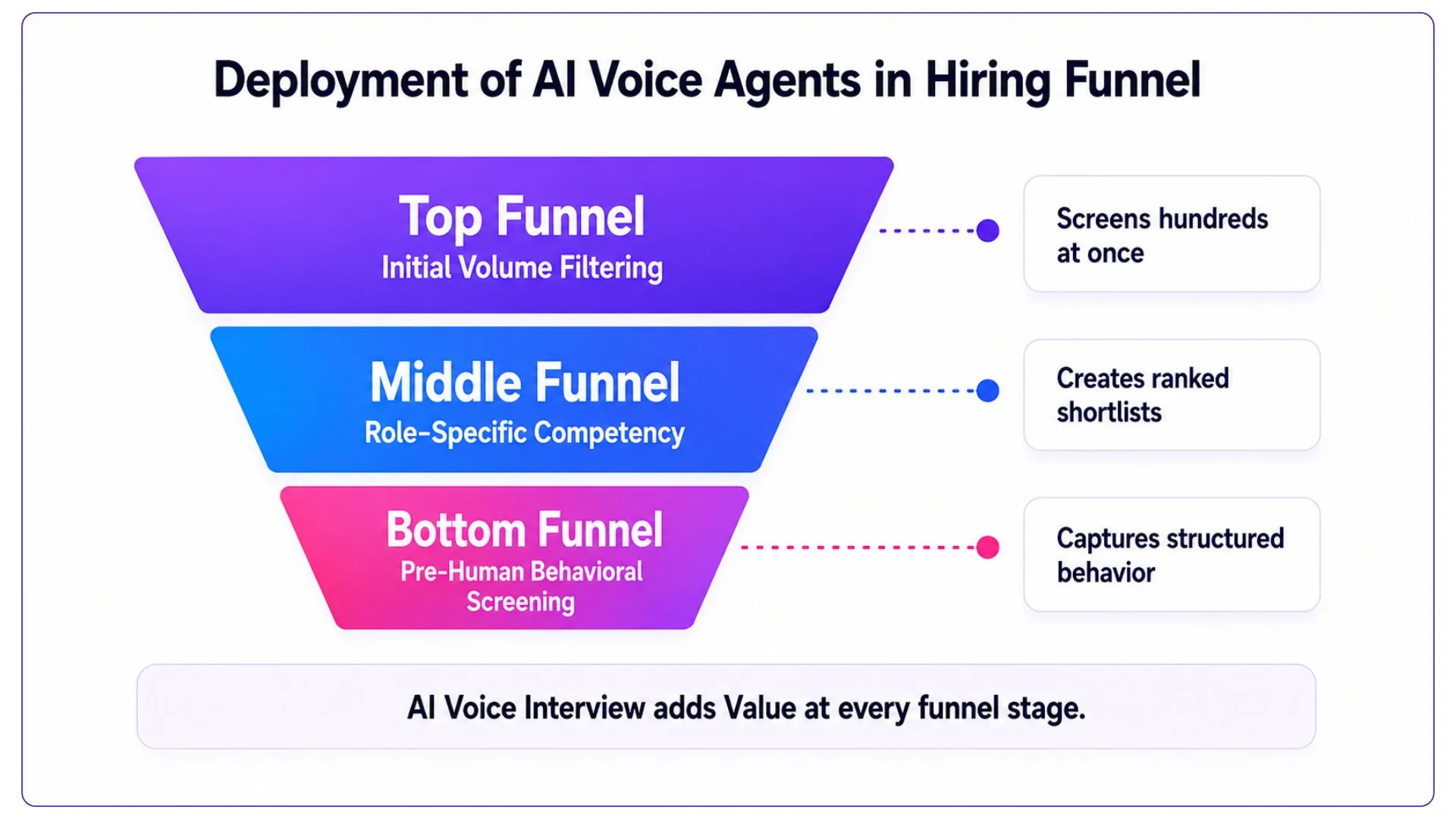
Voice Agent at the Top Funnel
Initial volume filtering. When hundreds of applicants respond to a job posting, a human recruiter can realistically conduct 8–10 phone screens per day. An AI voice agent runs the same process across hundreds of candidates in parallel — within hours. It filters for baseline communication clarity, role availability, and minimum fit criteria before any recruiter time is spent.
Middle Funnel Voice Interviewer in Hiring
Role-specific competency screening. After the initial filter, AI voice interviews go deeper — probing for job-specific skills such as problem-solving approach, product knowledge, or call-handling accuracy for BPO roles. The system scores against role-defined benchmarks and returns ranked shortlists, not raw stacks of applications.
AI Voice Interviewer at the Bottom Funnel
Structured pre-human behavioral screening. In the late funnel, AI voice tools can conduct structured behavioral event interviews — capturing evidence of past decision-making, composure under pressure, and communication quality. The output gives the human interviewer a prepared, data-backed starting point rather than a blank conversation.
AI Voice Interview Benefits for Recruiters
Voice AI interviews for high-volume hiring remove the screening bottleneck that slows recruitment teams. They conduct interviews at scale, capture comparable candidate data, and return ranked shortlists faster. As the system runs across every open role, recruiters gain time for final-stage judgment, candidate engagement, hiring quality, and faster decisions overall.
Which screening gap costs recruiters most: missed calls, slow shortlists, or weak evidence? Read more about the ROI of the tool on AI Voice Interview Benefits for Recruiters.
- Scales without adding headcount — One system conducts hundreds of simultaneous interviews; a recruiter team cannot match that output regardless of size
- Cuts time-to-shortlist from days to hours — Ranked shortlists arrive within hours of application, not after days of phone-tagging candidates who may not pick up
- Removes scheduling friction entirely — Candidates join when convenient; the system runs 24/7 across time zones with no calendar dependency
- Produces consistent, comparable data — Every candidate faces the same question structure and scoring logic, removing interviewer variability from early-stage decisions
- Reduces early-stage bias — Scoring is based on defined competency markers, not how comfortable a recruiter felt on a given call
- Frees recruiter time for depth — Human interviewers focus exclusively on final-stage candidates where their judgment actually changes outcomes
- Improves candidate experience — Immediate confirmation, structured process, and faster feedback loops raise engagement and reduce applicant drop-off at the top of the funnel
Traditional Interviewing Vs AI Voice Interviewing
AI voice interviewing does not replace human judgment; it preserves recruiter attention for decisions that need depth. Traditional screening works well with smaller, qualified pools. It weakens when applications rise, calls get missed, and shortlists slow down. AI voice interviews handle scale, so recruiters spend time where judgment matters most.
Which interview model gives better evidence, speed, and fairness? Here’s a more detailed blog on AI Interviews vs Traditional Interviews to help you with point-to-point differences before you start to redesign your screening workflow.
AI Voice Screening vs Phone Interview
Personal phone screening by recruiters was the hiring industry's workhorse for decades. It works — but only for roles where volume stays manageable and recruiter time is not the constraint. For teams filling hundreds of positions across compressed timelines, it has become the single biggest source of hiring delay. Calling applicants one by one, playing phone tag, and re-scheduling no-shows is not a screening strategy — it is a capacity problem disguised as one.
How is AI Voice Interview Different from Video Interview
Zoom and Google Meet interviews were the pandemic-era solution for in-person screening. They added video to the process but did not solve the underlying problem: human scheduling, inconsistent evaluation, and fatigue at scale. For high-volume roles, a video call still breaks down the same way a phone screen does — it just requires a better internet connection. Today, interview fatigue, no-shows, and camera anxiety have made video screens as much a friction point for candidates as for recruiters.
When the role demands depth over volume, the format needs to match, AI Video Interviewer is more structured approach for final-stage interviews that go beyond what a voice screen captures.
Conclusion
AI voice interviews do not replace hiring judgment — they protect it by removing the volume work that consumes recruiter bandwidth before a single qualified candidate reaches the table. Teams running BPO, customer service, or high-volume support functions see the clearest gains: faster shortlists, more consistent data, and human interviews reserved for candidates who have already demonstrated baseline fit.
If you want to see how the PMaps AI Voice Interviewer works against your own role requirements, reach out directly. Call +918591320212 or write to ssawant@pmaps.in — we will run you through a live demonstration with real job criteria.