
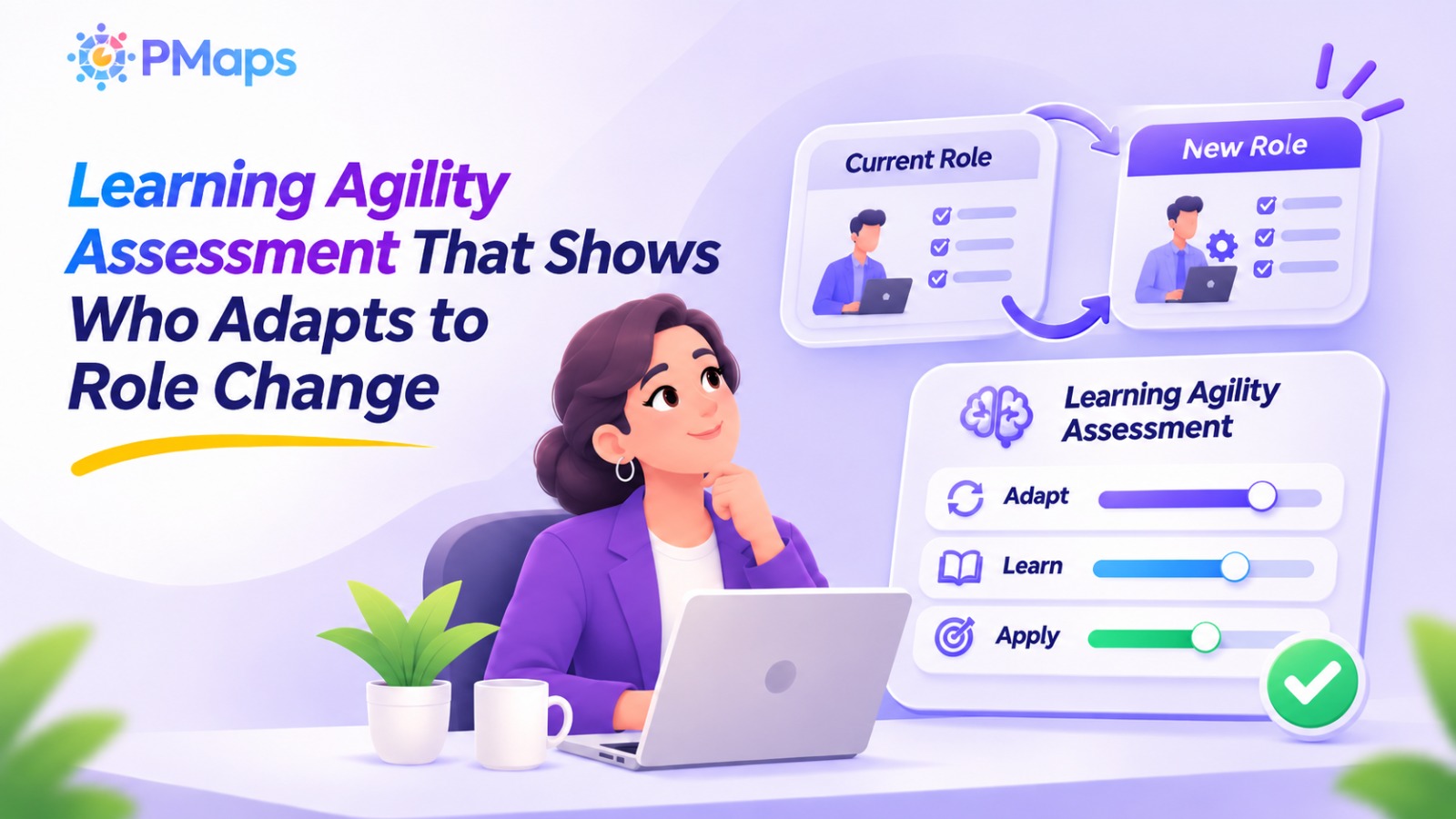
A learning agility assessment measures how quickly and accurately a person absorbs an unfamiliar process and returns to their previous standard of output. Gartner's forecast of 10 November 2026 puts 435.5 million workers - just over 20% of the global workforce - in roles whose tasks, methods and responsibilities change by 2030. Where development money goes, and what a hiring loop selects for, now turns on a measure most organizations do not hold.
What is a learning agility assessment?
A learning agility assessment measures how quickly and accurately a person absorbs an unfamiliar process and returns to their previous standard of output. It is a measure of the individual rather than the role, which is what separates it from an exposure study. PMaps reads every score against validated role benchmarks.
Learning agility is a long-standing construct in work psychology, and the reason it has become urgent is arithmetic. Gartner's 10 November 2026 forecast projects 10.6 million jobs created and 8.9 million eliminated by 2030, a net increase of 1.7 million. The net figure is the one being quoted. The 435.5 million figure in the same research is roughly fifty times larger, and it describes people who keep their jobs and have them rewritten underneath them.
For an employer, that converts a workforce question into a measurement question. Not how many roles disappear, but which of the people in the roles that remain will absorb the change without a productivity hole.
Why is AI exposure not the same as adaptation?
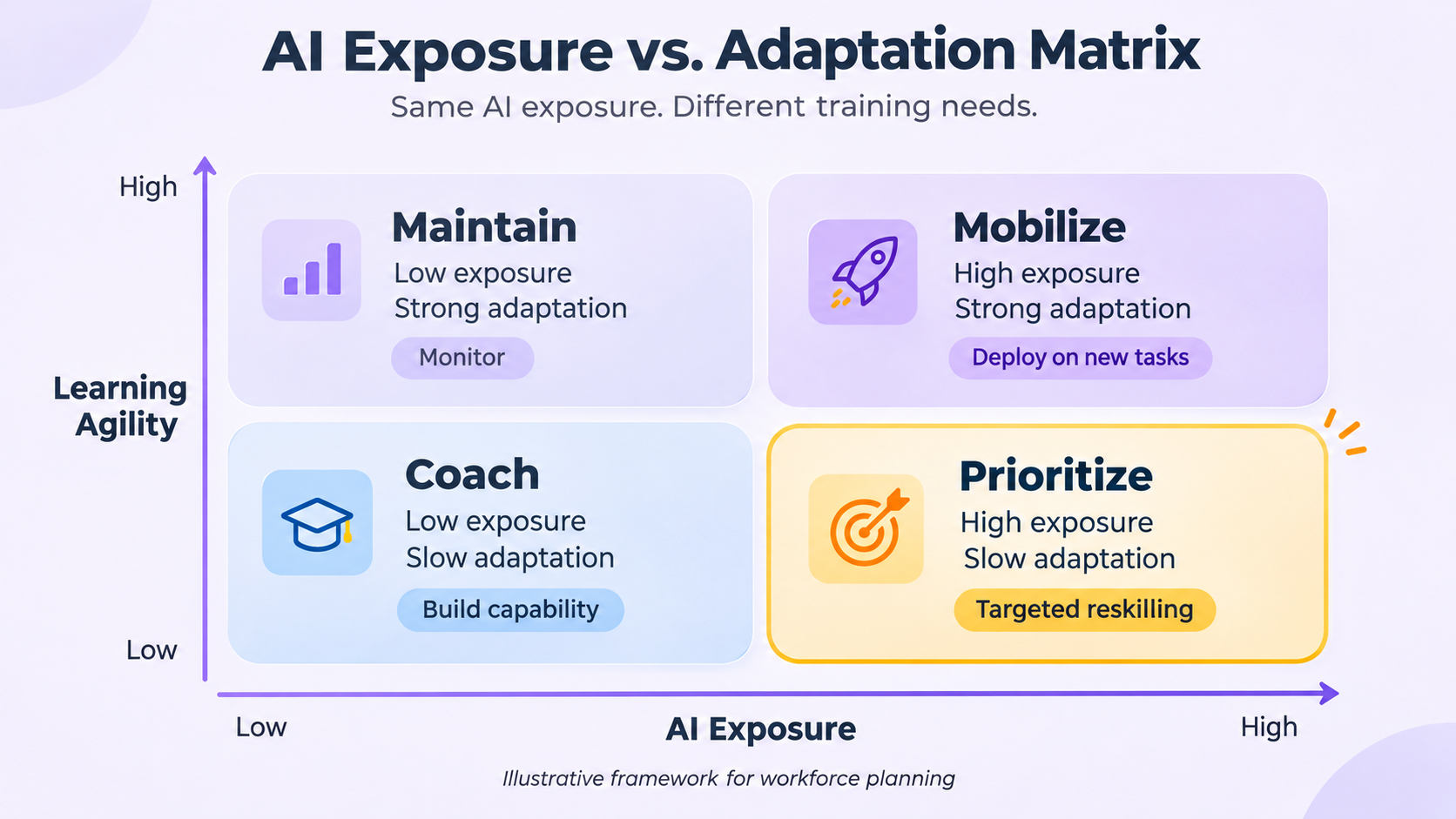
Exposure is a property of the job. Decompose a role into tasks, mark which ones a model can now perform, and you have an exposure score without speaking to anyone. Adaptation is a property of the person, and two people in the same seat with the same exposure score absorb the same change at very different speeds.
Every exposure study works by task decomposition, which is why exposure figures can be produced at national and sector scale. It is a legitimate way to size a problem and a poor way to allocate a budget.
Conflating the two produces two errors, and most organizations are making both at once.
The first is spending development money by exposure. The most exposed role family receives the training budget, which means the money is allocated by job description rather than by need. Inside that group, the people who would have adapted without help consume the same hours as the people who will not adapt with it.
The second error sits at the point of hire and compounds over three years. Hiring for AI readiness has quietly collapsed into hiring for tool familiarity: which models a candidate has used, which prompts they can write, which certificate they completed. Tool familiarity is a record of exposure history, and it depreciates on the release cycle of the tools themselves. The capacity to take a changed process, learn it and return to standard does not depreciate.
How do you measure learning agility in your existing workforce?
Use the process changes you have already made. For three changes in the last 18 months, record how many weeks each affected person took to return to their previous output level. Ticket logs, QA scores and productivity dashboards already hold this. Read the three series together rather than separately.
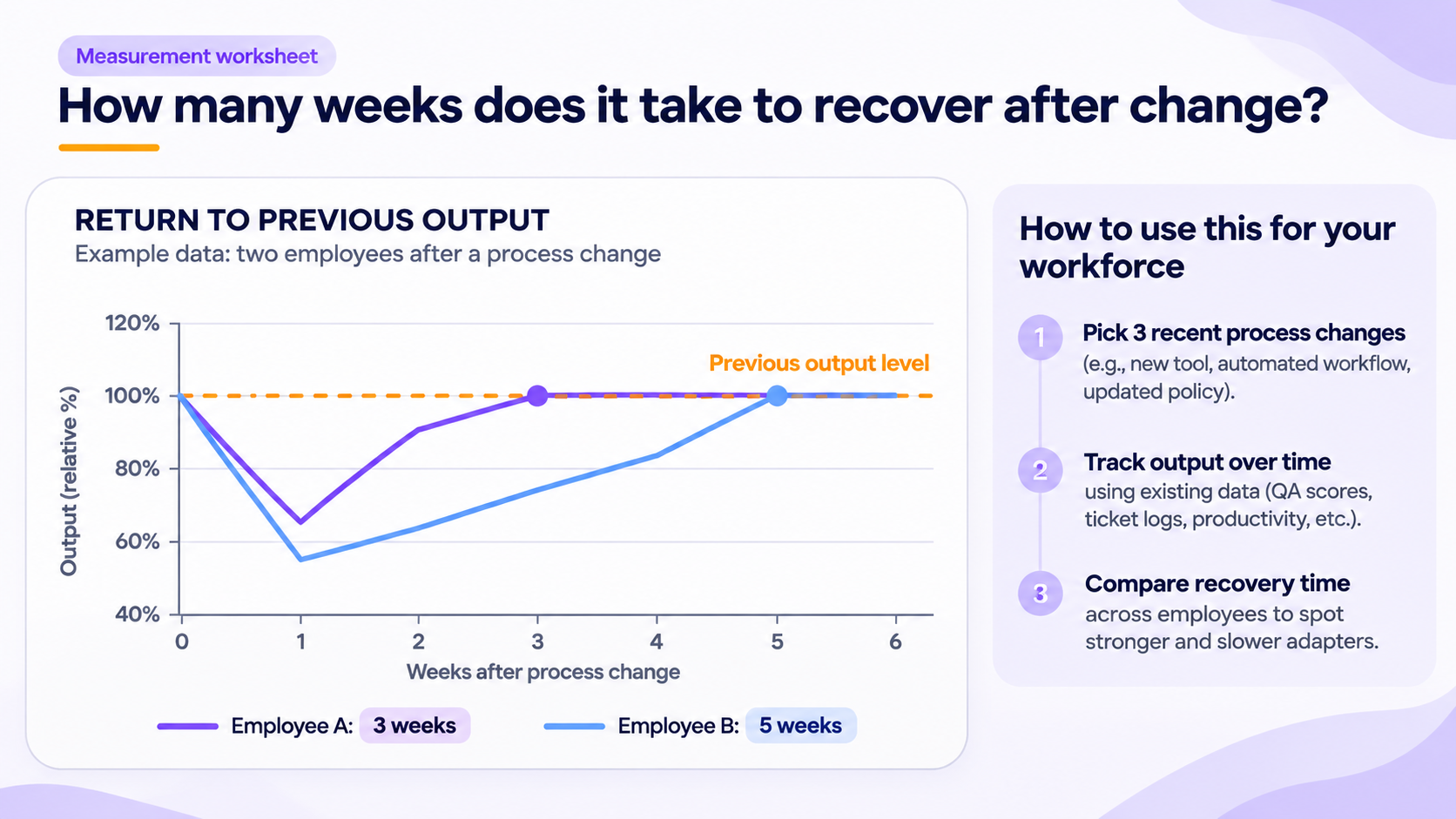
This is the cheapest adaptation evidence available to any organization, and almost nobody reads it. A CRM migration, a new dialer, a changed compliance workflow and a platform consolidation are all natural experiments that have already been run on your own people, at your own expense, with the results sitting in systems you pay for.
Three practical constraints. Use weeks-to-previous-output rather than a satisfaction survey, because self-reported comfort with change correlates poorly with the speed of actual recovery. Hold the measure constant across all three changes, or you are comparing instruments rather than people. And read it at the individual level within a team, because a team average conceals exactly the variance you are looking for.
What you end up with is a ranked adaptation record built on evidence rather than impression. The people who recovered quickly on all three changes are your adaptive bench. The people who recovered slowly on all three are where development money earns its return, and that is a more defensible basis for a reskilling assessment than a job title.
A formal learning agility assessment does the same job prospectively, which is what you need for a candidate, or for an employee moving into a role that has not changed yet.
What should a hiring loop measure for roles that will change?
Ask every candidate for one instance where a tool or process they relied on changed, and require three things in the answer: what specifically changed, how long until they were back to standard, and how they knew. Score it on a scale written down before the first interview, by one scorer.
The order matters. A scale defined after the interviews is a rationalization, and an inconsistent scale is worse than no question at all, because it produces a number that looks like evidence and is not. This is the same discipline that makes a structured candidate screening benchmark more predictive than an unstructured conversation, and it costs nothing but sequence.
Two failure modes to design out. Candidates reliably narrate enthusiasm for change rather than evidence of it, so the "how did you know" requirement is doing the real work - it forces a measure. And interviewers reliably reward fluency, so a single scorer on this one question removes the variance between interviewers before it reaches the hiring decision.
Where a structured interview is impractical at volume, a scored instrument carries the same logic through a funnel of thousands. For frontline and voice processes, PMaps delivers this through its AI voice interviewer for frontline hiring, in 8+ Indian languages.
How does a learning agility assessment differ from a skills test?
A skills test measures what a person can do today. A learning agility assessment measures how quickly they acquire what they cannot do yet. For a role whose tasks are being rewritten, the second measure holds its value longer, because the first one describes a job that is in the process of changing.
Both belong in a hiring process, and the weighting should follow the role's rate of change. For a stable role with a defined toolset, a skills measure carries most of the predictive load. For a role where a third of the working week is being reorganized, a skills snapshot has a short half-life and the agility measure is what tells you whether the person will still be effective in eighteen months.
The same logic applies to internal decisions. A skills inventory tells you what your bench can do now. It does not tell you who can be moved into a role that nobody in the organization has held before, which is the decision an AI-driven reorganization actually forces.
Which role families should you assess first?
Rank role families by how much of the working week is moving, not by headcount or seniority. Write out the eight to twelve tasks that make up the week, mark each one unchanged, assisted or replaced, and start with the family where the assisted and replaced share is largest.
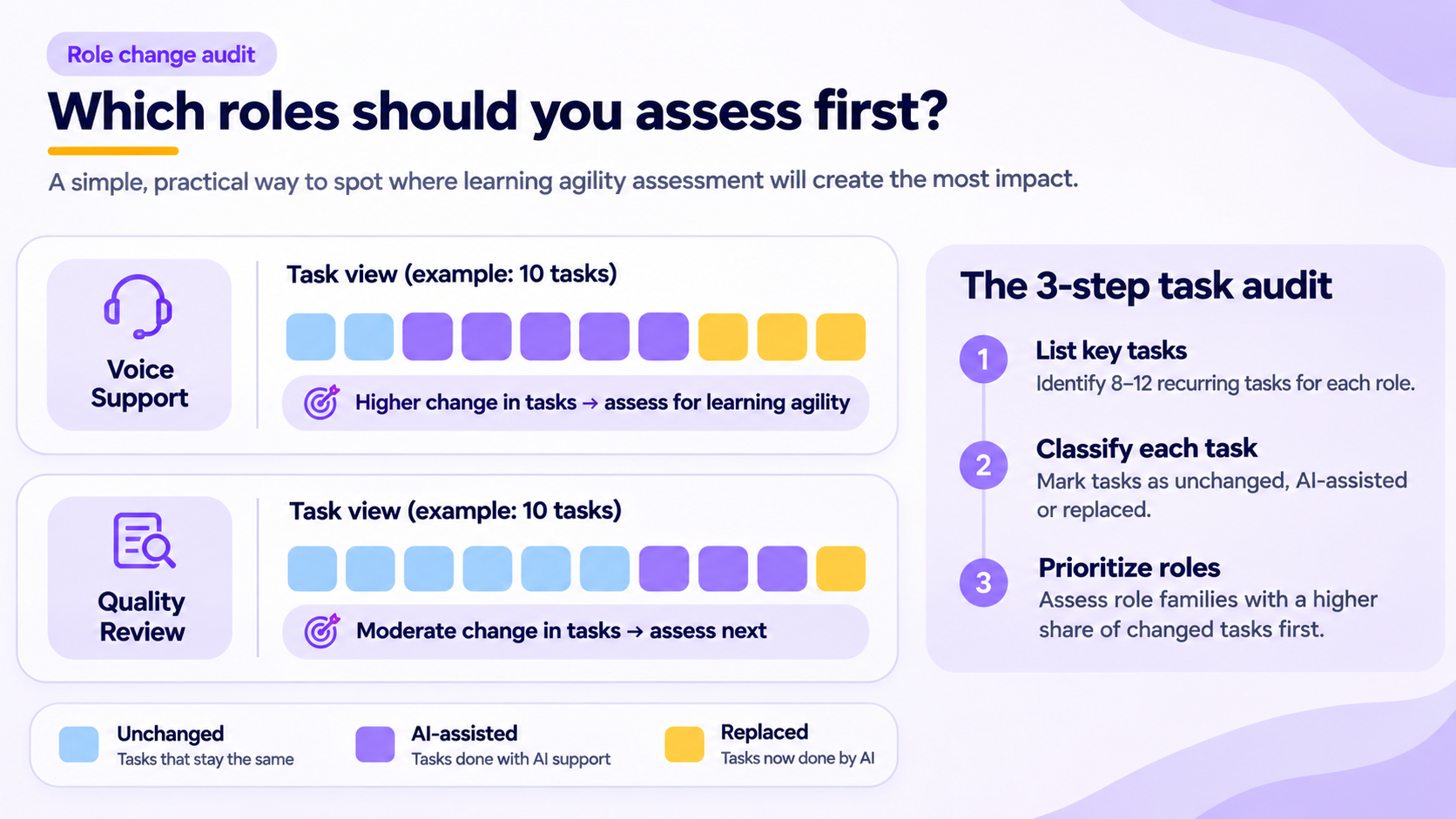
Headcount is the wrong sort order because it optimizes for coverage rather than exposure. Seniority is the wrong sort order because senior roles tend to contain more judgment tasks and fewer process tasks, which makes them later rather than earlier candidates for reorganization. A change readiness assessment run at the organizational level will not rank them for you either, because it measures the organization and not the roles inside it.
In Indian enterprise structures, the families that usually surface first are frontline voice and chat operations, transaction processing, collections, and first-line support - high-volume role families where one process rule is applied hundreds of times a month, and where a small amount of drift compounds quickly.
Produce that list without names on it. The exposure list tells you where change is landing. It is designed to tell you nothing at all about who handles it, and treating it as a list of people is the first error described above.
How does PMaps measure learning agility and AI resilience?
PMaps runs AI resilience assessment within Career Elevation Assessments, measuring how readily a person adapts to working with AI. It covers existing employees as well as candidates, reads every score against validated role benchmarks, and delivers in 8+ Indian languages for frontline and voice processes.
Three things make a PMaps score a prediction rather than a result. Assessment is multimodal - cognitive, behavioral and psychometric measures alongside AI video and voice interviews - so a score reflects the whole person rather than one narrow test. Every score is read against a validated role benchmark, so a good score means good for this role. And scores are validated against real on-the-job performance and attrition outcomes across sectors.
Across 12 years and 4M+ assessments, with 200+ enterprise clients across 7 countries, the pattern that holds through a role change is an unglamorous one: the organizations that come through well are not the ones that bought the most training. They are the ones that knew, before the change, which of their people would need it.
See how PMaps measures adaptation for the roles you are reorganizing, or book a 30-minute working session on one role family - your tasks, your last process change.