

Recruitment screening is the stage where an employer reduces a candidate pool to a shortlist worth interviewing. This page is written for talent acquisition leaders, CHROs and hiring heads running high-volume hiring in India — BPO and ITES, banking and financial services, production and frontline roles. It is not written for candidates preparing to be assessed.
India's white-collar hiring rose 14% year on year in October 2026 while the Naukri JobSpeak index itself fell month on month, which means a large number of organizations are about to scale their screening against a standard nobody has re-stated. The outcome this page is about is holding your selection bar steady while volume rises.
What is recruitment screening, and what does it actually measure?
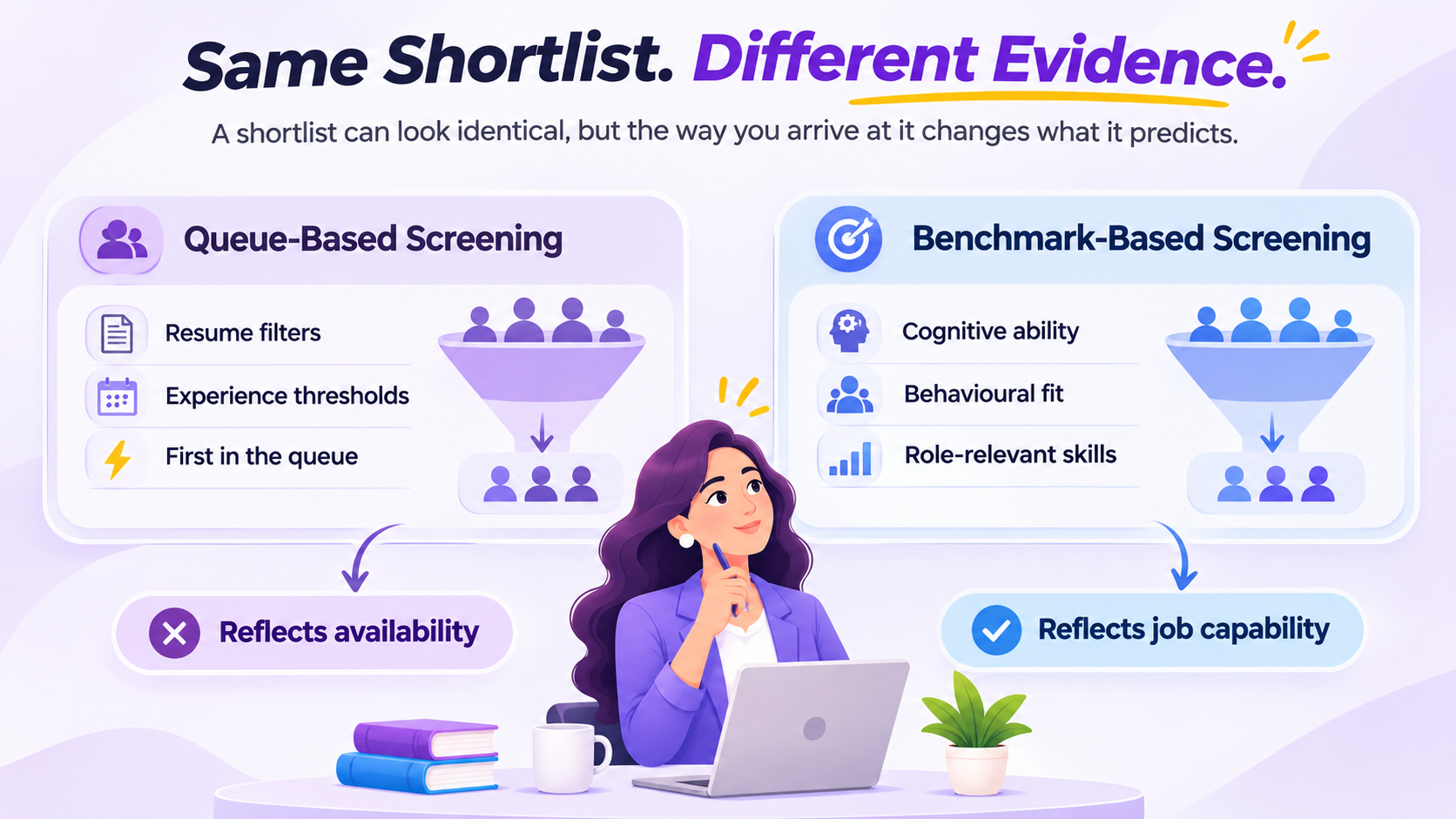
Recruitment screening is the stage where an employer reduces a candidate pool to a shortlist worth interviewing. Done well, it measures job-relevant capability against a validated role benchmark. Done at volume without one, it measures whoever reached the recruiter first, which is availability rather than fit.
That distinction is easy to lose because both versions produce the same artifact: a shortlist. The shortlist looks identical whether it came from a benchmark or from a queue. What differs is what the shortlist predicts. A benchmark-based screen produces a shortlist whose scores correlate with performance in that role. A throughput-based screen produces a shortlist whose scores correlate with when the candidate applied.
Most screening stacks in Indian enterprises contain some of each. Resume filters and experience thresholds are availability proxies — they describe what a candidate has been exposed to, not what they can do. Cognitive, behavioral and psychometric measures, read against a role benchmark, describe capability. The ratio between the two determines how much your screening survives a volume increase.
Why does a recruitment screening process drift as volume rises?
A recruitment screening process drifts because the standard is usually held in people rather than written down. When volume rises, the same recruiter hours spread across more candidates, so the judgment gets faster and looser. Nothing is decided to lower the bar. It moves anyway, and no report shows it.
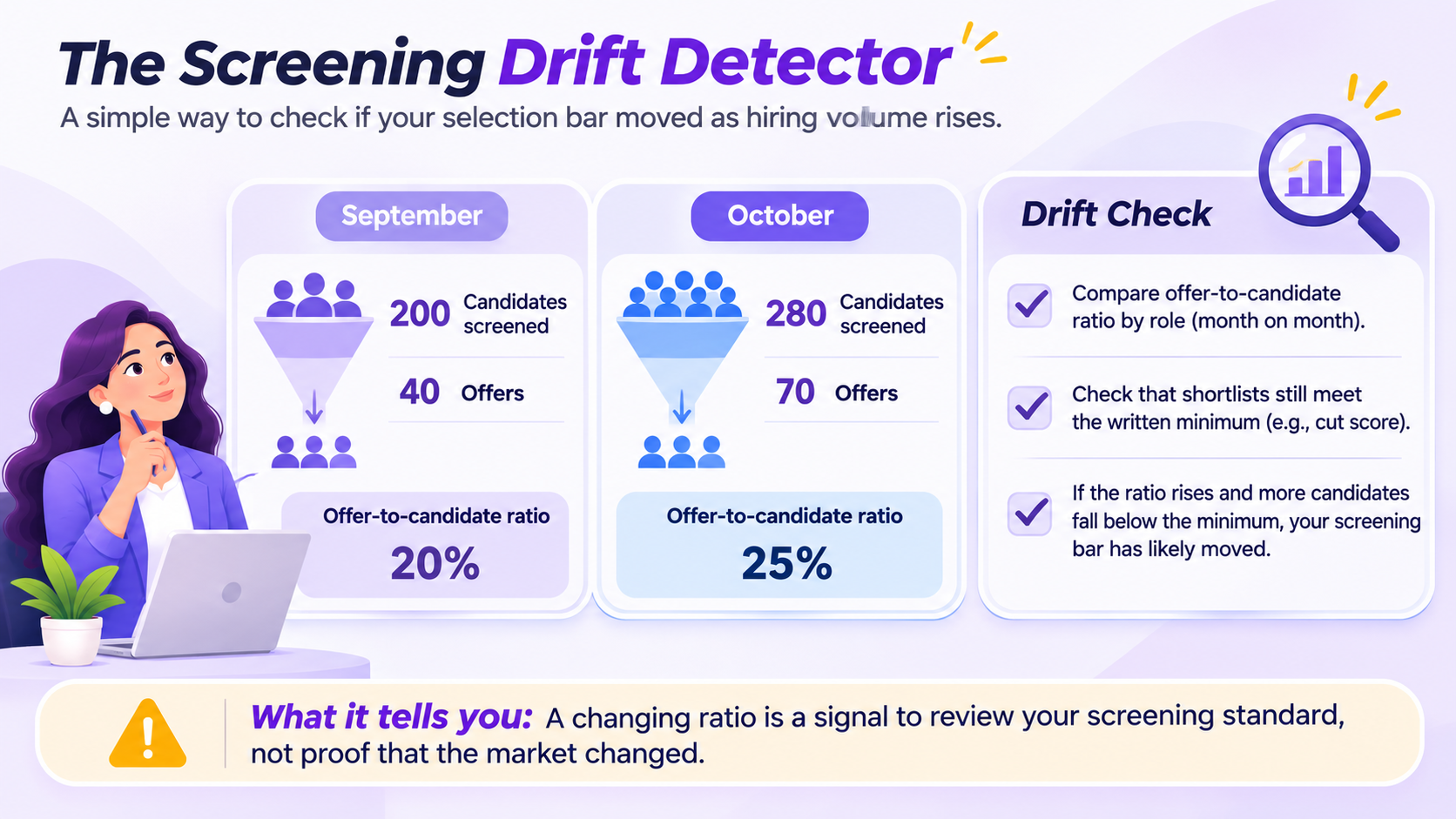
This is the mechanism worth understanding, because it is not a discipline problem and it cannot be solved by telling recruiters to be more careful. It is arithmetic. If a recruiter screened 200 candidates in September and 280 in October against the same number of working hours, each decision gets roughly 30% less attention. Under that pressure, the easiest thing to relax is the marginal call — the candidate who is close to the line. Those marginal calls are precisely the population a cut score exists to adjudicate.
The second reason drift goes unseen is that no standard report surfaces it. Time-to-fill improves, because shortlists are produced faster. Cost-per-hire improves, because more hires come from the same spend. Offer acceptance may hold. Every number on the recruiting dashboard looks better in the month the bar moves, and the consequence arrives two or three quarters later as frontline attrition or missed quota — by which point it is attributed to the market.
What makes bulk hiring different from ordinary recruitment screening?
Bulk hiring repeats one screening decision hundreds of times a month, usually for frontline, voice or field roles. Ordinary recruitment screening can absorb an inconsistent judgment call. Bulk hiring compounds it, because a two-point drift in the standard becomes several hundred mis-selected hires in a quarter.
October 2026 is a useful illustration of where this exposure actually sits. Production and manufacturing hiring rose 39%, automobiles 36%, BPO and ITES 17%, banking and financial services 16%, while IT and software services managed 5%. The growth landed disproportionately in the role families that hire in cohorts rather than one at a time.
In a cohort model, the screening rule is not a judgment — it is effectively a policy. One threshold decision governs the whole intake. That makes bulk hiring the setting where a written standard pays the highest return, and the setting where its absence is most expensive. It is also the setting where a well-built screen is cheapest to run, because the cost of defining the benchmark is amortized across every candidate in the cohort.
For voice and customer-facing processes the same logic extends to language. An AI voice interviewer for frontline hiring applies one consistent conversational standard across an entire intake, which is difficult to achieve with a panel of human screeners working at volume under time pressure.
How do you measure whether your screening bar moved?
Compare your offer-to-candidate ratio month on month, by role family rather than company-wide. Divide offers made by candidates who entered the process. If that ratio rises in the same month volume rises, the bar moves. A company-wide figure hides it by averaging stable corporate funnels against volatile frontline ones.
Run it on the three role families where your own volume grew most. Pull four numbers for each, for two consecutive months: candidates entered, screened in, offered, joined. The diagnostic is the first and third of those.
There is a second check worth running alongside it, and it is the one almost no organization holds. Count how many of the month's hires cleared your written minimum standard. If you do not have a written minimum, that is the finding — and it is a more useful finding than any ratio, because it tells you the drift is currently unmeasurable rather than merely unmeasured.
4,000,000+ assessments completed the volume PMaps has delivered since 2014, across 200+ enterprise clients in 7 countries.
Do recruitment screening tests work in tier-2 city hiring?
Yes, provided the benchmark is built for the role and not inherited from another location. A cut score drawn from Bengaluru hiring history does not describe a Surat floor. PMaps delivers assessments in 8+ Indian languages, so language fluency does not stand in for capability in regional markets.
This matters more this quarter than last. October 2026 hiring growth in Gujarat's smaller cities ran well ahead of the metros — Gandhinagar up 48%, Surat 36%, Vadodara 30%, Ahmedabad 23%, against 11% to 15% across the major metros. Employers expanding into those markets are making selection decisions where they hold no record of who succeeded there before.
The common failure is to carry the existing cut score across and treat it as a benchmark. It is not one. It is a summary of a different labor market's score distribution. Two corrections make it defensible: anchor the standard to on-the-job outcomes for the role rather than to a percentile of the local pool, and deliver the assessment in the language the work is actually performed in. An English-medium screen in a Hindi or Gujarati voice process measures English, and then reports it as capability.
How do you set a cut score you can defend?
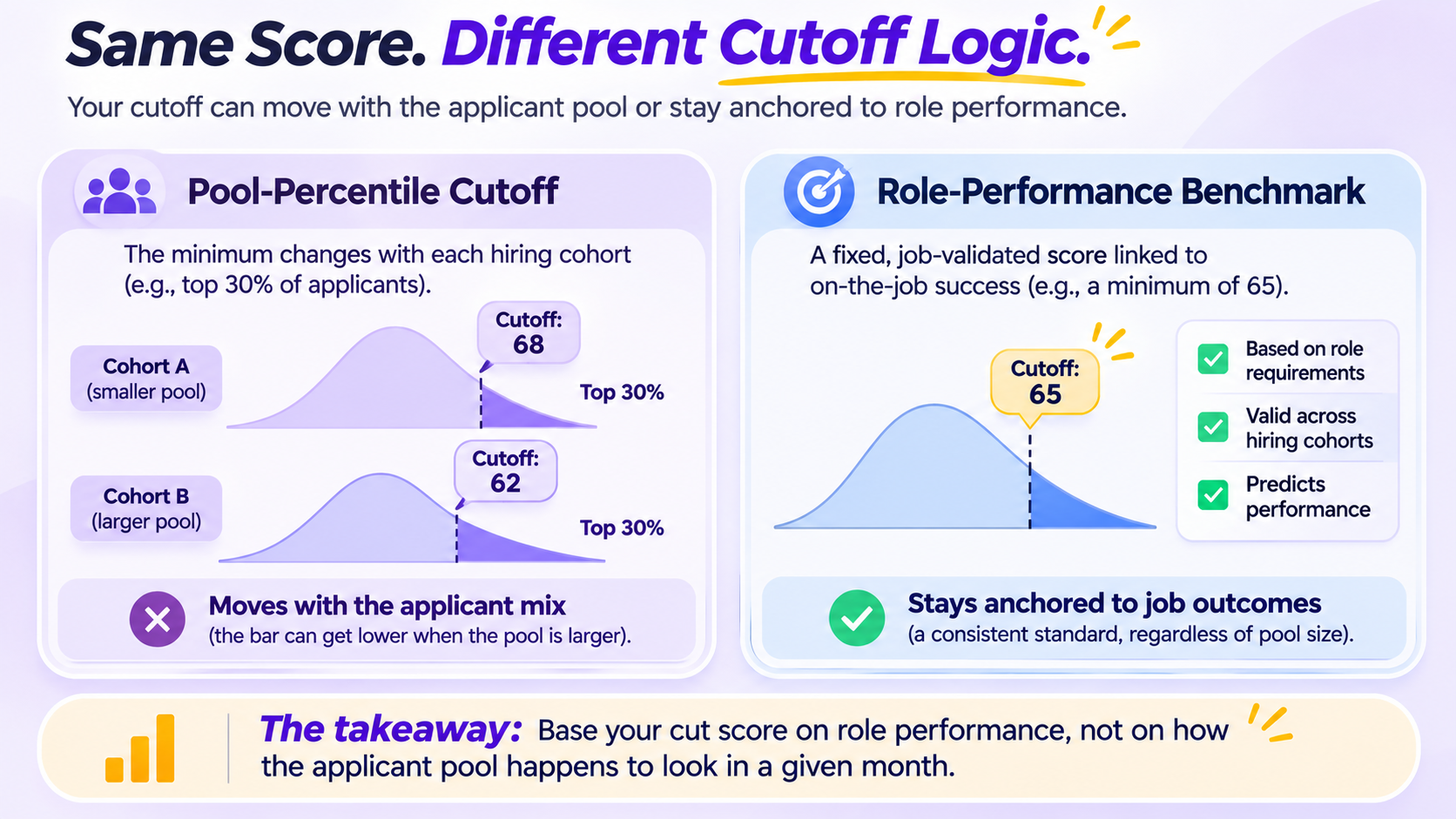
Set the cut score from performance data for that specific role, not from the score distribution of the candidates in front of you. A percentile cut moves every time the pool changes. A benchmark anchored to on-the-job outcomes holds steady, which is what makes a screening decision defensible later.
The practical difference shows up when someone asks why a candidate was rejected. "They scored below the 60th percentile of October candidates" is not a defensible answer, because it means the same candidate would have passed in September. "They scored below the threshold associated with meeting quota in this role" is defensible, and it is the same answer every month.
Building that threshold requires outcome data you may already hold: for a given role, which hires met their targets and stayed, and what did they score. Where that data does not exist yet, a validated role benchmark from a comparable deployment is a reasonable starting standard, provided it is labelled as provisional and revisited against your own outcomes after the first two cohorts.
This also applies to early-careers intake, which rose 15% in October. A campus hiring assessment faces the problem in its sharpest form, because candidates have no employment history to benchmark against at all — capability measurement is the only signal available.
What should a recruitment screening process include at volume?
Three things, in writing, before volume arrives: the capabilities each role family must demonstrate, the minimum standard on each, and the named person who may override it. Add a dated review. Without the date and the owner, you have a guideline, and guidelines are what drift under hiring pressure.
One page per role family is enough. The owner matters because overrides are not the problem — unlogged overrides are. A standard with a named owner produces a record of every exception, and the exception count is the earliest available signal that the bar is under pressure.
The dated review matters because a benchmark built for one volume regime is not automatically valid in another. A standard set for 200 candidates a month should be re-read when the pipeline reaches 400, not because the capability requirement changed, but because the evidence base behind the threshold has.
See the assessments built for volume hiring across BPO, BFSI, production and frontline roles or Book a Demo for a 30-minute walkthrough tailored to the role family where your October volume rose most.