.webp)
.webp)


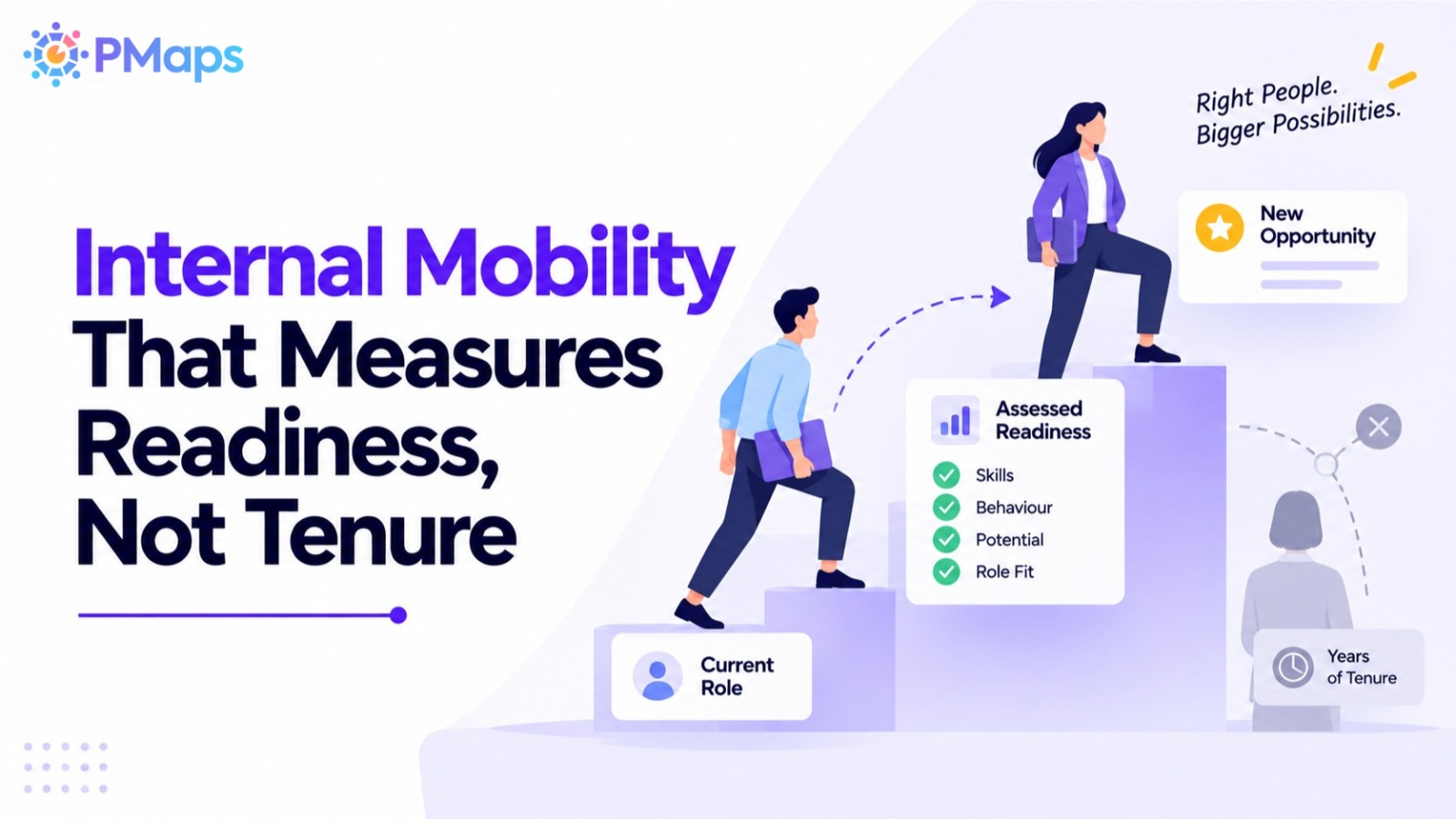
Naukri's H2 2026 Hiring Outlook, published 25 August from responses by more than 540 senior HR leaders, found that 31% name matching available skills to changing job requirements as their single biggest hiring challenge - while 83% expect attrition to stay below 15% over the next six months.
Internal mobility is what an employer does about that contradiction. This page is written for HR, talent acquisition and L&D leaders deciding whether an existing employee can do a role they have never held. It is not a guide for employees looking for their next move.
What is internal mobility in an enterprise?
Internal mobility is the movement of existing employees into different roles inside the same organization, through promotion, lateral transfer, or redeployment. For an employer it is a hiring channel, not a retention perk. Its constraint is measurement: most organizations know what their people were hired to do and have never assessed them for anything else.
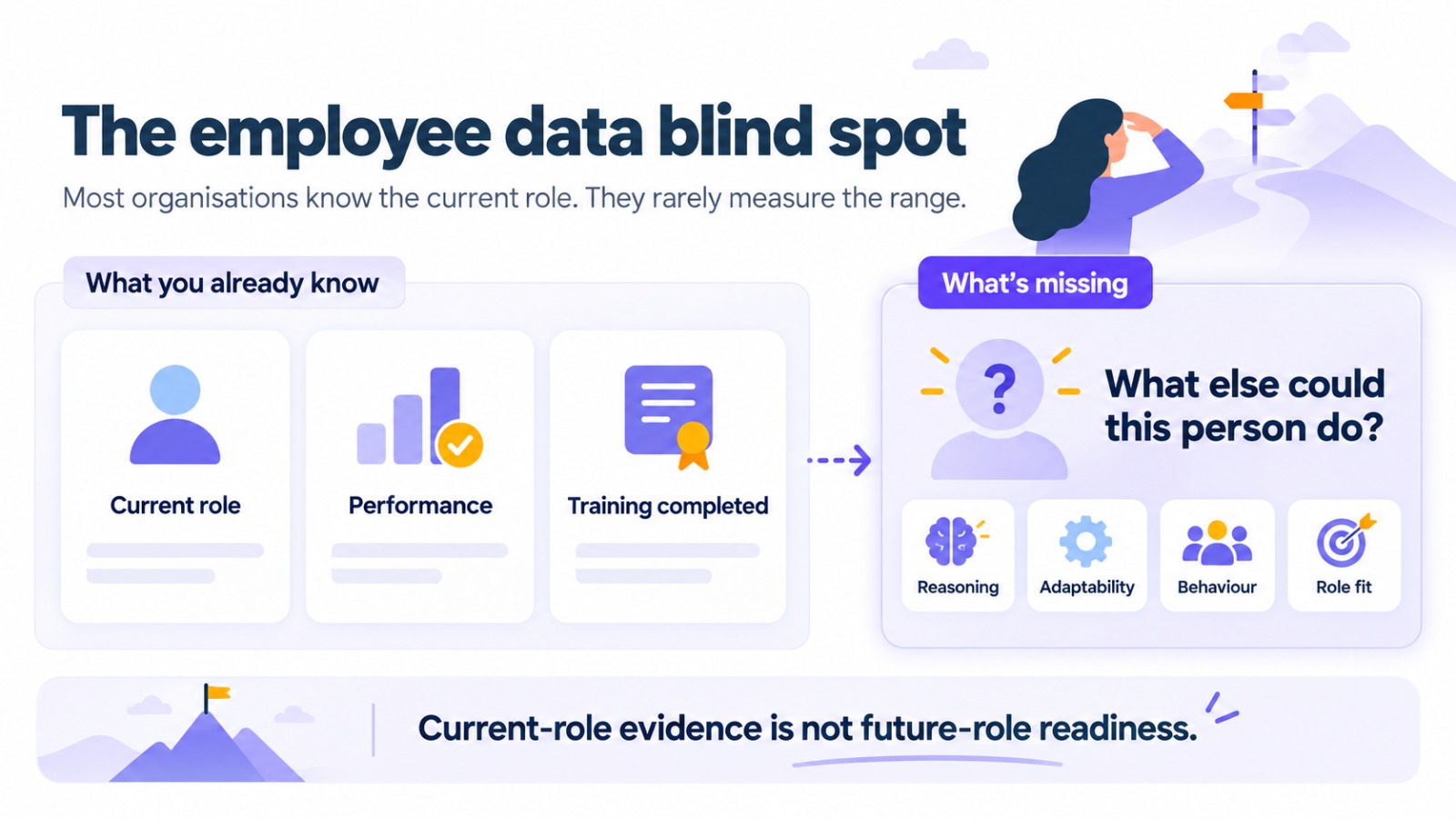
That last point is the one worth sitting with. An enterprise typically holds three kinds of records about an employee: what they were hired to do, how they have performed at it, and what training they have completed. None of those answers the question internal mobility actually asks, which is what else this person could do.
The gap is structural rather than negligent. Assessment budgets sit with talent acquisition and are spent at the point of hire. Once someone is inside, the measuring stops, and the only new evidence generated about them is a performance rating against the job they already hold. So the organization accumulates a great deal of information about people in their current roles and almost none about their range.
Why does a skills mismatch persist when attrition is low?
Because a skills mismatch is a measurement problem, not a supply problem. When attrition is low, most of the people who will do the work next quarter are already employed. If nobody has assessed them against the new role, the capability may be present and invisible, and the vacancy gets sent to recruitment by default.
Read the Naukri findings together rather than separately and the logic is hard to escape. If 83% of these leaders expect attrition below 15%, then more than eight in ten of the people doing the work in six months are inside the building today. If 62% say their heaviest hiring is at zero to three years of experience, the incoming hires are not carrying the missing skill either - at that band an employer buys potential and pays to develop it.
And 79% of the same leaders expect entirely new roles to be created. A genuinely new role has no incumbents anywhere. Nobody's CV carries the experience, because the experience does not exist yet in the labor market. Sourcing cannot supply a skill nobody has performed, which means the mismatch is real and the diagnosis is wrong.
There is a cost to the wrong diagnosis and it is not only the agency fee. Every role filled externally that could have been filled internally spends money to acquire capability the organization already owned, and takes longer: an external hire starts without the relationships, the systems knowledge, or the context that an internal candidate brings on day one.
What is the difference between a knowledge gap and a capability gap?
A knowledge gap is missing information: a tool, a regulation, a product line. It closes on a training timeline of weeks. A capability gap is a difference in how someone thinks or behaves under pressure, and it does not close in a training week. Handing both to the same team is why neither moves.
"Skills mismatch" is doing both jobs in one phrase, and the two have opposite remedies. Recruitment gets asked to solve knowledge gaps, which training could have solved faster and for a fraction of the cost. Training gets asked to solve capability gaps, which it cannot - a two-day workshop does not install comfort with ambiguity in someone who has spent nine years executing a defined process well.
Sorting them is a one-hour exercise and most organizations have never done it. Take the description for a role you are creating and put every requirement into one of two columns: things a competent adult could learn in six weeks, and things they could not. Tool proficiency, product knowledge and most regulatory content belong in the first. Judgment under incomplete information, composure with an unhappy customer, and the tolerance for being newly incompetent belong in the second.
If most requirements land in column one, the organization has a development problem it is trying to solve with a requisition. If most land in column two, the requirement set is behavioral, and behavioral requirements are exactly what a CV and an interview measure worst.
How do you assess someone for a role nobody has held yet?
Assess for the behaviors the role will demand rather than for experience of it, because no incumbent exists. Cognitive and behavioral assessment measures reasoning under ambiguity, structured problem-solving, and adaptability, and those predict performance in an unfamiliar role better than a record of tools somebody has already used.
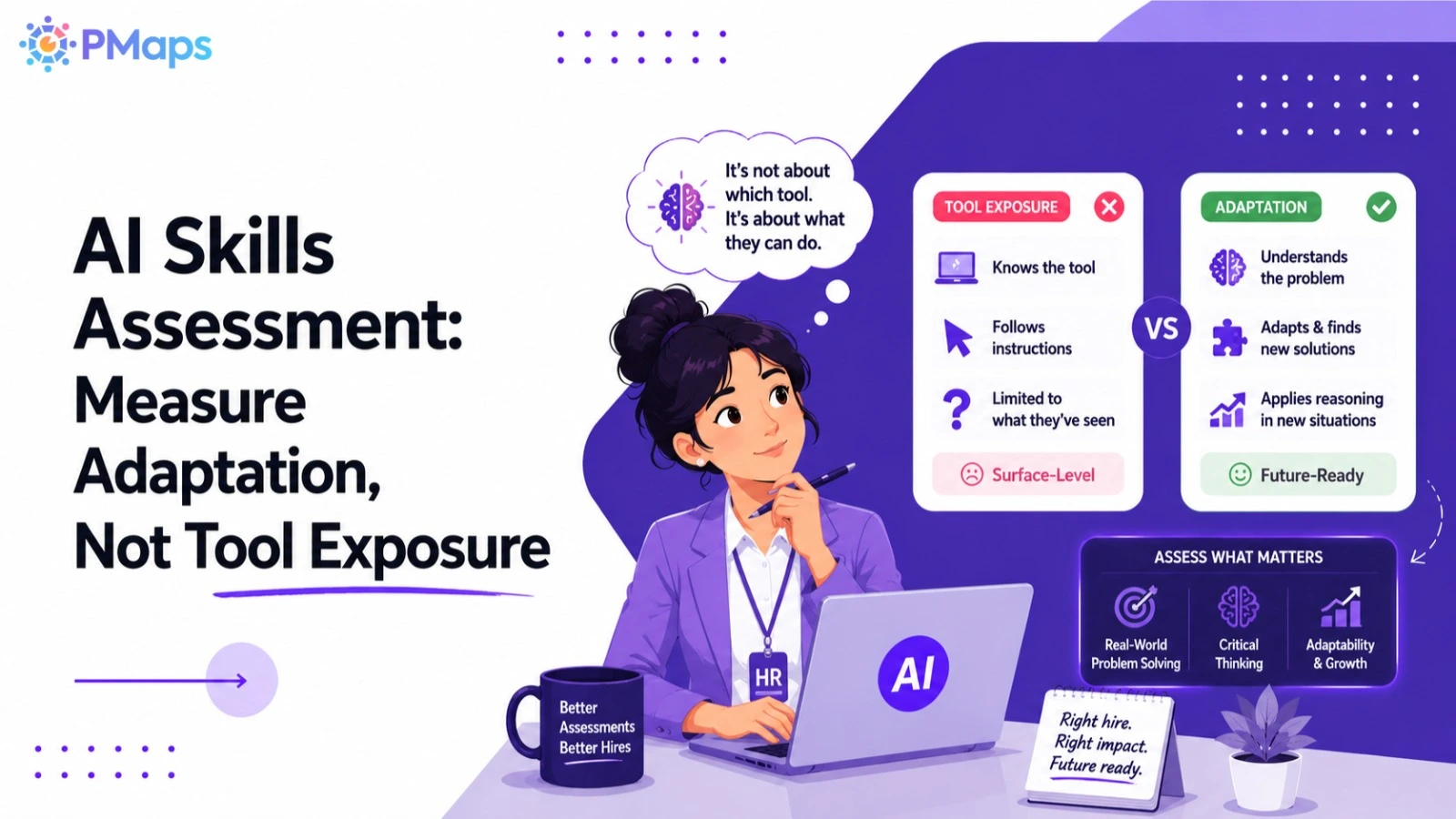
The distinction between exposure and adaptation matters more each year. Listing the platforms a person has used describes where they have been. It says nothing about how they behaved the last time the ground moved underneath them, which is the only relevant
question when the destination role is new.
There is a question worth asking about every internal candidate, and the answer usually already exists in performance records and in a manager's memory: when the process, system or product last changed under this person, how long was it before they were productive again, and what did they do in the first week? Someone who sought out the new documentation, asked for the pilot, and rebuilt their own workflow is telling you something a skills inventory cannot.
That is the behavior PMaps measures as AI resilience - how readily a person adapts to working with AI, rather than which AI tools they have already used. The same underlying trait predicts movement into any role that does not yet exist in a stable form.
How do you set a benchmark when there is no incumbent?
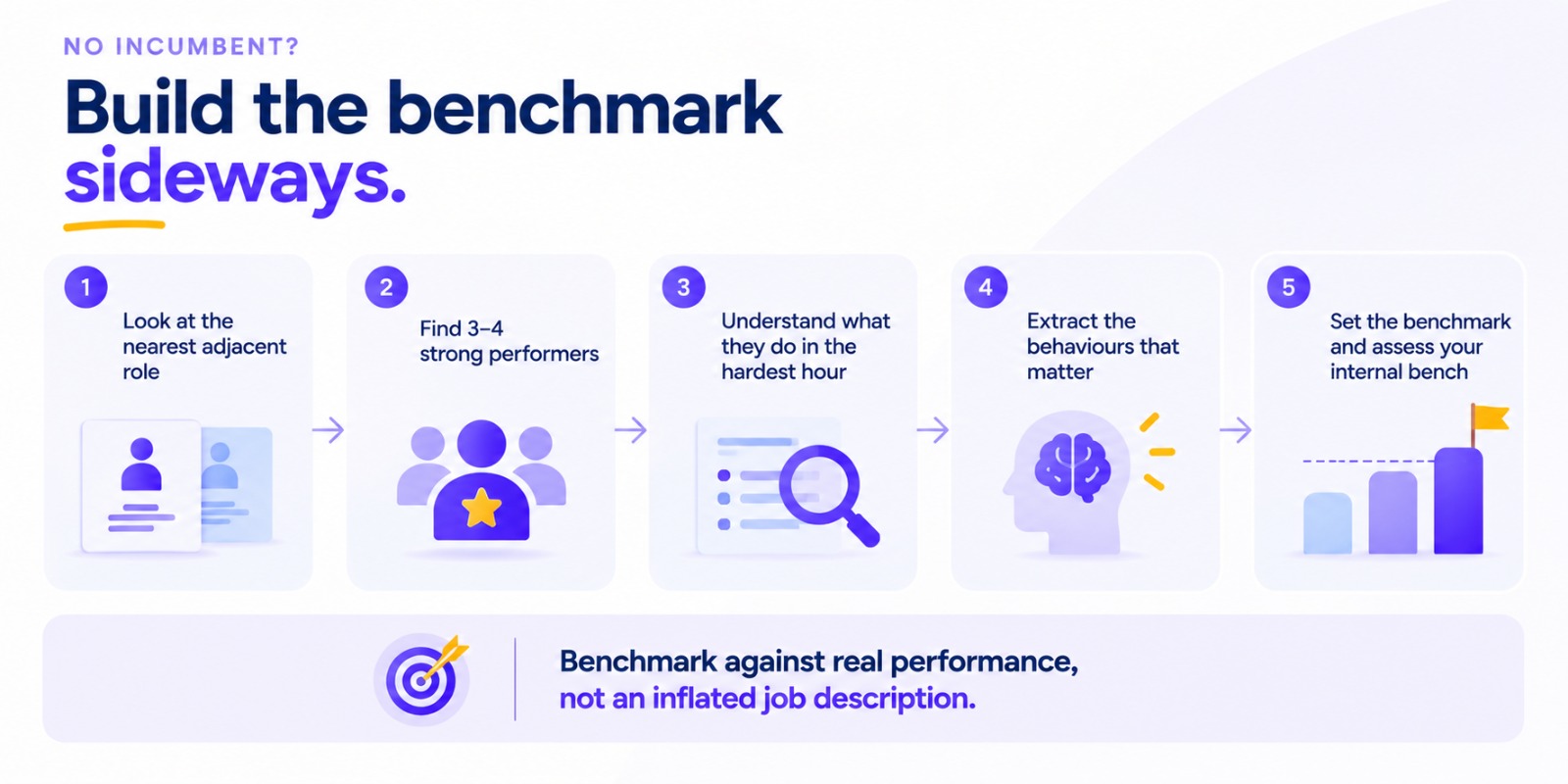
Benchmark against people, not the job description. Take the three or four employees performing the nearest adjacent role well, assess them, and use their score distribution as the standard. Job descriptions are written aspirationally and inflate the requirement; incumbents in an adjacent role describe what the work actually demands.
Job descriptions inflate for predictable reasons. They are written to justify a grade, to defend a salary band, and to discourage unqualified applicants, and each of those pressures adds a requirement that the work does not. Benchmarking against real performers strips those out, and the resulting list is almost always shorter, more behavioral, and more useful.
The method is simple enough to run without a platform. Identify the adjacent role. Identify three or four people doing it well, by outcome rather than by reputation. Write down what they actually do in the hardest hour of their week. That list is your real requirement set. Where an assessment is available, run those same people through it first and set the cut-off from their distribution, in writing, before you look at any candidate.
Set it before you see the internal pipeline, for the same reason a hiring bar is set before the applications arrive. A standard chosen after you have seen who is available is not a standard - it is a description of who was available, with a number attached.
How is this different from a performance review?
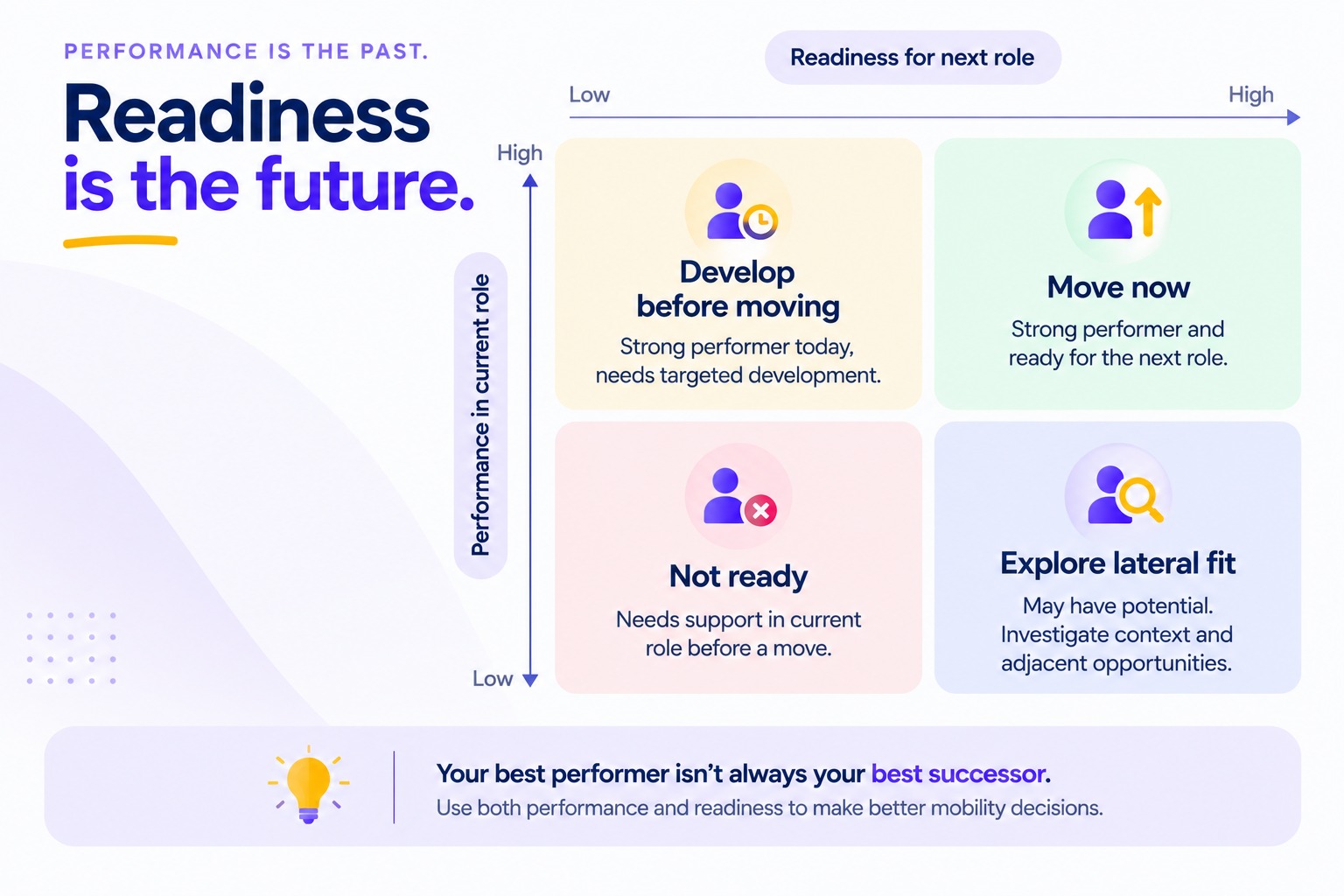
A performance review measures how well someone does the job they hold. An internal mobility assessment measures whether they can do a different one. The two use different evidence and answer different questions, and using a review as a readiness signal systematically favors people who are good at their current role.
This is the most common and most expensive substitution in internal mobility. The review is already there, it carries a number, and it feels like evidence. But strong performance in a defined role is partly a measure of fit with that role, and promoting it is how organizations move their best individual contributors into management and lose both.
A review also carries whatever bias the manager brought to it, unstructured and unrecorded. Structured assessment does not remove that, but it applies the same measure to every candidate and leaves a record of what was measured and why - which is what makes an internal mobility decision defensible six months later.
Use both. The review says whether someone is delivering now. The assessment says whether the capability the next role needs is present. Only the second one generalizes.
How does PMaps support internal mobility decisions?
Career Elevation Assessments cover skill-gap analysis for existing employees, high-potential identification, succession planning, and internal mobility decisions, including AI resilience assessment. Scores read against validated role benchmarks rather than a general population, so a good score means good for this role.
PMaps measures across several modes - cognitive, behavioral and psychometric assessment, plus AI video and voice interviews - so a score reflects the whole person rather than one narrow test. Assessments deliver in 8+ Indian languages on any device, which matters when internal mobility crosses into and out of frontline and operations roles.
Teams building an internal mobility program usually start by mapping one role. Our career elevation assessments for internal mobility cover the post-hire side, and the same competency framework runs on the pre-hire side through pre-employment assessment tests for job fitment - which is what makes an internal candidate and an external one comparable on the same scale.
One caution, because this is a category that invites overclaiming. Structured, competency-based assessment reduces bias relative to a manager's instinct about who is ready. It does not remove it, and a vendor telling you otherwise is describing a marketing position rather than a measurement one.
Map one role against your existing bench.
We run a 30-minute working session on one role you are creating. We map it against our job ontology and you leave with a competency profile you can run against your existing employees, whether or not you ever run an assessment with us. Book a Demo today!