.webp)
.webp)


More than 70% of employers now say skills matter more than degrees in evaluating talent, according to multiple workforce studies. Skills based hiring brings this shift into practice by placing verified capability at the center of selection decisions rather than relying on resumes or academic history.
Skills based hiring is a structured approach that prioritizes job-relevant skills validated through assessments, work samples, or structured interviews. This method helps leaders see who can perform the role effectively, without guessing through proxies such as titles, prestige, or tenure.
- Replaces degree or resume proxies that often misjudge true capability.
- Works through evidence like assessments, work samples, and structured evaluation.
- Matters because it raises hiring quality while widening access for skilled candidates.
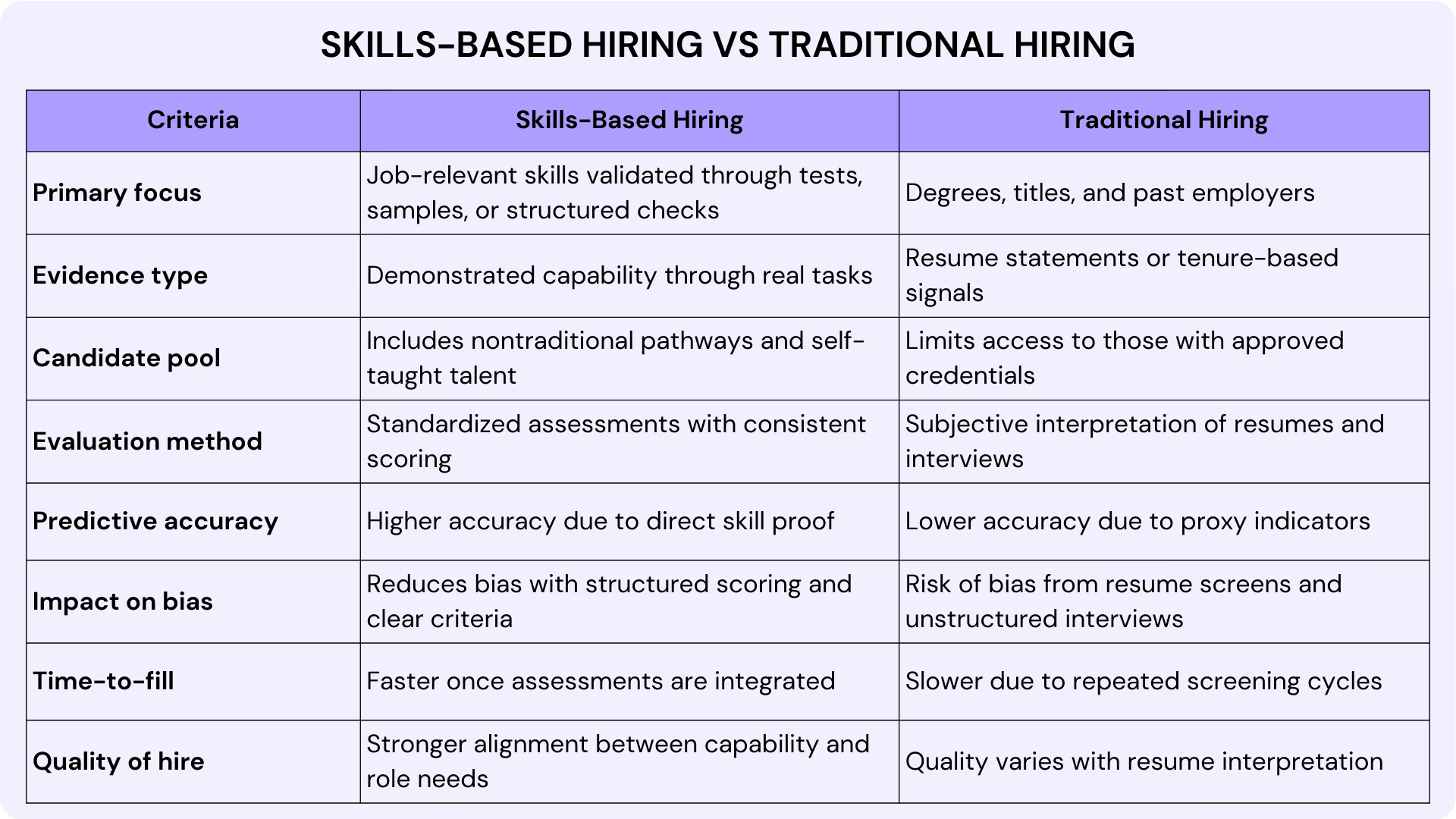
Difference Between Skills-Based Hiring and Traditional Hiring
Skills based hiring challenges long-held hiring habits by replacing assumptions with verifiable capability. This shift helps leaders remove guesswork and create more reliable, evidence-driven selection practices across roles and career stages.
Why is the Federal Government Prioritizing Skills-Based Hiring?
Skills based hiring gained strong national momentum when the U.S. federal government removed degree requirements for thousands of roles. This shift followed a clear finding: almost 50% of workers possess the skills for higher-wage roles but remain filtered out by degree screens. The government response reflects both economic need and talent accessibility priorities.
Business outcomes: Faster time-to-fill, better quality of hire, improved retention
Federal agencies report shorter hiring cycles when assessments verify capability early in the process. Leaders also see stronger fit because candidates enter roles with skills matching actual duties. Retention improves when employees feel aligned with work that reflects their strengths.
Candidate access and mobility: Wider talent pool from nontraditional pathways
Skills based hiring expands access for experienced workers without degrees, returning workers, veterans, and self-taught talent. This widens mobility for millions who have the capability but lack formal credentials. It also supports agencies struggling to fill specialized or emerging-skill roles.
A reality check: What changes in practice vs what companies say
Many organizations publicly support skills based hiring, yet internal systems still filter candidates through degree screens or outdated job descriptions. Progress requires consistent scoring rubrics, updated role definitions, and assessments tied directly to real tasks. Adoption increases when leaders see proof from pilot roles.
How Does Skills-Based Hiring Work?
Skills based hiring replaces assumption-driven screening with a structured process that validates capability through direct, role-relevant proof. This approach helps leaders reduce bias, strengthen prediction accuracy, and build hiring systems grounded in observable performance rather than background signals.
- Focus on capabilities: Identifies core skills needed for success, such as problem-solving, communication, analytical thinking, or role-specific technical ability.
- De-emphasizes credentials: Moves beyond degrees or employer names as primary indicators of potential during screening.
- Uses practical talent assessments: Applies tests, tasks, work samples, or case-based checks to understand what candidates can actually do.
- Broadens talent pool: Extends opportunities to self-taught workers, career shifters, and candidates from nontraditional learning paths.
What Are the Benefits of Skills-Based Hiring?
Skills based hiring supports talent decisions grounded in evidence rather than assumptions. This shift helps organizations improve hiring accuracy, open access for skilled workers, and address growing capability gaps across fast-changing roles.
- Addresses talent shortages: Identifies capable next-generation workers when traditional candidate pools lack required skills.
- Boosts diversity and inclusion: Removes credential barriers that often exclude skilled individuals from varied backgrounds.
- Improves performance: Matches real capability to daily role needs, raising output across teams.
- Increases retention: Helps employees stay longer because their core strengths align with their responsibilities.
What Tools Can Be Used for Skill Based Hiring?
Organizations use a mix of standardized role-based assessments, structured AI interview platforms, and job-relevant simulations to evaluate capability with consistency. These tools help measure skills directly, reduce screening bias, and create comparable evidence across all applicants.
Key categories include:
- Skills assessments: Measure cognitive, technical, or role-specific capabilities using standardized scoring.
- Work sample platforms: Present real tasks that reflect daily responsibilities for accurate performance insight.
- Structured interview systems: Apply consistent question sets and scoring guides to reduce subjectivity.
- Job simulations: Provide immersive scenarios that test decision-making, communication, and practical execution.
- Talent insights dashboards: Track hiring accuracy, skill benchmarks, and outcome trends for ongoing refinement.
Who Is Leading Skills-Based Hiring Globally?
Skills based hiring has grown across regions where talent shortages and shifting job requirements demand new evaluation methods. Several governments, large employers, and skill-focused ecosystems are setting the pace by adopting capability-first practices across wide workforce segments.
Key global leaders include:
- United States government: Removed degree requirements for many federal roles and now uses skills-focused evaluation across agencies.
- Singapore SkillsFuture movement: Promotes continuous skills development and supports employers adopting skill-first practices.
- Large global employers: Companies in tech, consulting, and telecommunications now use assessments and simulations for core hiring.
- Skills consortiums and credential networks: Digital credentialing ecosystems create verified records of capability for cross-market mobility.
Common Challenges and How to Avoid Them
Skills based hiring introduces new processes that require clear governance, careful design, and strong internal alignment. Many challenges arise not from the method itself but from inconsistent execution, unclear role definitions, or limited adoption among hiring teams.
Bias and adverse impact risk
Bias can enter skills based hiring when scoring lacks structure or when reviews vary across evaluators. Clear rubrics, consistent scoring, and periodic audits help ensure fairness across candidate groups and maintain reliable evaluation standards.
Over-testing and candidate drop-off
Extended assessments often discourage capable candidates, especially those managing active job searches. Short, role-relevant tasks reduce friction while keeping evaluation accuracy intact. Staged assessments also maintain engagement by spreading effort across manageable steps.
Skills Inflation
Some organizations list too many required skills, which creates confusion and weakens the clarity of the role. Effective hiring teams define only essential capabilities, limit unnecessary criteria, and ensure listed skills reflect actual daily responsibilities.
Hiring manager resistance
Hiring managers may hesitate when shifting from traditional processes. Resistance decreases when teams see measurable results from pilot roles. Sharing clear outcomes, calibrating expectations, and demonstrating improved accuracy helps strengthen adoption across teams.
How to Measure Success of Skills-Based Talent Assessment?
Skills based assessment delivers measurable value only when leaders track outcomes across performance, fairness, and hiring accuracy. A consistent measurement framework strengthens decision-making and offers a clearer understanding of long-term workforce impact.
- Core metrics: Tracks time-to-fill, early 90/180-day performance, pass-through rates, and hiring manager satisfaction to evaluate hiring accuracy.
- DEI and fairness metrics: Monitors stage-level diversity, score patterns, representation shifts, and audit outcomes to confirm balanced and fair evaluation.
- ROI narrative: Measures reduced mis-hire costs, shorter ramp time, stronger early productivity, and improved workforce stability driven by accurate skill matching.
Conclusion
Skills based hiring helps leaders build stronger teams by focusing on verified capability instead of background signals. It creates clearer pathways for skilled candidates, improves hiring accuracy, and reduces turnover risk across varied roles.
Organizations gain long-term value when they apply consistent assessments, track outcomes, and refine role definitions based on observable performance. For structured skill evaluations suited to your workforce, connect with PMaps at 8591320212 or assessment@pmaps.in


.avif)