.webp)
.webp)


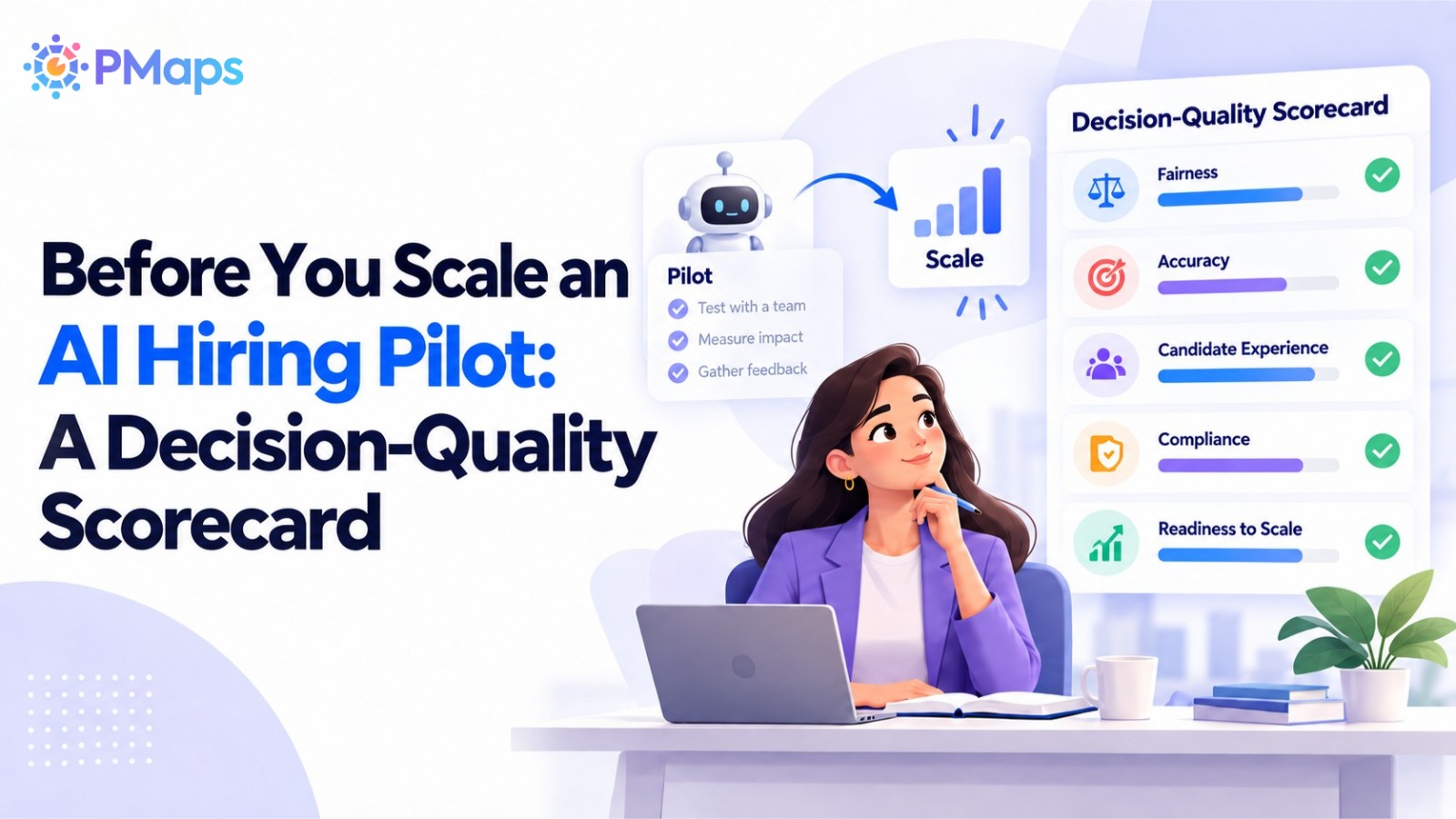
AI hiring pilots often begin with a product demonstration and end with a usage report.But neither tells you whether the approach is ready to scale.
A technically successful pilot may still fall short if it does not improve the hiring decision, reduce avoidable effort, improve the candidate experience, or produce evidence that the organisation can confidently defend.
Before moving an AI-enabled hiring pilot into routine use, Talent Acquisition, HR, and assessment teams need a clearer decision framework.
This scorecard focuses on six questions that help determine whether a pilot should scale, improve, or stop.
1. Define the hiring decision before evaluating the technology
Start by writing down the exact hiring decision the pilot is expected to improve.
For example, is the pilot designed to:
- Identify candidates who meet a minimum role threshold?
- Make first-round interviews more consistent?
- Reduce recruiter effort while retaining necessary human judgement?
- Improve the structure of an existing assessment process?
Avoid treating several objectives as one.Faster screening, greater consistency, reduced candidate burden, and stronger predictive evidence are different outcomes. Each needs its own success criteria and supporting evidence.A pilot becomes easier to evaluate when the team can clearly answer one question:
What decision should become better because of this pilot?
2. Set the evidence threshold before reviewing the results
Define what evidence would justify moving the pilot forward before the results arrive. Depending on the purpose of the pilot, useful measures may include:
- Assessment completion rate
- Candidate drop-off
- Recruiter time saved
- Report usability
- Agreement between assessment output and structured human evaluation
- Adverse-impact review
- Later job-performance evidence, where available
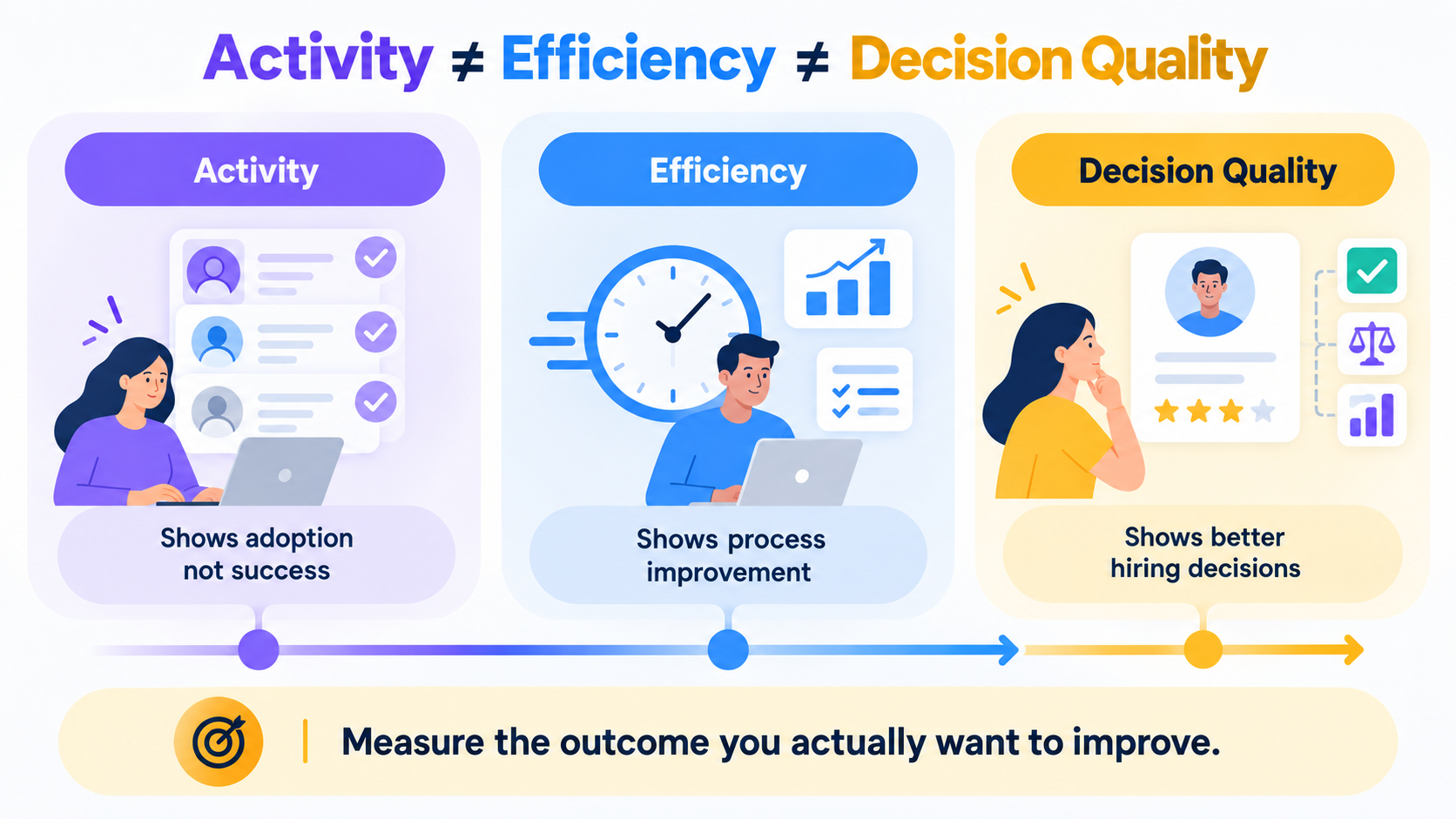
The evidence must match the outcome being evaluated. Positive recruiter feedback can show that a tool is easier to use, but it does not by itself validate the underlying assessment.
Similarly, reducing the length of a process demonstrates an efficiency gain. It does not automatically show that hiring decisions became more accurate.
The question is not simply, “Did people like the pilot?”
It is, “Did the evidence meet the threshold we agreed would matter?”
3. Protect the human decision boundary
AI-enabled hiring systems should have a clearly documented role in the decision process.
Teams should define:
- What the system evaluates
- What it recommends
- What it does not decide
- Where human judgement remains necessary
- Who remains accountable for the final decision
Reviewers should be able to examine an output, understand the evidence available to them, question the recommendation, and override it through a documented process where appropriate. An advisory score should not quietly become an automatic pass-or-fail decision simply because the technology makes automation possible.
The boundary between system output and professional judgement should remain visible throughout the pilot.
4. Measure candidate burden and accessibility
A pilot should work for candidates under realistic conditions, not only during an internal demonstration.
Test the experience across relevant:
- Devices
- Languages
- Candidate environments
- Assessment formats
- Stages of the hiring process
Measure completion time, clarity of instructions, support requests, candidate drop-off, and any avoidable barriers created by the experience. Recruiter efficiency is only one side of the equation.
A process that saves internal time but creates unnecessary complexity for candidates may simply be shifting the burden from one part of the hiring journey to another. Candidate experience should therefore be treated as an evaluation criterion, not an afterthought.
5. Verify data, privacy, and integration controls
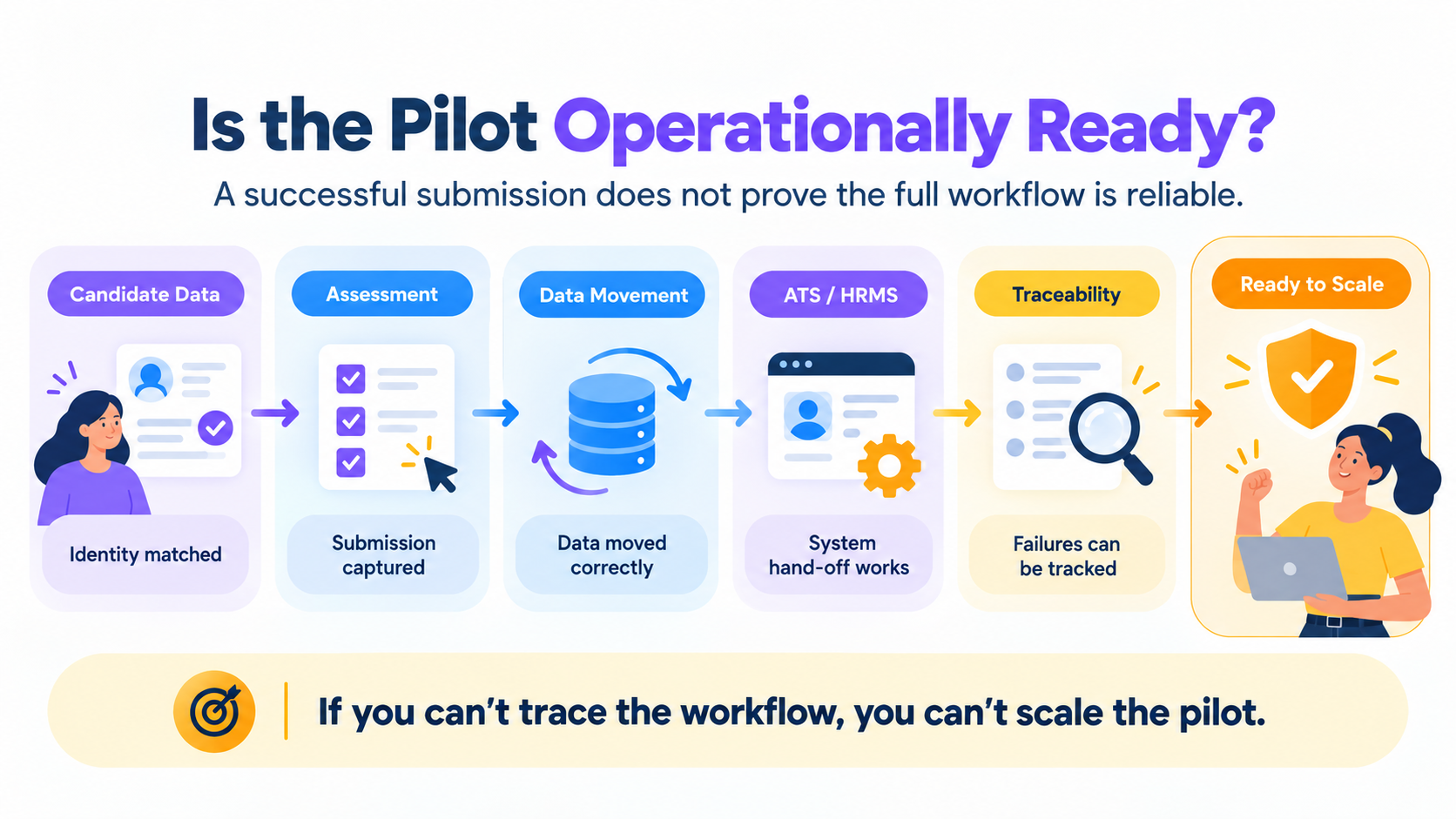
Operational readiness requires more than a successful assessment submission.
Teams should confirm:
- What candidate data is collected
- Where that data moves
- How long it is retained
- Which systems receive the assessment result
- How candidate identity is matched
- How source attribution is recorded
- How failures or exceptions can be traced
The actual ATS or HRMS hand-off should be tested rather than assumed. A successful form submission does not prove that the complete workflow is reliable.
If the team cannot trace a candidate record, reproduce the workflow, or explain why an integration failed, the pilot is not yet operationally ready to scale.
6. Decide in advance: Scale, Improve, or Stop
Do not wait until the end of the pilot to decide what a successful result should look like.
Agree on the decision rule beforehand.
SCALE
Scale the pilot when the agreed evidence threshold has been met, the workflow is repeatable, and the remaining limitations or risks are understood.
IMPROVE
Improve the pilot when the business problem is valid but the evidence, workflow, configuration, candidate experience, or operating controls remain incomplete.
This means the use case may still have value, but further work is required before wider deployment.
STOP
Stop the pilot when activity is high but decision quality is not improving, the result cannot be adequately explained, or essential controls cannot be made reliable within the agreed timebox. Stopping a pilot is not necessarily a technology failure.
It can be evidence that the problem, implementation, or expected outcome needs to be reconsidered before additional investment is made.
A Simple AI Hiring Pilot Decision Page
For every pilot, create a one-page decision record containing:
This creates a record of why the pilot progressed rather than simply documenting that it was used.
The Principle Behind the Scorecard
The discipline is straightforward: Define what “better” means before selecting the technology, and define the evidence before interpreting the outcome.
AI, automation, and advanced analytics can support hiring and assessment workflows, but the technology itself should not determine what success means.
The business problem, hiring decision, evidence threshold, candidate experience, operational controls, and human judgement requirements should come first.
This scorecard builds on the problem-first perspective discussed by Saurabh Rana and Clodagh O’Reilly in the Association for Business Psychology article, “Don’t Start with AI, Start with the Problem”, which argues that technology choices should follow a clearly defined assessment problem and evidence standard.