.webp)
.webp)


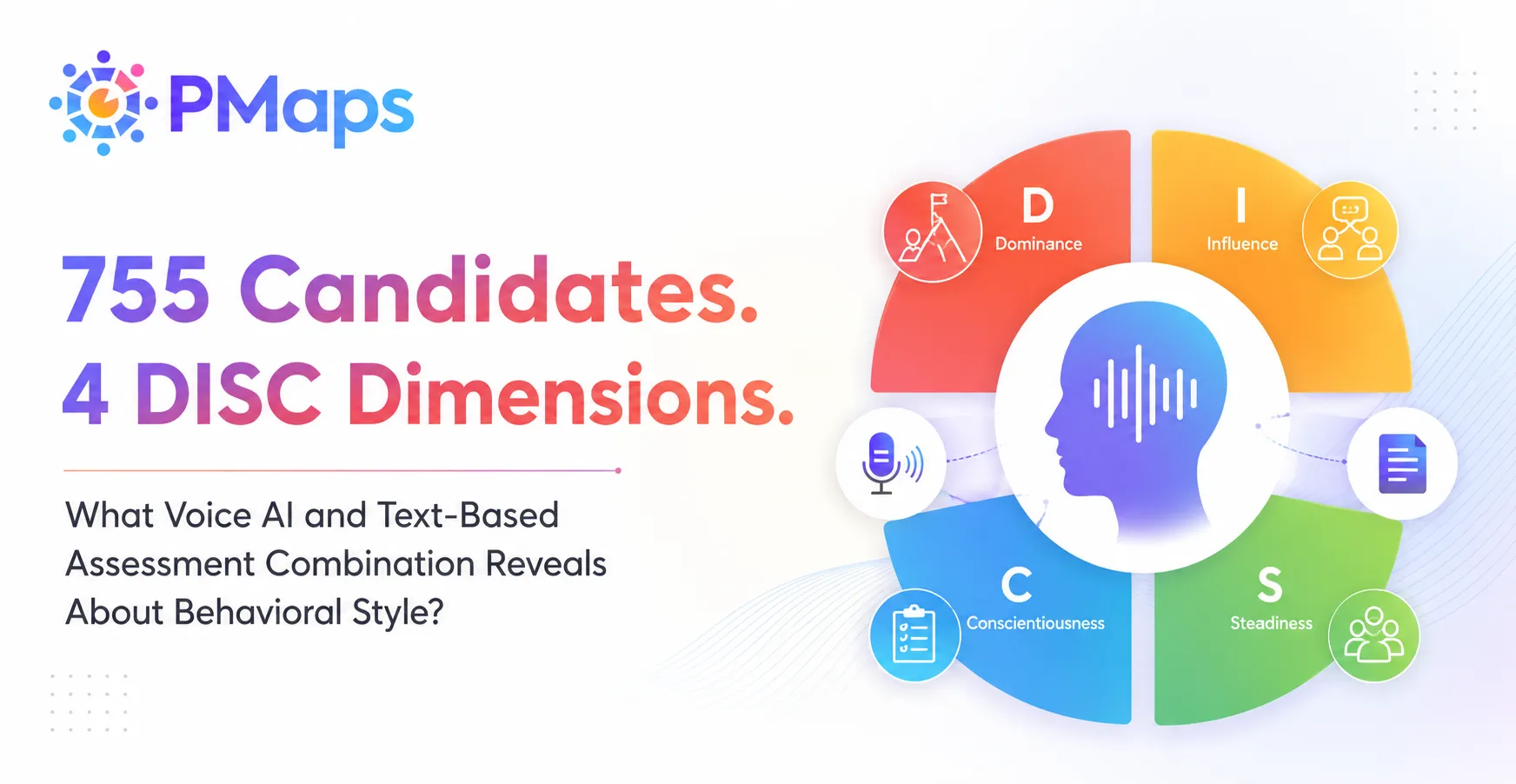
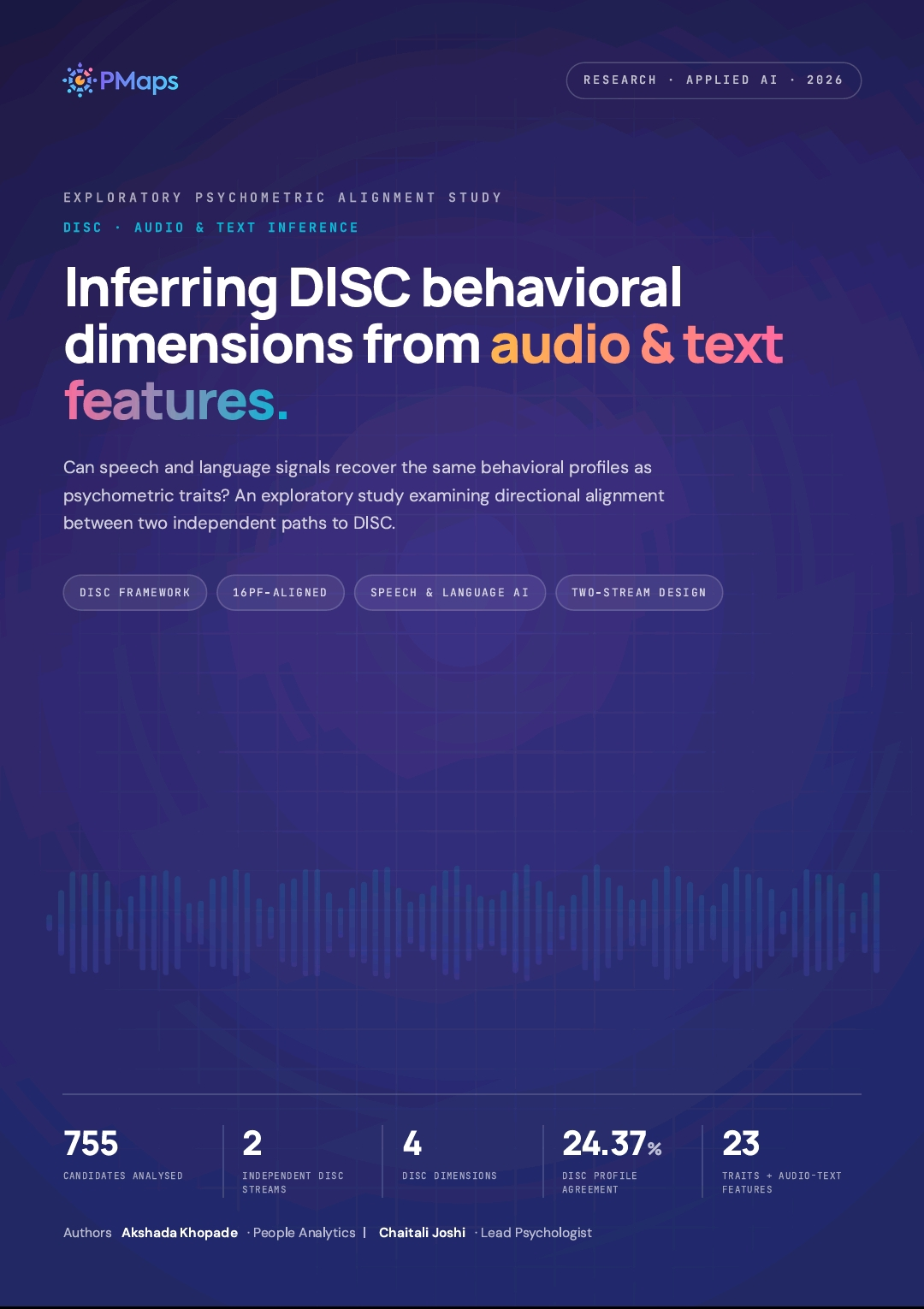
You've been evaluating candidates using standard psychometric traits for years. You view their scores, assess their fit, and move forward with confidence. But what if the spoken communication of your candidates could reveal those exact behavioral tendencies directly from their voice and speech?
This white paper doesn't promise a flawless AI replacement for psychological testing. It does something more useful — it shows you, with data, where preference meets expression and what a directionally aligned, multi-stream assessment looks like. 755 candidates. Four DISC dimensions. One finding that will change how you view the intersection of AI and human psychology. Here's a detail you will want to understand.
Why should I question how I'm currently evaluating candidate behavior?
Most traditional assessments rely entirely on self-reported questionnaires—capturing what candidates say they prefer. This research introduces a completely independent layer—how they actually express themselves through speech and language features. The assumption being challenged isn't that psychometrics are wrong, but that they are the only valid signal available for behavioral interpretation.
Who was actually studied, and is this relevant to my context?
Picture a modern, high-volume talent acquisition lifecycle handling a highly diverse, multilingual applicant pool—dozens of audio responses, back-to-back reviews, and a recruitment team trying to surface genuine communication insights fast. That's the exact context this study was built inside.
- 755 candidates analysed after undergoing strict data cleaning and quality checks.
- A genuinely multinational workforce spanning Indian, Pakistani, Egyptian, and other regional origins.
- An early-to-mid career demographic with a mean age of 32.9 years and varying ranges of professional work experience.
If you've ever sat across an enterprise hiring panel and wondered if AI can interpret a candidate's communication style without losing psychological grounding—this sample was drawn from that exact real-world environment. That is what gives the resulting data its true weight.
What did the data actually find about how communication reflects behavioral style?
Think about how a candidate articulates ideas in an interview versus how they score on a paper-based profile. The data picked up on exactly that intersection, comparing stable psychological traits against real-time acoustic and linguistic features.
- Modest but systematic directional alignment across all four DISC dimensions, proving the links are structured rather than random.
- A 24.37% overall DISC profile agreement rate when independently matching an individual's highest-scoring primary dimension across both methods.
- Clear, theory-driven feature blueprints that connect vocal delivery directly to specific behavioral types.
The Behavioral-Acoustic Blueprints:
- Dominance-oriented: Higher vocal energy, faster speech, and fewer pauses.
- Influence-oriented: Higher emotional tone and increased use of positive language.
- Steadiness-oriented: Slower speech, greater pause usage, and a calmer delivery style.
- Conscientiousness-oriented: More deliberate pacing and lower overall emotional expressiveness.
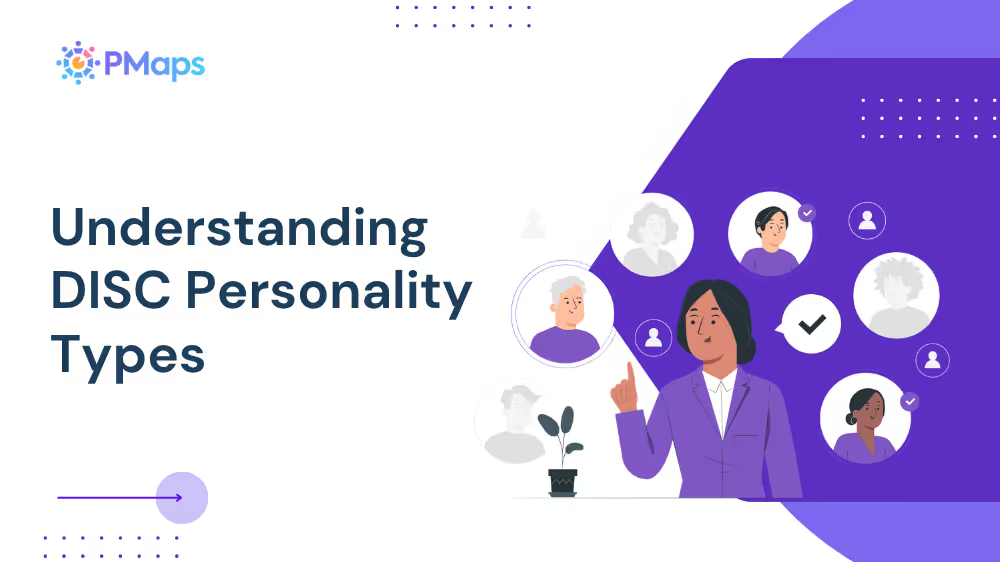
Those dimensions have clear definitions, specific communication markers, and direct implications for how your candidates show up in real-world interactions. For a closer look at how each style shows up on the job, see our breakdown of DiSC Personality Types.
How do I use audio-text behavioral signals alongside traditional scores in real talent decisions?
Imagine evaluating talent for two distinct organizational roles—one requiring a calm, steady customer-support approach, and another demanding a highly assertive, results-driven closer. The same communication style will not thrive in both.
- Traditional psychometrics, like a structured Personality Assessment for Hiring, reveal a candidate's stable, baseline workplace preferences.
- Audio-text AI inference acts as an observable lens, showing how those preferences surface through speech, pacing, and tone.
- The combination moves your team away from one-dimensional screening, offering a transparent framework where behavioral style matches real role demands.
Can I trust the methodology behind this?
Before you integrate AI-driven insights into your talent strategy, you should know exactly where the methodology excels and where its boundaries lie. This study leads with those limitations transparently:
- Different aspects of behavior: It maps stable preferences (psychometrics) against expressed communication (audio-text)—perfect equivalence is structurally impossible.
- Context sensitivity: Audio-text features are inherently sensitive to the specific interaction environment and may fluctuate across different settings.
- Linear mappings: The study relies on theory-guided linear weights, which ensure high model transparency but may bypass hyper-complex behavioral dynamics.
Knowing these three boundaries isn't a reason to look away from the findings—it's a reason to use them correctly as a valid, complementary, and exploratory layer.
Who built this and what framework does it stand on?
Good science doesn't emerge from an unverified algorithm. Before the feature-level patterns were mapped, the study was anchored securely in three foundational pillars the industry has built upon for decades:
- Marston's DISC Framework: The core behavioral model used as the shared interpretive layer, the same foundation behind PMaps' DISC Assessment for Hiring.
- Cattell's 16PF Framework: The standardized psychometric trait baseline used to compute behavioral preferences.
- Speech & Language Processing AI: A Python-driven pipeline extracting standardized acoustic (pitch, jitter, energy) and textual features.
Authored by Akshada Khopade, People Analytics Specialist & Statistician, and Chaitali Joshi, Lead Psychologist—both practicing at PMaps. The frameworks are public. The authors are named. If anything in this research raises a technical or psychological question you want answered directly, there are real professionals available to ask.
The research has done its part. Now it's your turn.
Talent evaluation is shifting beyond singular, black-box scores. This study tests the boundaries of behavioral AI—honestly, rigorously, and with concrete data. Explore the mechanics of multi-stream behavioral profiling. Download the white paper — or reach us directly at +91 8591320212 or ssawant@pmaps.in.