.webp)
.webp)


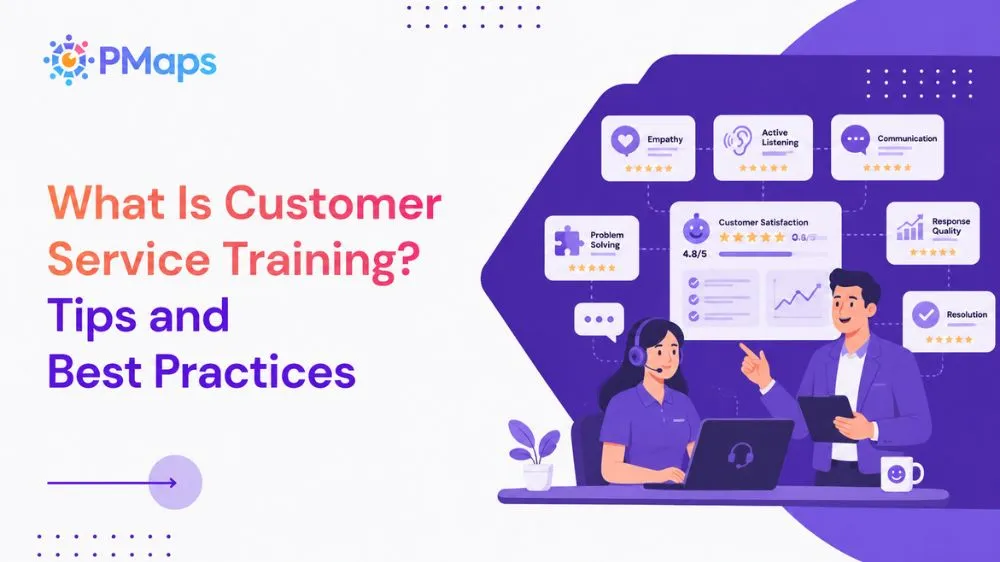
Customer service training is a structured way to prepare employees for real customer conversations. It teaches agents how to use products, follow support processes, communicate with customers, manage difficult conversations, and work confidently across CRM or ticketing platforms.
When a customer reaches out, the person on the other end either builds trust or breaks it. That outcome is rarely accidental. It reflects how clearly the agent understands the product, how well they communicate, and how prepared they are to handle pressure. Structured customer service training can help teams improve first-contact resolution, reduce avoidable escalations, and support stronger agent retention when paired with regular skill measurement.
But training works best when it starts with evidence. Before building modules or assigning sessions, teams need to know where agents actually struggle — communication, problem-solving, product knowledge, empathy, or tool usage. That is where a customer service assessment helps managers identify skill gaps and design training that improves real performance.
Core Components of a Customer Service Training Program
Customer service training for employees works when it addresses every layer of the job — not just attitude, but knowledge, tools, and process. A complete program gives agents what they need to resolve issues on the first attempt, communicate without friction, and handle pressure without defaulting to escalation.
- Product and service knowledge depth
- Communication frameworks and tone calibration
- CRM and support software proficiency
- Escalation workflows and case routing protocols
- Feedback loops and performance review cycles
What's the difference between training and hiring customer service candidates? Which one should you rather go for? While hiring allows you to select for potential, attitude, instincts, and how someone responds under pressure. Training an existing team converts that potential into consistent, repeatable performance. The strongest teams do both deliberately: hire for trainability, then build the program that makes that investment pay off.
Best Customer Service Training Practices for Managers
Running a training program and managing its outcomes are different jobs. Managers who see lasting improvement don't treat training as a one-time event, they embed it into daily workflows, measure behavior change rather than completion rates, and build feedback loops that make improvement a continuous habit.
Tips for effective customer service training:
- Train on real tickets and live call recordings, not hypothetical scenarios
- Separate knowledge transfer sessions from skill-building drills — they require different formats
- Use call shadowing and peer coaching alongside formal modules
- Measure changes in resolution quality and escalation rates post-training, not just quiz scores
- Recertify regularly, products and policies change; training that goes stale creates new problems
What Are the 5 Key Skills in Customer Service?
Customer service skills training goes beyond scripted responses. It covers the full capability an agent needs from first contact through resolution — how they listen, communicate, navigate tools, and handle pressure. Five skills anchor that capability, split across two categories that have to work together to close any interaction well.
See how each of these customer service skills plays out in real support roles and where most teams have gaps.
Essential Soft Skills of a Customer Support Team
Soft skills govern how a customer experiences a support interaction — not just whether their issue gets solved, but whether they felt heard, respected, and confident in the person helping them.
- Active listening and accurate needs identification
- Empathy and emotional composure under pressure
- Customer Service Communication Skills — clear, warm, and free of jargon
- Conflict de-escalation and deliberate redirection
- Consistent patience across high-volume, repetitive shifts
Technical Hard Skills Needed in Customer Service Job Roles
Technical skills are what turn agent empathy into actual, lasting resolution. Without them, even the most patient and caring interaction still ends with the customer waiting for their problem to be fixed.
- CRM proficiency — Salesforce, Zendesk, Freshdesk, and equivalent platforms
- Ticketing system navigation — routing, tagging, prioritization, and SLA awareness
- Product knowledge deep enough to troubleshoot, not just escalate
- Multi-channel handling across email, phone, live chat, and social
Here’s a set of 10 hard customer service skills for better issue analysis, documentation accuracy, and customer case management.
4 Successful L&D Modules for CS Agents and Customer Service Training Materials
The best customer service training for employees does not begin with modules — it begins with skill data. PMaps assessment results help managers understand exactly where agents fall short before deciding on format, duration, or delivery. These four L&D structures consistently appear in programs that produce measurable improvements in support performance.
- Onboarding and product immersion — Build genuine depth in the first 30 days, not just surface-level orientation
- Communication and tone calibration — Scenario-driven and role-play intensive, reviewed against real recorded calls
- De-escalation and conflict handling — Live simulations over static slide decks; real-call pressure can't be replicated any other way
- Quality assurance and improvement loops — Agents review actual interactions, identify patterns, and close gaps before they become habits
Download the PMaps Customer Service Training Materials developed from customer service skill data — to build your program on what agents are actually missing.
Key Metrics to Measure Customer Service Success
Customer service training without measurement runs on assumption. Satisfaction scores tell you how customers feel — but the metrics that reflect real training impact are operational: how often issues get resolved on the first contact, how long they take, and how frequently they need to go further up the chain.
- First Contact Resolution (FCR) — the clearest indicator that training is translating into actual agent capability
- Average Handle Time (AHT) — efficiency that holds alongside resolution quality, not at its expense
- Customer Satisfaction Score (CSAT) — direct feedback captured immediately post-interaction
- Net Promoter Score (NPS) — long-range loyalty signal across the full customer relationship
- Escalation Rate — consistently high rates almost always point to training gaps, not issue complexity
- Agent Retention — undertrained teams burn out faster; retention is a downstream measure of how supported agents feel
Conclusion
Customer service training is the infrastructure behind consistent support performance. It determines how agents respond when queues rise, customers are frustrated, and issues become complex. The strongest programs do not begin with generic modules. They begin with skill data. When managers know where agents struggle, they can build focused training that improves resolution quality, reduces avoidable escalations, and supports better customer experience. Give us a call 8591320212 and drop a email on ssawant@pmaps.in.
For organizations looking to understand what is customer service assessment, PMaps provides a structured test that benchmarks candidates on the core competencies that predict long-term performance.