.webp)
.webp)


Customer service manager skills are the driving force behind your team’s productivity. They are the key to unlocking customer satisfaction, reducing churn, and improving first contact resolution. A skilled customer service manager directly influences business outcomes by managing teams, shaping support experiences, and optimizing service delivery.
Customer Service Manager Competency Framework
To assess and grow top-performing talent, it’s essential to view customer service manager competencies through a structured lens. Pairing that framework with a customer service manager test turns those competencies into a measurable hiring and promotion benchmark A competency framework spans three key domains:
.png)
1. Leadership and People Management
This includes coaching, hiring, onboarding, performance reviews, and workforce planning. At higher levels, it covers mentoring, succession planning, and change management.
2. Interpersonal and Problem-Solving
Skills in conflict de-escalation, stakeholder communication, and customer journey mapping fall here. Emotional intelligence, empathy, and resilience define how managers respond under pressure.
3. Technical and Business Skills
These cover CRM fluency, queue design, automation governance, KPI literacy (CSAT, AHT, NPS), and compliance basics.
Customer Service Manager Proficiency Levels: L1 to L4

- L1 – Getting Started: Learning the Ropes
This entry-level stage involves observing and absorbing. Managers grasp ticketing tools, follow SOPs, and shadow experienced team leads. - L2 – Steady and Self-Sufficient
At this point, managers run daily operations independently. They support onboarding, follow WFM schedules, and help maintain service standards. - L3 – Driving Team Performance
Managers here influence outcomes. They lead QA reviews, mentor team leads, and fix process gaps to improve measurable KPIs such as CSAT and AHT. - L4 – Strategic Leadership in Action
These seasoned managers steer large-scale projects, represent customer voice (VOC), and shape operational strategies.
24 Key Customer Service Manager Skills You Shouldn’t Miss
- Performance Management – Monitoring and improving agent KPIs through coaching and structured feedback.
- Hiring & Onboarding – Selecting the right talent and setting up new hires for early success.
- Training Design – Crafting learning modules that align with evolving support needs.
- Change Management – Leading teams through shifts in tools, workflows, or policy with minimal disruption.
- Workforce Management (WFM) – Scheduling, forecasting, and capacity planning for consistent coverage.
- Coaching & Development – Running 1:1s, driving skill uplift, and addressing underperformance tactfully.
- Budgeting & Forecasting – Managing headcount costs, tool spend, and support capacity plans.
- Vendor Management – Collaborating with third-party BPOs or technology providers effectively.
- Conflict De-escalation – Calming tense customer or team interactions without escalating further.
- Stakeholder Communication – Aligning with product, sales, and tech teams for shared goals.
- Empathy & Composure – Balancing professionalism with human understanding during tough conversations.
- Accessibility & Inclusive Communication – Ensuring language and platforms work for diverse users.
- Customer Journey Mapping – Understanding key friction points and improving support flows.
- Voice of Customer (VOC) Analysis – Gathering and interpreting feedback to surface real service gaps.
- Risk & Compliance Knowledge – Adhering to regulations like GDPR or PCI in everyday operations.
- CRM & Helpdesk Tool Fluency – Navigating platforms like Zendesk, Freshdesk, or Salesforce with ease.
- Queue & Routing Design – Managing ticket flows and escalations for response efficiency.
- KPI Literacy – Reading and reacting to CSAT, AHT, FCR, and NPS performance data.
- Automation & Macros Governance – Streamlining support using rules, bots, and canned responses responsibly.
- Process Design (ITIL Light) – Documenting workflows and refining support playbooks.
- QA & Calibration – Running quality checks and aligning reviewers on scoring standards.
- Omnichannel Strategy – Managing support across chat, email, social, and phone channels.
- Knowledge Management – Building and maintaining internal and customer-facing knowledge bases.
- Data Storytelling – Turning metrics into clear narratives that guide decisions and improvement roadmaps.
Skills vs Qualities vs Competencies: What’s the Difference?
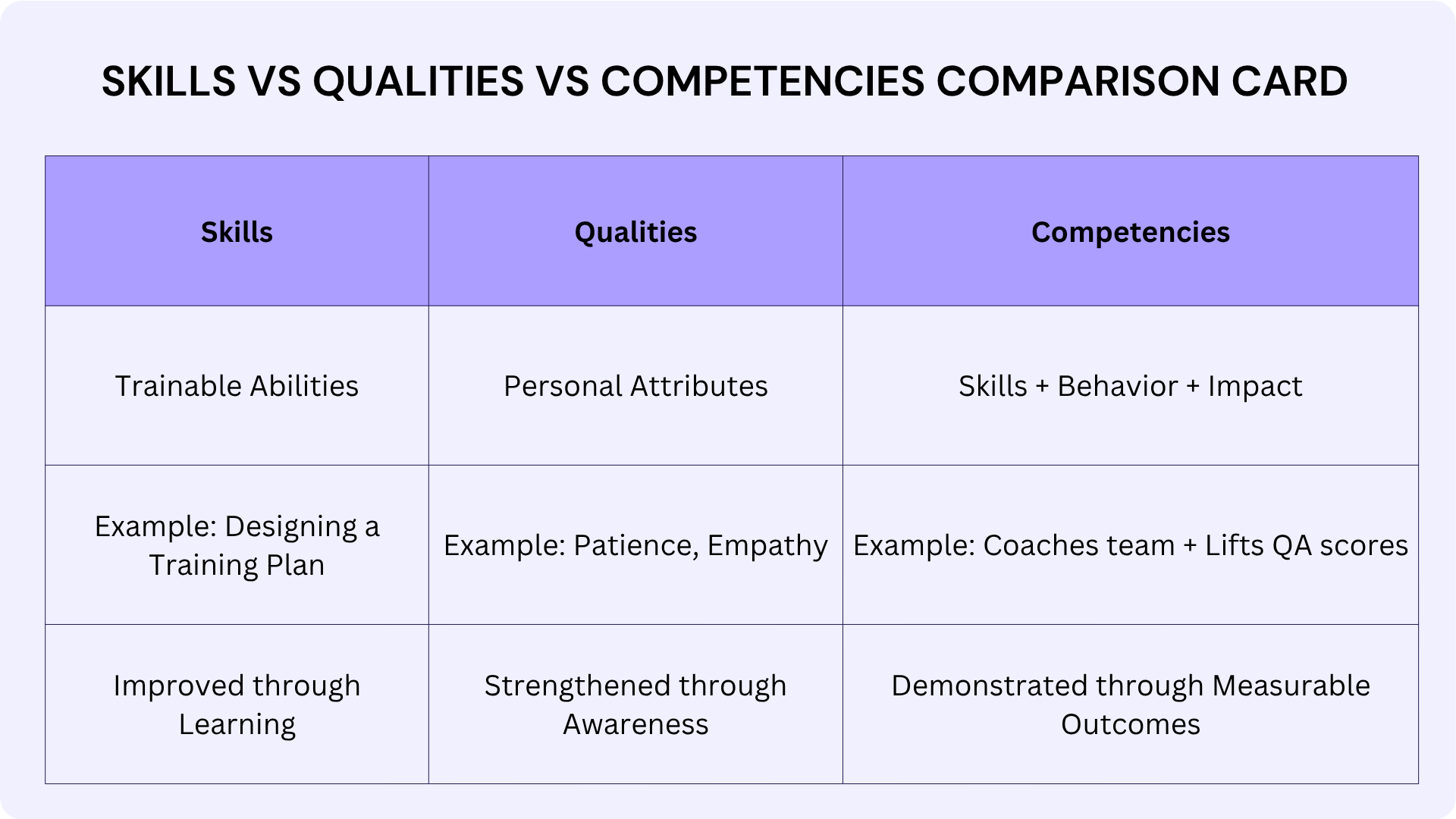
Skills
Skills are trainable, task-specific abilities acquired through practice or formal learning. Example: Creating WFM schedules using forecasting tools.
Qualities
Qualities are inherent traits or personality-driven behaviors. Example: Remaining calm and empathetic during an escalation call.
Competencies
Competencies combine skills and behaviors shown consistently at a certain proficiency level. Example: “Uses QA feedback to coach reps, improving CSAT scores by 12% in one quarter.”
How to Assess Customer Service Manager Skills?
A good customer service manager test evaluates beyond presentable resumes and instinct. It checks for real-world reaction and on-job capabilities with a combined suite of skill-based tasks, situational tests, and behavioral assessments.
Skill Assessment
- Case simulations: Assign a mock support queue to test routing, prioritization, and escalation judgment.
- Tool walkthroughs: Evaluate hands-on familiarity with CRMs, QA tools, or dashboards.
- Scenario-based MCQs: Use objective questions to test knowledge of CSAT, AHT, FCR metrics, or compliance.
Behavioral Assessment
- Coaching conversations: Observe clarity, tone, and support during feedback discussions.
- Conflict role-plays: Evaluate how they handle tense customer or team scenarios.
- Stakeholder alignment tasks: Assess collaboration style with cross-functional teams.
Interview Questions by Skill
- Team Development: “How did you turn around the performance of a struggling team member?”
- Process Change: “Share a time you led your team through a major support shift.”
- Metric Ownership: “Which KPIs do you regularly monitor, and how do you act on them?”
- Customer Conflict: “Tell me how you handled an escalation that reached leadership.”
Improve the Customer Service Manager Skills: A 90-Day Roadmap.

Days 0–30: Learn the Environment and Set a Foundation
The first month focuses on observation and context-building. The goal is to help managers understand existing workflows, team expectations, and performance benchmarks.
Days 31–60: Build Core Skills and Confidence
The second phase shifts to active learning. The focus here is on strengthening operational and interpersonal skills through micro-learning, coaching, and updated processes.
Days 61–90: Lead and Influence
The final phase is about taking initiative. Managers are expected to step into leadership by owning deliverables, mentoring peers, and contributing strategic insights.
Final Takeaway
Customer service manager skills go far beyond frontline know-how. From coaching teams to managing metrics and aligning with business goals, these competencies directly impact retention, satisfaction, and long-term support success.
PMaps offers customizable assessment tools to evaluate skills, competencies, and potential with precision. Need support building your customer service manager assessment? Reach out to our experts at 8591320212 or assessment@pmaps.in to discuss your requirements.
Learn what is voice assessment test and how it helps hiring teams evaluate spoken communication before shortlisting.


%20Interview%20Questions%20and%20Answers.avif)