As an HR or TA leader, the pressure to assess right communication skills and protect CSAT while making objective hiring decisions is relentless. One mis-hire in a customer-facing role can impact retention, inflate training costs, and leave a dent in brand perception that no CX dashboard can hide.
Yet many teams still rely on gut feel or generic interview scripts to judge communication skills. The result? Missed red flags and avoidable customer churn. Good communication is about clarity under pressure, channel-appropriate tone, and the emotional intelligence to de-escalate heated moments.
This guide gives you a standardized, scalable hiring framework to measure communication with precision using real scenarios, role-fit tools, and report-ready insights to align hiring decisions with CX performance.
What Customer Communication Skills Actually Mean in Customer Service Roles?
Communication in customer service is rarely tested at its best. It’s tested when things go wrong. While speaking politely or handling scripts well is only the bare minimum . These skills reflect a candidate’s ability to understand, de-escalate, and guide customer interactions toward resolution without losing brand tone or customer trust.
Picture this: a support agent faces a furious customer during a peak-hour call. Do they calm the tension—or fuel it with passive responses or vague promises? Effective communication in service roles blends emotional intelligence with practical messaging. It’s what keeps a frustrated customer from walking away, or what transforms a neutral experience into brand loyalty.
Be it a voice call or responding via chat, the right hire doesn’t just speak, rather they listen, adapt, and communicate in a way that leaves the customer feeling understood and helped. Inconsistent messaging, poor tone, or vague responses can undermine even the most technically capable agents.
What are the Core Customer Service Communication Skills to Look For?
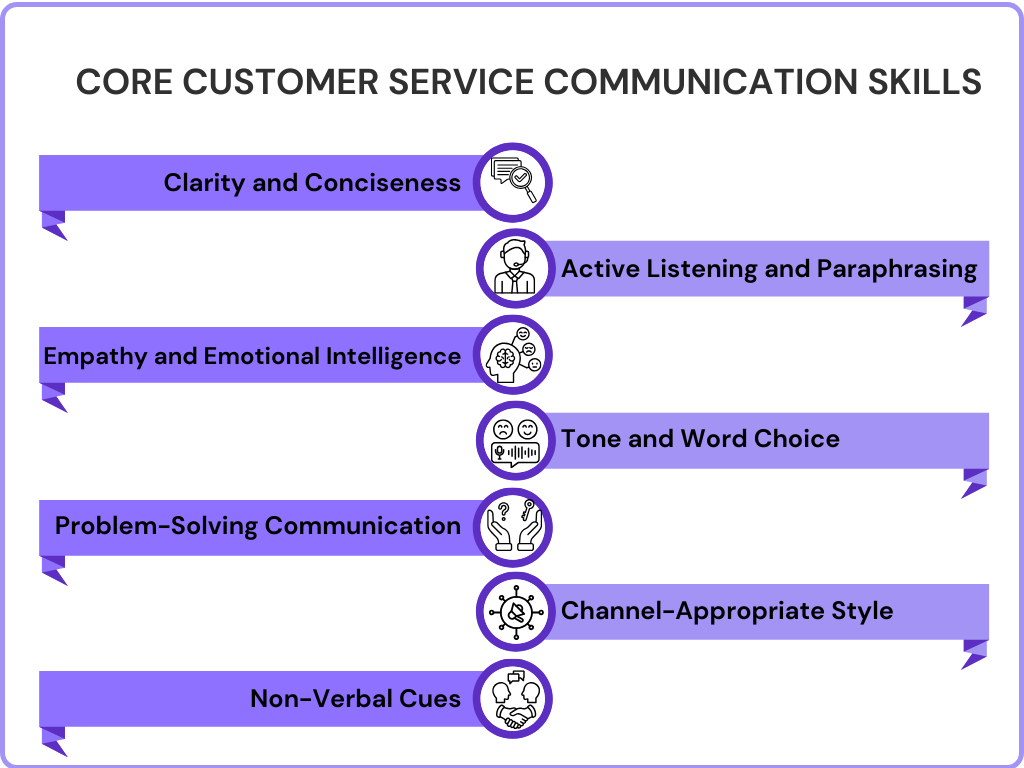
Hiring for strong customer service communication skills requires more than surface-level observations. Here are the core skills that define customer-ready communication—and how they show up in real interactions:

- Clarity and Conciseness: Explains solutions without jargon, repeats key points when needed, and avoids overwhelming the customer with technical details.
- Active Listening and Paraphrasing: Reflects the issue back to the customer to confirm understanding. Helps customers feel heard, especially during complex or emotional complaints.
- Empathy and Emotional Intelligence: Acknowledges the customer’s frustration and responds with emotionally aware language that validates their experience.
- Tone and Word Choice: Uses positive, calm, and reassuring language. Steers clear of blame, sarcasm, or overly casual responses.
- Problem-Solving Communication: Walks customers through the resolution process in logical, step-by-step language. Explains the "why" behind steps when relevant.
- Channel-Appropriate Style: Adapts communication based on platform: short and responsive in chat, warm and structured in calls, clear and detailed in email.
- Non-Verbal Cues (for in-person or video roles): Maintains eye contact, uses an open posture, and controls speech pace to reflect confidence and care.
Map Skills to the Role and Channel
Not every service role demands the same communication style. A phone support agent needs speed and voice clarity. An account manager needs persuasion and relationship-building. Tailoring your evaluation to the role’s primary channel is key. Here’s a simple role-skill map to guide structured hiring:

Quick Tip: Use Customer Service Communication Skill Tests that offer standardized, role-based evaluations with skill-specific scoring. You get detailed descriptive dashboards and skill reports which makes it easier to hire with confidence.
A Step-by-Step Framework to Assess Candidates Customer Communication Skills
To assess candidates’ customer communication skills in a standardized manner, you need to move beyond generic screening. The following four steps blend screening, simulation, and structured interviews to reveal how a candidate’s customer communication skills perform under realistic pressure.

Step 1 – Screen for Communication in the Application Itself
Before the interview, scan the application for signs of clarity, professionalism, and role-specific communication strength. Resumes and cover letters often reveal more than expected, look for indicators in:
- Resume and cover letter parsing
- Tone and grammar in first round AI recruit interview
- Specificity in experience ("Handled 50+ inbound calls per day" vs "Good communicator")
Red flags include vague phrases (“people person”), generic language, or grammar issues—especially in writing-heavy roles like email or chat support.
Step 2 – Use Async Assessment Tools
Objective assessments surface real communication skills early in the hiring funnel. Use the following tools to evaluate candidates effectively:
- Email Writing Test – Evaluate structure, clarity, and tone.
- Chat Assessment – Test quick-thinking, brevity, and empathy.
- Voice and Accent Test – Check pronunciation, clarity, and pacing.
- Listening and Comprehension Tests – Assess processing speed and accuracy in verbal exchanges.
Async tools are scalable and offer measurable insights before the interview stage.
Step 3 – Assess Communication Skills During the Interview
Interviews should test more than general talk. Use these structured methods to assess real-time communication under pressure:
- Behavioral Event Interviewing (BEI) – “Tell me about a time you calmed an angry customer.”
- Situational Judgement Tests (SJTs) – Pose real-life dilemmas for role-specific reactions.
- AI Video Interviewer – Capture spontaneous responses, tone, and customer focus.
These methods add structure while revealing situational communication instincts.
Step 4 – Include Role-Play and Customer Simulations
To see how candidates perform in real situations, run scenario-based assessments. These practical exercises reveal applied communication skills:
- Handling an upset customer over the phone
- Writing a follow-up email after a technical complaint
- Simulating a live chat interaction under pressure
You can also use other relevant BPO Assessment tools with built-in simulations and benchmark for real-world customer challenges. Next, we’ll review effective interview communication and identify common pitfalls to avoid.
Customer Service Communication Examples You Can Use in Interviews
Spotting weak communication during interviews starts with knowing what to listen for. These customer service communication examples help distinguish surface-level talkers from true communicators.
Red Flags to Watch For:
- Defensive tone when challenged
- Overuse of technical jargon
- Blame-shifting language (“That’s not my job”)
- Flat or scripted delivery with no emotional nuance
Email Response Example (Upset Customer Scenario):
Weak Reply: “Sorry for the delay. We’ll try to look into it soon.”
Strong Reply: “I understand how frustrating delays can be. I’ve escalated your concern and will update you by 5 PM today.”
That second version acknowledges emotion, provides a clear action, and sets expectations—all essential for customer-facing roles.
Tip: Use targeted Customer Service Interview Questions to probe how candidates respond to real complaints, not just how they talk about communication in theory.
Adapting Your Assessment for Different Customer-Facing Roles
Using the same assessment for every role may overlook the unique skills of each position. For example, someone answering front desk questions needs different strengths than someone managing enterprise accounts. By customizing your evaluation for your unique requirements, you improve hiring accuracy and help ensure the right person is assigned.
Frontline Customer Service Reps
Frontline service roles demand speed, empathy, and consistency under pressure. Evaluate candidates on these key communication strengths:
- De-escalation skills under pressure
- Script adherence with personalized tone
- Real-time problem-solving across calls or chats
Technical Support / Product Specialists
Technical roles demand clear, simplified communication. Prioritize these skills to ensure candidates can guide customers through complex issues with confidence:
- Clarity in technical breakdowns
- Step-by-step guidance delivery
- Confirmation of customer understanding
Account Managers / Customer Success Roles
In customer success roles, communication shapes relationships and retention. Focus on these strategic abilities to evaluate long-term impact and stakeholder influence:
- Proactive engagement habits
- Presentation and reporting skills
- Ability to influence and align with business goals
Tools like the Language Test from structured platforms can help you zero in on these strengths by role. PMaps offers job-role-specific assessments built exactly for this use case. Next, we’ll outline common mistakes hiring teams make when evaluating communication and explain how to avoid them.
Common Mistakes to Avoid When Assessing Customer Communication Skills
Even experienced hiring managers can misjudge communication ability if assessments aren’t structured. These common errors often result in underperformance or poor customer experiences post-hire.
- Mistake 1: Relying solely on gut feel from conversational interviews
Candidates may present well but struggle under real-world service pressure. - Mistake 2: Confusing extroversion with communication skill
Talkativeness isn’t the same as clarity, empathy, or tone control. - Mistake 3: Overlooking written communication for chat and email roles
Grammar, formatting, and tone matter deeply in written service channels. - Mistake 4: Skipping simulations to save time
Without realistic scenarios, you miss how a candidate reacts to stress or customer tension. - Mistake 5: Not training interviewers on a shared rubric
Inconsistent judgments arise when hiring panels don’t follow the same criteria or scoring framework.
Conclusion
You need support agents who can actually solve problems. To build a team your customers love, you need candidates with clarity, empathy, and cool heads. PMaps helps you find them. Our specific tools, like the in-demand Voice & Accent Test, measure tone, language, and de-escalation skills with precision.
Ready to hire people your customers enjoy talking to? Call at 8591320212 or Email us on assessment@pmaps.in


.png)