.webp)
.webp)


A leadership style is the consistent pattern a manager uses to make decisions, communicate, and motivate a team. It shapes everything from morale to turnover long before a single project outcome shows up on a dashboard. Gallup's research on the State of the American Manager found that managers account for at least 70% of the variance in team engagement scores. That's more than pay, perks, or company policy combined. That's the real case for learning the common leadership styles at work. Getting yours right changes outcomes at a scale most HR interventions can't match.
Curious where your leaders or future leaders stand? PMaps' Leadership Assessment pinpoints your default style in minutes.
What Are Leadership Styles?
Leadership style types describe the recurring approach a person takes toward authority, feedback, and decision rights. Some leaders default to control, others to consensus, and most shift depending on the team and the stakes involved. Researchers have mapped dozens of different leadership styles since Kurt Lewin's original three-style study in the 1930s, but most fall under a smaller set of recognizable patterns that show up across industries, from manufacturing floors to hospital wards to software teams.
Why Do Leadership Styles Matter?
Leadership style types aren't an abstract HR topic, they show up directly in retention numbers. LinkedIn's Workforce Confidence Survey found nearly seven in ten U.S. workers would consider quitting over a bad manager. A leader's default style also sets the ceiling on how a team makes decisions, handles conflict, and responds under pressure, long before a performance review captures any of it.
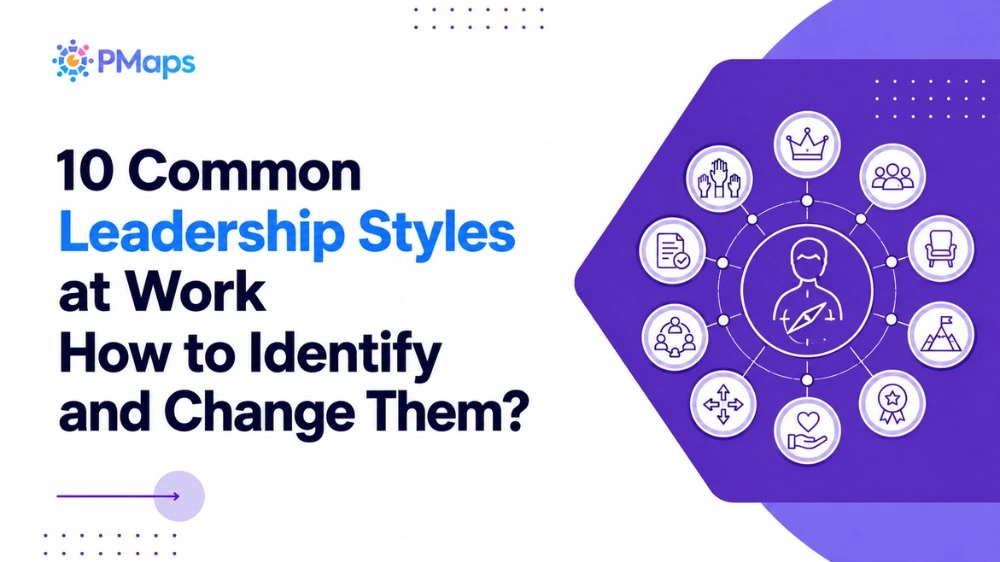
What Are the 10 Common Leadership Styles?
Most leaders lean on the same two or three approaches out of habit, without ever naming them. The ten profiles below double as leadership style examples you'll recognize from your own team, along with where each one helps and where it tends to backfire.
Autocratic Leadership
Autocratic Leadership puts decision-making entirely in one person's hands, with little input sought from the team.
- Centralized, top-down decisions
- Fast execution, minimal debate
- Limited employee input or ownership
Best for: crisis response, safety-critical work, and tightly regulated production lines where speed and consistency matter more than buy-in. Watch-out: morale and initiative tend to erode if this stays the default once the crisis passes.
Democratic Leadership
Democratic Leadership invites the team into the discussion, then the leader makes the final call after hearing everyone out.
- Open discussion before decisions
- Shared ownership of outcomes
- Slower, more deliberate pace
Best for: teams solving ambiguous problems where diverse input improves the answer. Watch-out: it can stall when a decision needs to happen fast.
Laissez-Faire Leadership
Laissez-faire leadership hands most of the decision-making down to the team, with the leader stepping in only when asked.
- High autonomy, minimal oversight
- Leader acts as a resource, not a gatekeeper
- Works best with experienced, self-driven teams
Best for: senior specialists, research teams, and creative roles where oversight slows the work down. Watch-out: newer or less experienced employees can flounder without enough structure.
Transformational Leadership
Transformational Leadership leads through a compelling vision, pushing a team past what they thought their ceiling was.
- Vision-led, future-focused communication
- High energy, high expectations
- Invests heavily in people's growth
Best for: growth phases, turnarounds, and periods of major change where a team needs a reason to stretch beyond routine targets.
India's own Ratan Tata Leadership Style shows transformational leadership in action, turning long-term vision into decades of business growth.
Watch-out: this style can outpace a team's day-to-day capacity if the vision never gets translated into concrete, achievable steps along the way.
Transactional Leadership
Of the ten, this is the most purely performance-driven style, with almost no room for ambiguity in what's expected.
Transactional Leadership runs on a clear exchange: hit the target, get the reward, miss it, and there's a consequence.
- Clear KPIs and expectations
- Reward and consequence tightly linked
- Common in sales floors and call centers
Best for: roles with measurable, short-cycle output. Watch-out: it rarely builds loyalty or innovation on its own.
Servant Leadership
Servant Leadership flips the usual hierarchy: the leader's main job is removing obstacles for the team, not directing them.
- Leader prioritizes team needs first
- Coaching over commanding
- Builds high trust over time
Best for: high-trust, high-retention cultures like hospitality, healthcare, and nonprofit work. Watch-out: it can be mistaken for a lack of authority if boundaries aren't clear.
Situational Leadership
Situational Leadership isn't one style at all, it's the practice of switching styles based on a team member's skill and confidence on a given task.
- No single default approach
- Reads the person and the task, not just the role
- Requires strong judgment from the leader
Best for: managers overseeing a mixed-experience team. Watch-out: it's hard to execute without real skill in reading people accurately.
Facilitative Leadership
Facilitative Leadership focuses less on giving answers and more on running the process that gets the group to a good one.
- Leader guides discussion, doesn't dominate it
- Strong at surfacing disagreement productively
- Common in cross-functional and agile settings
Best for: workshops, planning sessions, and teams that span multiple departments. Watch-out: it needs a genuinely skilled facilitator, or discussions drift without landing anywhere.
Participative Leadership
Participant Leadership (usually called participative leadership) builds employee input directly into the decision process, not just the discussion around it.
- Formal channels for employee input
- Decisions reflect team feedback, not just leader judgment
- Higher buy-in on rollout
Best for: change management and policy rollouts that need real adoption, not just compliance. Watch-out: it can be gamed if feedback is collected but never actually used.
Bureaucratic Leadership
Bureaucratic leadership runs on policy and procedure first, with the rulebook taking precedence over individual judgment calls.
- Strict adherence to process and hierarchy
- Predictable, auditable decision trails
- Common in banking, pharma, and government
Best for: regulated industries where a compliance failure carries real legal or safety risk. Watch-out: it can slow decisions to a crawl in fast-moving markets.
How to Assess Leadership Style?
Self-perception and team perception of a leader's style often diverge sharply, which is exactly why structured evaluation outperforms a self-assessment quiz. Here's how to identify your leadership style without relying on guesswork: cross-reference how a leader believes they operate against how their team actually experiences their decisions day to day.
Common Types of Leadership Assessments:
- Personality-Based Assessments (e.g., DISC, Big Five,16PF): map underlying traits like dominance, conscientiousness, and openness that shape how someone naturally leads.
- 360-Degree Feedback Assessments: gather input from managers, peers, and direct reports to compare self-perception against how the team actually experiences a leader's style.
- Emotional Intelligence (EQ) Assessments: measure self-awareness, empathy, and relationship management, all strong predictors of leadership effectiveness.
- Leadership Style Inventories (e.g., the Multifactor Leadership Questionnaire): survey-based tools that classify a leader's default style, such as transformational or transactional.
- Situational Judgment Tests (SJTs): present realistic workplace scenarios to see how a leader would actually respond under pressure.
- AI-Powered Leadership Simulations: use interactive, scenario-driven exercises to evaluate real-time decision-making at scale, often paired with IRT-calibrated scoring.
- Behavioral and Competency-Based Assessments: score observable actions like delegation, conflict resolution, and decision-making against role-specific benchmarks.
PMaps has rounded up the Best Leadership Assessments HR teams can compare and trust to benchmark this gap, rather than guesswork.
How Hard is it to Change a Leadership Style?
Learning how to change your leadership style starts with treating it as a learned habit, not a fixed trait, which means it's changeable, though rarely overnight. Most style shifts take six to twelve months of deliberate practice, paired with honest feedback from the team, before a new pattern feels natural. The hardest part isn't choosing a new approach on paper, it's catching the old default reflex in the moment it happens. Structured coaching and 360-degree feedback tend to close that gap faster than reading about leadership theory alone.
Comparison of Leadership Types: Which Leadership Style Is the Best?
There's no single best leadership style, only a best fit for the team, the task, and the moment at hand. The comparison below lines up all ten leadership style types side by side, so it's easier to see which approach actually matches a given situation instead of a personal default.
Looking Forward
None of these ten styles is right or wrong on its own, the fit depends entirely on the team in front of a leader today. The leaders who grow fastest tend to be the ones who know their default well enough to deliberately switch out of it when the moment calls for something else. To pinpoint where your own leaders stand today, reach out to PMaps at assessment@pmaps.in or 8591320212.