.webp)
.webp)


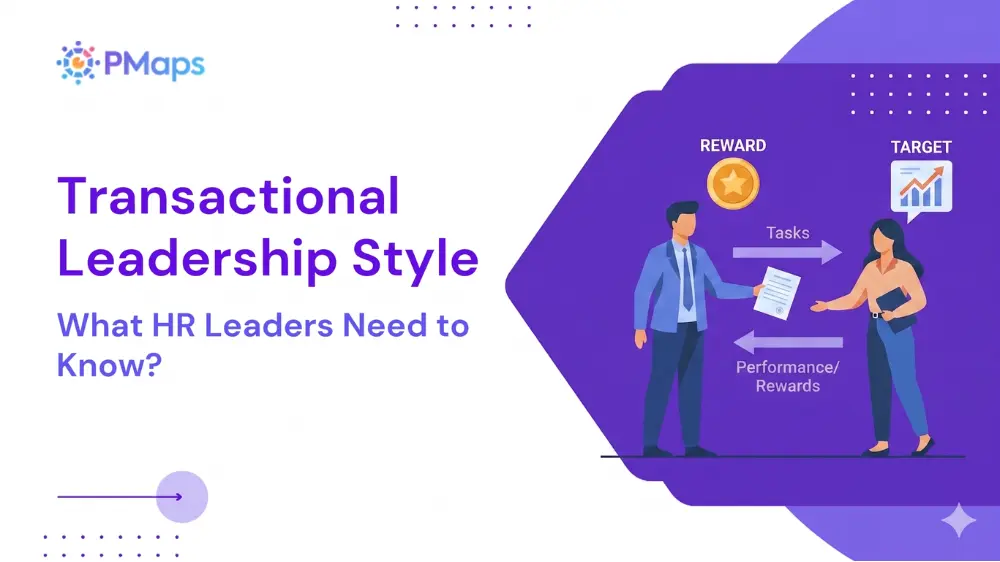
Transactional leadership style is a structured management approach based on defined expectations, contingent rewards, and corrective actions. Research from McKinsey indicates that organizations with clearly defined performance systems can see productivity improvements of up to 20%.
HR teams use leadership assessments to evaluate whether managers fit roles requiring consistency, compliance, and high-volume execution.
What Is Transactional Leadership? A Working Definition
The transactional leadership definition focuses on a clear exchange between performance and reward. This transactional model is often described as reward-and-punishment leadership, in which outcomes are directly tied to incentives or corrective actions. Here leaders define expectations in measurable terms. Employees who meet these expectations receive incentives such as bonuses, recognition, or promotions. Employees who fail to meet them face structured corrective action.
The concept originates from rule-based organizational systems. Max Weber introduced structured authority models, later expanded by James MacGregor Burns and Bernard Bass into modern leadership frameworks. Today, HR teams apply this model in performance-driven environments.
Transactional leadership style falls within different leadership styles under directive frameworks. It prioritizes measurable output, role clarity, and compliance over autonomy or creative exploration. This makes it suitable for roles where consistency directly impacts business outcomes.
Core Characteristics of Transactional Leadership
Transactional leadership characteristics define how this leadership style ensures predictable performance and consistent execution across teams. Here are some of the core characteristics of transactional leadership style:
- Contingent Reward Leadership defines how transactional leadership style drives behavior. Leaders assign incentives for meeting predefined targets or completing tasks successfully. Research on performance management shows that clearly linked reward systems can improve short-term productivity and consistency in output across operational teams.
- Management by Exception (Active) involves continuous performance monitoring. Leaders track metrics closely and intervene before issues escalate. This approach reduces operational risk and ensures that deviations are corrected before they affect overall outcomes.
- Management by Exception (Passive) only activates when standards are not met. Leaders wait for performance gaps or completed outcomes before taking corrective action. This model works in stable environments where processes are predictable and deviations are easy to measure.
- A Defined Role Structure means a strict structure that ensures clarity across teams. Roles, responsibilities, and procedures remain clearly defined. Organizational behavior research shows that structured environments reduce ambiguity and improve execution speed in high-volume roles.
- Short-Term Goal Orientation keeps teams aligned with immediate targets. Weekly metrics, monthly benchmarks, and quarterly KPIs define success. This structure supports operational control but limits focus on long-term capability development.
- Top-Down Decision Authority centralizes decision-making with leaders. Instructions move downward with limited employee input. This structure supports industries where compliance, accuracy, and speed directly influence business outcomes.
Transactional vs Other Leadership Styles
Transactional leadership style differs from other leadership styles in how it drives performance, manages authority, and structures motivation. While transactional vs transformational leadership remains the most searched comparison, HR leaders must evaluate multiple leadership styles based on role context and team maturity.
Transactional leadership style structures performance through control, clarity, and measurable incentives. Other leadership styles introduce flexibility, autonomy, or intrinsic motivation based on organizational needs. HR leaders apply multiple leadership styles across workforce layers. Transactional leadership style supports execution, while other styles support engagement and long-term capability building.
Transactional Leadership in Practice — Industry Examples
These transactional leadership examples show how the model operates across industries with strict performance and compliance requirements. Transactional leadership style performs best in environments where output consistency, compliance, and measurable performance define success. Industry use cases clarify how this model operates:
- BFSI: A regional bank manager assigns monthly loan and revenue targets. Relationship managers who meet targets receive incentives based on predefined slabs. Consistent underperformance triggers structured improvement plans. This ensures predictable revenue tracking and regulatory compliance.
- GCC (Global Capability Centers): GCC environments manage large-scale operations across BPO and ITeS functions. Team leaders track adherence, average handling time, and resolution rates daily. Incentives align with weekly dashboards. Transactional leadership style ensures SLA compliance and consistent service delivery across distributed teams.
- Manufacturing: Shift supervisors enforce production quotas and safety compliance protocols. Output deviations trigger immediate corrective action. This reduces downtime and maintains process stability across assembly lines.
- Pharma & Healthcare: Field sales teams operate under defined call cycles and territory coverage targets. Incentives follow fixed quarterly metrics. Compliance with reporting standards ensures audit readiness and consistent execution.
Transactional leadership style reduces performance variability in these industries. It ensures operational stability even with large and distributed workforces
When Transactional Leadership Works — and When It Doesn't
Transactional leadership style performs effectively in environments where clarity, consistency, and control define success. Its impact depends on role structure, team expectations, and performance measurement systems.
Where it performs
Transactional leadership style delivers results in roles where output is measurable and processes are stable. It creates clarity and reduces execution variability across teams.
- Repetitive, process-driven roles with defined KPIs
- Entry-level and mid-level operational teams
- Crisis situations requiring immediate direction
- Large, distributed teams with standardized workflows
- Compliance-heavy environments with strict reporting requirements
Where it falls short
Transactional leadership style creates limitations in roles that require flexibility, creativity, or long-term capability development. Over-reliance can reduce engagement and ownership.
- Creative roles requiring independent thinking
- R&D and innovation-driven teams
- Leadership development and succession pipelines
- High-attrition environments with low engagement
- Roles requiring collaboration and decision autonomy
Organizations address these gaps by combining leadership approaches based on team maturity and role complexity. This ensures balance between execution and engagement.
How HR Leaders Assess Transactional Leadership Tendencies
When hiring or evaluating managers for succession, HR leaders must assess alignment between individual behavior, team expectations, and organizational goals. Leadership style mismatch often leads to performance inconsistency, low engagement, and increased attrition in structured roles.
Key assessment methods and dimensions
- Personality assessment to evaluate rule adherence, discipline, and behavioral consistency
- High-potential identification tests to detect early leadership tendencies in entry-level talent
- Communication assessment through structured voice or video interviews under pressure scenarios
- Cognitive ability tests to measure decision-making speed and problem-solving accuracy
- Behavioral simulations and AI-led interviews to observe response to targets, incentives, and performance deviations
These assessment methods provide a multi-dimensional view of leadership tendencies. They help HR teams move beyond resumes and identify managers who can sustain performance in structured, high-volume environments.
Conclusion
Transactional leadership style delivers results where structure defines success. The challenge lies in knowing when to apply it and when to adapt. HR leaders who assess leadership fit early avoid costly mismatches. The next step is simple, you start evaluating your leaders behavior before it impacts your teams performance, confused what competencies to prioritize? Call us at 8591320212 or drop a mail at assessment@pmaps.in.