.webp)
.webp)


What Is Situational Leadership Theory?
Situational leadership theory is a management framework where leaders adapt their style to each team member's development level — not their own preference. So, why is situational leadership important? Because one fixed style fails most people, hence, understanding the situational leadership model for effective Management answers that:
The history of situational leadership theory can be traced back to Paul Hersey and Ken Blanchard in 1969, built on behavioural research that challenged the idea of one universal leadership approach. This blog covers the model's core stages, four leadership styles, real-world applications, and its documented advantages and limits — in that order.
Assessing leadership readiness across your organization? Use the Leadership Test to benchmark where your managers currently stand — before designing development interventions around situational leadership.
Core Components of the Situational Leadership Model
The situational leadership model rests on a deceptively simple idea: the right leadership style depends on the readiness of the person being led — not on the preferences of the leader. What makes this model intellectually compelling is how precisely it maps leader behaviour to follower development, across three distinct components that together function as a working system rather than a theory in isolation. Here is what each component actually means.
Stages of Situational Leadership Development
A core insight of situational leadership theory is that people move through predictable stages of development — and effective leaders change their approach at each stage, not just once at the start of a role.
- D1 – Enthusiastic Beginner: High commitment, low competence. New to the task but motivated. Needs directive guidance and clear step-by-step instruction to build early momentum without getting lost.
- D2 – Disillusioned Learner: Some skill has developed, but motivation has dipped. Reality has hit. Leaders must coach actively, acknowledge the difficulty honestly, and reinforce incremental progress so the learner doesn't stall.
- D3 – Capable but Cautious: Competence is solid; self-confidence hasn't caught up. This person needs support and collaboration, not more instruction. Over-directing at this stage actively undermines performance.
- D4 – Self-Reliant Achiever: High competence, high commitment. Fully capable of owning outcomes. The appropriate response is full delegation — micromanaging a D4 is one of the more costly leadership errors a manager can make.
4 Situational Leadership Styles
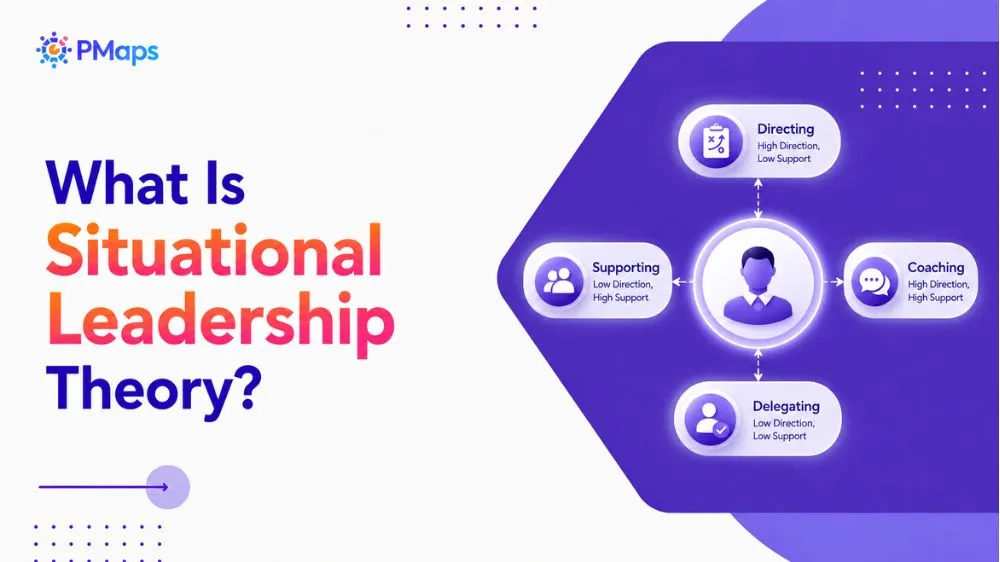
Paired directly with these four development stages are four leadership styles — not personality types, but deliberate behavioural choices that a skilled leader can select and shift between based on the individual in front of them.
- S1 – Directing: The Autocratic Leadership Style is the closest parallel here — high task, low relationship. The leader tells, shows, and monitors closely, giving D1 individuals the structured direction they need to start. As the learner develops, the task dimension stays high — but the relationship must now carry real weight.
- S2 – Coaching: High task, high relationship. The leader explains reasoning and invites questions, motivating through meaning and visibility. Unlike the Transactional Leadership Style, this treats D2 engagement as the lever, not a metric. Once competence is no longer the gap, the leader's challenge changes entirely. It shifts from building a person's skill to building their confidence in the skill they already have.
- S3 – Supporting: Low task direction, high relationship focus. The leader facilitates and shares decisions — closest to the Servant Leadership Style in philosophy. For D3 individuals who are capable but not yet confident in their own calls. At the highest development level, the most counterintuitive leadership move is also the most effective: withdraw entirely. Trust that the work done in earlier stages has done its job.
- S4 – Delegating: Low task, low relationship. Full ownership passes to the individual — consistent with the Participative Leadership Style. The leader steps back entirely, reserved for D4 achievers who are capable and self-directed.
What Are the Characteristics of a Situational Leader?
A situational leader isn't defined by one dominant style. They're defined by the speed and accuracy with which they shift between styles — reading people, context, and organizational pressure without defaulting to habit.
- Diagnostic Acuity: Reads a team member's development level accurately before choosing a leadership approach — considers both competence and commitment, not just task output.
- Behavioral Flexibility: Moves between directing, coaching, supporting, and delegating without ego attachment. Unlike the process-first orientation of the Facilitative Leadership Style, situational leadership mandates active style shifts, not stylistic preference.
- Performance Orientation: Adapts style to serve outcomes, not comfort. Style shifts are deliberate and tied to individual growth — not reactions to mood or pressure.
- Relational Intelligence: Builds trust across all four development stages. People at every level feel led appropriately — not over-managed or left without support. This human-first orientation is close to what the Transformational Leadership Style emphasizes, though situational leadership applies it with far more behavioural specificity.
Consider a product team mid-sprint. A junior UX designer joins with enthusiasm but no prior product exposure (D1). A senior engineer on the same team has led five sprints independently and consistently delivers (D4). The situational leader provides the junior designer with close daily direction — clear tasks, structured check-ins, immediate feedback. The senior engineer gets full ownership of the technical architecture with minimal check-ins. Same team. Same week. Two entirely different leadership approaches — both intentional, both tied to where each person actually is.
Advantages and Disadvantages of the Situational Leadership Model
Every leadership model involves trade-offs, and situational leadership theory is no exception. Its advantages are well-documented. But leaders who apply it without understanding its limits often create the very inconsistency the model is designed to prevent. The table below gives you the at-a-glance picture first.
The case for situational leadership is strong. But whether it delivers depends heavily on the leader's own self-awareness and diagnostic discipline. Here is how the benefits play out — and where the limits show up.
The Benefits of the Situational Leadership Model
The situational leadership model is most effective when its benefits are understood not as abstract qualities but as specific, measurable outcomes. A Gallup study found that managers who adapt their approach to individual team members can drive engagement variance by as much as 70% — making leadership style one of the most controllable levers of performance available to an organization.
- Accelerates individual development: By matching style to readiness, leaders create the precise conditions for faster competence-building and sustainable confidence — rather than letting people plateau at D2.
- Reduces attrition risk: People who feel led appropriately — neither micromanaged nor unsupported — are significantly less likely to disengage. LinkedIn's 2023 Workplace Learning Report found that employees who feel their managers invest in their growth are 3.5x more likely to stay.
- Builds trust across development stages: Whether directing a newcomer or delegating to an expert, the intentional approach signals respect. Psychologically safe teams consistently outperform those where leadership is unpredictable.
- Works alongside Different Leadership Styles: Unlike rigid frameworks that compete with existing philosophies, the situational leadership model integrates with and complements most leadership approaches already practiced in an organization.
- Produces fewer bottlenecks: Situational leaders consistently report better alignment between task complexity and individual capability — resulting in faster project cycles and fewer escalations.
When Is Situational Leadership Best for Your Team?
Situational leadership delivers the clearest return in environments where team composition is diverse, roles evolve quickly, or individual development is as central to success as collective output.
- Cross-functional teams: When team members arrive with vastly different experience levels, a uniform leadership style becomes a liability. Situational leadership provides a structured way to differentiate management without it feeling arbitrary.
- High-growth organizations: Startups and scaling companies often have D1 and D4 individuals working side by side — on the same team, in the same sprint. The model provides a practical map for leading through that diversity.
- Mentorship-heavy roles: For leaders who also function as coaches or sponsors, situational leadership offers a clear behavioural framework — aligning development intent with consistent, stage-appropriate leadership practice.
- Post-restructuring environments: When roles shift and team confidence drops, situational leadership provides a responsive, human-centred approach to re-establishing direction without defaulting to control.
Consider how the Ratan Tata Leadership Style exemplifies this adaptive philosophy — directing during organizational crises and delegating during innovation — situating every leadership decision in context rather than following a fixed style regardless of circumstances.
Where should you refrain from using situational leadership? In highly standardized, compliance-heavy environments — certain manufacturing operations, regulated financial processes, or public sector settings where uniform procedure is non-negotiable — the variability inherent in situational leadership can introduce inconsistency that outweighs its benefits. Similarly, in small, stable, high-competence teams where most members sit at D4, the model adds diagnostic overhead with minimal return. The diagnostic investment only pays off when the development range across your team is wide enough to warrant it.
Conclusion
The situational leadership theory doesn't ask leaders to be everything at once. It asks them to be precisely what's needed, for the specific person in front of them, at this particular stage of their development. Organizations that get this right don't just build better managers — they build teams that actually grow.
If your organization is building leaders who lead with evidence, not instinct, we'd like to be part of that work. Call us at 8591320212 or write to us at assessment@pmaps.in — let's talk about how an assessment platform can help your managers identify where each team member actually is, before deciding how to lead them there.