
.webp)
.webp)


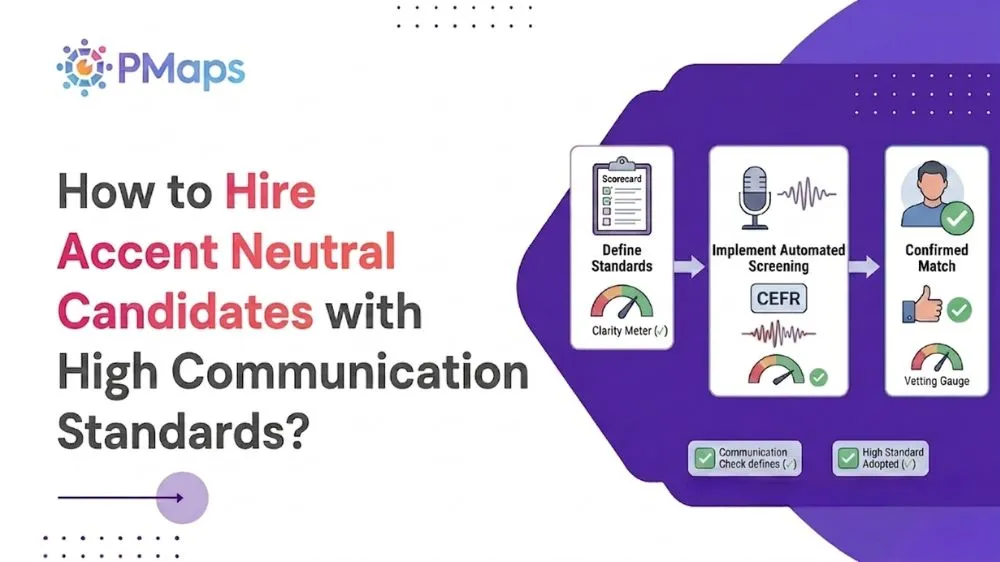
Hiring accent-neutral candidates for the international voice process means screening for speech clarity and understandability, not a specific regional accent. Candidates with minimal phonetic interference handle international calls better and score higher on CSAT benchmarks.
A 2023 CustomerServ global survey of thousands of BPO agents found that understandability, not accent type, predicts customer satisfaction in voice process roles. Is your candidate's accent right for the job? That question is harder to answer than most hiring managers assume, and the rest of this piece breaks down exactly how to get it right.
Foreign Accent and Employer Beliefs
Most hiring managers treat an accent as a proxy for communication quality. That shortcut is costing teams good candidates and producing poor hiring decisions. Here is what the research says about what employers actually get wrong about accents.
What's More Important: Accent or Issue Resolution?
CustomerServ's research puts it directly: customers care more about whether their problem is solved than whether the agent sounds local. Agents with moderate accents who resolve queries efficiently consistently outperform clear-sounding agents who struggle under pressure. Filtering on accent alone reverses the priority.
Cultural Competence vs. Accent Neutrality
Research from Stetson University found that cultural intelligence among service staff predicts more reliable positive customer interactions than accent neutrality does. An agent who understands what a customer means, culturally rather than just linguistically, closes calls faster with fewer escalations. Many BPOs are now replacing pure accent reduction programs with cultural competence training for exactly this reason.
YoY Changes in Hiring Practices to Hire Accent-Neutral Candidates
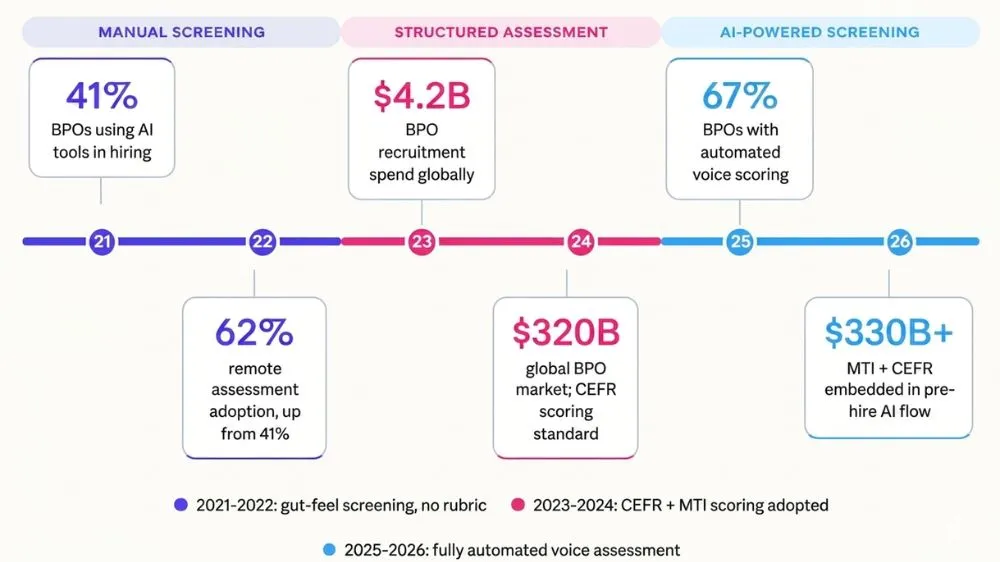
Accent-based hiring has not stayed static. Between 2021 and 2026, the industry shifted from gut-feel voice screening to structured, data-driven tests and AI voice interviews. The infographic below maps that shift year by year.
Best Way to Hire Neutral Accent Candidates
Subjective voice screening, where a recruiter listens and decides, produces inconsistent outcomes and opens the door to bias. A structured, tool-supported process fixes both problems. These are the methods that actually work:
- Screen for understandability, not accent type. A candidate who speaks with a regional lilt but communicates clearly is a better hire than someone who sounds neutral but loses listeners on complex queries.
- Use a standardized voice and accent assessment early in the funnel, before interview rounds, to obtain objective pronunciation and fluency scores for every candidate.
- Score MTI (Mother Tongue Influence) as a percentage, not a pass/fail. A lower MTI percentage indicates minimal native-language interference; a higher percentage suggests the candidate may need targeted training before going live on international calls.
- Test in context, not isolation. Give candidates a realistic scenario, a mock customer call, a complaint to handle, not just a reading exercise. Speech that sounds fine in isolation can break down under pressure.
- Add a CEFR benchmark to your scorecard. For international voice process roles, B2 is the practical minimum; C1 is the standard for client-facing escalation handling.
- Have two reviewers independently score each voice sample to remove single-evaluator bias.
- Flag candidates who score well on clarity but show strong cultural knowledge gaps—both matter.
Is Accent Neutralization Possible with Accent Training?
Yes, to a meaningful degree, and no, not completely. Accent is shaped by years of first-language use; it cannot be fully erased, and trying to do so is both unrealistic and unnecessary. The goal of accent training is to reduce the specific phonetic patterns that cause misunderstanding, not to replace a person's voice.
Here is how L&D leaders can use voice assessment data to build a training program that actually moves the needle:
- Pull MTI scores from pre-hire assessments to identify which phoneme substitutions are most common across your cohort. Gujarati speakers may need different drills than Bengali speakers; a single generic training module will not serve both.
Still noticing communication gaps after onboarding? Understand MTI patterns earlier to improve hiring accuracy and customer-facing communication readiness.
- Run a voice benchmark recording at week one of training. Record the same passage at week four and week eight. Measurable change in specific sounds, not general impressions, is what tells you the training is working.
- Teach phonetics, not mimicry. Agents who understand why a sound works in English (mouth position, airflow, syllable stress) can self-correct. Agents who only imitate a trainer's voice have no tool for fixing errors when the trainer is not present.
- Use the CEFR pronunciation band as a baseline, then set a target band for the role. Build the training curriculum around closing that specific gap rather than training to a general "neutral accent."
Want globally benchmarked English proficiency hiring standards? Explore what CEFR measures and why recruiters increasingly rely on it.
- Combine individual drills with shadowing exercises using neutral-accent English audio. Fifteen minutes of daily shadowing builds rhythm and intonation patterns that isolated pronunciation drills miss.
- Track CSAT scores against MTI improvement scores over 90 days. That correlation, or lack of it, tells L&D whether the training investment is translating into actual call performance.
- Build a feedback loop between QA and L&D. Quality analysts often catch accent-related comprehension issues that structured training doesn't address. Their flags should be reflected directly in the training content.
Conclusion
Hiring for accent neutrality without a structured process means hiring on accent bias. The candidates who perform best in international voice roles are not those who sound a specific way; they are those who communicate clearly, handle cultural nuance, and score well on objective voice assessments. If you are building or auditing a voice process hiring pipeline and want to know where your current screening process has gaps, reach out to ssawant@pmaps.in or call us at 8591320212.




.webp)
.avif)


