.webp)
.webp)


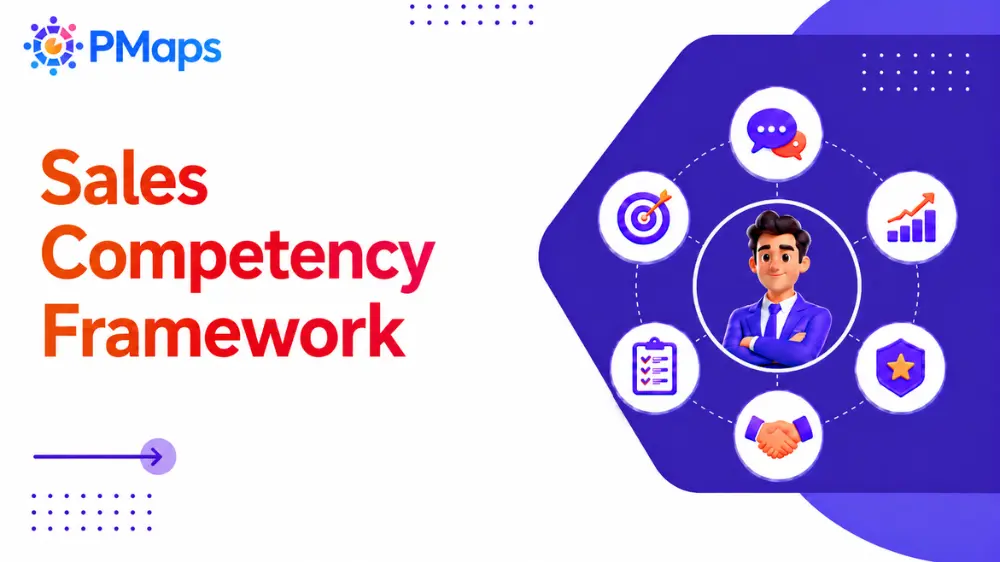
A sales competency framework is a structured blueprint defining the skills, knowledge, and behaviors a sales role demands, turning a sales assessment into an objective, data-backed hiring decision instead of guesswork. Sales roles see roughly 35% annual turnover, nearly triple the average across industries and replacing one rep costs upward of $114,957, according to DePaul University research. Those numbers are exactly why competency-based hiring for sales has stopped being optional.
What is the Sales Competency Framework?
Picture two sales competency framework examples: one lists vague traits like "persuasive" and "driven," the other ties specific, observable behaviors to deal stages, quota attainment, and customer outcomes. Only the second version is something a recruiter can actually use.
Most organizations combine more than one Sales assessment type to build a complete competency picture:
- Cognitive ability tests measure how quickly sales candidates interpret buyer cues, compare options, solve pricing concerns, and stay logical under pressure during prospecting, demos, and closing conversations with consistent accuracy.
- Behavioral and personality assessments reveal whether sales candidates show resilience after rejection, coachability during feedback, ethical judgment, customer empathy, ownership, and a communication style suited for consultative, high-pressure sales roles.
- Role-play and simulation exercises test how sales candidates uncover needs, frame value, handle objections, ask follow-up questions, negotiate pricing, and protect margins in realistic buyer conversations across deal stages confidently.
- AI voice screening assess sales candidates' tone, confidence, listening discipline, articulation, pitch structure, and buyer impact before recruiters spend time reviewing resumes or scheduling interviews for shortlist decisions.
- Skills tests verify whether sales candidates understand offerings, buyer personas, CRM hygiene, competitor positioning, pricing basics, compliance needs, and domain concepts required for target roles before joining teams.
Once you have assessment data, you need a way to compare candidates and reps against each other. That's where a sales competency matrix earns its place, turning scattered scores into a single, comparable view across your team.
A matrix only works if the competencies inside it are accurate. Before mapping anyone's score, you have to define what "good" actually looks like for your specific sales motion and buyer.
How to Build a Sales Competency Framework?
Building a credible framework means working backward from reality, not forward from assumption. Start with how your best sellers actually behave, then translate that behavior into measurable criteria recruiters and managers can apply consistently across every hiring decision and performance review.
Analyze Work Style of Top Sales Performers
Top performers rarely follow the same script as your average rep. Sit with their calls, CRM notes, and win-loss data to identify the specific habits separating consistent closers from the rest of the team.
- Shadow live calls and demos to capture real-time decision-making
- Review CRM activity patterns: call frequency, follow-up speed, pipeline hygiene
- Interview managers about what separates A-players from average reps
- Map win-loss data against rep behavior, not just final outcomes
Sales Skills Gap Analysis
A sales skills gap analysis compares what your current team can do against what the role genuinely requires. The distance between the two tells you exactly where training, coaching, or hiring needs to focus next.
- Score existing reps against the competencies you've identified
- Flag competencies where most of the team consistently falls short
- Separate individual gaps from team-wide skill shortages
- Prioritize gaps by revenue impact, not by ease of fixing
Define Core Sales Competencies
Core sales competencies usually fall into four buckets: business acumen, discovery and questioning, objection handling, and closing discipline. Behavioral competencies for sales professionals — resilience, coachability, emotional control — sit underneath all four and shape how consistently they show up.
- Business acumen — connecting your solution to a buyer's financial outcomes
- Discovery skill — uncovering real pain points, not surface-level requirements
- Objection handling — reframing pushback without losing deal momentum
- Closing discipline — recognizing buying signals and asking decisively
Weight these differently by role. An SDR's framework leans on outreach persistence and qualification accuracy, while an enterprise AE's leans on negotiation, stakeholder mapping, and long-cycle relationship management.
For a complementary lens on what separates consistent quota achievers, What are the 5 Cs of sales success? is worth a look once your core list is drafted.
Establish Sales Competency Levels for Proficiency
Each competency needs proficiency levels — beginner, intermediate, advanced, expert — so progress is visible. A sales manager competency framework should layer in coaching and forecasting accuracy, since managing a pipeline differs sharply from running one.
- Beginner — understands the competency conceptually but needs guidance
- Intermediate — applies the competency consistently with occasional support
- Advanced — applies it independently and mentors others
- Expert — shapes best practice and trains the wider team
Step-by-Step Development of Sales Assessment Rubric
A rubric turns subjective impressions into a repeatable scoring system. Building one well takes more than listing traits — it requires linking each competency to an observable behavior, a measurable indicator, and a score range two different evaluators would rate the same way, every time. Many teams start from a sales competency framework template, but customizing it to your own sales motion matters more than the template itself.
- Identify the competency — name exactly which skill or behavior this part of the rubric scores
- Define proficiency descriptors — write what beginner, intermediate, and expert performance looks like in practice
- Assign weighted scoring — give higher-impact competencies more weight than nice-to-have skills
- Pilot with known performers — test the rubric on existing top and bottom reps to confirm it discriminates fairly
- Calibrate across evaluators — have two assessors score the same candidate and reconcile any scoring gaps
Anchoring this process to What is a sales readiness assessment? helps keep every scoring decision grounded in real performance signals rather than impressions.
How to Implement Sales Competency Framework?
A framework only creates value once it's actively used in hiring and development decisions. Implementation means embedding it into your assessment process, interview structure, and ongoing performance conversations — not filing it away after the workshop.
How to Measure Sales Competencies Objectively?
Objectivity disappears the moment scoring depends on a single interviewer's gut reaction. How to measure sales competencies objectively comes down to standardizing the tools, the scoring criteria, and the conditions every candidate faces.
- Automate scoring system — remove manual grading bias by letting software apply rubric criteria consistently
- Proctor your sales assessment — use identity verification and browser-lock features so scores reflect genuine ability
- Use an AI test builder — generate role-specific questions quickly while keeping scoring criteria standardized
- Combine insights with interview rounds — pair assessment data with an AI interview to validate communication and pitch delivery
- Use standard multimode assessments — blend cognitive, behavioral, and skills tests so no single dimension skews the score
Connecting these scores to a broader What is Sales Performance Analysis view shows whether competency data actually predicts revenue outcomes over time.
How to Use Sales Competency Framework for Sales Team Development?
Beyond hiring, the same framework should guide coaching conversations, promotion decisions, and territory assignments. When competency scores connect directly to Sales KPIs, development plans stop being generic and start targeting actual revenue gaps.
- Build individual development plans around each rep's lowest-scoring competencies
- Tie promotion criteria to advanced or expert proficiency levels
- Use competency trends to inform territory and account assignments
- Revisit scores quarterly to track real movement, not assumptions
Conclusion
A sales rep competency evaluation built on real behavioral data does more than fill a hiring gap — it changes how your entire revenue team grows. The harder question isn't whether your current process works. It's how much revenue slips through because nobody can say for certain where the gaps are. Curious what your team's competency gaps actually look like? Write to assessment@pmaps.in or call 8591320212 for a closer look at where PMaps assessments could fit your hiring process.