.webp)
.webp)


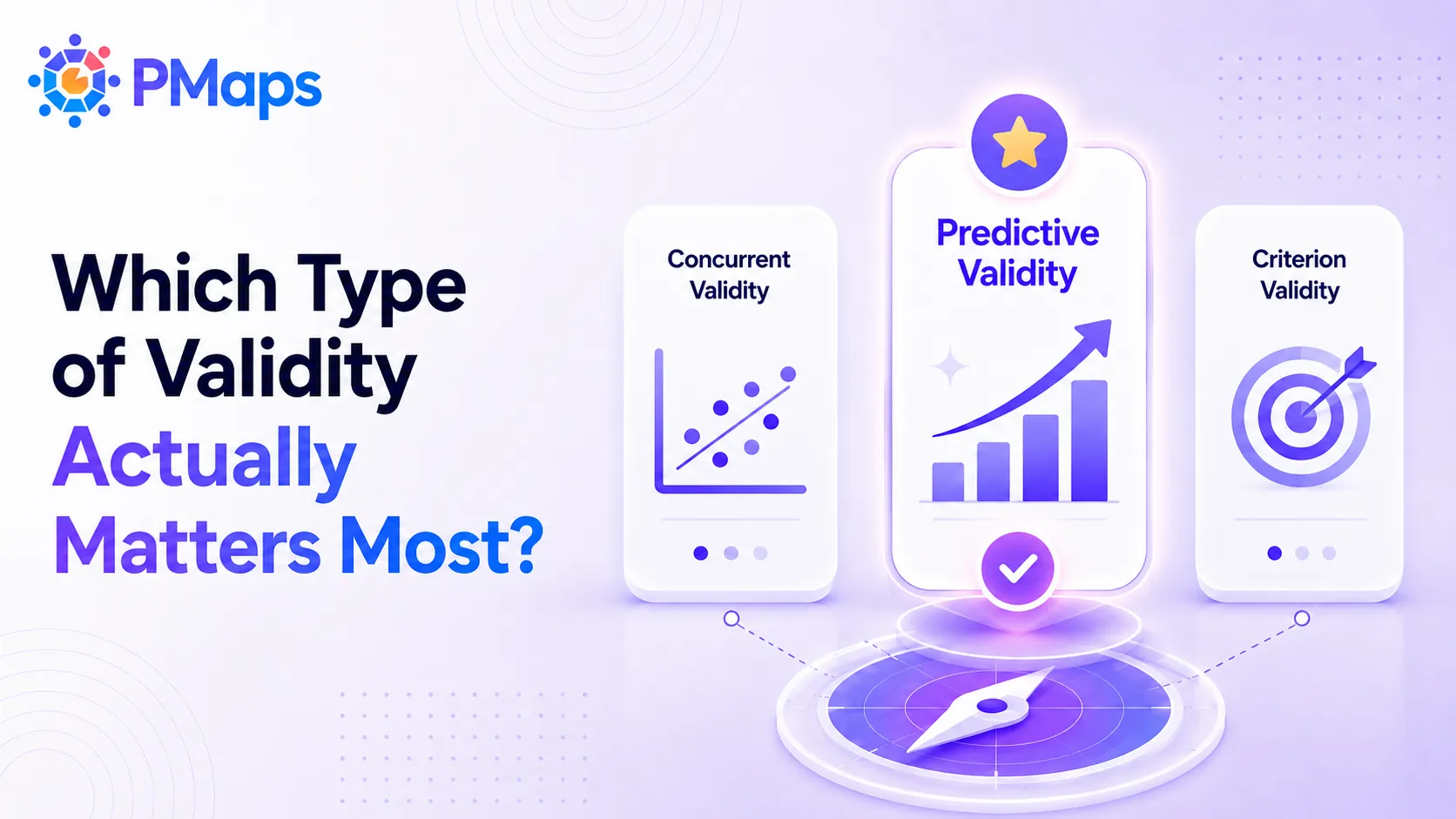
This assessment is validated" sounds reassuring, but it can mean very different things — and not all of them are proof that the test predicts job performance. Validity is a family of concepts, and they're not interchangeable. A test can look perfectly job-relevant and still have no measured link to who succeeds. For hiring decisions, only one branch of the family closes that gap.
This guide maps the validity family in plain language, explains the difference between predictive and concurrent validity, and shows which type you actually need before you trust an assessment to gate hiring.
In short: Criterion validity — proof that assessment scores correlate with a real job outcome — is the type that matters for hiring. It comes in two forms: predictive validity (score candidates now, measure their outcomes later) and concurrent validity (score current employees whose performance you already know). Content and construct validity support an assessment's design, but only criterion validity proves it predicts performance.
The validity family, from weakest to strongest proof
Face validity — does it look relevant?
Face validity is whether an assessment simply appears job-related to candidates and stakeholders. It affects how seriously candidates take the test, so it's worth having — but it's an impression, not evidence. A test can have high face validity and predict nothing.
Content validity — does it cover the job?
Content validity is the degree to which the assessment samples the actual knowledge, skills, and behaviors the role requires. It's established by expert judgment and job analysis. Useful and important for defensibility — but it shows the test covers the domain, not that it predicts success in it.
Construct validity — does it measure the trait it claims?
Construct validity is whether the assessment truly measures the underlying trait it says it measures — conscientiousness, numerical reasoning, influence. It's the psychometric foundation: if a “resilience” score doesn't actually capture resilience, nothing built on it can be trusted. Necessary, but still upstream of the performance question.
Criterion validity — do scores predict a real outcome?
Criterion validity is the one hiring leaders should anchor on: a measured relationship between assessment scores and a real-world performance criterion — sales, retention, conversion, ratings. This is the type that answers the only question that matters at the point of decision: do higher scorers actually perform better?
The two forms of criterion validity
Criterion validity splits into two designs, depending on when you measure the outcome.
Predictive validity scores candidates now and measures their job outcomes later — say, 6 to 12 months after hire. Because the scores are collected before anyone knows the outcome, this is the cleanest possible evidence that the assessment predicts performance. The cost is time: you wait for the outcomes to mature.
Concurrent validity scores a group of current employees whose performance you already know, and checks whether scores track results. It's faster, because there's no waiting — and it's the natural choice when you already have an assessed population with performance history. The trade-off is that current employees are a pre-selected, surviving group, which can understate the full picture.
Both are criterion validity. Both test the same thing: does the score predict the result?
Which one do you need for hiring?
Criterion validity — predictive or concurrent. Content and construct validity tell you the assessment is well-built and job-relevant, which matters for quality and defensibility. But the claim “this assessment predicts who will perform” can only be backed by criterion evidence against a real outcome inside your context.
When PMaps validated a tele-sales assessment for a leading BFSI lender, it was a criterion (predictive) validity study: 1,118 hires, scored before hire, measured a full year later against real disbursement. That design is what let the study say — with evidence, not assertion — that high performers had scored higher.
See the worked study in the predictive validity case study, and the full method in how to validate a hiring assessment.
Don't confuse validity with reliability
A quick but crucial distinction. Reliability is consistency — whether the test gives stable results across attempts and items. Validity is whether it measures and predicts what it should. A test can be highly reliable (consistent) and still invalid (consistently measuring the wrong thing). You need both: reliability is necessary, but it isn't sufficient.
Common misconceptions
- Validated" means it predicts performance. Not necessarily — it may only mean content or construct validity. Ask which type.
- Face validity is enough. Looking relevant is not the same as being predictive.
- A vendor's global validity transfers to your roles. Treat external evidence as a starting point; criterion validity is strongest when established in your own context.
- Reliability equals validity. Consistency isn't accuracy.
- One validation lasts forever. Criterion validity should be re-checked as roles and pools shift.
How PMaps helps
PMaps is an AI-powered talent assessment platform that helps enterprises improve their hiring odds — scientifically. PMaps builds on sound construct and content design, then proves it where it counts: criterion validity against your real business outcomes, so a “valid” assessment means one that predicts performance — not just one that looks the part. Trusted by 200+ enterprise clients across 7 countries. [confirm current approved figures before publish]
Want criterion-validated assessments for your roles? Book a 30-minute walkthrough and we'll tie scores to your outcomes.