.webp)
.webp)


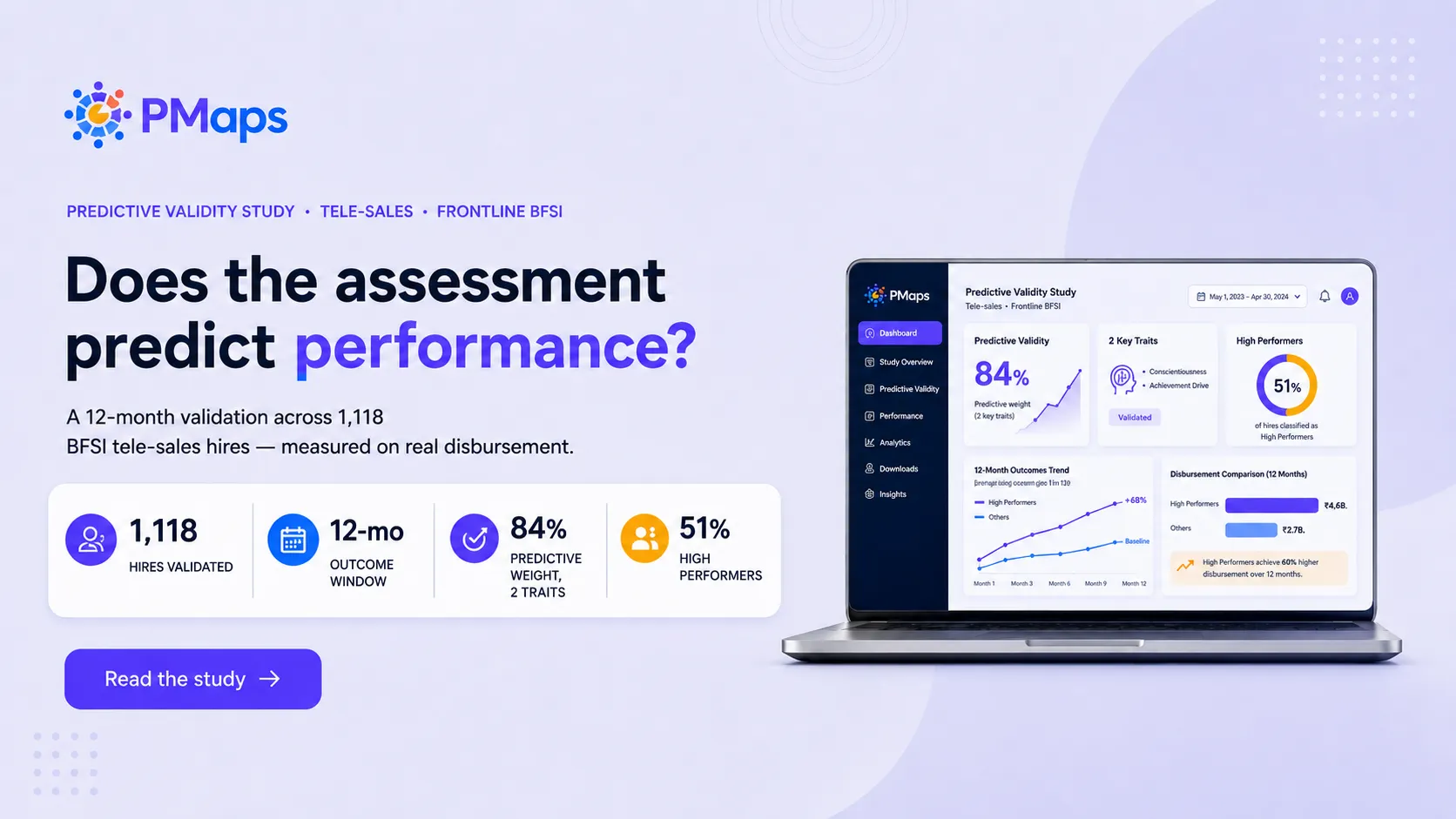
We validated the PMaps tele-sales hiring assessment against real business outcomes — 1,118 hires at a leading BFSI lender, measured over a full year on cumulative disbursement. The answer is unambiguous: high performers out-scored low performers on every section of the assessment.
- 1,118 hires validated
- 12-mo outcome window
- 84% of predictive weight in 2 traits
- 51% high performers
Explore the complete breakdown—download the full case study.
Every hiring decision rests on one assumption. We tested it.
A pre-hire assessment is only worth running if its scores predict who performs on the job. So we ran the test directly. Working with a leading BFSI lender, we tracked 1,118 tele-sales hires across a full 12-month window (March 2024–March 2025) and measured each against an objective business outcome: cumulative disbursement, the metric the role exists to drive.
No subjective manager ratings. No proxy. Real output, real money disbursed, over a real year.
What does it take to prove a hiring assessment is valid?
Two conditions: a real outcome and a large, balanced sample. Both held here.
- Outcome metric: Cumulative disbursement amount per agent — objective and business-critical.
- The split: Candidates were divided against a ₹45 Lakh threshold into high performers (567 hires, 51%) and low performers (551 hires, 49%) — a near-even split, which is the strongest possible test bed for predictive validity.
- The instrument: A 63-question, 40-minute battery across four competency sections, each weighted by how much it contributes to the predictive score — not equal-weighted guesswork.
- Retention check: 79% of hires were still active, confirming the cohort reflects sustained on-the-job performance, not short-tenure noise.
“ Why a 51/49 split matters: if an assessment can cleanly separate two near-equal groups, the signal is real — not an artifact of one group dominating the sample.
Did the high performers score higher? Yes — on every section.
Across all four competencies, the group that went on to disburse ≥ ₹45 Lakhs had recorded higher assessment scores at the pre-hire stage. Not on a lucky subset — across the board.
100% of sections favored high performers.
That consistency is what makes the assessment reliable enough to base hiring decisions on. The score isn't just correlated with performance — it's correlated through the right traits.
Which competencies actually predict tele-sales performance?
Two competencies do almost all the work. Together they carry 84% of the model's predictive weight — and they happen to be the two with the widest gap between high and low performers. The instrument's design and its real-world behavior agree.
The takeaway for hiring leaders: for a relationship-driven sales role, behavioral fit — not raw aptitude — is the dominant signal. Set your cut-scores primarily on Personality Profiler and Attention to Detail. Treat the language sections as developmental signals for onboarding, not as gates.
Can you shorten the test without losing predictive power?
Yes. The spoken-language section consumes roughly 30% of total test time for 1% of the predictive weight — the worst leverage in the battery. Streamlining it and recalibrating the written section could shrink the assessment from 40 minutes toward ~28 minutes while keeping 84%+ of the predictive power intact.
A shorter, sharper assessment isn't a weaker one. Cutting time from the lowest-signal sections concentrates the test on what actually predicts performance — and improves completion rates and candidate experience at volume.
Where you hire from matters as much as how you screen.
Because the assessment is validated, its high-performer classification becomes a clean lens on sourcing quality. The spread was dramatic:
- Best center: 75% high-performer yield · ₹164L average disbursement
- Cohort average: 51% high-performer yield · ₹97L average disbursement
- Largest center (by volume): 40% high-performer yield · ₹64L average disbursement
The sourcing paradox: the channels supplying the most candidates also supplied the most low performers. Rebalancing intake toward proven high-yield sources lifts overall hire quality — before a single test question changes.
A valid score is only useful if it's a genuine one.
Predictive validity assumes scores were honestly earned. AI-assisted proctoring let us verify that center by center. Most assessments cluster as genuine, but the data surfaced clear flags — including one center with an outsized "not genuine" rate whose strong scores couldn't be trusted at face value until investigated.
The fix is operational discipline, not redesign: tighten proctoring where flags cluster, and every downstream validity claim gets stronger.
From a validated assessment to better hiring outcomes.
The study confirms three moves any hiring leader can make:
- Trust the gate. The assessment predicts performance through job-relevant behavior. It's sound enough to base frontline hiring decisions on today.
- Hire from the right places. Quality varied from 40% to 75% by source. Rebalancing intake lifts outcomes immediately.
- Protect the signal. Tighten proctoring where flags cluster and re-validate against your outcome metric annually so the gate stays trustworthy.
This wasn't a one-off test. It's a repeatable system.
PMaps ran a five-stage loop you can stand up inside your own hiring function for any frontline role — a quarter of focused work, not a year-long program:
- Define the outcome — pick one objective success metric you already track.
- Calibrate the gate — set cut-scores on the sections that actually discriminate.
- Embed in the funnel — filter early, before interviews, automated in your ATS.
- Route by source — steer intake toward high-yield channels.
- Protect & re-validate — keep scores honest and refresh the model each cycle.
Assessments built to predict performance — not just measure traits.
PMaps is an AI-powered, bias-reducing, multi-lingual talent assessment platform that helps enterprises improve their hiring odds — scientifically. Scores are validated against real on-the-job performance, the same discipline behind this study.
- Predictive, not descriptive — scores correlate with on-the-job outcomes, so you hire for results instead of gut feel.
- Role-specific science — competency frameworks tuned to each role's true success drivers and weighted by what actually predicts.
- Integrity you can trust — AI-assisted proctoring flags suspicious attempts, so a passing score is a genuine one.
- Analytics that drive action — dashboards show where quality concentrates by competency, source, and center.
Trusted by 200+ enterprise clients across 7 countries · 3M+ assessments completed · 8+ Indian languages. [confirm current approved figures before publish]
Make your next hire a predictable one.
Validate a hiring gate for your priority roles — the same loop that produced this study, applied to your goals.