.webp)
.webp)


Last week, the story was about who you let into the building. This week it's about who's already inside — and whether any of them can do the job you can't hire for.
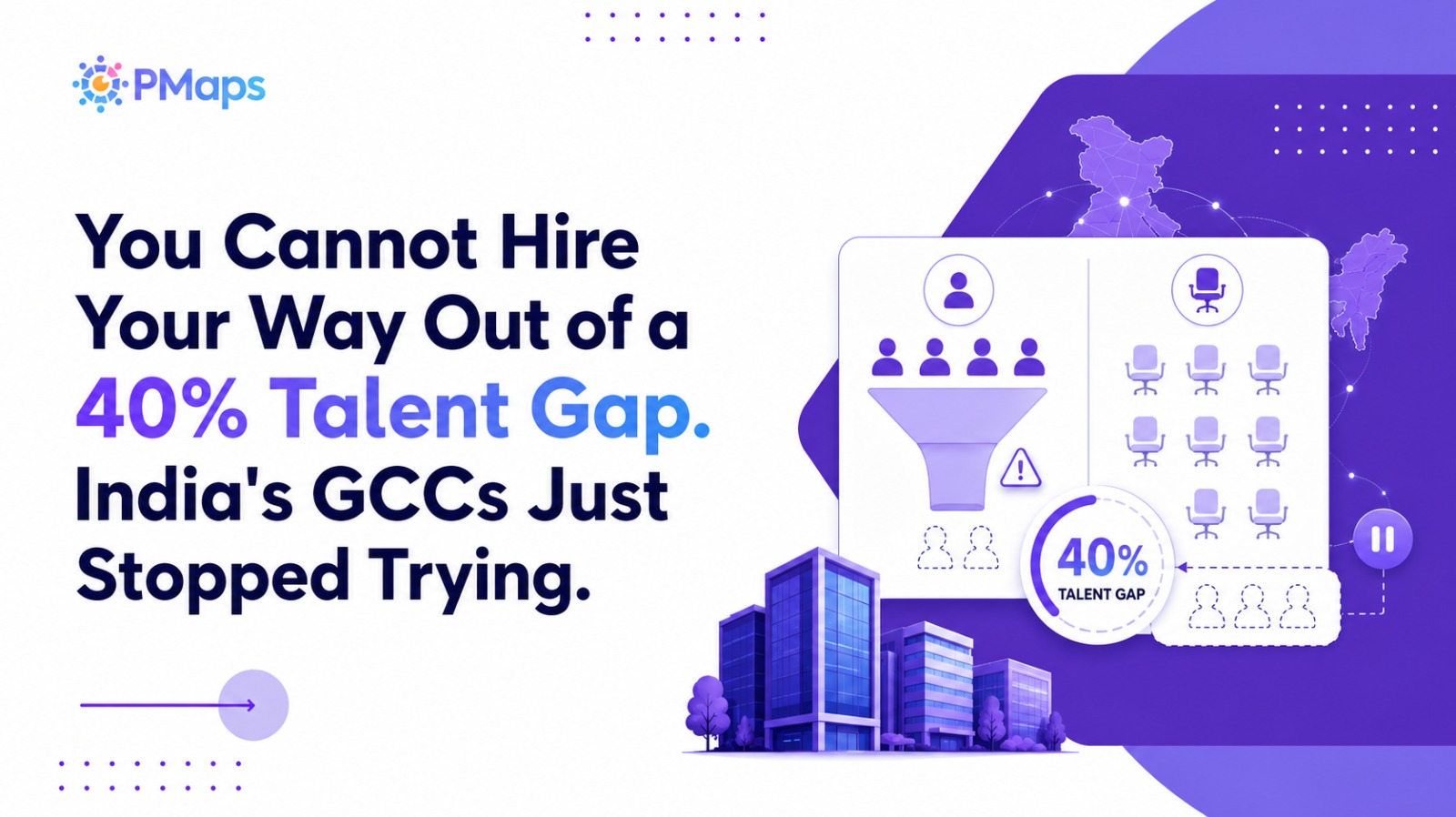
Here's the number that forced the change. India's Global Capability Centres are reporting a supply-demand gap of 36–40% in AI, data, and analytics roles — the widest of any capability area, with platform engineering close behind at 32–36%. That's per Quess Corp's India GCC Tech Talent Landscape report for Q1 FY27, released 15 July.
When the gap is that wide, the math of external hiring breaks. There aren't enough Applied AI Engineers in the market to hire, the ones who exist cost a 20–40% premium, and every GCC in your city is chasing the same shortlist. So the leading centres have quietly stopped trying to hire their way out.
They're building the talent internally instead — and the report shows exactly how.
The shift nobody announced but everybody made
The Quess data describes a specific pattern it calls role-adjacent reskilling: not retraining people from scratch, but moving them one step sideways into a related emerging role.
Two more findings make this strategy obvious rather than clever. First, 56% of GCC hiring demand in Q1 FY27 was for professionals with 4–12 years of experience — mid-career people who already exist inside most centres. Second, overall GCC hiring grew only 5–6% quarter-on-quarter, while the capability need grew far faster. The arithmetic only closes if the gap is filled from within.
This is the "build" in the "build, borrow, bot" strategy that talent advisors have been describing all year. The problem is that most GCCs are executing the skills half of it and completely missing the people half.
Why most reskilling programs fund the wrong people
Here's where it goes wrong, and it goes wrong the same way almost everywhere.
A centre maps its adjacencies — backend to applied AI, exactly like the table above — and launches a reskilling track. It picks candidates for the track the way it picks everyone for everything: tenure, current performance rating, and manager nomination. Then, six months and a real training budget later, a predictable third of the cohort hasn't made the leap. They completed the courses. They passed the modules. They did not become AI engineers.
The reason is that skill adjacency and learning adjacency are not the same thing. Two backend developers with identical résumés, identical ratings, and identical current skills can have completely different capacities to absorb a genuinely new way of working. One retools in a quarter. The other plateaus. Nothing on their performance review predicted which was which — because a performance rating measures how well someone does the job they already have, not how readily they'll adapt to one they don't.
That adaptability has a name now, because working alongside AI systems has made it the decisive trait: how quickly and willingly a person adjusts to new tools, new workflows, and machine-assisted work. Call it learning agility, call it AI resilience — it is the single variable that separates a reskilling investment that pays back from one that funds a course completion certificate.
And it is the one thing almost no GCC measures before committing the budget.
The Internal Adjacency Audit — run it before you fund the next cohort
You don't need a platform to start. You need to run three passes on the roles you can't hire for. Take your single hardest-to-fill AI or data role and work through these in order.
Pass 1: Map the demand honestly
List the roles where your supply-demand gap is real — the reqs that have sat open for 90+ days, the ones you've re-posted twice. For each, write the two or three current roles that are one adjacency step away, using the pattern above. This is the easy pass, and it's the only one most centres complete. If you stop here, you have a training plan and no idea who to put in it.
Pass 2: Separate the willing from the able from the adaptable
For each adjacent internal role, you have a pool of people. Sort them on three axes, not one:
- Willing — do they want the move? (Easy to find out; most surveys stop here.)
- Able — do they have the current skills the adjacency assumes? (Your skills matrix already knows this.)
- Adaptable — can they actually absorb the new way of working? (This is the axis nobody has data on.)
The people who are willing and able but not adaptable are the ones who quietly consume your reskilling budget and don't convert. The people who are adaptable but currently overlooked — wrong tenure, modest current rating — are the ones your nomination process misses. The whole value of the audit is finding those two groups before you spend, not after.
Look at how you'd currently pick the cohort. If the answer is manager nomination plus performance rating plus a self-reported interest form, write that down and be honest: none of those three measures the thing that determines success. You are selecting for visibility, past performance, and enthusiasm — a reasonable proxy for many things, and a poor proxy for adaptability.
This is the pass that tells you whether you have a reskilling strategy or a reskilling budget with good intentions attached.
The BFSI and mid-market cut
Two details from the data are worth pulling out if they're yours.
BFSI GCCs accounted for 20.9% of hiring demand in the quarter — second only to manufacturing. BFSI centres are expanding into exactly the AI-and-analytics roles with the widest gap, and they carry large populations of mid-career operations, risk, and data staff — a deep adjacency pool most of them haven't mapped. If you run talent for a BFSI GCC, the "build" strategy is more available to you than to almost anyone, and probably the least measured.
Sub-500-employee GCCs posted the fastest hiring growth, around 8%. Smaller and newer centres feel the talent gap most acutely because they can't outspend the Fortune 500 GCCs on comp. For them, internal adaptability isn't a nice-to-have — it's the only affordable path to capability. The audit above matters most for the centres with the least budget to waste on the wrong cohort.
What to do in the next 30 days
- Run Pass 1 on your three longest-open reqs. Map the adjacencies. If your L&D team can't name the adjacent internal roles in an afternoon, that's your first finding.
- Add the third axis to one pilot cohort. Before you nominate the next reskilling batch by tenure and rating, find one objective measure of adaptability and apply it. Compare the list it produces to the list your managers would have nominated. The delta is the point.
- Audit your last cohort backwards. Take a reskilling program you already ran. Who converted, who didn't? Line that up against how they were selected. If selection didn't predict conversion, you've proven the gap in your own house — the most persuasive evidence there is.
- Stop measuring readiness with a performance review. Performance rates the current job. Reskilling is about the next one. Decouple them before the next budget cycle.
Where PMaps fits
Passes 1 and 2 you can start on a whiteboard. Where it stops being a whiteboard problem is the third axis — objectively measuring who can actually make the leap, across a population, before the money is spent.
That's what PMaps built its post-hire capability for. Career Elevation Assessments cover internal mobility, high-potential identification, succession planning, and skill-gap analysis — including an AI resilience assessment that measures how readily an employee adapts to working with AI, which is precisely the adaptability axis Pass 2 exposes. Scores are read against validated role benchmarks, so "ready for the applied-AI track" means ready for that role, not ready in the abstract.
The credibility behind the score: 12 years building assessments, 3M+ assessments completed, validated against real on-the-job performance across 200+ enterprise clients in 7 countries, including Tech Mahindra, Lumofy, and TeamLease/Digivarsity. Delivery in 8+ Indian languages, which matters as GCC capability spreads into Tier-2 cities — now 11–13% of delivery demand and climbing.
Improve your hiring odds. Scientifically. And now, your reskilling odds too.
Book a 30-minute walkthrough — bring one hard-to-fill role, and we'll show you what measuring adaptability across your adjacency pool actually looks like.