.webp)
.webp)


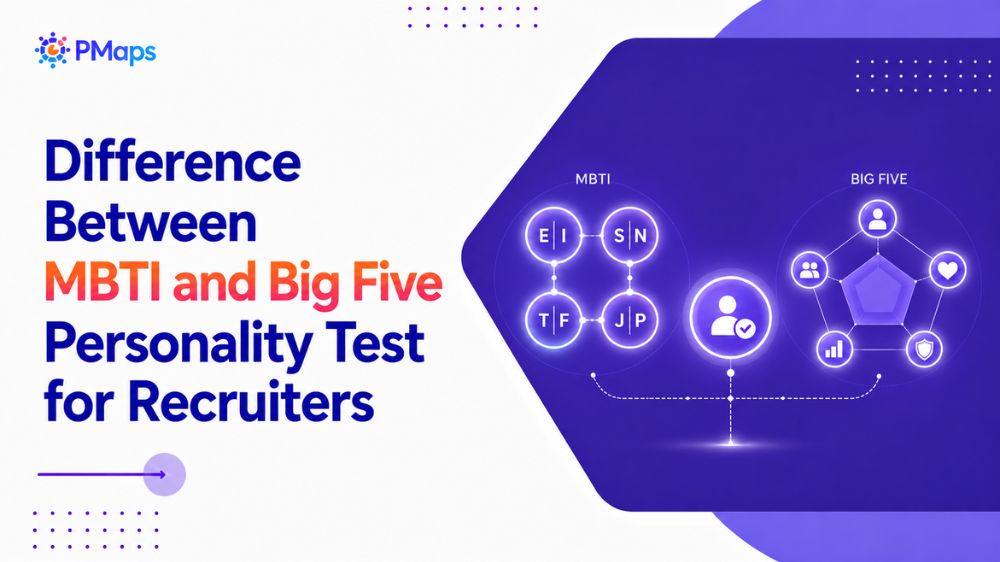
The main difference between the Myers-Briggs Type Indicator (MBTI) and the Big Five Test is how they categorize human behavior: MBTI sorts people into binary boxes, you are either an Introvert or an Extrovert, while the Big Five measures personality on a continuous spectrum. A candidate might score 72% extraverted, which is meaningfully different from 51%.
Because of this structural difference, academic psychologists overwhelmingly prefer the Big Five for its scientific accuracy, whereas the MBTI remains popular for team-building, coaching, and workplace icebreakers. For recruiters who need to predict on-the-job behavior, that distinction matters enormously.
These two personality assessments dominate the conversation: the Myers-Briggs Type Indicator (MBTI) and the Big Five (OCEAN). Both have their advocates. Both have their critics. And the difference between the two is not academic, it directly shapes how confidently you can use either one to make hiring decisions. This article breaks down where they differ, where they overlap, and what actually matters when you are screening candidates at scale.
Current Use Case of Myers-Briggs vs Big Five for organizational
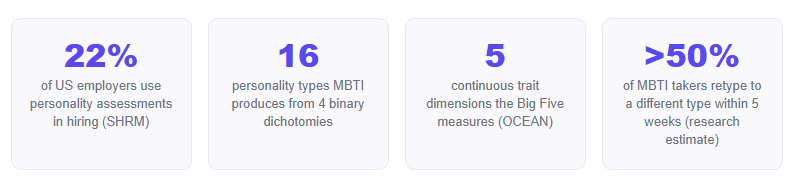
Recruiters have always had to read people fast. The question is whether the tools they use to do that are actually up to the job or just comfortable and familiar. Personality data is finding its way into more hiring pipelines every year. Research from the Society for Human Resource Management found that roughly 22% of U.S. employers use some type of personality assessment in hiring.
In India's GCC and BPO sector, where high-volume recruiting is the norm and attrition is a persistent cost problem, that number is rising. The stakes for getting the tool right are real. Myers-Briggs works best for team development, communication, and self-awareness. It helps employees discuss work preferences, decision-making styles, and team friction in a simple format. On the other hand, the five factor model works better for hiring, workforce planning, and role-fit assessment. Trait-based structure gives recruiters more stable data for comparing candidates across roles. Here’s a clean weak and strong fit recommendation on the basis of their relevance and application:
For a step-by-step framework, read How to Use Personality Tests in the Hiring Process and learn how to place the right assessment at the right hiring stage.
Key Differences Between MBTI and Big Five in Detail
The gap between these two systems is not a matter of branding or popularity. It runs through the core design of each assessment, what gets measured, how results are reported, and what the science actually says about their usefulness in predicting work behavior. Here is a dimension-by-dimension look.
What Are the Traits in MBTI vs the Five Factor Model?
MBTI measures four dichotomies like Introversion/Extraversion, Sensing/Intuition, Thinking/Feeling, and Judging/Perceiving and assigns you one letter from each pair, producing one of 16 personality types. The output is categorical: you are an INTJ or an ENFP, full stop.
The Five Factor Model (also called OCEAN or the Big Five Traits) measures five dimensions: Openness to Experience, Conscientiousness, Extraversion, Agreeableness, and Neuroticism. Crucially, every dimension is scored as a percentage along a continuous spectrum. A candidate does not "have" or "lack" Conscientiousness, they sit somewhere on a range, and that placement carries real predictive weight.
For recruiters, the practical implication is this: MBTI tells you a person's preferred operating style. The Big Five tells you how much of each trait they actually possess and how that level is likely to affect performance in a specific role.
How Is the Test Design and Measurement Different Between MBTI and Big Five?
MBTI uses forced-choice questions where respondents pick one of two options that reflect opposite preferences. The design assumes that all four dichotomies are independent, that knowing someone is introverted tells you nothing about whether they are a Judger or a Perceiver.
The Big Five uses Likert-scale items, typically ranging from "strongly disagree" to "strongly agree," across a large bank of statements. The design allows responses to fall anywhere along the spectrum rather than forcing a binary choice. It also captures the degree of a trait, not just its direction.
BPO assessment system screens hundreds of candidates for customer-facing roles, or GCCs building specialized technical teams, the granularity of the Big Five is more useful. A score of 34% on Agreeableness versus 68% is a meaningful distinction when matching candidates to roles that require negotiation, compliance work, or client management.
What is the Output or Report Style in Myers-Briggs vs OCEAN Model?
MBTI reports give you a four-letter type label (e.g., ESTJ) along with a narrative description of that type's common traits, strengths, and growth areas. The report is readable and accessible which is part of why it is so widely adopted for team workshops and coaching conversations.
The OCEAN Personality Assessment report delivers percentage scores across five dimensions. It is less immediately intuitive for candidates reading their own results, but it gives hiring managers and HR teams a richer data set. You can compare candidates on specific dimensions relevant to the role. You can see how a candidate's Neuroticism score maps to the emotional demands of the job. You can build threshold benchmarks for Conscientiousness when hiring for compliance-sensitive positions.
The MBTI report is designed to be shared with the person who took it. The Big Five report, in its recruitment application, is designed to inform a decision.
Basis of Scientific Backing: Which Is Better, MBTI or Big Five Personality Test?
This is where the debate gets sharper. The Big Five emerged from decades of lexical hypothesis research, the idea that the most important personality traits would eventually find their way into the language people use to describe each other. Lewis Goldberg, Paul Costa, and Robert McCrae built the OCEAN framework on large cross-cultural datasets, and the model has since been replicated across languages and populations worldwide.
The MBTI has a different origin: it was developed by Isabel Briggs Myers and her mother Katharine Cook Briggs, drawing on Carl Jung's typology theory. It was not initially derived from empirical research. Critics in academic psychology have pointed out for decades that its forced binary categorization misrepresents personality, which research consistently shows exists on a spectrum rather than in discrete types.
That said, the MBTI is not useless. It is a reasonable tool for initiating self-reflection and team conversations. What it is not is a validated predictor of job performance and that distinction matters significantly when the goal is hiring.
What Is the Test-Retest Reliability of Myers-Briggs vs Big Five Personality?
Test-retest reliability measures whether a person gets the same result if they retake an assessment weeks or months later. For any tool used in hiring, this is a basic requirement.
Studies on MBTI reliability have found that a meaningful proportion of retakers, some estimates put it above 50%, receive a different four-letter type within five weeks. The binary nature of the dichotomies makes this more likely: if you score 51% toward Introversion today and 49% next month, your type changes entirely, even though your actual personality has not shifted.
The Big Five shows considerably stronger test-retest reliability. Because it captures degree rather than direction, small fluctuations in responses do not flip the result. A person who scores 62% on Conscientiousness is unlikely to score 38% on a retest. This stability matters in talent management contexts where assessments inform long-term decisions such as promotion pipelines, team composition, succession planning.
How Does MBTI Relate to Big Five Personality?
These two systems are different in structure, but they are not unrelated. They are measuring overlapping territory from different angles, and the correlations between them are well documented. Understanding those correlations helps recruiters who work with organizations that already have MBTI data in their systems but want to move toward more rigorous assessment.
The Myers-Briggs Type Indicator and the Big Five assess personality from different angles, but they share significant correlations. MBTI assigns discrete categories based on preferences; the Big Five measures continuous trait spectrums. The overlap is real, but it is not one-to-one, and the directionality matters.
The Edge of Big Five Over MBTI
For team-building workshops, MBTI is a perfectly reasonable choice. For hiring decisions where you need to predict whether a candidate will perform in a specific role, under specific pressures, in a specific environment, the Big Five has measurable advantages. Here is where those advantages actually show up in practice.
The Missing Dimension: Neuroticism
MBTI has no equivalent for Neuroticism, the Big Five measure of emotional stability, anxiety, and stress response. This matters in high-pressure roles like collections, escalation handling, emergency response, and complex client management.
This absence is a structural blind spot. A candidate may perform well in an MBTI team exercise and still struggle under stress. Understanding DISC Personality can support structured conversations, but Big Five directly quantifies emotional stability.
MBTI vs Big Five for Workplace Assessment
For workplace assessment, the Big Five gives stronger role-linked insight. Conscientiousness predicts task performance. Agreeableness supports cooperative and service roles. Openness supports creative, strategic, and analytical work.
MBTI explains operating style, but its 16 types do not predict job outcomes cleanly. An ESTJ label may describe preference. It does not show quota delivery, team management ability, or 90-day retention risk.
Predictive Validity
Research on personality and job performance often points to Conscientiousness and Emotional Stability as strong predictors across roles. Big Five measures both through structured, scalable trait scores.
MBTI does not produce the same predictive data. Its binary labels are harder to connect with attrition, training success, or performance records. For hiring decisions, Big Five results are easier to compare against workplace outcomes.
Spectrum Precision vs Binary Classification
MBTI uses forced-choice categories. Two candidates with different trait levels can receive the same four-letter type. A 51% extraverted person and a 95% extraverted person may both appear as E.
Big Five keeps that difference visible. Those candidates would receive different Extraversion scores. For client-facing, sales, leadership, or service roles, this level of detail helps recruiters avoid losing useful assessment data.
Cross-Cultural Validity
The Big Five has been studied across many cultures and languages. Its factor structure remains reasonably stable across regions, which helps organizations hiring across countries and multilingual talent pools.
This matters for India’s GCC hiring where looking for global standards is common. MBTI has less consistent cross-cultural evidence. Type distributions can shift across cultures, making international norm comparison more difficult for recruiters.
Final Words
The difference between MBTI and the Big Five is not a matter of one being "right" and the other "wrong." It is a matter of fit for purpose. MBTI is a reasonable tool for building self-awareness and facilitating team conversations. The Big Five is the right tool when you need to predict behavior, reduce hiring error, and build a defensible, data-backed assessment process.
For recruiters in bulk hiring environments, the choice has real consequences. An assessment that cannot predict performance, that does not measure emotional stability, and that reclassifies people differently on retakes is not a hiring tool, it is a conversation starter. If you are evaluating which assessment framework belongs in your talent pipeline, the PMaps team is available to walk you through a structured comparison. Reach us at +91 8591320212 or ssawant@pmaps.in.
One question you should be asking: if your current assessment cannot tell you which candidates are most likely to stay past six months or thrive under pressure, what exactly is it predicting?