.webp)
.webp)


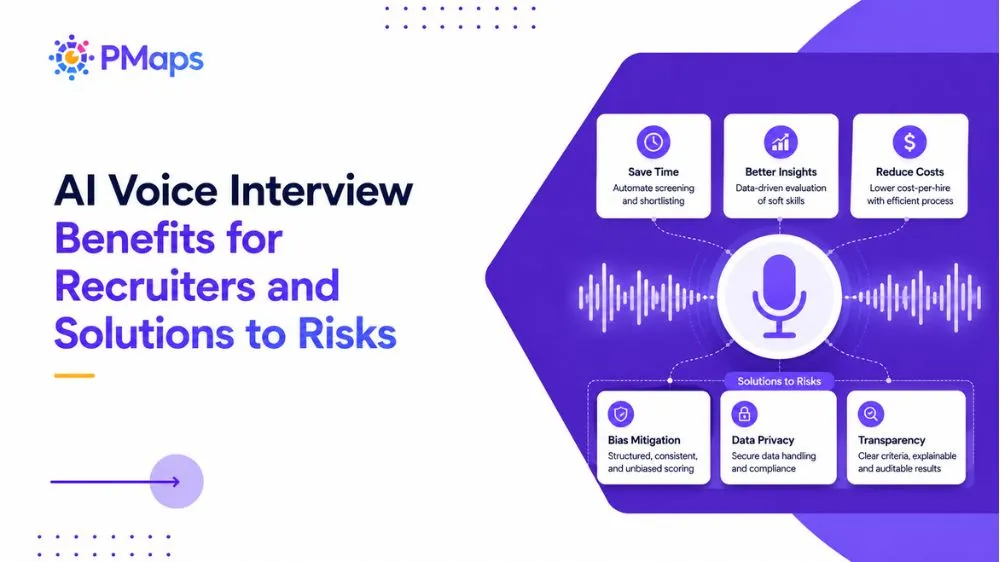
Benefits of AI voice interview in recruitment are clear for high-volume hiring teams. AI voice interviews replace manual phone screens with structured, automated conversations. Candidates complete them on their own schedule. Recruiters get scored transcripts, clear summaries, and faster shortlists. This matters in BPO/GCC, retail, logistics, food service, and customer support hiring. These teams often handle hundreds of applicants per role. It reduces screening bottlenecks, improves consistency, and supports fairer first-round decisions.
Planning an AI Voice Agent? Asish Dogra’s How to Build an AI Voice Agent session with PMaps shows the build path from scratch.
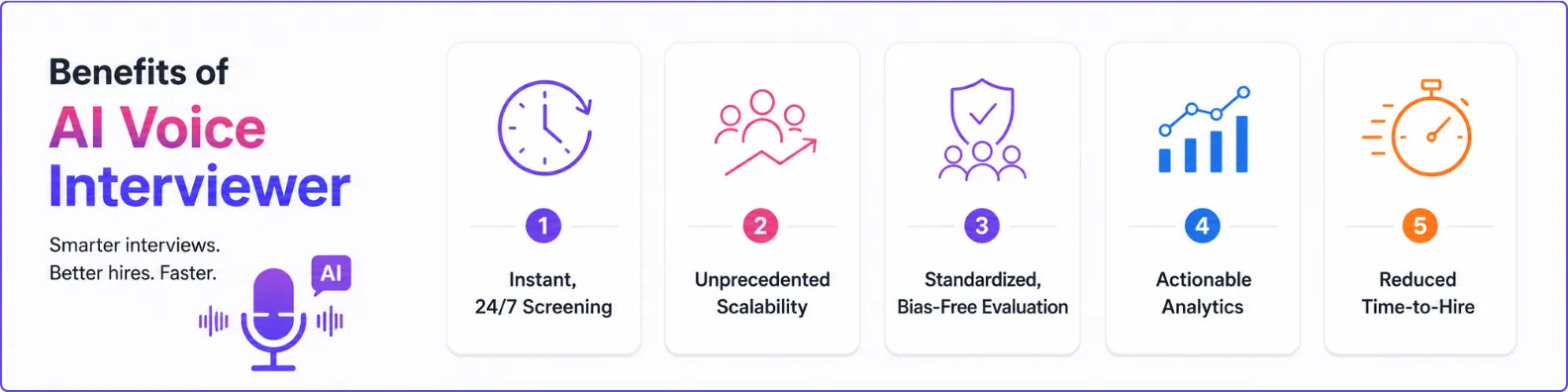
Top 5 Advantages of AI Voice Interviewing
AI voice interviewing improves recruiter throughput without removing human decision control. Voice AI benefits in hiring appear when early screening removes call scheduling, repeated questions, delayed notes, and uneven first-round judgments across large applicant pools across regions in customer-facing operations roles.
Instant, 24/7 Screening
First-round screening can run after office hours, on weekends, or across time zones. Applicants respond when they are available. Hiring teams stop waiting for callback slots. This improves movement in BPO assessments, retail hiring, warehouse staffing, and peak seasonal recruitment.
Unprecedented Scalability
One recruiter can manage large applicant flow without adding phone-screening panels. Each person receives one question path, scoring rubric, and response record. AI recruiting tool benefits become visible when branch hiring, campus drives, and frontline campaigns need the same standard.
Standardized, Bias-Free Evaluation
Every applicant hears the same core questions. This reduces variation from interviewer fatigue, rush, or uneven probing. Voice data can be reviewed against job-linked criteria. Human review remains needed for fairness, exceptions, and final hiring decisions.
Actionable Analytics
Recorded answers produce transcripts, summaries, trait signals, and communication indicators. Assessment platforms can connect these outputs with psychometric tests, voice assessments, and analytics dashboards. The hiring team sees risk markers, fit scores, and interview notes before scheduling deeper discussions. Use voice analysis to compare shortlists faster, with recruiter judgment still in control.
Reduced Time-to-Hire
The benefits of AI voice interview in recruitment become visible when requisitions move fast. Automated first rounds reduce waiting time between application and shortlist. Recruiters can spend more time on offer readiness, manager alignment, and final-fit conversations.
AI voice interviews vs traditional interview on phone screens show the operational difference: less calendar chase, fewer repeated calls, clearer evidence, and more time for final human judgment across shortlisted talent pools.
What are the Challenges of Voice AI?
Voice AI can misread context, accents, intent, and edge cases without careful human calibration. These challenges matter in recruitment when candidate speech, network quality, background noise, and anxiety distort signals. Recruiters need guardrails, audit trails, and human review to keep automated screening fair, explainable, consistent, and job-linked at hiring scale.
- Accent variation can affect fluency scoring when models are not calibrated for regional speech patterns.
- Background noise can reduce transcription accuracy, mainly for candidates using shared homes or public spaces.
- Candidate anxiety can make strong applicants sound hesitant during an automated first-round interview.
- Over-scripted agents can miss useful context when candidates give unexpected but valid responses.
- Poorly mapped questions can assess communication style rather than true job readiness.
- Data privacy concerns can rise when candidates are not told how voice data is stored.
- Weak fallback paths can frustrate candidates when the AI fails to understand repeated answers.
Calibrating AI Voice Agents to Tackle Disadvantages
AI voice agents need controlled calibration before recruiters trust their outcomes. Calibration connects question design, speech recognition, latency control, fallback logic, consent language, and recruiter review. This makes voice AI safer for candidates and clearer for hiring teams. For instance, even if PMaps uses AI-led scoring with structured reports, human review stays central for sensitive decisions, candidate fairness, and exception handling at scale during rollouts.

Conversation Design & Latency Optimization
Conversation quality depends on natural turn-taking, plain prompts, and short pauses. Candidates should know when to speak, pause, clarify, or repeat without feeling monitored, rushed, or judged by silence alone.
- Keep questions short, role-linked, and direct so candidates respond without confusion.
- Set response pauses carefully so candidates do not feel interrupted or rushed.
Scope Constraints and Prompting
Scope control prevents the agent from drifting into irrelevant questions. Recruiters should map each prompt to role skills, must-have criteria, and acceptable follow-up paths before any live candidate interaction starts.
- Define what the agent can ask, score, repeat, and hand over.
- Use fixed prompts for mandatory checks and flexible probes for job-linked follow-ups.
Graceful Degradation and Fallbacks
Fallback planning protects candidate experience when speech input fails. The agent needs clear recovery steps, such as repetition, rescheduling, human review, or alternate channels during unstable interactions in remote hiring.
- Shift to text, rescheduling, or recruiter review when speech quality drops.
- Mark incomplete answers clearly so recruiters do not confuse system limits with candidate weakness.
Mitigation of Social and Ethical Risks
Ethical calibration turns automation into accountable screening. Recruiters need consent language, bias audits, score checks, and escalation paths for candidates whose speech data may carry social disadvantage during first rounds.
- Tell candidates how recordings, transcripts, scores, and personal data will be handled.
- Review score patterns across gender, region, language, and experience groups before full rollout.
The 70/30 Rule of Human-AI Balance
The 70/30 rule keeps efficiency and empathy in balance. AI handles repetitive evidence collection, and recruiters stay responsible for context, exception review, candidate care, and hiring accountability across final decisions.
- Let AI manage 70% of repetitive screening work and structured first-round documentation.
- Keep humans responsible for 30% involving exceptions, empathy, context, and final judgment.
Once calibration standards are clear, recruiters can see where AI voice interviews work best across industries and hiring volumes.
Real-World Applications of AI Voice Interviewers
Real-world voice AI hiring works best in high-volume, time-sensitive roles.Voice AI benefits in hiring show up where applications rise faster than recruiter call capacity. The strongest cases come from BPO, e-commerce, hospitality, healthcare enrollment, and one-person HR operations.

BPO Hiring and Contact Center Roles
BPO hiring depends on voice readiness, listening accuracy, patience, and customer-handling judgment. PMaps reports one BPO case where early attrition moved from 53% to 31%. Monthly screening capacity increased from 1,200 to 5,000+ candidates. Recruiter effort per screen fell by 70%. If contact-center attrition keeps returning, you may want to read AI Voice Interviewer In BPO before another hiring sprint.
Retail and E-Commerce Hiring
Retail and e-commerce teams face severe pressure during festive spikes. PMaps reports one e-commerce case where weekly screening capacity moved from 1,500 to 7,500+ candidates. Time-to-shortlist fell from 5–7 days to under 24 hours. Peak-period CSAT moved from 73% to 88%. If festive hiring is near, see how PMaps helped E-Commerce/FMCG Hiring with AI Voice Interviewer before your next talent rush.
Logistics and Food Service Hiring
Logistics hiring needs fast checks for shifts, licenses, route fit, and availability. Classet’s transportation page states AI voice interviews screen CDL drivers, dispatchers, and logistics staff around the clock. It reports 65% faster time-to-hire and 3x more drivers screened. Food service hiring needs schedule fit, customer tone, and reliability checks. Classet’s hospitality page covers food service, kitchen, and guest-facing roles. It reports 65% fewer no-shows, 4x faster time-to-fill, and 80% interview completion.
Healthcare Enrollment and Service Programs
Healthcare-adjacent enrollment teams lose candidates when callbacks delay decisions. Indigo Innovations used HeyMilo for dental career enrollment. The reported outcomes included a 50% faster enrollment process, 50% lower interview cost, and 50% higher conversion.
High-Volume Applicant Screening Examples
Alpine Home Air gives a useful small-team example. HeyMilo reports one HR person managed 3,000+ applicants, including up to 3,000 applicants in three days. Screening time reduced by 70%, with screenings completed in days instead of weeks. Indigo is not cited as processing 1,000 daily. The accurate claim is stronger and safer. Its director said AI interviews could handle a thousand a day, with no Sunday or midnight limitation.
Conclusion
AI voice interviews give recruiters faster evidence, cleaner screening records, and more consistent early decisions. They work best with calibrated questions, human review, and clear candidate consent. PMaps adds voice interviews, assessments, and dashboards for high-volume hiring. Assess voice-ready candidates with PMaps. Call 8591320212 or write to assessment@pmaps.in.

.webp)

.webp)