.webp)
.webp)


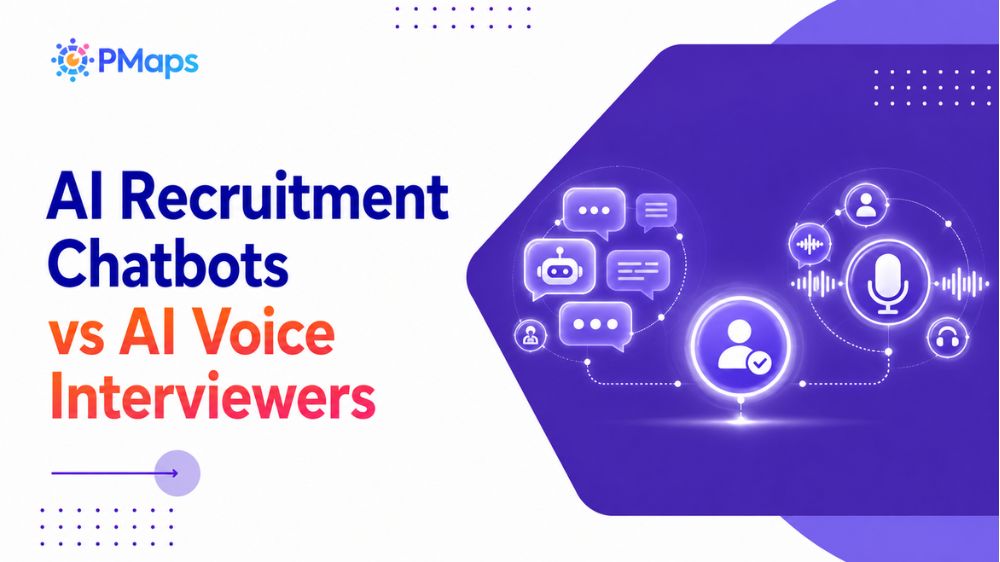
AI recruitment chatbots entered the hiring mainstream as the first intelligent layer between candidates and recruiters, automating early-stage engagement, filtering applicants, and collecting structured data before any human involvement begins. Today, over 65% of recruiters say they have already incorporated AI into their hiring workflows (DemandSage, 2025), and a ResumeBuilder survey of 948 business leaders confirmed that 51% of companies are actively using AI in hiring with adoption projected to reach 68% by the end of 2025. Distinguishing a chatbot from a voice interviewer is no longer a technical question; it is a strategic one that determines how effectively each tool performs in your pipeline.
Voice AI vs ChatBot vs Human in Recruitment
Each layer of recruitment technology serves a different function, operates at a different stage, and delivers a different candidate experience. Mapping these differences helps HR teams deploy the right tool at the right moment and avoid the costly mistake of using one to do the job of another.
| Dimension | AI Recruiting Chatbot | AI Voice Interviewer | Human Recruiter |
|---|---|---|---|
| Channel | Text / chat | Spoken conversation | In person / phone |
| Core Job | Answer, qualify, schedule | Screen and score via interview | Judge, build relationships, close |
| Interaction | Scripted or NLP text | Two-way natural dialogue | Fully adaptive |
| Assessment Depth | Shallow, mainly knockout questions | Deep, covering communication, fluency, and fit | Deep but inconsistent |
| Scale | Unlimited and instant | Thousands of calls in parallel | One at a time |
| Availability | 24/7 | 24/7 | Business hours |
| Best For | FAQs, scheduling, status updates | Communication-heavy screening | Final decisions and offers |
| Consistency | High | High, with structured scoring | Variable |
What are Recruiting Bots?
Recruiting bots is a broad category covering AI-powered tools that automate candidate engagement at various points across the hiring funnel. Two distinct types have emerged as the primary deployments in modern recruitment: the recruiting voice bot and the recruiting chatbot. Understanding each is the first step to using both well.
What is a Recruiting Voice Bot? A recruiting voice bot is an AI-powered telephony tool that engages candidates through automated spoken conversations. It makes or receives calls, runs through pre-set screening dialogues, schedules interviews, and captures candidate responses all without a recruiter's direct involvement. Voice bots excel in high-volume outreach scenarios where speed of initial contact determines whether candidates remain engaged or move on to competing opportunities.
What is a Recruiting Chatbot? An AI recruiting chatbot is a text-based conversational interface embedded within career portals, job boards, ATS platforms, or messaging applications. It activates the moment a candidate lands on a job listing — collecting information, answering common questions, pre-screening against knockout criteria, and routing qualified applicants forward automatically. Unlike voice tools, the chatbot operates entirely through typed dialogue, making it a genuinely low-friction entry point for candidates responding from any device at any time of day.
What is an AI Interview?
AI interviews represent the next layer beyond basic bot interactions. They are structured, automated evaluation experiences designed to assess whether a candidate is genuinely role-ready — measuring competency and communication quality, not just availability. Two formats currently define this category.
What is an AI Voice Interviewer?
An AI Voice Interviewer is an autonomous system that conducts structured spoken interviews over the phone or through a voice interface. It uses natural language processing to parse candidate responses, evaluate communication clarity and fluency, assess tone and confidence, and produce a scored report for recruiters to review. Unlike a basic voice bot that simply follows a fixed script, a voice interviewer adapts dynamically to what candidates say — generating qualitative hiring intelligence that goes far beyond binary screening outputs.
To understand how AI voice interviews work in hiring, read our detailed guide on AI Voice Interviewers. It explains key capabilities, use cases, scoring logic, candidate experience, and where voice AI fits in high-volume recruitment.
What is an AI Video Interviewer?
An AI video interviewer records and analyses candidate responses in an asynchronous video format. Candidates answer pre-set interview questions on camera on their own schedule, and the AI evaluates verbal content, facial expressions, speech pace, keyword alignment, and presentation quality. The system then surfaces insights and rankings for recruiter review. This format is widely adopted in remote hiring processes where communication style and professional presentation are non-negotiable role requirements.
Curious about a broader AI role beyond the interview stage? Learn what an AI recruiter is and how intelligent systems are being applied across sourcing, screening, and candidate relationship management.
Pros and Cons of AI Recruiting Chatbot
The AI recruiting chatbot delivers measurable operational gains at the top of the hiring funnel, but carries real limitations that must be factored into any strategic deployment decision. Here is an honest assessment of both sides.
Pros:
- Available around the clock across global time zones, ensuring no candidate waits for business hours to make contact — 81% of candidates actively appreciate AI chatbots for answering recruitment questions 24/7 (Careertrainer.ai, 2024)
- Handles thousands of simultaneous conversations without performance degradation; AI chatbots handle up to 58% of initial candidate inquiries without any human intervention required (Careertrainer.ai, 2024)
- Automates resume parsing, knockout question filtering, and calendar-based interview scheduling in a single workflow, with up to 75% of candidate communications fully automatable through AI tools (Apollo Technical / Wifitalents)
- Integrates cleanly with most ATS platforms, keeping all candidate data structured and accessible for recruiters and enabling faster, more consistent downstream hiring decisions
- Significantly reduces cost-per-screen versus manual recruiter outreach — organisations using chatbots have cut response times from seven days to under 24 hours and reduced time-to-hire by up to 50% (Salesso, 2025)
- Reduces candidate drop-off through continuous engagement; AI-powered chatbot tools reduce early-stage candidate abandonment rates by 28% (Careertrainer.ai, 2024)
Cons:
- Limited to text interaction — cannot assess verbal fluency, tone, communication confidence, or spoken articulation
- Scripted conversations can feel transactional, particularly for senior, specialist, or client-facing roles
- Struggles with nuanced, multi-layered candidate queries that fall outside the parameters of its trained dialogue flow
- Requires regular maintenance to stay aligned with changing job descriptions, compliance standards, and organisational tone
Want to understand what voice-based hiring tools deliver beyond what chatbots can? Explore Voice Interviewer Benefits to see the full scope of value voice AI adds to the candidate screening process.
Where PMaps differ. This is exactly the ceiling PMaps EVA and AI Video Interview are built to break. Instead of a scripted text exchange, EVA holds a human-like conversation with multiple dynamic follow-ups, probing depth the way a recruiter would — not just collecting answers. It also keeps candidates moving with automated follow-ups across email, WhatsApp, and SMS, and can place a bot tele-call to re-engage when a candidate goes quiet, turning a static chatbot interaction into an active, end-to-end screen.
Advantages of Voice AI in Hiring and Lacks
Voice AI lifts automated screening from transactional to genuinely conversational — what the industry calls Conversational AI — creating a humanised hiring touchpoint that operates at machine scale. For roles where how someone speaks matters as much as what they submit, voice AI fundamentally changes the quality of pre-hire data available to recruiters.
Advantages:
- Simulates the dynamics of a real recruiter call through natural spoken dialogue rather than form-based text interaction
- Captures and evaluates candidate tone, speech pace, verbal confidence, and response coherence in real time — data points that text screening cannot produce at any scale
- Scales mid-funnel screening without linearly increasing recruiter hours; Deloitte's 2026 HR Tech Predictions report found that AI-led screening reduced time-to-hire by approximately 23% and increased job offer rates by 12% (Tracker RMS, citing Deloitte, 2026)
- Supports multilingual voice screening for diverse domestic and international candidate pools
- Produces consistent, comparable scoring across large applicant batches, reducing unconscious bias in early-stage evaluation; Andreessen Horowitz data shows AI-screened candidates advance to first-round interviews at nearly double the rate achieved through manual screening (Tracker RMS, 2026)
- Generates structured candidate scorecards that give recruiters a clear shortlist ranked by communication quality
Looking for platforms that deliver on these capabilities at the highest standard? Best AI Voice Interviewer tools are purpose-built to deliver spoken assessment at scale without compromising the depth of evaluation that communication-heavy roles demand.
Lacks:
- Higher implementation cost and infrastructure requirements compared to deploying a text-based chatbot
- Candidate discomfort with fully automated voice interviews remains a real adoption barrier in some candidate demographics
- Accent diversity and regional dialect recognition continue to affect transcription accuracy and scoring consistency on some platforms
- Limited resume parsing capability versus structured chatbot-led data collection workflows
Which is Better, HR Chatbot or Voice AI?
Neither wins outright — they solve different problems. The recruiting voice bots vs AI interviewers debate dissolves once you match the tool to the stage and the role. Here is how they actually differ.
Distinguished Primary Function
A chatbot's job is engagement — answer, qualify, schedule. A voice interviewer's job is evaluation: conduct a real screening conversation and score it. One keeps candidates moving; the other decides who should.
Difference in Features
Chatbots offer FAQ handling, knockout questions, and scheduling. Voice interviewers add dynamic follow-ups, communication scoring, language assessment, and ranked shortlists with audio evidence — features a text bot structurally cannot provide.
Key Workflow or Operational Distinction
Chatbots live at the very top of the funnel, pre- and during application. Voice interviewers sit one stage deeper — at screening — replacing the manual phone screen rather than the FAQ page.
Best Use Case for Voice AI vs Recruitment ChatBot
Use a chatbot for high-volume engagement and logistics. Use voice AI when the role demands spoken communication — contact center, sales, field, and frontline hires where a résumé tells you almost nothing.
Candidate Experience
Chatbots deliver instant text answers candidates love for quick questions. Voice interviewers feel like a genuine first conversation — more human for screening, though transparency about AI use is essential to keep trust.
High Volume Hiring Efficiency
Both scale infinitely versus a human team. The difference: a chatbot clears logistics fast, while a voice interviewer compresses the entire screening round — assessment included — into the same 24/7 window.
Assessment Depth
This is the real divide. A chatbot confirms facts; a voice interviewer measures capability. For any role where how someone speaks predicts performance, that depth is the difference between filtering and actually evaluating.
HR AI Recruitment Chatbot Vs Voice AI: When to Use?
You rarely pick one forever — you pick per stage and per role. Match the tool to the job to be done, and the two stop competing and start compounding.
Use of Chatbot in Recruitment
Reach for a chatbot when the goal is engagement and logistics at scale — answering questions, qualifying basics, and removing scheduling friction before a human or voice round.
- Careers-page and WhatsApp FAQs, 24/7
- Knockout questions and basic eligibility checks
- Interview scheduling and reminders
- Application status updates and re-engagement nudges
Use of Voice AI in Recruitment
Reach for voice AI when communication quality matters and volume is high — the spoken screen that used to eat your recruiters' week.
- BPO, contact-center, and voice-process screening
- Sales and frontline roles where communication is the skill
- Multilingual and regional-language hiring
- Structured, scored interviews replacing manual phone screens
Listen to PMaps EVA handle a real voice interview without scripts or manual scoring. Then review the recruiter-ready scorecard. Begin with a 50-interview free pilot — write to ssawant@pmaps.in or call +91 8591320212.
Closing Words
The distinction between AI recruitment chatbots and voice AI is not about which technology wins — it is about which technology works at which moment. The highest-performing hiring teams are not debating one versus the other; they are building intelligent, layered stacks where chatbots handle volume and voice AI handles depth. The real question for any HR leader is: which stage of your hiring process is still running entirely on manual effort, and what would it mean for your team if that changed?
PMaps' ai recruiter voice agent conducts conversational, structured screening calls at scale and delivers scored results hiring teams can act on.

.webp)