.webp)
.webp)



You've been scoring sales candidates for years. You rank them, shortlist the top performers, and move forward with confidence. But what if the score itself was built on a premise that was never tested against your context, your roles, or your industry's specific demands? This white paper doesn't promise a better sales hire. It does something more useful — it shows you, with data, where the current logic breaks down and what a more structurally honest alternative looks like. 817 candidates. Two validated behavioral factors. One finding that will make you read your next assessment report differently. Here’s a detail you will
Why should I question how I'm currently scoring sales candidates?
Most sales assessments hand you a number and call it a fit signal. This research found something that complicates that — in a way you'll want to know before your next shortlist. The assumption being challenged isn't obscure. It's the one your current tool is probably built on.
Who was actually studied, and is this relevant to my context?
Picture a busy financial services hiring cycle in the UAE — dozens of applicants, back-to-back screening calls, a recruiter trying to move fast without moving wrong. That's the exact context this study was built inside.
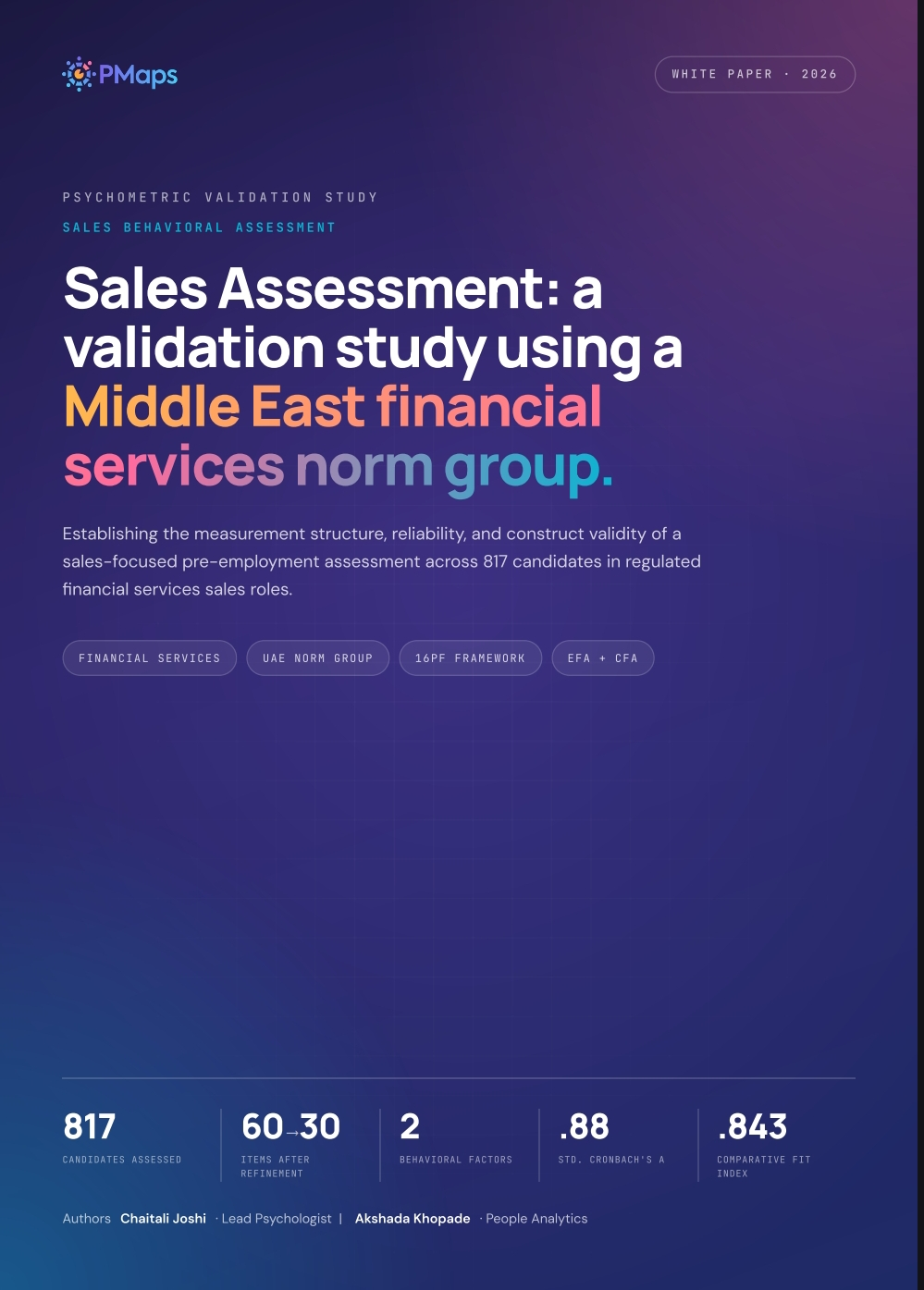
- 817 pre-hire candidates actively applying for sales roles
- UAE financial services sector — compliance pressure, performance targets, fiduciary responsibility
- A genuinely multinational workforce spanning Indian, Pakistani, Egyptian, and other regional origins
If you've ever sat across a hiring panel in a regulated sales environment and wondered whether your shortlist was actually the right one — this sample was drawn from that same room. That's what gives what came next its weight.
What did the data actually find about how salespeople behave?
Think about the last time a high-scoring candidate underperformed on the floor. Or a moderate scorer quietly became your most consistent closer. The data picked up on exactly that kind of pattern.
- Strong in one orientation doesn't guarantee strong in the other
- Moderate in one doesn't mean deficient in the other
- The gap between the two tells you something your current score probably doesn't
Those two orientations have names, defining traits, and direct implications for the kind of sales role you're filling. What they are and how they separate — that's what the document was written to show you.
How do I use two orientations instead of one score in real hiring decisions?
Imagine two open roles on the same sales floor — one owning a compliance-heavy advisory pipeline, the other cold-calling against a monthly target. The same candidate profile won't thrive in both. Most assessments score them identically anyway.
- Compliance-sensitive execution roles need one behavioral alignment
- Pipeline-owning, target-driven roles need another
- Most teams are currently using one score to fill both
This is where the framework stops being academic and starts sitting in your next debrief. The discussion section maps each orientation directly to role demands — so the hiring call you make is matched, not just ranked.
Can I trust the methodology behind this?
Before you take any research into a hiring decision, you should know exactly where it was built and where it runs out. Most studies don't tell you that upfront. This one leads with it.
- Single region — UAE only; generalisability to other markets is untested
- No criterion data — applicants, not incumbents; predictive validity isn't claimed
- Self-reported responses — impression management risk exists
Knowing these three boundaries isn't a reason to distrust the findings — it's a reason to use them correctly. What the study does establish within those limits, it establishes with enough rigor to act on.
Who built this and what framework does it stand on?
Good research doesn't emerge from a vacuum. Before the factor analysis ran, before the items were refined, the study was anchored in three bodies of work that the field has been building on for decades.
- Cattell's 16PF — the personality framework the factors were mapped against
- Barrick & Mount's Big Five meta-analysis — the foundational job performance evidence base
- Fornell & Larcker's structural equation standards — the validity criteria applied throughout
Authored by Chaitali Joshi, Lead Psychologist, and Akshada Khopade, People Analytics Specialist — both at PMaps, both practicing, both reachable on LinkedIn. The frameworks are public. The authors are named. If anything in this study raises a question you want answered directly, there are real people to ask
PMaps Research Featured by The Association for Business Psychology (ABP)
PMaps research on sales behavioral assessments was highlighted in “Don’t Start with AI, Start with the Problem”, a thought leadership article published by The Association for Business Psychology (ABP), co-authored by PMaps Founder Saurabh Rana and business psychologist Clodagh O’Reilly.
Drawing on research involving 817 sales candidates, the article emphasizes the importance of evidence-based talent assessments and why organizations should prioritize clearly defined business problems before adopting AI-driven solutions.
The research has done its part. Now it's your turn.
Sales hiring has been running on untested assumptions for a long time. This study tests them — rigorously, honestly, and with real-world data behind it. Thirteen pages. One finding that changes how you read every sales assessment report after it. Download the white paper — or reach us directly at +91 85913 20212 or ssawant@pmaps.in.