.webp)
.webp)


Most leadership benches look strong on paper. Senior, credentialed, long-tenured. The org chart says the pipeline is healthy. Then a role opens up, the most-tenured name gets promoted, and six months later the team is struggling — not because the person wasn’t experienced, but because experience was never the thing that needed measuring.
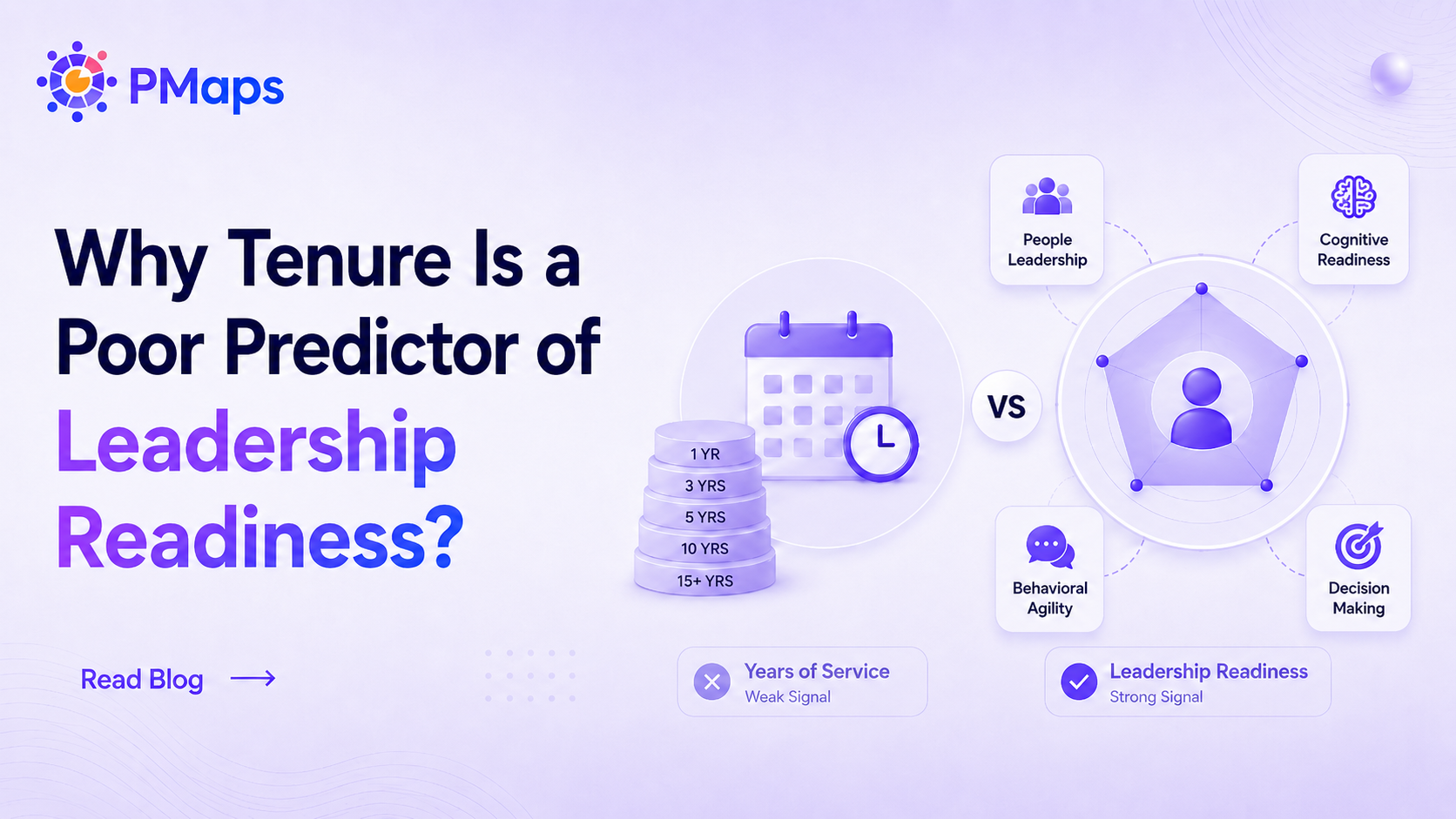
This is the quiet problem with using tenure as a proxy for leadership readiness: it answers a question nobody asked. Tenure tells you how long someone has led. It says almost nothing about how well they lead, how cleanly they collaborate, or whether they can think under the pressure the next stage of growth will bring.
If tenure isn’t the right measure, what criteria is relevant for assessing the next generation of leaders for your organisation? Explore our leadership assessment to find out.
Tenure measures time, not capability
Years in seat correlate with familiarity — of the systems, the people, the politics. That familiarity is real and useful. But it is not the same as the behavioral and cognitive profile that distinguishes a capable individual contributor from someone who can lead, align, and scale a team.
When promotion and succession run on tenure, three failure modes show up repeatedly:
- The Peter Principle in slow motion. People rise to the level of their tenure, not their capability, and stall there — managing teams they were never equipped to manage.
- Invisible development needs. A leader can spend a decade in role and never have their actual gaps named, because nobody ever measured them against a standard.
- Bias dressed as merit. “Most experienced” often quietly means “most familiar to the people deciding” — which narrows the pool and reinforces whoever already resembles current leadership.
None of this is an argument against experienced leaders. It’s an argument against treating experience as evidence of readiness when it is only evidence of time.
What “readiness” actually means
Leadership readiness is a profile, not a length of service. It combines two things that tenure can’t show you:
- Behavior — how a leader operates with people: collaboration, conflict management, accountability, people management, self-management, and the rest of the competencies that decide whether a team follows them.
- Cognition — how a leader handles complexity: reasoning under time pressure, problem solving, attention to detail when the stakes are high.
A strong leader needs both. Someone can have flawless judgment and still fracture every team they touch; someone can be universally liked and unable to reason through a hard call. Tenure measures neither. A standard leadership competency framework measures both — and scores them against a benchmark, so “ready” means ready for this role, not “ready compared to a vague mental average.”
The proof: 78 senior leaders, one benchmark
A high-growth consumer-fintech lender recently put this to the test. Their leadership bench was, on paper, exactly what you’d want — 95% had 10+ years of experience, 71% were post-graduates, and the average age was 42. By the tenure logic, almost everyone should have been “ready.”
PMaps benchmarked all of them with a custom Leadership Behavioral Assessment: a 128-item behavioral core across 13 competencies, paired with five cognitive sections, scored against a defined benchmark.
The result: 57% of the bench qualified as role-fit. 43% were flagged for development.
That split is the whole point. Because the cohort was uniformly senior, the 57/43 divide couldn’t be explained by experience or credentials — those were nearly constant across the group. It reflected genuine differences in behavior and cognition that tenure had completely masked. The clearest weak spot among the development group wasn’t anything you’d see on a résumé: it was Collaboration Skills. The clearest strength among the fit group was cleaner reasoning under time pressure.
Tenure would have promoted the wrong people with confidence. Measurement showed exactly who was ready, who wasn’t, and where to invest.
Replace the proxy with a measurement
You don’t need to throw out experience as a signal. You need to stop letting it stand in for a measurement it was never able to make. The practical shift:
- Define the profile. What behavioral competencies and cognitive abilities does this leadership role actually require? Build the benchmark around that, not around a generic ideal.
- Measure every candidate against the same bar. One standardized read, applied identically, removes the “most familiar” tilt that tenure smuggles in.
- Use the gaps, don’t just rank. A readiness measurement isn’t only a yes/no — it tells you precisely where a not-yet-ready leader needs coaching, which makes development targeted instead of generic.
This is the difference between a pipeline you hope is healthy and one you can show is healthy.
See readiness instead of guessing at it. PMaps benchmarks your leadership bench across behavioral competencies and cognitive ability, scored against the roles you’re actually planning for. Talk to our team at 8591320212 or assessment@pmaps.in to scope a leadership benchmark for your organization.