.webp)
.webp)


Ask a manager why someone was promoted and you’ll usually get a confident answer: strong performer, ready for more, natural leader. Ask how they know, and the answer gets softer. Most promotion decisions run on a blend of performance impressions, tenure, and a manager’s gut — and gut, however well-intentioned, is where bias lives.
This isn’t an accusation of bad faith. It’s a structural problem. When the criteria are subjective, the people deciding tend to favor whoever is most familiar — the candidate who resembles current leadership, who’s most visible, who interviews well. The genuinely capable person in a less-visible role never makes the list. The fix isn’t more goodwill. It’s benchmark-referenced scoring.
Performance scores are just supportive documents. Benchmark‑referenced assessments are your predictive insight. Check out how our managerial assessment tool separates instinct from evidence.
Why subjective promotions are biased by default
Bias in promotion rarely looks like prejudice. It looks like reasonable-sounding shortcuts:
- Familiarity bias — managers nominate the people they’ve worked with closely, narrowing the pool to the already-visible.
- Tenure-as-merit — “most experienced” gets read as “most ready,” even when experience and readiness are different things.
- Halo effect — strong performance in the current role is assumed to predict performance in a very different one.
- Recency and likeability — whoever made a good impression most recently, or is simply easiest to like, gets the edge.
Each of these feels like judgment. None of them is evidence. And because they’re invisible to the person applying them, you can’t train them away with a workshop alone — you have to change what the decision is based on.
What benchmark-referenced scoring actually means
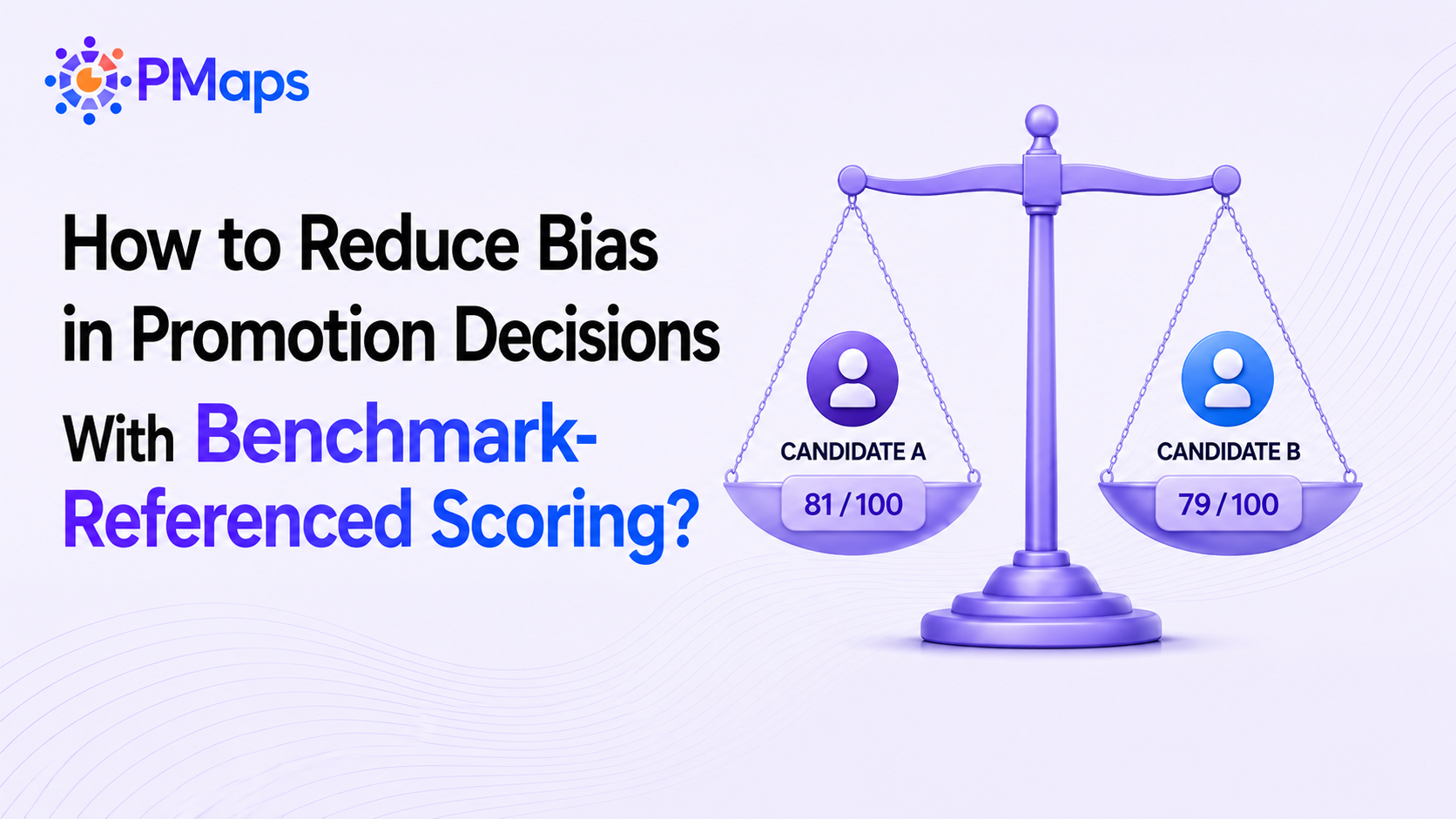
A benchmark-referenced score answers a precise question: how does this person measure against the defined standard for this role — not against the other candidates, and not against the decision-maker’s mental model.
That distinction matters. Ranking people against each other still smuggles in bias, because the comparison is relative and the criteria can shift. A benchmark is fixed and external. Every candidate is measured on the same competencies, against the same bar, scored the same way. “Ready” stops meaning “the one we liked best” and starts meaning “cleared the standard the role requires.”
For this to genuinely reduce bias, the scoring has to be:
- Standardized — one instrument, identical conditions for everyone.
- Multidimensional — behavior and cognition, so the decision isn’t hostage to a single signal.
- Validated — the benchmark is tied to what actually predicts performance in the role, not an arbitrary cutoff.
This is the logic behind PMaps’ approach: scores are read against validated role benchmarks, so a good score means good for this role, not good in the abstract.
The proof: a uniformly senior bench, scored to one bar
The cleanest demonstration of bias-removal is a group where bias would normally have nowhere obvious to hide. A high-growth consumer-fintech lender benchmarked 78 senior leaders — a cohort that was 95% experienced (10+ years), 71% post-graduate, average age 42. On résumé and tenure, nearly everyone looked promotable.
Scored against a single benchmark across 13 behavioral competencies and five cognitive sections, the picture changed: 57% cleared the bar as role-fit; 43% were flagged for development.
Two things make this a bias story, not just a scoring story:
- The same bar was applied to everyone. No panel variance, no “most familiar” tilt — every leader took the identical assessment under identical conditions.
- Experience couldn’t explain the split. Because the cohort was uniformly senior, the 57/43 divide reflected real behavioral and cognitive differences, not the credentials that subjective decisions usually reward. The biggest development gap was Collaboration Skills — something tenure and titles would never have flagged.
A subjective process would likely have promoted on seniority and missed both the readiness signal and the development need. Benchmark-referenced scoring surfaced both, on the same evidence, for every person.
Building a fairer, more defensible promotion process
You don’t have to remove human judgment — you have to give it better inputs. A practical sequence:
- Define the benchmark first. Decide what the role requires before you look at candidates, so the bar can’t be reverse-engineered around a favorite.
- Score every candidate identically. Same assessment, same conditions, same scoring — internal and external candidates alike.
- Let the data lead, then add context. Use the benchmark read as the spine of the decision; layer in performance history and manager input as context, not as the whole case.
- Keep the record. A benchmark-referenced decision is defensible — you can show exactly why one candidate cleared the bar and another didn’t, which matters for fairness and for compliance.
The payoff isn’t only fairness. It’s accuracy. Removing the familiarity tilt doesn’t just widen the pool — it surfaces the people who were genuinely ready and would otherwise have been overlooked.
Make your next promotion decision on evidence, not impression. PMaps scores candidates against validated role benchmarks across behavior and cognition — objective, consistent, and defensible. Talk to our team at 8591320212 or assessment@pmaps.in to set up benchmark-referenced scoring for your promotion process.