.webp)
.webp)


There's a quiet contradiction inside the smartest GCC expansion strategy of 2026, and almost nobody has named it.
The strategy is sound. GCC hiring in Tier-2 cities is growing at 23% year-on-year — nearly twice the pace of the metros — and Tier-2 now accounts for 15% of all GCC hiring, per the foundit Insights Tracker. Around 40% of GCCs are actively expanding into Tier-2 and Tier-3 cities, drawn by the two numbers that make the business case obvious: attrition runs roughly 10–12 percentage points lower than Bengaluru, and talent costs 20–35% less. By 2030, Tier-2 and Tier-3 cities could hold close to 39% of the entire GCC workforce. This is the right move, made for the right reasons.
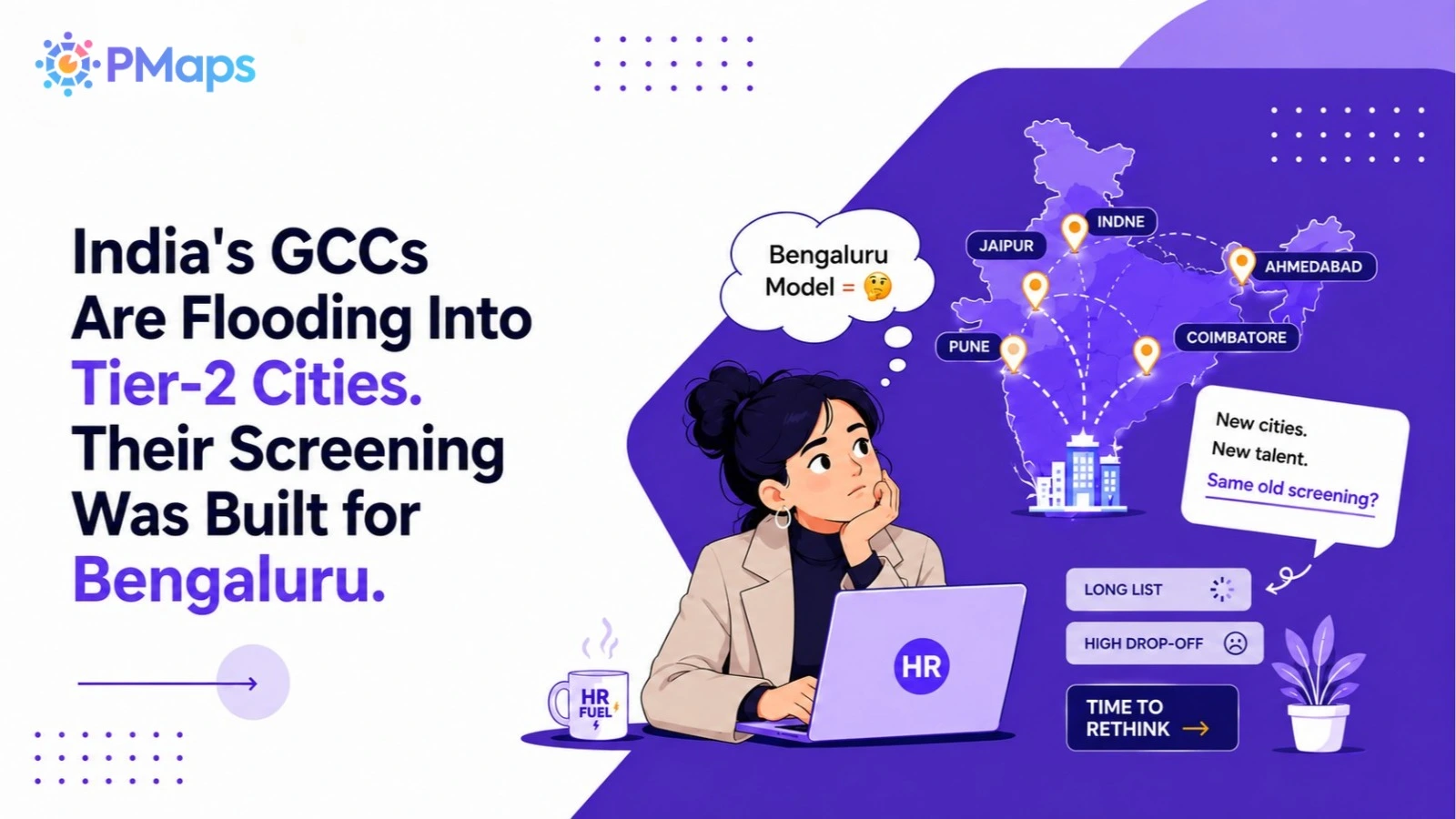
Here's the contradiction. A GCC decides to open in Coimbatore or Indore to reach a different talent pool — and then screens that pool with a process calibrated for Bengaluru. The same resume filters, the same career-arc assumptions, the same benchmarks set against metro supply. And that process systematically rejects the very profiles Tier-2 is richest in.
You fly to a new city to fish, and you bring a net with the wrong mesh.
What "different talent pool" actually means
The phrase gets used loosely, as if Tier-2 were just Bengaluru with cheaper rent. It isn't. The talent is shaped differently, in ways that matter enormously to how you screen.
Tier-2 career arcs are non-linear. There are more career interruptions — family, relocation, a stint back in a hometown. More movement between product and services and back again, because the local market offered whichever was hiring. Longer single-employer tenures, because there were fewer employers to move between. A ten-year Tier-2 career often looks nothing like the tidy escalator of a Bengaluru CV: services company, then product startup, then a gap, then a services role again, then the thing they're genuinely good at.
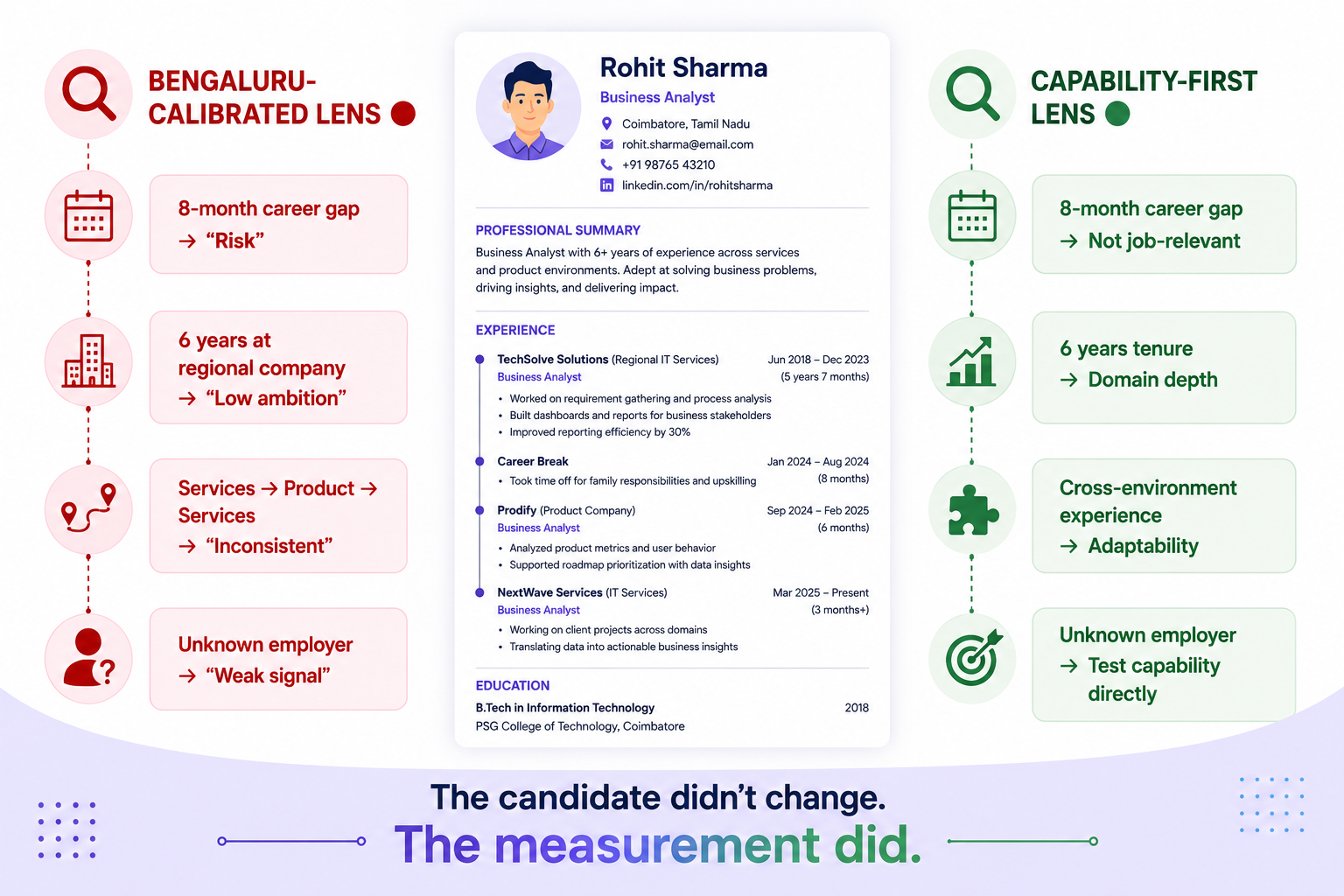
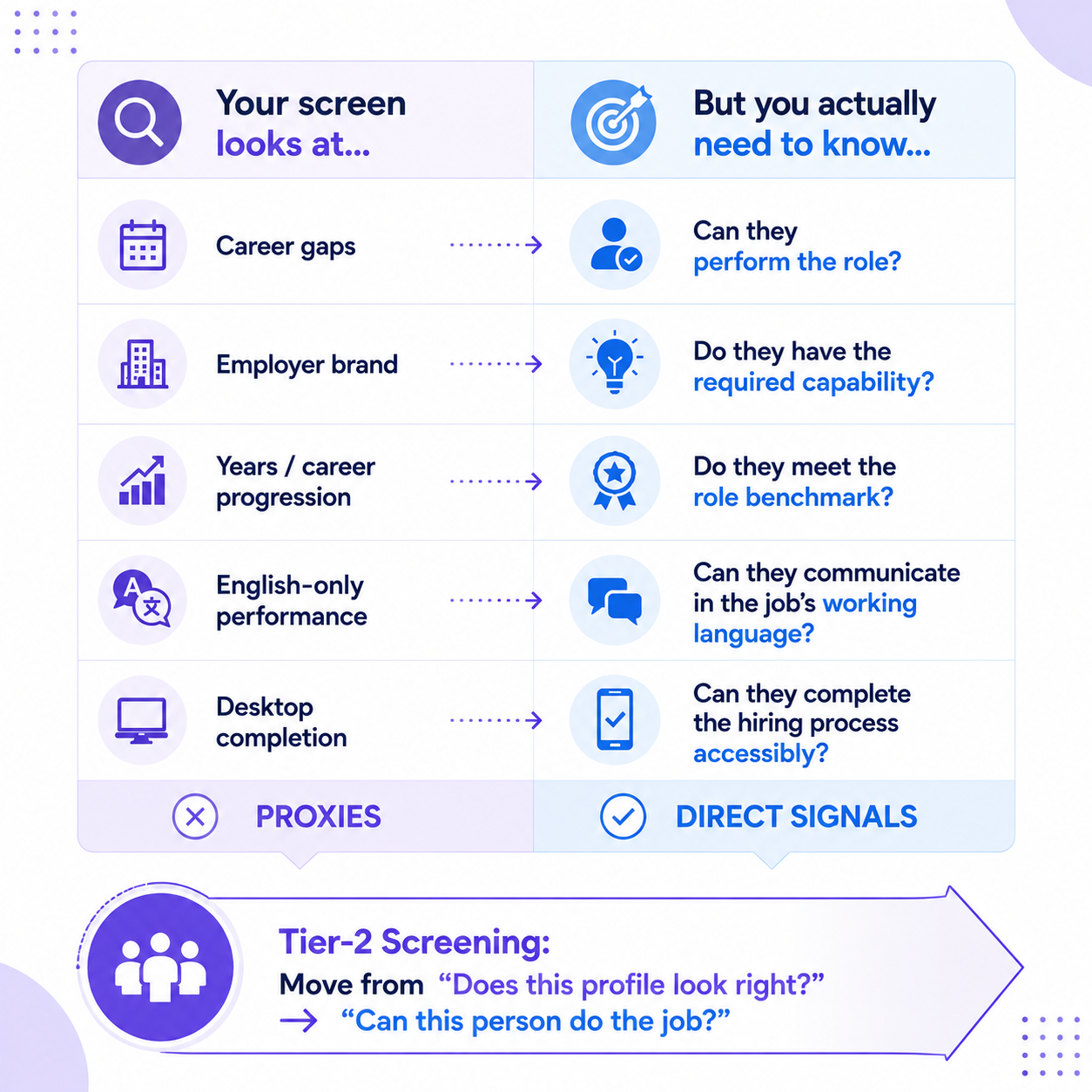
Now consider what a standard screening process does with that shape. Resume filters and ATS keyword screens are built on linear-arc assumptions. A gap reads as a risk flag. A services-to-product-to-services move reads as indecision or "job hopping." An unfamiliar Tier-2 employer name carries no brand signal, so it's discounted. A long tenure at one company reads as lack of ambition. None of these judgments is about whether the person can do the job. All of them are about the shape of the arc, not the capability underneath it — and every one of them fires more often on a Tier-2 profile than a metro one.
The result is an expensive absurdity: you invest in a Tier-2 site specifically to access this pool, then run a screen that penalizes it for being exactly what you went there to find.
Why the metro bar doesn't travel
Three specific ways a Bengaluru-calibrated process breaks when you move it to Tier-2.
1. It rewards continuity, and Tier-2 talent is discontinuous. Linear progression clean promotions, no gaps, brand-name employers in sequence is a metro luxury built on metro density. Apply continuity as a screening criterion in Tier-2 and you don't raise quality, you filter for the small subset of Tier-2 candidates whose arcs happen to look metro. You've imported the pool you were trying to leave behind.
2. Its benchmarks are set against the wrong distribution. A score cutoff for a cognitive test, an assessment, a years-of-experience filter is only meaningful relative to the supply it was calibrated against. A bar set on Bengaluru's applicant distribution, applied unchanged to Coimbatore's, produces confident, systematic error. It will over-reject in some dimensions and over-accept in others, and because the number didn't change, nobody notices it's now measuring against a distribution it was never built for.
3. It reads employer brand as a proxy for quality. Much of metro screening quietly leans on employer brand: a candidate from a marquee company is pre-validated. Tier-2 talent overwhelmingly comes from employers your screeners have never heard of. When a brand stands in for capability, an unfamiliar name reads as a null or negative signal and you reject strong people for the crime of having worked somewhere you can't rank.
Every one of these is a case of the proxy failing while the thing being proxied actual capability goes unmeasured. That's the crack the whole problem lives in.
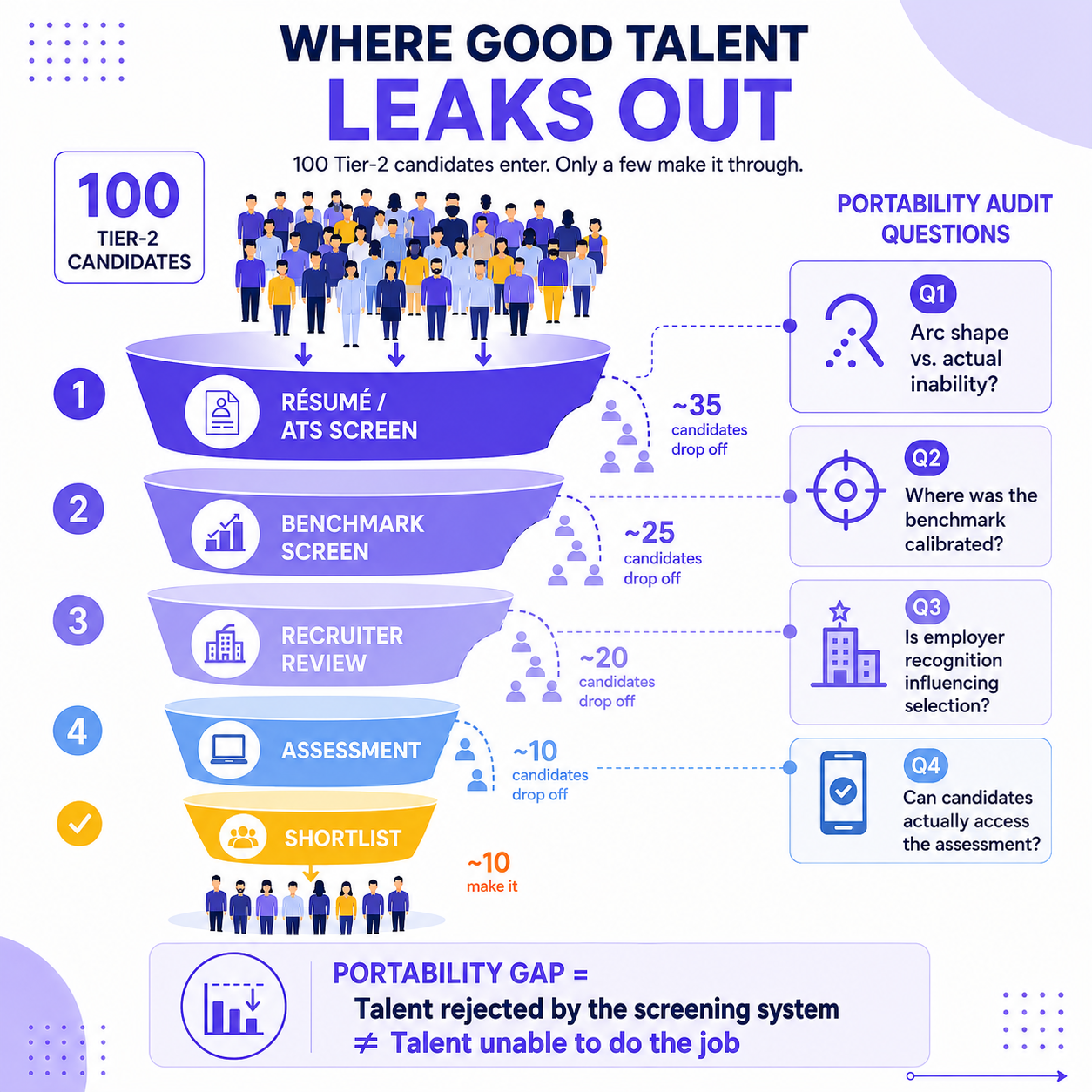
The Portability Audit — four questions before you scale a Tier-2 site
You don't need a new platform to run this. You need your last batch of Tier-2 rejections and an honest afternoon. Take a Tier-2 role you're actively hiring for and work through these in order.
Question 1: Pull your last 20 Tier-2 rejections. How many were rejected for arc shape, not demonstrated inability?
Go through them by hand. For each rejection, mark the real reason: gap in the timeline, "too many switches," unfamiliar employer, long single tenure, non-standard progression versus a demonstrated inability to do the work. Count the ratio. If arc-shape reasons dominate and in most Tier-2 funnels they do you have just measured the size of your own leak. These aren't weak candidates. They're candidates your process can't read.
Question 2: Where did the passing benchmark come from, and what supply was it built on?
Ask whoever owns the cutoff. If the benchmark was set on metro data or worse, inherited from HQ with no local calibration it is measuring your Tier-2 pool against a distribution that pool was never part of. A benchmark that isn't calibrated to the supply it's screening isn't a standard. It's a metro artifact you're applying to non-metro people.
Question 3: How much of your screen depends on recognizing the employer?
Walk your screening stages and mark every point where an employer's name influences the decision explicitly (brand filters) or implicitly (a screener's gut read). For a Tier-2 pool, every one of those points is a systematic penalty on unfamiliar-but-strong candidates. The fix isn't to pretend brand tells you nothing; it's to replace brand-as-proxy with a direct measure of the capability you were using brand to guess at.
Question 4: Can the Tier-2 candidate actually complete your screen — in their language, on their device, on their connection?
Metro-built assessments quietly assume English fluency, a laptop, and reliable bandwidth. Tier-2 realities differ. If your screen is English-only, it filters for English comfort, not job capability and for many roles those are different things. If it assumes a stable broadband connection and a desktop, it filters for infrastructure, not talent. An assessment the right candidate can't complete is a rejection dressed as a no-show.
The BFSI and high-volume cut
Two contexts where the portability gap costs the most.
BFSI and manufacturing GCCs are among the most aggressive Tier-2 movers, and often for a specific reason: the 8–15 year domain specialists they need frequently exist only in Tier-2 industrial and regional centres, not in Bengaluru at all. For these mandates, Tier-2 isn't a cost play it's the only pond with the fish. Which means a screen that rejects non-linear Tier-2 arcs isn't leaving margin on the table; it's failing the mandate outright, because there is no metro fallback pool to retreat to.
High-volume, multilingual roles BPO, operations, customer experience, frontline are where the language and access dimension of Question 4 bites hardest. These roles are moving to Tier-2 fastest, they hire in large batches, and they're often conducted in regional languages on the job. Screening them in English-only, desktop-only formats doesn't protect quality. It just quietly excludes the exact candidates who'd perform best in the role's actual working language.
What to do in the next 30 days
- Run Question 1 this week. Twenty rejections, sorted by reason. The arc-shape-to-inability ratio is the single most persuasive number you can put in front of a hiring manager who thinks the Tier-2 pool is "just weaker."
- Recalibrate one benchmark to local supply. Take one Tier-2 role and set its bar against its own applicant distribution, not the inherited metro number. Compare who clears each. The delta is your portability gap, quantified.
- Strip employer brand from one screening stage. Replace it with a direct capability measure for that stage. Track whether the candidates it now surfaces — the ones brand would have filtered — perform. They will, more often than your screeners expect.
- Localize one assessment. Offer one high-volume Tier-2 role's screen in the working language and on mobile. Measure completion rate before and after. The lift is the talent your old format was silently turning away.
Where PMaps fits
Every question above points at the same root fix: stop screening on proxies for capability — arc shape, employer brand, metro benchmarks — and measure the capability directly. That's not a mindset change you can make into an ATS. It needs an instrument built for it.
That's what PMaps is. For 12 years, PMaps has measured candidates on what they can actually do — across cognitive, behavioral, psychometric, video, and voice assessments — read against role-specific benchmarks rather than career-arc assumptions. Because the measure is capability, not continuity, a non-linear Tier-2 arc doesn't get penalized for its shape: the assessment reads the person, not the timeline. Benchmarks are calibrated to the role, which is exactly the recalibration Question 2 demands. And assessments run in 8+ Indian languages on formats built for real access conditions — which is the whole of Question 4. For high-volume multilingual roles, VnA Assessment measures voice and communication capability directly, and EVA, our AI Voice Interviewer, conducts structured screening at Tier-2 scale in the language the job is actually done in.
The credibility behind it: 3M+ assessments across 200+ enterprise clients in 7 countries, including Moder, Medusind, and IKS Healthcare — high-volume, distributed, multilingual operations that hire exactly where the metro bar doesn't travel.
Improve your hiring odds. Scientifically. Especially in the cities where the resume tells you least.
Book a 30-minute walkthrough — bring one Tier-2 role, and we'll show you what measuring capability instead of arc shape does to your funnel.